Loading page


Not all AI crawlers do the same job. Learn which bots to allow or block in robots.txt - GPTBot, ClaudeBot, PerplexityBot and more - without accidentally deleting yourself from AI answers.
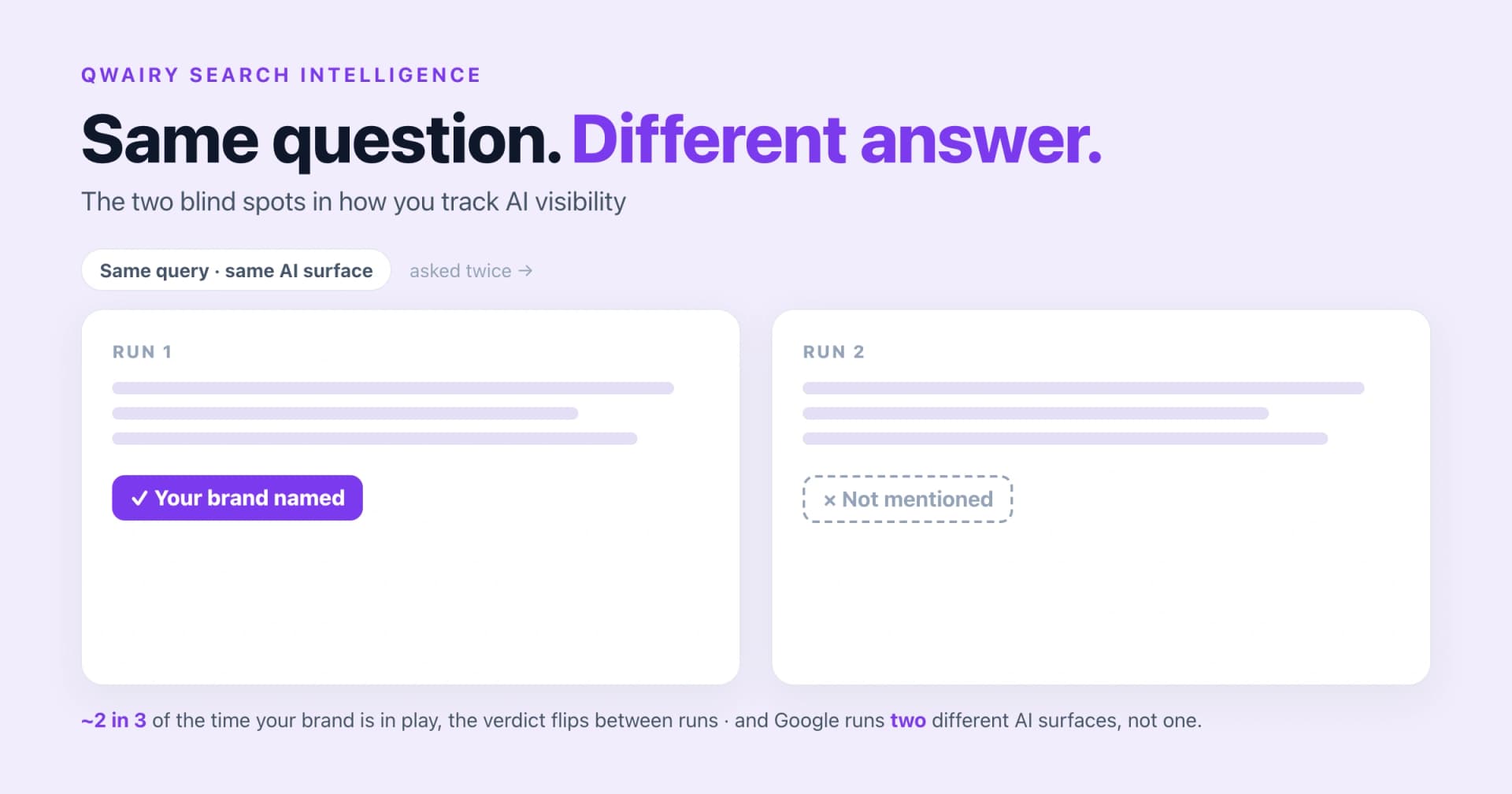
Two structural reasons a single AI visibility check misleads, both visible in Google's numbers. (1) Google is not one AI surface but two - AI Overview and AI Mode - which behave like opposites: AI Mode is ~4x longer, names 2x more competitors, cites 1.7x more sources. (2) Neither surface is deterministic: ask the same question again and the brand-mention verdict flips on ~1 in 4 questions, and ~2 in 3 of the questions where the brand appears at all. Same instability on ChatGPT and Perplexity.
A practical, cross-engine playbook for earning citations from AI engines like ChatGPT, Perplexity, Gemini and Google AI Overviews. Learn how citations are chosen, the tactics that work across engines, and how to measure your citation share.

Comment Meilleurtaux, leader de la comparaison de crédits immobiliers en France, a utilisé Qwairy pour mesurer et améliorer sa visibilité dans les moteurs IA.

On May 7, 2026, ChatGPT started embedding clickable links to brands' own sites inside its answers. A study of 140,000+ ChatGPT answers: the rate jumped roughly 14× overnight, every link carries a utm_source=chatgpt.com tag, and only ChatGPT moved.

A qualitative study on 150 French unbranded prompts across 9 intent typologies. Why brand-owned editorial dominates 76% of AI citations, how negative framing wipes out official sources (×18), and what GEO teams should do about it.

Most AI crawlers read raw HTML and never run your JavaScript, so client-side content is invisible to them. Learn how to test for it and fix it with SSR, SSG, or prerendering.

A data-backed breakdown of the factors that actually get your pages cited by AI answer engines like ChatGPT and Perplexity - and what matters far less than most checklists claim.
A complete, data-backed guide to Generative Engine Optimization (GEO) for SEOs. Covers how LLMs consume and select content, semantic optimization, E-E-A-T signals, page typology, and content maintenance — with primary sources throughout.

A practical, honest look at what llms.txt is, who actually supports it, and whether adding one helps your AI visibility. Includes a step-by-step guide and realistic expectations.

The technical foundation for getting cited by AI engines: crawler access, rendering, HTML quality, structured data, and discovery. A prioritized, run-anywhere checklist for any site.

A practical guide to structuring your site so AI answer engines can find, extract, and attribute every page. Covers topic clusters, internal linking, URL and heading hierarchy, self-contained pages, and entity consistency.