Loading page

Looking to track your brand presence in LLMs? Here is how to it for free or at scale.

SEO is changing - and fast. As AI-driven tools like ChatGPT, Gemini, and Perplexity become the go-to search interfaces for millions of users, the way people discover brands is shifting dramatically. These tools don't show a list of ten blue links like Google does. Instead, they generate direct answers to user questions - often without linking to external websites at all. If your brand isn't mentioned in those answers, you're invisible. It's that simple. In this guide, we'll show you exactly how to track whether your brand is being mentioned in LLMs, using:
By the end of this article, you'll know not only how to audit your brand visibility across LLMs, but how to turn those insights into real growth opportunities. Let's dive in.
Before you can track whether your brand is mentioned in large language models (LLMs), you need to clearly understand what a "mention" actually looks like. In traditional SEO, visibility often means ranking on page 1 of Google for a relevant keyword. In the world of LLMs, it's not about ranking - it's about being named or used as a source directly in the AI's response. There are two ways your brand can show up in a response from an LLM:
This is when the LLM explicitly names your brand as part of an answer. Example:
"According to experts, brands like Nike, Adidas, and Allbirds offer high-quality running shoes."
Even if there's no link, this is powerful. Your brand is trusted enough to be part of the answer - that builds awareness and reputation.
This happens when the LLM uses content from your website or blog as a source to build its response. Some LLMs - like Perplexity or SearchGPT (ChatGPT with browsing) - will cite these sources with a clickable link.
"Based on an article from yoursite.com, the best time to send marketing emails is Tuesday at 10 a.m."
Here, your site acts as a trusted reference, much like getting a backlink - except it's inside the AI's answer.
💡 How LLMs Work Today
Most modern LLMs (like Gemini, ChatGPT with browsing, or Perplexity) use a hybrid model known as RAG (Retrieval-Augmented Generation).
You'll want a Google Sheet or Excel file with the following structure:
Prompt / Question | LLM Tested | Date | Brand Mentioned? | Type of Mention | Notes |
"Best CRM for startups" | ChatGPT | July 2025 | Yes | Brand + Source | Linked to blog |
"Top running shoes 2025" | Perplexity | July 2025 | No | - | - |
You're not just guessing here - you want to test real, relevant prompts your audience is likely to type into ChatGPT or Perplexity.
Where to find them:
^(who|what|where|how|which|why|when|best|vs|top|is|should)\s✏️ Example Prompt Ideas:
Haga una auditoría gratuita: en pocos minutos, ChatGPT, Gemini y Perplexity responden en directo a 8 preguntas de compra sobre su mercado y usted ve a quién recomiendan.
Open each LLM and manually run your list of prompts.
Where to run them:
💡 Bonus Tip: Add Competitor Tracking Too
In a second sheet, track your competitors' visibility too. Use the same prompts and note:
While tracking LLM mentions manually with spreadsheets can be insightful, it becomes time-consuming fast - especially if:
That's exactly why we built Qwairy.co: a SaaS tool designed specifically for **GEO (Generative Engine Optimization)**. Qwairy helps you track, understand, and improve your brand presence inside LLM responses - across tools like ChatGPT, Gemini, and Perplexity. Here's how you can track if your brand is mentioned on LLMs with Qwairy.
Getting started is simple.
Once your brand is set up, Qwairy automatically:
You can also add your own custom prompts if you're targeting specific customer questions, product features, or branded comparisons.
✨ Example: If you're a CRM tool for startups, Qwairy might suggest prompts like:
"What's the best CRM for early-stage founders?" or "HubSpot vs [Your Brand] - which is better for SMBs?"
Once your prompts are selected, you can fine-tune what you want Qwairy to track:
Qwairy's dashboard is where the magic happens. You can view:
Every week, Qwairy updates your dashboard with fresh LLM data.
🧠 Real-world example: Let's say your brand was cited as a source in Perplexity for "best project management tools for startups" last month. This week, it's missing.
Qwairy will flag that change - so you can investigate what happened, whether a competitor took your spot, and what page needs optimization.
In the next part, we'll explore how to act on this data: how to build the right content, earn better citations, and improve your GEO performance.
Content Opportunities enumera los temas en los que la IA menciona a sus competidores y no a su marca, cada uno con una puntuación de impacto.
Once you started tracking, here is when the fun starts. Your goal isn't just to monitor LLMs - it's to influence what they say about your brand. The first thing to do is to identify:
Example: You sell a privacy-focused analytics tool, but you're not mentioned when someone asks ChatGPT "What are the best Google Analytics alternatives?"
Here are a couple things you can do:
💡 Need More Help?
If your brand isn't appearing in prompts like "best CRM for startups," you might need to update your content. Learn more about how to rank directly on ChatGPT in our article.
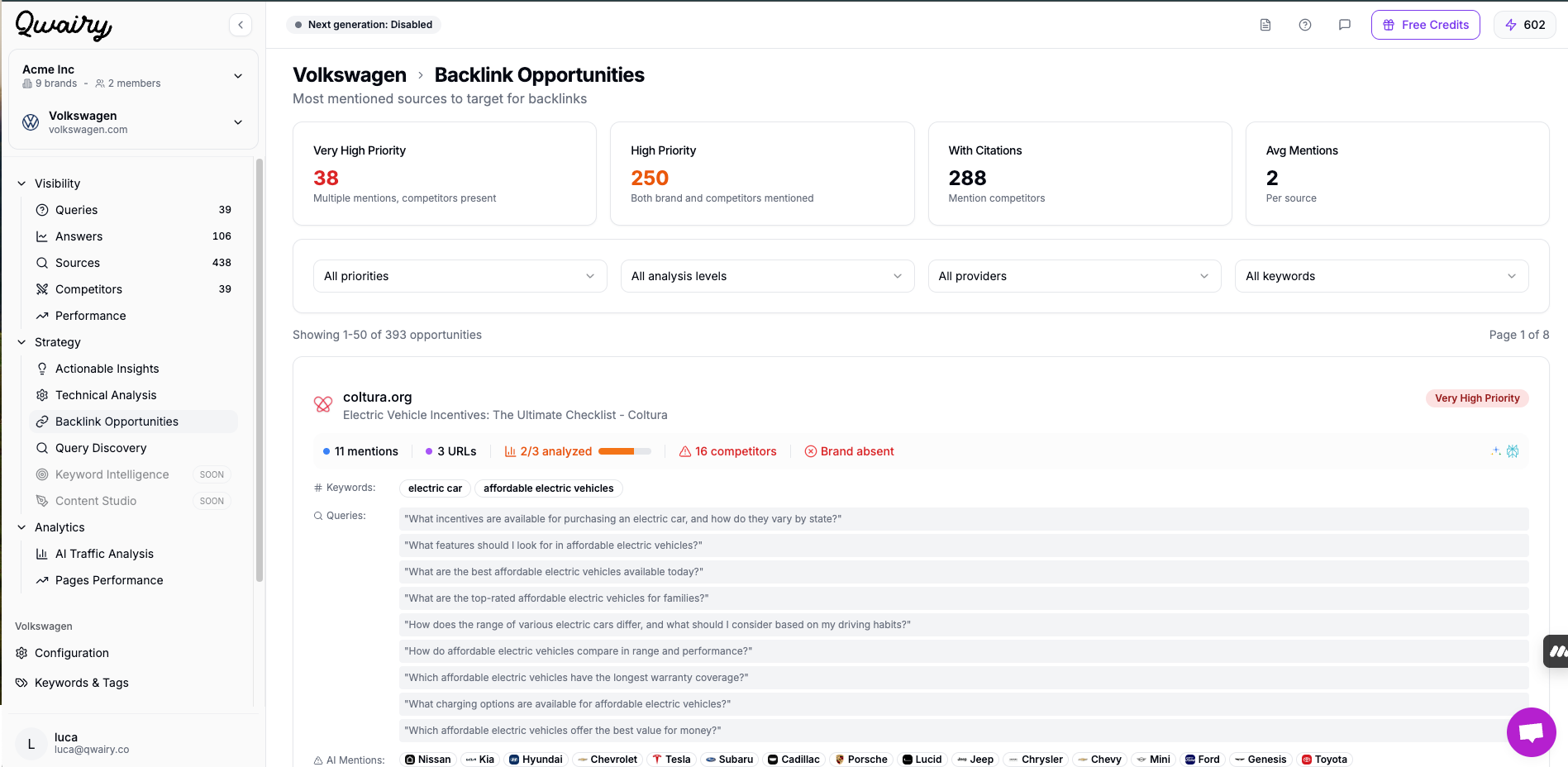
One of the most overlooked GEO strategies is working upstream - not just on your own content, but on the content that LLMs rely on. From Qwairy's source data, you'll see which domains LLMs are regularly quoting in your niche. You can also dive deeper into how ChatGPT selects its sources in this dedicated guide. These might include:
Your goal: Get your brand or content featured there. Ways to do this:
If that source gets pulled into a future LLM answer, you do too.
💡 Want to Go Deeper?
Want to go deeper into optimization? Here's our step-by-step guide on how to position your brand across LLMs using content, backlinks, and structured data.
The way users discover and engage with brands is changing fast. Search isn't just about Google anymore - it's happening inside AI models like ChatGPT, Gemini, and Perplexity. And in this new world of LLMs, being mentioned is everything. Whether it's as a cited source or a trusted brand recommendation, your visibility in these platforms will increasingly determine:
Siga las preguntas que importan para su negocio, vea qué marcas menciona cada respuesta y qué fuentes cita, y trabaje sobre las carencias.
Plan gratuito con 120 créditos iniciales • Sin tarjeta de crédito
Otros artículos
How to Improve Your Brand Sentiment in ChatGPT and AI Search
Being mentioned by ChatGPT is not enough if it calls your products overpriced. A step-by-step process to analyze and improve how AI assistants talk about your brand, with Nike as an example.
GEO Strategy: 5 AI Search Truths and a 4-Step Framework
Five truths about AI search shared at the SEO & GEO Summit in Paris, and the 4-step GEO framework Qwairy gives every client to get recommended by ChatGPT, Gemini and other AI engines.