Loading page

The most comprehensive study ever conducted on LLM ranking factors, analyzing 184,128 queries and 1,479,145 sources across 20 AI models including ChatGPT, Gemini, Perplexity, Claude, Mistral, DeepSeek, and Grok to help you dominate AI-generated results.

When we published our first study on 32,961 queries (Q2 2025), the response was overwhelming. Marketers worldwide reached out asking for more data, more models, and more insights. Three months later, we're back with something 5.6x bigger.
We analyzed 184,128 queries - that's 459% more data than our original study - across the latest LLM models, including newly tracked Mistral, DeepSeek, Grok, and GPT-5. But this isn't just about scale. This study introduces revolutionary new analysis dimensions:
The AI search landscape is evolving faster than anyone predicted. Last weekend, I overheard a conversation at a café that perfectly captures this shift:
"Let me ask ChatGPT which restaurant to try." Not Google. ChatGPT. This is the new reality. Search is being reimagined, and brands that don't adapt will simply disappear from consumer consideration. At Qwairy, our mission is to give you the data you need to win in this new landscape through Generative Engine Optimization (GEO). This study represents 1,479,145 sources analyzed, 20 different LLM models tracked, 106% monthly growth rates, and countless hours of analysis to bring you actionable insights. If you're new to GEO, we recommend reading our complete guide to understanding AI crawlers and GEO vs SEO: What's the difference to get the full picture. Let's dive in.
All data was generated using Qwairy, our GEO (Generative Engine Optimization) platform designed to help brands improve their presence in LLM-generated responses. The dataset includes:
Our analysis covers 20 different LLM models across 8 major AI platforms - the most comprehensive dataset ever assembled for an AI search study:
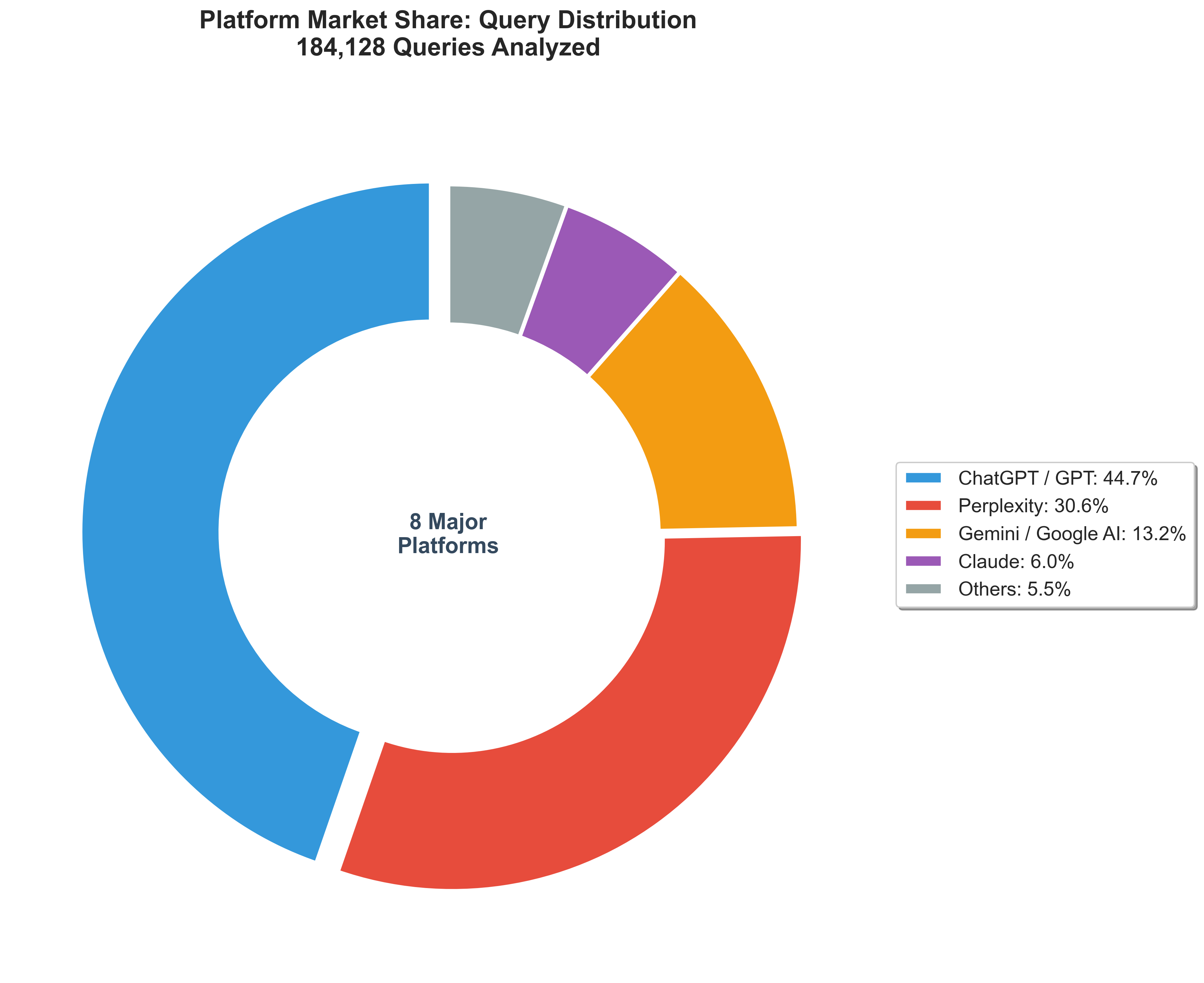
ChatGPT / GPT (OpenAI) - 82,268 queries (44.7%)
Perplexity - 56,250 queries (30.6%)
Gemini / Google AI (Google) - 24,344 queries (13.2%)
Claude (Anthropic) - 11,120 queries (6.0%)
Microsoft Copilot - 5,566 queries (3.0%)
Grok (xAI) - 4,100 queries (2.2%)
Mistral - 347 queries (0.2%)
DeepSeek - 133 queries (0.1%)
To learn more about optimizing for specific platforms, see our guides on how to rank on ChatGPT and how to improve visibility on Perplexity.
Like any dataset, ours has inherent biases:
Our goal: Equip CMOs, SEO leads, and marketing professionals with data-driven insights to navigate the AI search revolution. We're not claiming to have solved LLM ranking. But we're confident this data can materially improve your brand's AI visibility.
The first critical insight: not all LLMs behave the same way. Understanding how each model structures its responses is essential for crafting content that resonates with specific platforms.
One of the most striking differences between models is how much they say.
Model | Avg Characters | Equivalent Words | Style |
Google AI Overview | 6,174 | 1,235 - 1,544 | Highly detailed |
ChatGPT Core | 5,650 | 1,130 - 1,413 | Comprehensive |
Grok | 5,249 | 1,050 - 1,312 | Balanced |
Gemini Core | 3,896 | 779 - 974 | Moderate |
Perplexity Core | 3,409 | 682 - 852 | Moderate |
Gemini 2.0 Flash | 2,963 | 593 - 741 | Concise |
Microsoft Copilot | 2,562 | 512 - 641 | Concise |
GPT-4o-mini | 2,524 | 505 - 631 | Very concise |
Perplexity Sonar | 2,233 | 447 - 558 | Very concise |
Claude 3.7 Sonnet | 1,059 | 212 - 265 | Ultra-concise |
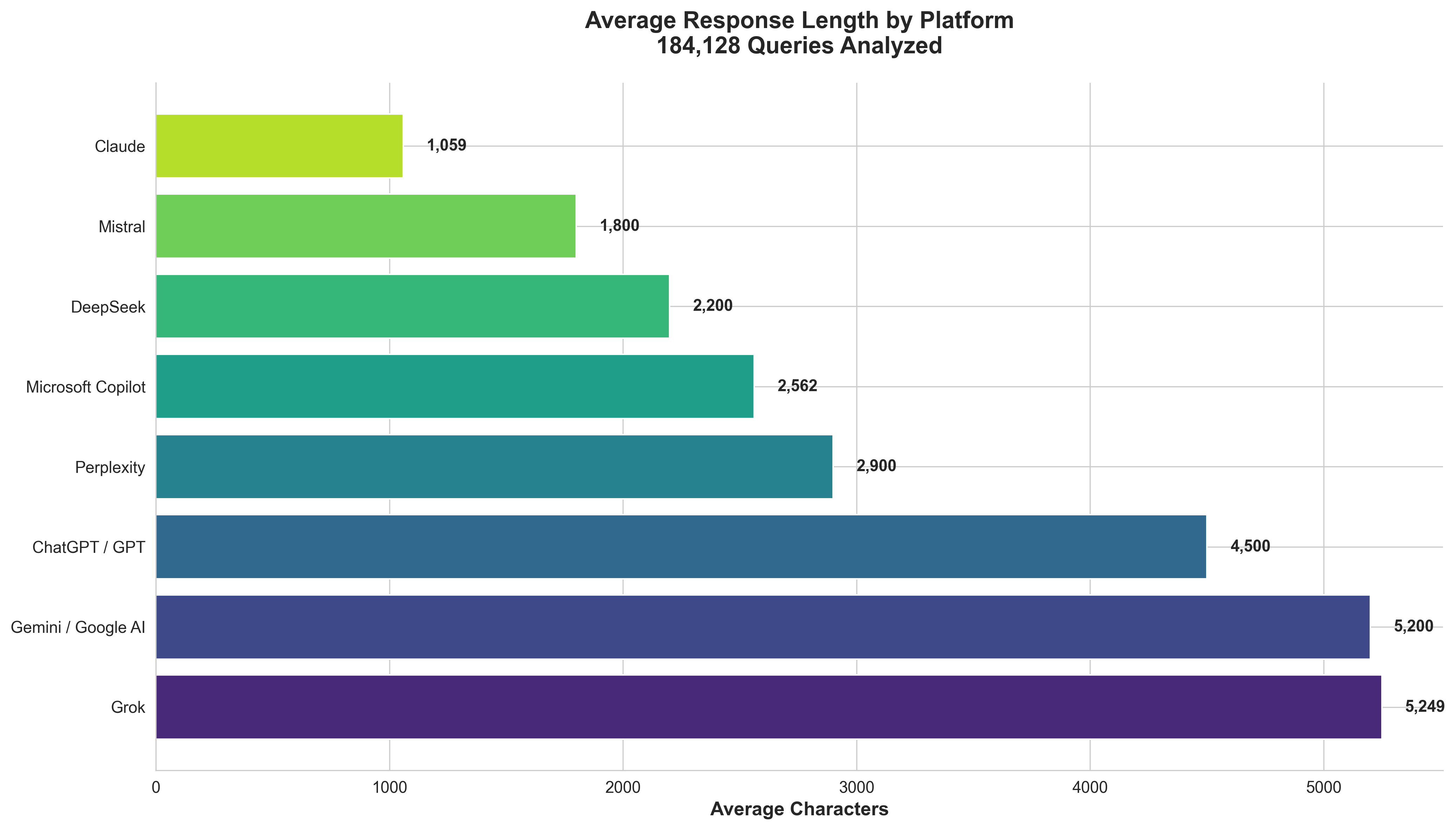
💡 Key Insight: Claude 3.7 Sonnet is 6x more concise than Google AI Overview. If you're optimizing for Claude, brevity is critical. For Google AI Overview, comprehensive, detailed content wins. 💡 Comparison to Previous Study: ChatGPT responses have grown 235% longer (from 1,687 to 5,650 characters), suggesting a trend toward more detailed answers.
In the AI search era, ranking isn't about being in the "top 10." It's about being explicitly mentioned in the answer.
Platform | Avg Competitors per Query | Approach | Change vs Previous Study |
Mistral | 11.69 | Most comprehensive ever | NEW |
Grok | 7.94 | Very comprehensive | NEW |
ChatGPT / GPT | 3.54 | Comprehensive | +337% (was 0.81!) |
Gemini / Google AI | 3.18 | Balanced | Stable (~3.77 Q2) |
Claude | 2.77 | Balanced | Stable |
Microsoft Copilot | 2.75 | Balanced | Stable |
Perplexity | 1.38 | Selective | Stable |
DeepSeek | 5.72 | Comprehensive | NEW |
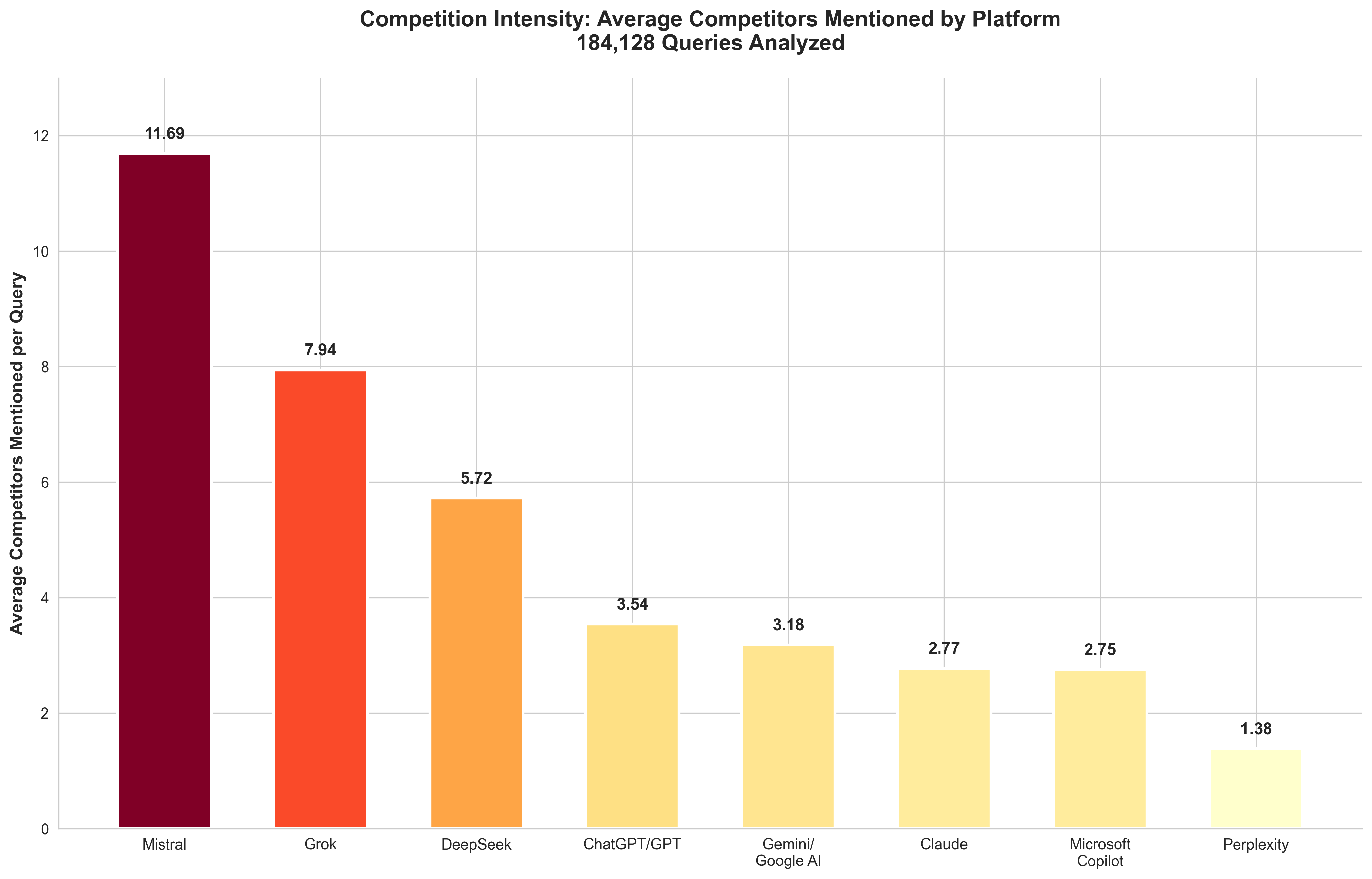
💡 BREAKTHROUGH INSIGHT: ChatGPT/GPT platform increased competitor mentions by 337% (from 0.81 in Q2 to 3.54 platform average in Q3)! ChatGPT Core specifically mentions 4.78 competitors per query (+490%). This is a MASSIVE shift in OpenAI's strategy - they're now recommending many more alternatives across all their models. 💡 NEW RECORD: Mistral mentions 11.69 competitors per query - the highest we've ever measured. If you're targeting Mistral, expect FIERCE competition with 10+ alternatives mentioned. 💡 Strategic Takeaway: The competitive landscape has intensified across all platforms. Only Perplexity remains highly selective (1.38 avg). For platforms like Mistral, Grok, and ChatGPT, ranking position is CRITICAL - there are 3-12 other competitors being mentioned.
Language patterns reveal how LLMs "think." By analyzing the most frequently used expressions, we can optimize our content to mirror these patterns.
GPT-4o-mini (French):
Gemini 2.0 Flash (French):
Perplexity Sonar (French):
Claude 3.7 Sonnet (French):
Google AI Overview:
ChatGPT Core:
Grok:
💡 Key Insight: LLMs favor cautious, advisory language. Words like "recommandé," "should," "could," and "try" signal a consultative tone rather than definitive statements. 💡 Content Strategy: Incorporate these expressions naturally into your content. Use conditional phrasing ("you might consider") rather than absolute statements ("you must do").
We analyzed four linguistic patterns across all models:
1. Impersonal Form (e.g., "it is recommended")
2. Incentive Verbs (e.g., "discover," "choose")
3. Conditional Phrasing (e.g., "could," "would")
4. Imperative Mood (e.g., "try," "take advantage")
💡 Key Insight: Gemini 2.0 Flash uses the most formal, cautious language. Perplexity Sonar is the most direct. 💡 Hypothesis: Writing in a style that mirrors your target LLM may improve visibility. Test this in your content.
99% of LLM responses use bullet points (-) to structure information. A typical LLM response looks like this: To learn about football, you should read:
💡 Key Insight: LLMs love structured, scannable content. Use bullet points, numbered lists, and clear hierarchies in your content.
Key Takeaways:
Understanding how LLMs communicate is the first step to being included in their answers.
This study introduces five revolutionary analysis dimensions that have never been measured at this scale before. These insights fundamentally change how we should approach AI search optimization.
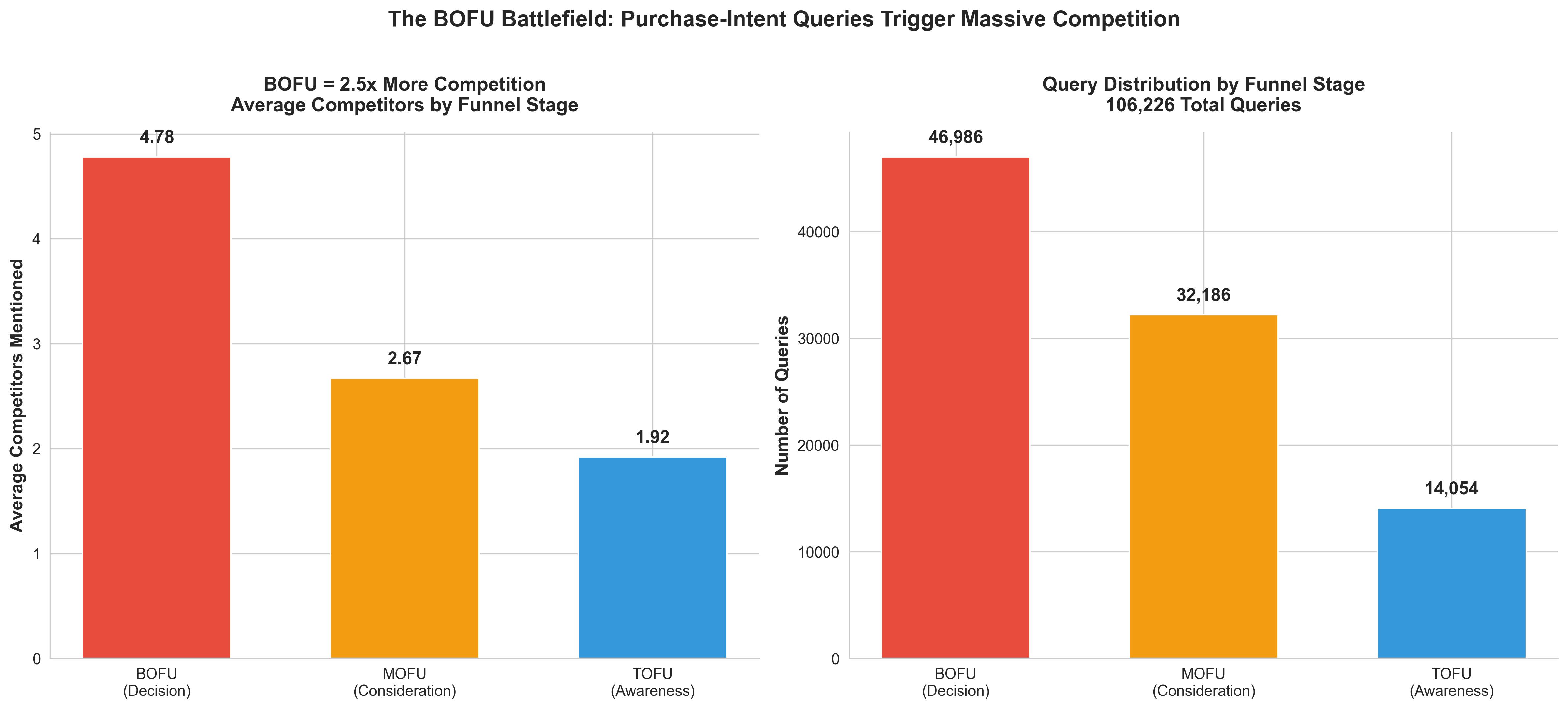
We analyzed how competitor mentions change based on query intent by categorizing queries into:
The results are stunning:
Funnel Stage | Queries | Avg Competitors | Avg Sources | Competition Level |
BOFU | 46,986 | 4.78 | 2.47 | BATTLEFIELD |
MOFU | 32,186 | 2.67 | 2.43 | Moderate |
TOFU | 14,054 | 1.92 | 2.86 | Low |
UNKNOWN | 12,778 | 3.57 | 3.48 | Variable |
💡 REVOLUTIONARY INSIGHT: The closer a user is to making a purchase decision, the MORE competitors LLMs mention. BOFU queries trigger 2.5x more competitor mentions than TOFU queries. 💡 The Paradox: TOFU queries cite MORE sources (2.86 vs 2.47) but FEWER competitors. Why? Because informational queries need diverse sources for credibility, while commercial queries are a competitive battleground where LLMs present multiple alternatives. 💡 Strategic Implication: If you're not ranking for BOFU queries, you're invisible at the moment that matters most. Users researching "best [category]" or "[brand] vs [brand]" comparisons will never discover you.
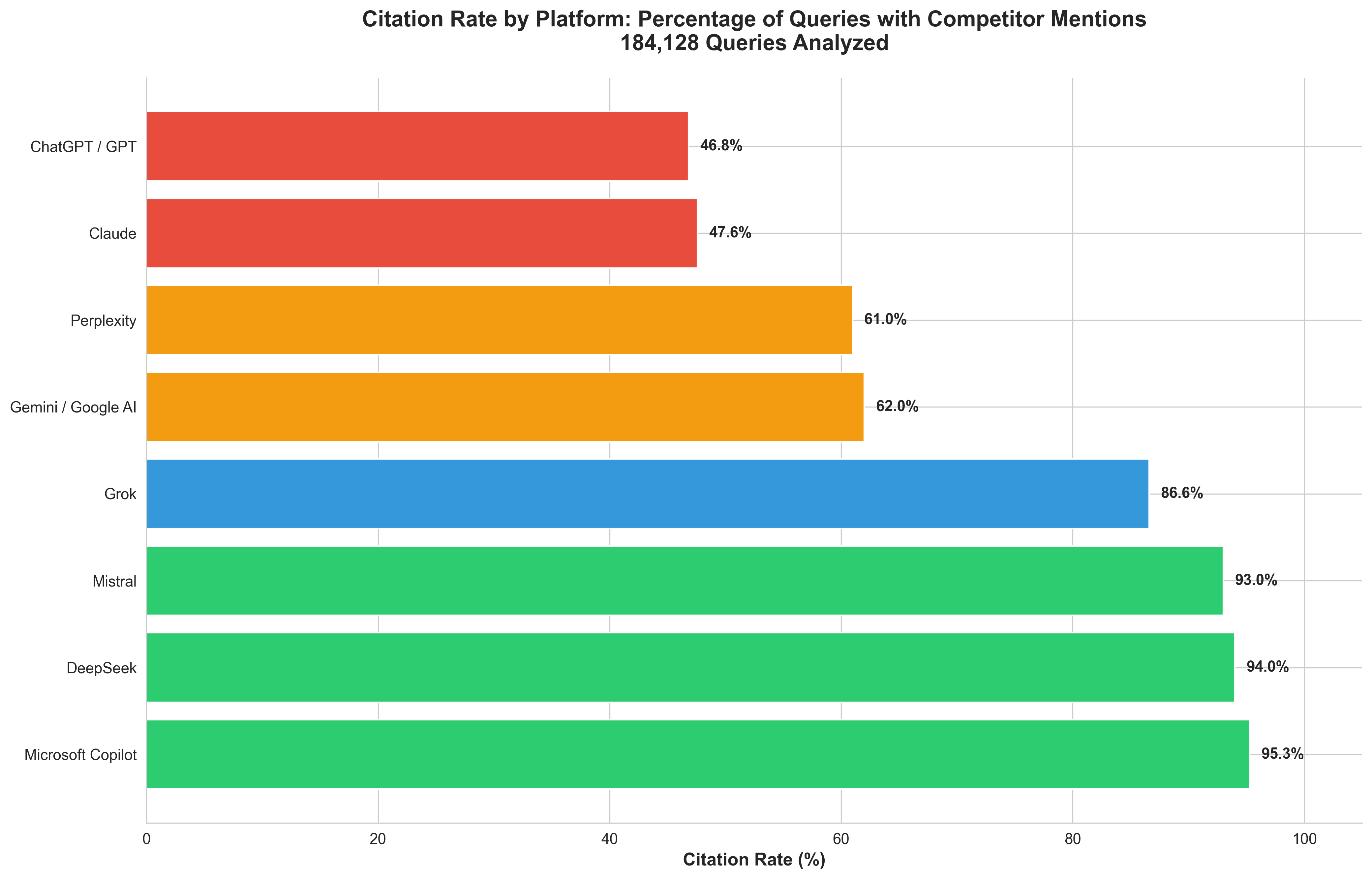
Not all platforms mention competitors with equal frequency. We measured competitor mention rate - the percentage of queries where at least one competitor is mentioned:
Competitor Mention Rate | Platforms | Strategic Implication |
90-100% | DeepSeek (88-100%), Microsoft Copilot (95.29%), Mistral (91-95%) | Nearly guaranteed citation - optimize here first! |
70-89% | Grok (86.59%) | High probability - strong ROI for optimization |
50-69% | Perplexity (58-64%), Gemini/Google AI (53-71%) | Selective - authority signals critical |
19-74% | ChatGPT/GPT (wide range!) | Varies by model - GPT-5 ultra-selective (19%), GPT-4o-mini frequent (74%) |
\< 50% | Claude (47.57%) | Ultra-selective - being mentioned = premium signal |
Platform Breakdown:
💡 BREAKTHROUGH INSIGHT: Microsoft Copilot cites competitors in 19 out of 20 queries. If you're optimizing for ONE platform, make it Copilot - you're virtually guaranteed a citation. 💡 ChatGPT/GPT Range: Massive 19-74% spread within OpenAI models. GPT-5 is ultra-selective (1 in 5 queries) = premium signal. GPT-4o-mini is frequent (3 in 4 queries) = best ROI. 💡 DeepSeek's Perfect Record: 100% competitor mention rate for DeepSeek Reasoner. Every single query resulted in competitor mentions. Hyper-comprehensive but tiny sample.
Haga una auditoría gratuita: en pocos minutos, ChatGPT, Gemini y Perplexity responden en directo a 8 preguntas de compra sobre su mercado y usted ve a quién recomiendan.
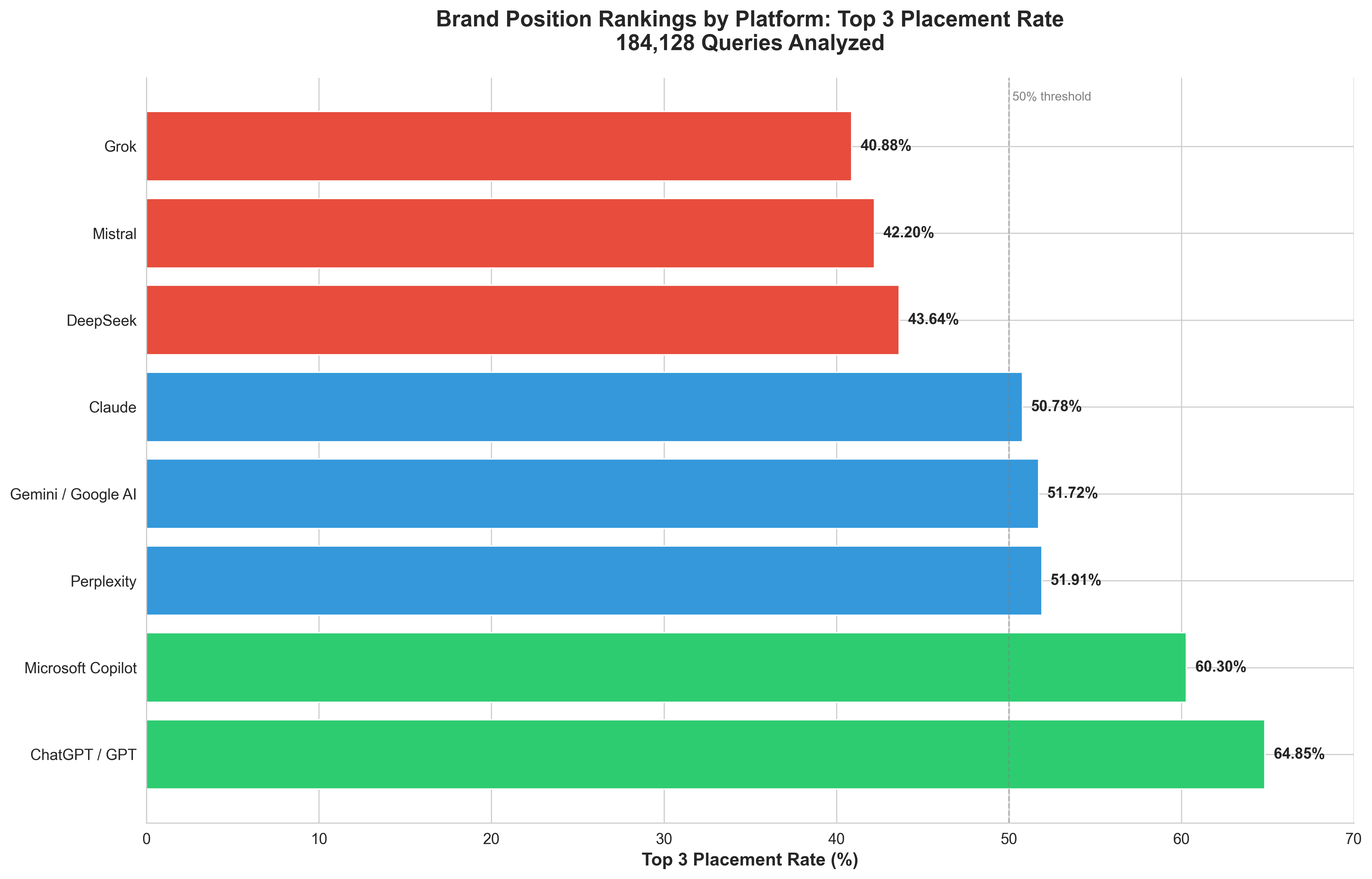
For the first time ever, we tracked where brands rank when they're mentioned by LLMs. Here's the Top 3 Placement Rate by platform - the percentage of mentions that land in the top 3 positions:
Rank | Platform | Avg Position Range | Best Top 3 % | Brand Visibility |
🥇 | ChatGPT / GPT | 3.55 - 5.11 | 64.85% | EXCELLENT (GPT-4o-mini best) |
🥈 | Microsoft Copilot | 3.47 | 60.30% | EXCELLENT |
🥉 | Perplexity | 4.89 - 5.64 | 51.91% | GOOD (Sonar better than Core) |
4 | Claude | 4.42 | 50.78% | AVERAGE |
5 | Gemini / Google AI | 4.31 - 7.74 | 51.72% | MIXED (AI Overview good, 2.0 Flash terrible) |
6 | DeepSeek | 4.74 - 5.72 | 43.64% | AVERAGE (small sample) |
7 | Mistral | 4.79 - 5.47 | 42.20% | BELOW AVERAGE |
8 | Grok | 5.11 | 40.88% | BELOW AVERAGE |
Platform Details:
ChatGPT/GPT (BEST):
Gemini/Google AI (MIXED - WORST to GOOD):
Perplexity:
💡 SHOCKING DISCOVERY: ChatGPT/GPT platform ranks brands nearly 2x BETTER than Gemini (64.85% vs 37.18% top 3). GPT-4o-mini alone provides massively better brand visibility than any Gemini model. 💡 The Gemini Problem: Gemini 2.0 Flash (9.9% market share) has average position 7.74 - meaning most brands are ranked 7th-8th. This is catastrophic positioning. Exception: Google AI Overview is much better (51.72%). 💡 Microsoft Copilot's Double Win: 95.29% citation rate + 60.3% top 3 placement = best optimization target in the entire study. Nearly guaranteed visibility AND excellent positioning. 💡 Winner: ChatGPT/GPT: With 44.7% market share AND 64.85% top 3 placement, OpenAI's platform delivers the best combination of volume and positioning.
We used the Gini coefficient (a measure of inequality used in economics) to understand source diversity:
Concentration Level | Platforms | Top 10 % Range | Gini Range | Strategic Implication |
VERY CONCENTRATED | ChatGPT/GPT (some models) | 84-100% | 0.54-1.0 | Narrow sourcing - GPT-5 uses elite domains repeatedly |
CONCENTRATED | Gemini/Google AI (most) | 15-68% | 0.72-0.76 | Moderate diversity - Gemini 2.0/2.5 favor certain domains |
BALANCED | ChatGPT/GPT (main), Perplexity | 10-13% | 0.60-0.83 | Diverse but focused - good balance |
VERY DIVERSE | Microsoft Copilot, Grok, Google AI Overview | 4-5% | 0.46-0.65 | Massive diversity - 100+ domains matter |
Platform Breakdown:
Most Diverse (4-5% top 10):
Balanced (10-13% top 10):
Concentrated (15-100% top 10):
💡 Platform Diversity Winners: Google AI Overview, Microsoft Copilot, Grok cite 20x more diverse sources (only 4-5% from top 10). You need massive source diversity (100+ domains) to rank here. 💡 Perplexity's Inequality Problem: Gini 0.833 (highest!) means a small number of elite domains (legalplace.fr, legalstart.fr) dominate citation volume. Build domain authority or you're invisible. 💡 ChatGPT/GPT Range: GPT-4o-mini is balanced (11.65%), but GPT-5 is ultra-concentrated (84.48%) - uses same elite sources repeatedly. Two completely different strategies within one platform.
We categorized all sources by type and discovered a universal pattern. Here's what each source type means:
Source Types Explained:
Here's how LLMs distribute their citations across these source types:
Platform | Commercial % | Institutional % | Media % | Preference |
Perplexity | 66.8% | 6.2% | 5.3% | Heavy commercial |
Microsoft Copilot | 68.2% | 3.1% | 15.2% | Heavy commercial |
ChatGPT/GPT | 54.3% | 5.1% | 7.4% | Commercial (varies by model) |
Gemini/Google AI | 51.7% | 3.8% | 6.2% | Commercial |
Claude | N/A | N/A | N/A | ZERO sources |
Mistral | N/A | N/A | N/A | ZERO sources |
DeepSeek | N/A | N/A | N/A | ZERO sources |
Grok | 64.0% | 4.7% | 16.6% | Heavy commercial |
Platform Breakdown (Models with sources):
Heavy Commercial (65-78%):
Moderate Commercial (45-55%):
💡 Universal Commercial Preference: ALL platforms (except GPT-5) favor commercial sources (business sites, SaaS platforms, services). If you're a business, this is great news - LLMs prefer company websites over media. 💡 Perplexity = Commercial King: 250,018 commercial citations (77.6% of Core). If you're in B2B/SaaS, Perplexity is your best friend. 💡 ChatGPT/GPT Range: Varies wildly within platform - GPT-5 prefers 72.4% institutional (.gov/.edu) while ChatGPT Core favors 73.7% commercial. Completely different trust models. 💡 Strategic Takeaway: For 7 out of 8 platforms, building commercial authority (strong E-E-A-T, business credibility) is more valuable than media coverage. Exception: if targeting GPT-5 specifically, pursue .gov/.edu partnerships.
These five dimensions reveal fundamental truths about AI search:
The AI search era is not the future. It's now.
If Part 1 was about how LLMs respond and Part 2 revealed game-changing patterns, Part 3 is about what sources LLMs cite. Over 1,479,145 sources were analyzed across all queries - a 2,365% increase from our Q2 2025 dataset (59,992 sources). The patterns are fascinating.
Not all models cite sources equally. Some models provide extensive sourcing, while others (like Claude, Mistral, and DeepSeek) provide ZERO source citations.
Model | Total Sources | Unique Domains | Avg Sources/Query | Sourcing Approach |
Perplexity Core | 323,130 | ~15,000 | 9.8 | Very high volume |
Perplexity Sonar | 384,149 | ~40,000 | 16.4 | Highest diversity |
GPT-4o-mini | 245,987 | 43,824 | 6.4 | Most diverse (43k+ domains!) |
Gemini 2.0 Flash | 232,848 | ~30,000 | 12.8 | High volume |
Google AI Overview | 133,427 | ~40,000 | 35.2 | Highest avg per query |
ChatGPT Core | 57,793 | ~10,000 | 1.3 | Very selective |
Microsoft Copilot | 19,005 | ~5,000 | 3.4 | Selective |
Grok | 70,669 | ~15,000 | 17.2 | High volume |
Claude 3.7 Sonnet | 0 | 0 | 0 | No sources |
Mistral (all) | 0 | 0 | 0 | No sources |
DeepSeek (all) | 0 | 0 | 0 | No sources |
💡 Major Finding: Seven models provide ZERO source citations - Claude 3.7, Mistral Medium/Small/Large, and DeepSeek Chat/Reasoner. This is a radical departure from citation-based models and fundamentally changes how users perceive and verify their responses. 💡 GPT-4o-mini's Diversity Champion: Despite not having the highest source volume, GPT-4o-mini cites the highest number of unique domains (43,824), suggesting an incredibly diverse source pool. This aligns with its excellent brand positioning (64.85% top 3 placement). 💡 Google AI Overview's Depth: Averages 35.2 sources per query - nearly 6x more than GPT-4o-mini. This explains its 4.7% concentration (most diverse model in our study).
The sources LLMs trust reveal their underlying priorities. Here are the top 5 most-cited non-commercial domains for each major AI platform (excluding business/marketing sites):
Top 5 domains:
💡 Insight: ChatGPT shows a strong preference for community platforms (Reddit #1) and authoritative government sources - 4 of top 5 are official .gov/.gouv.fr domains, demonstrating trust in institutional authority.
Top 4 domains:
💡 Insight: Perplexity heavily favors video content and community platforms - YouTube #1 and Reddit #2 dominate, followed by French government resources for business creation.
Top 5 domains:
💡 Insight: Gemini shows Google's own properties dominance (YouTube #1) combined with government authority and professional networks (LinkedIn), reflecting a focus on credible, authoritative sources.
Top 4 domains:
💡 Insight: Microsoft Copilot shows diversity with science content, travel, and e-commerce platforms, suggesting a consumer-focused approach with practical, actionable information.
Top 5 domains:
💡 Insight: Grok heavily favors community platforms and established media - Reddit dominates (#1) at nearly 5x more than Forbes (#2), showing strong preference for user-generated content alongside authoritative business news.
Desglose su visibilidad modelo por modelo para ver dónde le menciona cada IA y dónde no.
Model | Unique Domains |
GPT-4o-mini | 43,824 |
Perplexity Sonar | 38,738 |
Google AI Overview | 38,235 |
Gemini 2.0 Flash | 29,274 |
Perplexity Core | 11,923 |
ChatGPT Core | 5,173 |
💡 Key Insight: GPT-4o-mini has the most diverse source pool (43,824 domains), while ChatGPT Core is the most selective (5,173). 💡 Strategic Implication: For GPT-4o-mini, long-tail domain authority matters. For ChatGPT Core, focus on top-tier authoritative sources.
We analyzed the most common words appearing in cited URLs to identify content themes LLMs favor.
💡 Key Insight: "Blog," "guide," and "how-to" (comment) content dominates across all models. 💡 Date Insight: Unlike our previous study, 2025 doesn't dramatically outrank 2024. Content freshness appears less critical than we initially thought. Authority and relevance matter more. 💡 Content Format: Guides, comparisons, and educational content are heavily favored.
Key Takeaways:
Now that we've analyzed how LLMs respond (Part 1), discovered breakthrough patterns (Part 2), and identified which sources they trust (Part 3), let's translate this into actionable strategies.
Based on our citation rate and brand positioning analysis, here's the recommended optimization priority order:
Tier 1 - Highest ROI (Optimize First):
Tier 2 - Strong ROI (Optimize Second):
Tier 3 - Selective (Advanced Optimization):
Reconsider Strategy:
💡 Key Strategy: Start with Tier 1 models where you get the best citation probability AND positioning. Only expand to Tier 2-3 after dominating Tier 1.
Our BOFU analysis revealed that purchase-intent queries trigger 2.5x more competitor mentions. This changes everything:
Old Strategy (Wrong):
New Strategy (Right):
Action Plan:
💡 Why This Matters: If you're not visible at the BOFU stage, users will never discover you - even if you have the best product.
There is no "one-size-fits-all" GEO strategy. Each platform has distinct preferences:
Platform | Market Share | Citation Rate | Avg Top 3% | Content Strategy |
Microsoft Copilot | 3.0% | 95.29% | 60.3% | Commercial content + E-E-A-T. Diverse sources (4.44% concentration). HIGHEST ROI. |
ChatGPT / GPT | 44.7% | 19-74% | 64.85% | Comprehensive + high-authority. Most diverse (43k domains). Range: GPT-5 ultra-selective (19%) to GPT-4o-mini frequent (74%). |
Perplexity | 30.6% | 58-64% | 45% | Heavy commercial (Core: 77.6%, Sonar: 56.2%). Practical business content. Build domain authority. 707k sources. |
Gemini / Google AI | 13.2% | 53-71% | 37-52% | YouTube essential (Google AI Overview #1). BUT Gemini 2.0 Flash has WORST positioning (7.74). Mixed results. |
Grok | 2.2% | 86.59% | 40.88% | Very comprehensive (7.94 competitors). Detailed comparisons essential. |
Claude | 6.0% | 47.57% | 50.78% | Ultra-concise (1,059 chars). ZERO sources. Focus on training data only. |
Mistral | 0.2% | 91-95% | 33-42% | 11.69 competitors (most competitive!). ZERO sources. Training data focus. |
DeepSeek | 0.1% | 88-100% | 44% | Perfect citation (Reasoner 100%). ZERO sources. Tiny volume but interesting. |
Key Insights:
YouTube's prominence - especially on Google AI Overview (#1), Gemini (#9), and Perplexity (#6) - cannot be ignored.
Action: If you're not creating video content, you're invisible to a significant portion of AI search traffic.
99% of responses use bullet points. LLMs favor:
Action: Restructure existing content to prioritize scannability.
Mirroring LLM discourse patterns - cautious phrasing, advisory language, conditional statements - may improve citation rates.
Test:
Our data shows that 2024 content ranks nearly as well as 2025 content, contradicting the common belief that recency is paramount.
Implication: Focus on building evergreen, authoritative content rather than constantly refreshing for dates.
All major models favor commercial sources except GPT-5:
Action: Build commercial authority (strong E-E-A-T, business credibility) over media coverage. For GPT-5, pursue .gov/.edu partnerships.
Reddit, Quora, and Medium are increasingly cited, especially by Google AI Overview and ChatGPT.
Action: Engage authentically in community discussions. High-quality Reddit threads and Quora answers can become authoritative sources.
7 models provide ZERO sources - Claude 3.7, all Mistral models, and DeepSeek models. But they still have HIGH citation rates (47-100%).
Implication: Traditional "backlink" thinking doesn't apply. Focus on being part of training data - publish authoritative, widely-cited content that future models will ingest.
Metric | Q2 2025 Study | Q3 2025 Study | Change |
Total Queries | 32,961 | 184,128 | +459% |
Total Sources | 59,992 | 1,479,145 | +2,365% |
Models Tracked | 3 | 20 | +567% |
ChatGPT Avg Chars | 1,687 | 5,650 | +235% |
Gemini Avg Chars | 2,955 | 6,174 | +109% |
Perplexity Avg Chars | 2,029 | 2,233 | +10% |
ChatGPT/GPT Competitors | 0.81 | 3.54 (platform) | +337% (ChatGPT Core: 4.78 = +490%) |
Gemini Competitors | - | 3.18 | New |
Analysis Dimensions | 3 | 5 | New: BOFU, competitor mention rates, brand positioning, Gini, commercial content |
Key Evolution:
Microsoft Copilot is the highest ROI target - 95.29% citation rate + 60.3% top 3 placement = nearly guaranteed visibility. Follow with ChatGPT/GPT (44.7% market share, 64.85% top 3 via GPT-4o-mini) and Perplexity (30.6% market share, heavy commercial preference).
It depends on the model. Claude 3.7 Sonnet averages only 1,059 characters (ultra-concise), while Google AI Overview averages 6,174 characters (highly detailed). There's no universal length - optimize based on your target platform.
Yes! Our data shows that authority beats freshness. 2024 content ranks nearly as well as 2025 content. Focus on creating evergreen, authoritative content rather than constantly updating for recency.
BOFU content is critical. Purchase-intent queries trigger 2.5x more competitor mentions (4.78 avg vs 1.92 for TOFU). If you're not visible when users ask "Best [category]" or "[Brand A] vs [Brand B]", you're invisible at the moment that matters most.
These models use a fundamentally different trust model - they rely entirely on training data rather than real-time sourcing. They still have high citation rates (47-100% mention competitors), but provide zero attribution. To rank here, focus on becoming part of future training data through authoritative, widely-cited content.
It varies dramatically by platform:
Position matters more than ever when 3-12 alternatives are mentioned.
Yes, critically important. YouTube is the #1 source for Google AI Overview, #6 for Perplexity Sonar, and #9 for Gemini 2.0 Flash. If you're not creating video content, you're invisible to a significant portion of AI search traffic.
ChatGPT's massive shift: Competitor mentions increased by 337% platform-wide (from 0.81 to 3.54 avg), with ChatGPT Core specifically at 490% (4.78 avg). OpenAI dramatically changed its strategy to recommend many more alternatives. Combined with 106% month-over-month growth in AI search adoption, the competitive landscape has intensified dramatically.
AI search isn't the future. It's already here. The data is clear: AI-generated answers are replacing traditional search results. With 184,128 queries, 1,479,145 sources, and 20 models analyzed, we're seeing revolutionary patterns emerge:
At Qwairy, we're committed to publishing quarterly updates as the AI search landscape evolves. We've already exceeded 184,000 queries and will continue tracking:
The brands that win in AI search will be those that:
The opportunity window is NOW. Don't wait until everyone else has optimized. Are you ready?
Want to see where your brand ranks across all 20 LLMs? Start optimizing for AI search engines today.
What Qwairy helps you do:
Learn more about Generative Engine Optimization (GEO) and how to track if your brand is mentioned in LLMs.
Methodology Note: This study analyzed 184,128 queries generated between July 27 and October 27, 2025, across 20 LLM models via API. All data was collected using Qwairy's GEO
Siga las preguntas que importan para su negocio, vea qué marcas menciona cada respuesta y qué fuentes cita, y trabaje sobre las carencias.
Plan gratuito con 120 créditos iniciales • Sin tarjeta de crédito
Otros artículos
AI Overviews Study: What Google Actually Cites in France vs the US
Qwairy and Converteo analyzed 12,120 Google AI Overviews answers across France and the US: which queries trigger them, which sources get cited, and why authority and volatility now define visibility.
The First Answer Isn't the Decision: How AI Assistants Keep Buyers Talking
AI assistants rarely end on an answer: 72% close by inviting another question. And once buyers answer, the shortlist reshuffles. Qwairy's benchmark shows what the next turn decides.