Loading page

Discover how to use Qwairy to surface hidden opportunities and stay ahead of the AI visibility curve. Monitor your brand across ChatGPT, Perplexity, and more.

As AI-powered search continues to reshape how people discover content, ensuring your brand is visible in AI-generated answers is no longer optional - it's essential. That's where Qwairy comes in. Designed as a visibility and performance platform for AI search, Qwairy helps brands monitor, analyze, and optimize how they're mentioned across tools like ChatGPT, AI Overview, Gemini, Perplexity, and more. Here's how to use Qwairy to surface hidden opportunities and stay ahead of the AI visibility curve.
The first step when using Qwairy is to monitor your brand's visibility across these AI ecosystems.
Qwairy collects and analyzes real user queries that relate to your brand - across thousands of AI-generated answers.
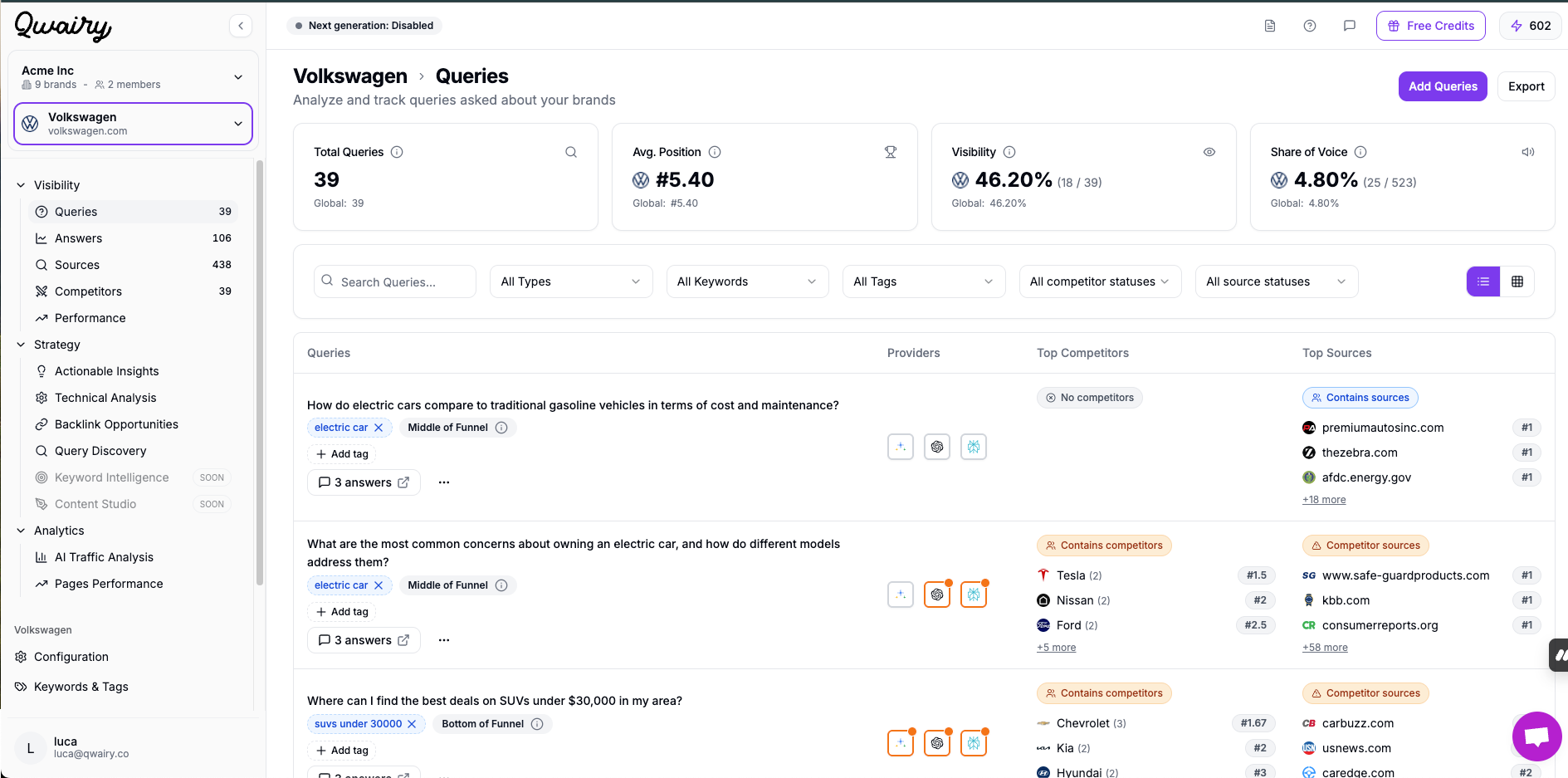
For example, if you are Volkswagen (car manufacturer) you might want to know your visibility across queries like:
Qwairy.co identifies those queries for you and helps you understand your brand presence in those answers.
💡 Please note that you can also add any query yourself at anytime.
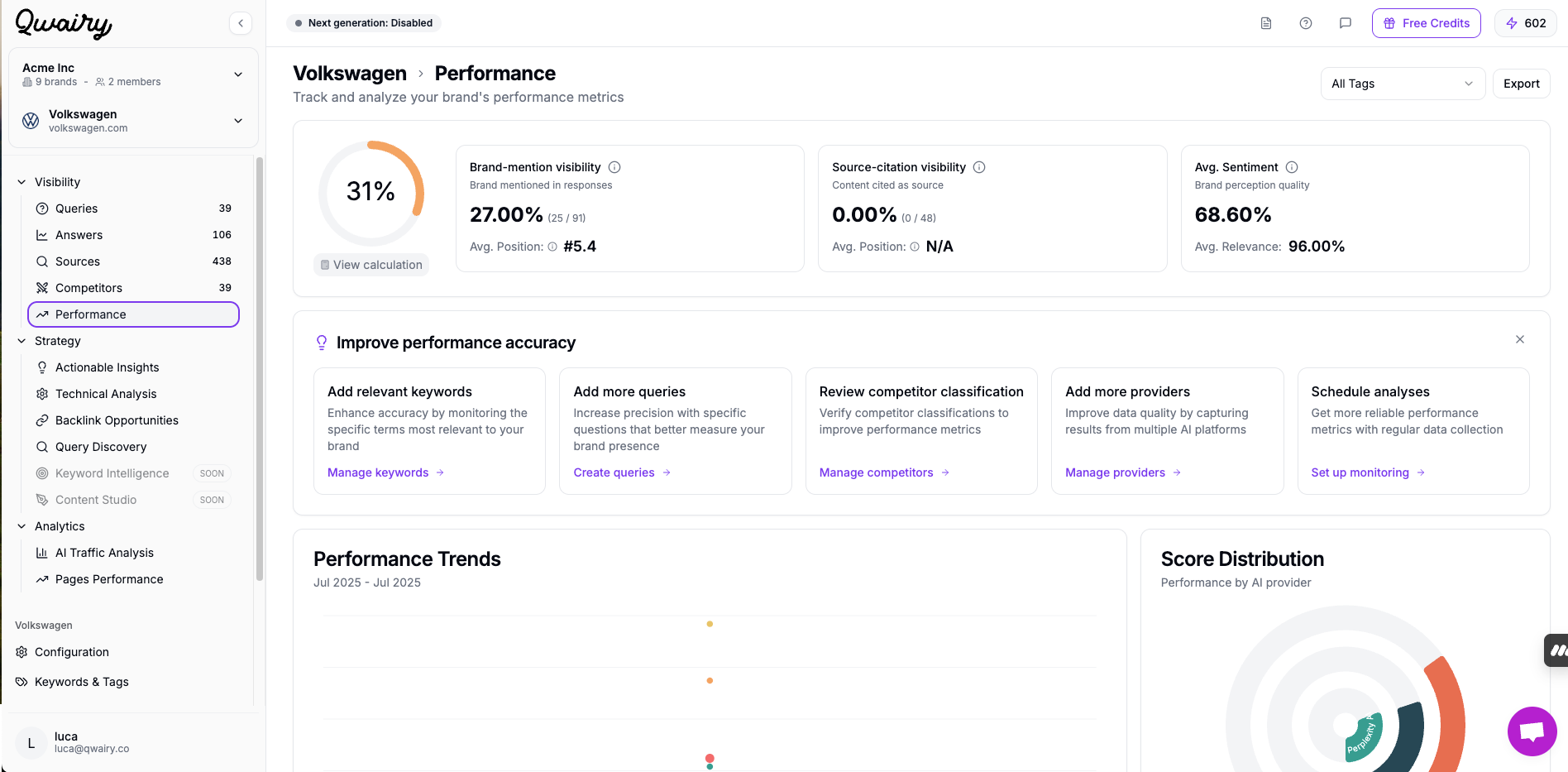
Qwairy breaks down your performance by provider (e.g., GPT-4o Mini, Sonar, AI Overview), so you can see how your brand appears across different AI systems. As you might know there are two possibilities to be featured in an AI answer:
For example we run this for Volkswagen:
With this data, you're not just analyzing where you rank - you're identifying which platforms to prioritize, and which content partnerships or technical optimizations will yield the greatest gains.
Brand visibility isn't just about frequency - it's about tone and relevance. Qwairy helps you track:
Most powerfully, Qwairy reveals a new type of gap - one that classic SEO tools miss:
You might be ranking on Google, but not being cited by ChatGPT, Perplexity, or Gemini.
That's the situation Volkswagen faces in our example.
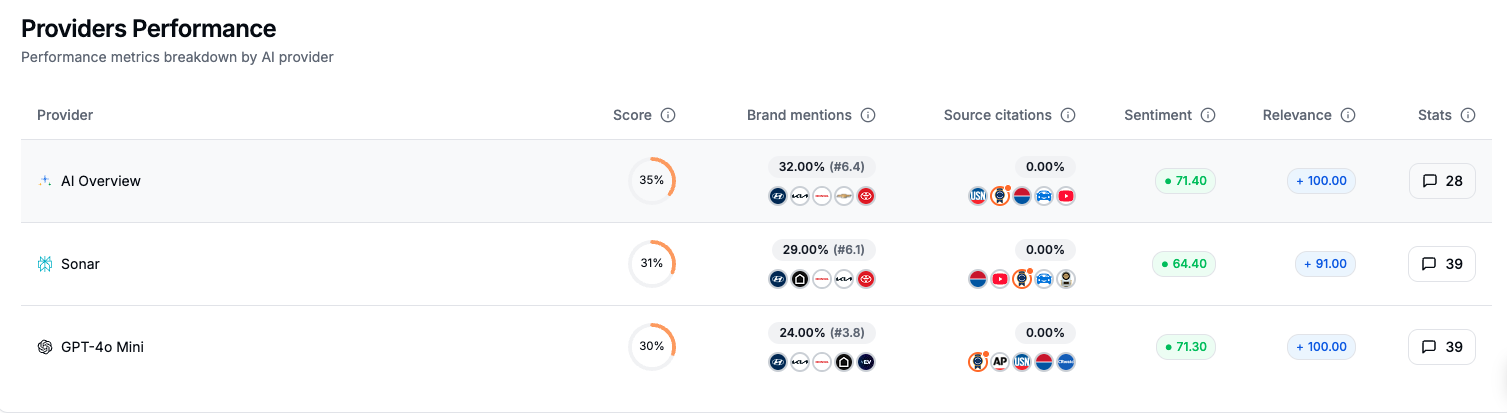
Despite a well-optimized digital presence, its AI source-citation visibility is 0%, suggesting that LLMs aren't recognizing VW-owned content as authoritative. This gap is invisible in most analytics platforms - but not in Qwairy.
The heart of Qwairy lies in its Performance Dashboard - a centralized view that shows how your brand performs across LLMs like ChatGPT, Gemini and Perplexity. This dashboard is not just visual, it's actionable: every number you see can lead to a GEO decision.
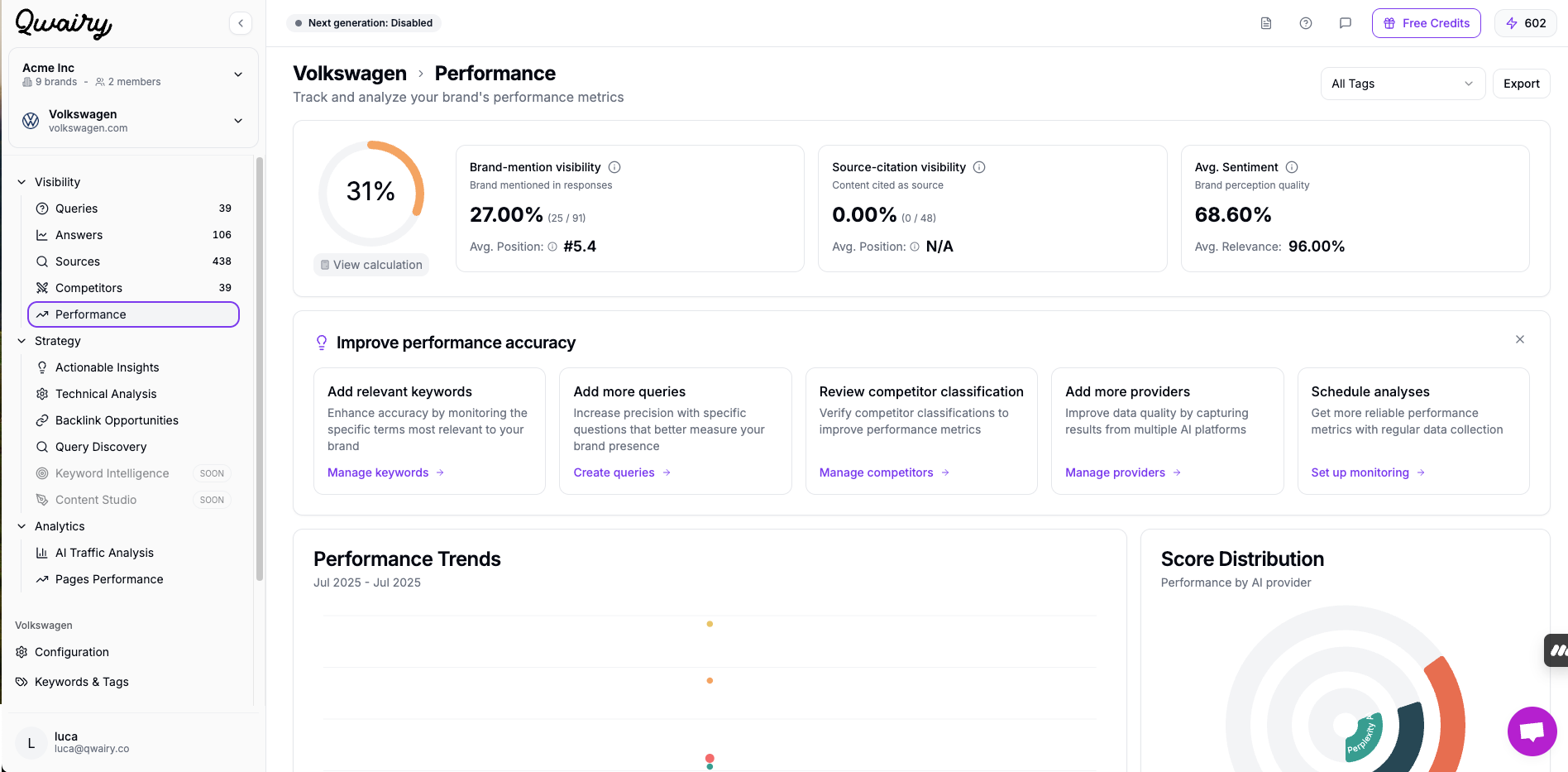
At the top, you'll see a high-level summary of your brand's GEO performance:
✅ In this example, Volkswagen has 27% brand-mention visibility, 0% citation visibility, and 68.60% average sentiment.
You also get positioning data, showing if you're the first, second or fifth brand mentioned.
At the bottom of the main panel, Qwairy plots your brand's weekly visibility trends. You can detect if a new content push or backlink strategy is improving your presence.
📊 Dots on the graph represent data points across time - with filters available for AI model or keyword clusters.
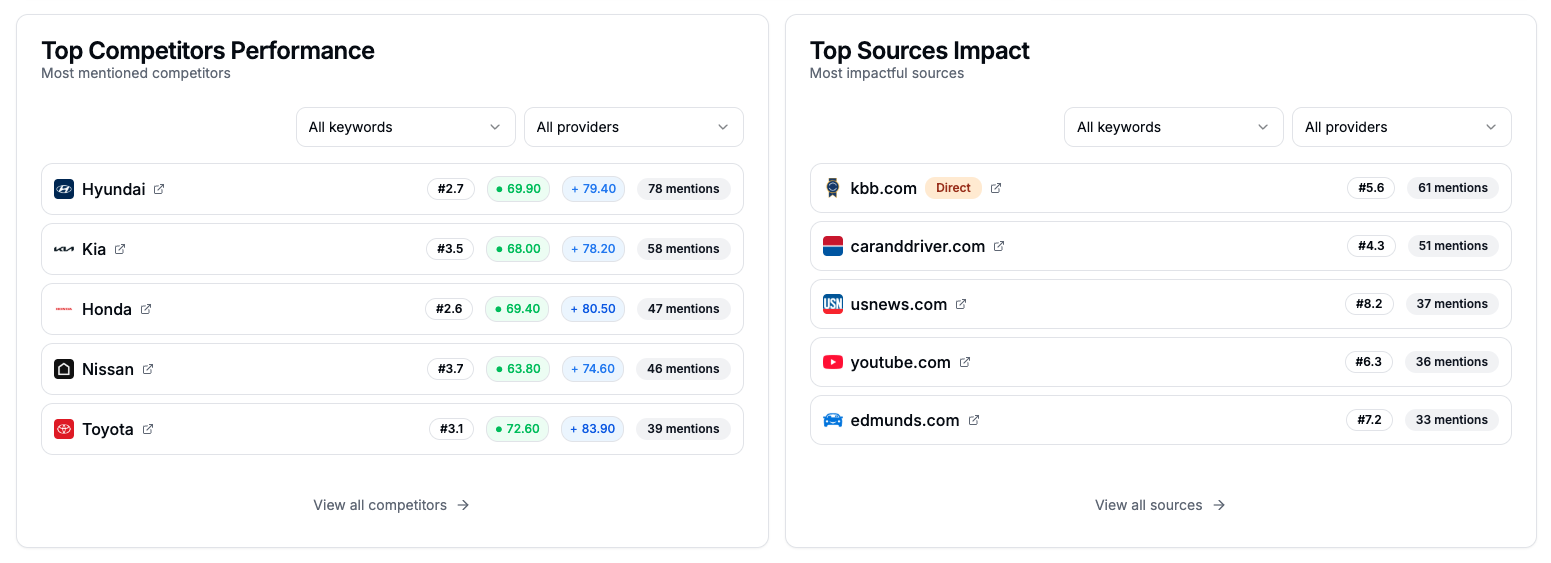
This panel shows how your main competitors are performing on the same prompts.
🧠 Use this to identify who's dominating and reverse-engineer why - are they cited? Are they answering more informational queries?
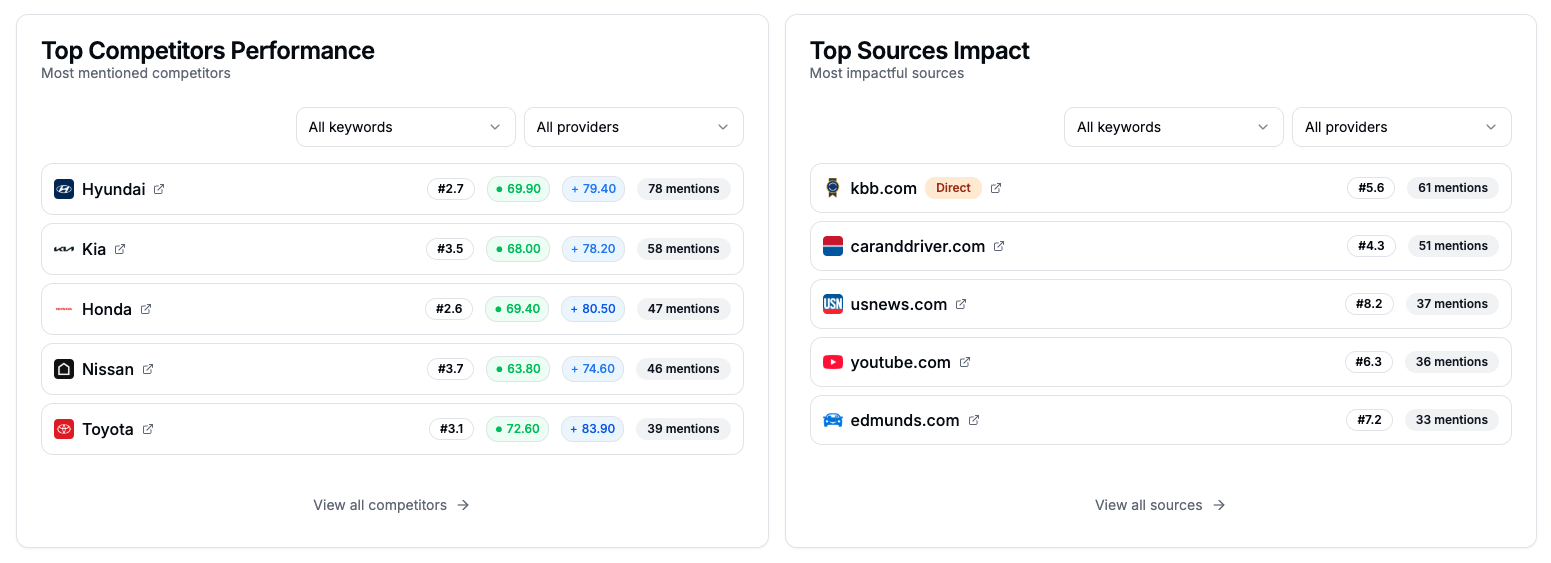
On the right, you'll see the most impactful websites used by LLMs as sources for your queries.
kbb.com, caranddriver.com, usnews.com, etc.📌 If you're not ranking, but these domains are used as a source - consider guest blogging, partnerships or citations on them. This is core to GEO backlink strategy.
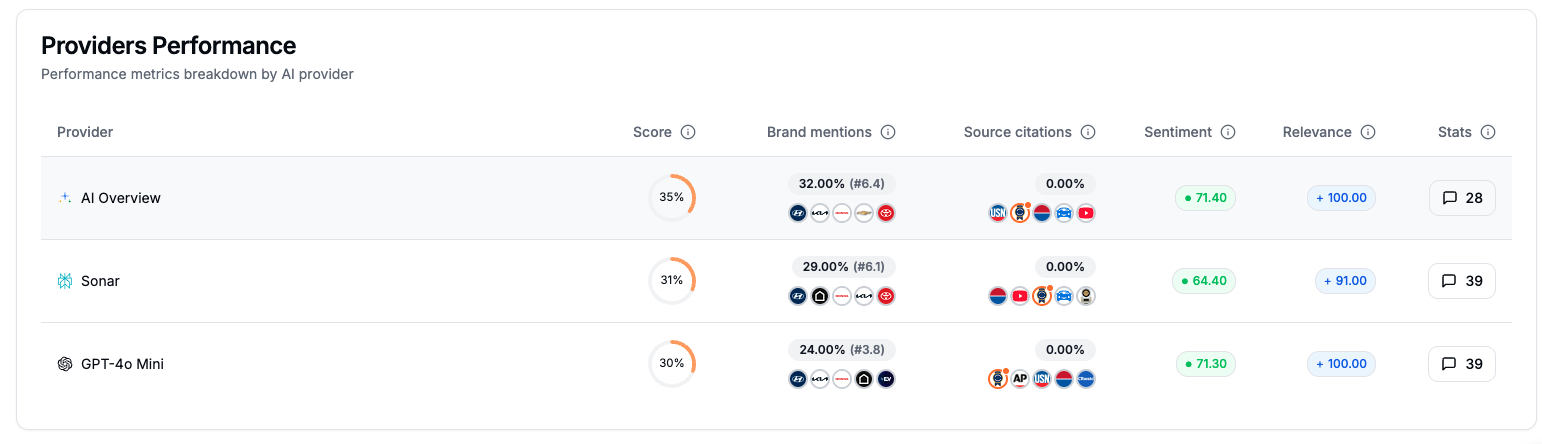
This is your LLM-specific breakdown. Qwairy segments your visibility score, mentions, citations, sentiment, and relevance by:
For example:
Run a free audit: in a few minutes, ChatGPT, Gemini and Perplexity answer 8 buying questions about your market live, and you see who they recommend.
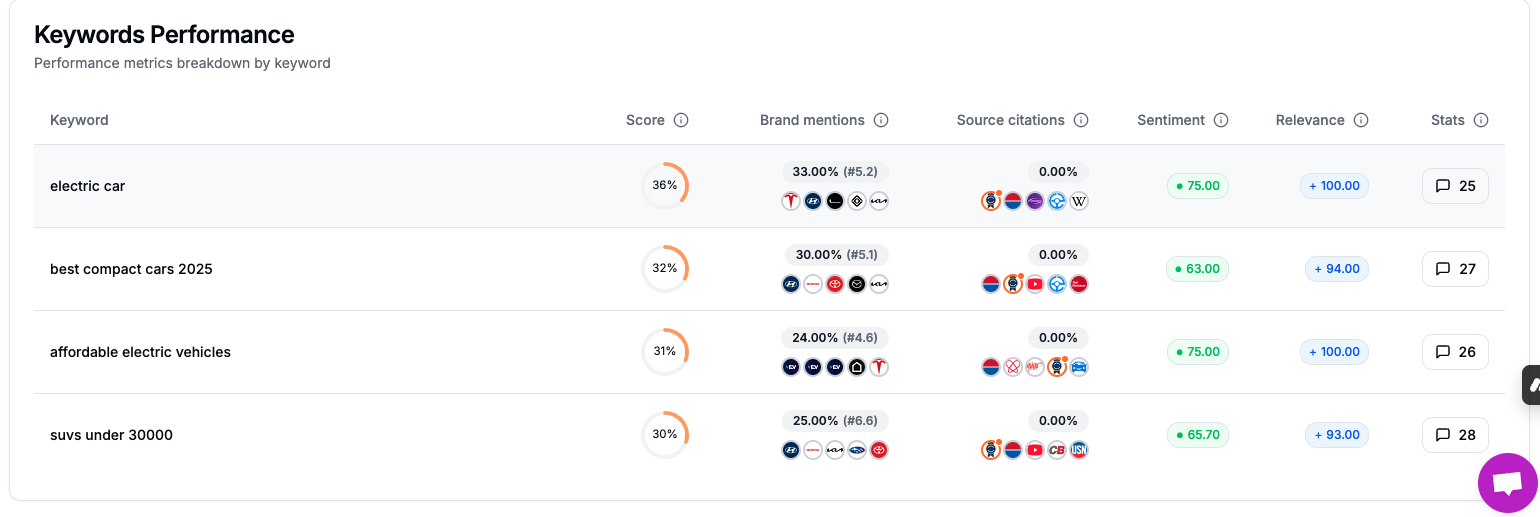
This section breaks down performance keyword by keyword - ideal to guide content creation. For each prompt:
📝 This is gold for building a GEO content plan: spot top queries where you're weak, and create or re-optimize content aligned with those prompts.
Don't forget - every chart or report can be exported from the dashboard. Whether for your SEO agency, internal team or CMO, Qwairy's data is ready to go.
Unlike traditional search engines that crawl billions of pages, LLMs:
With Qwairy's Sources and Backlink Opportunities modules, you can:
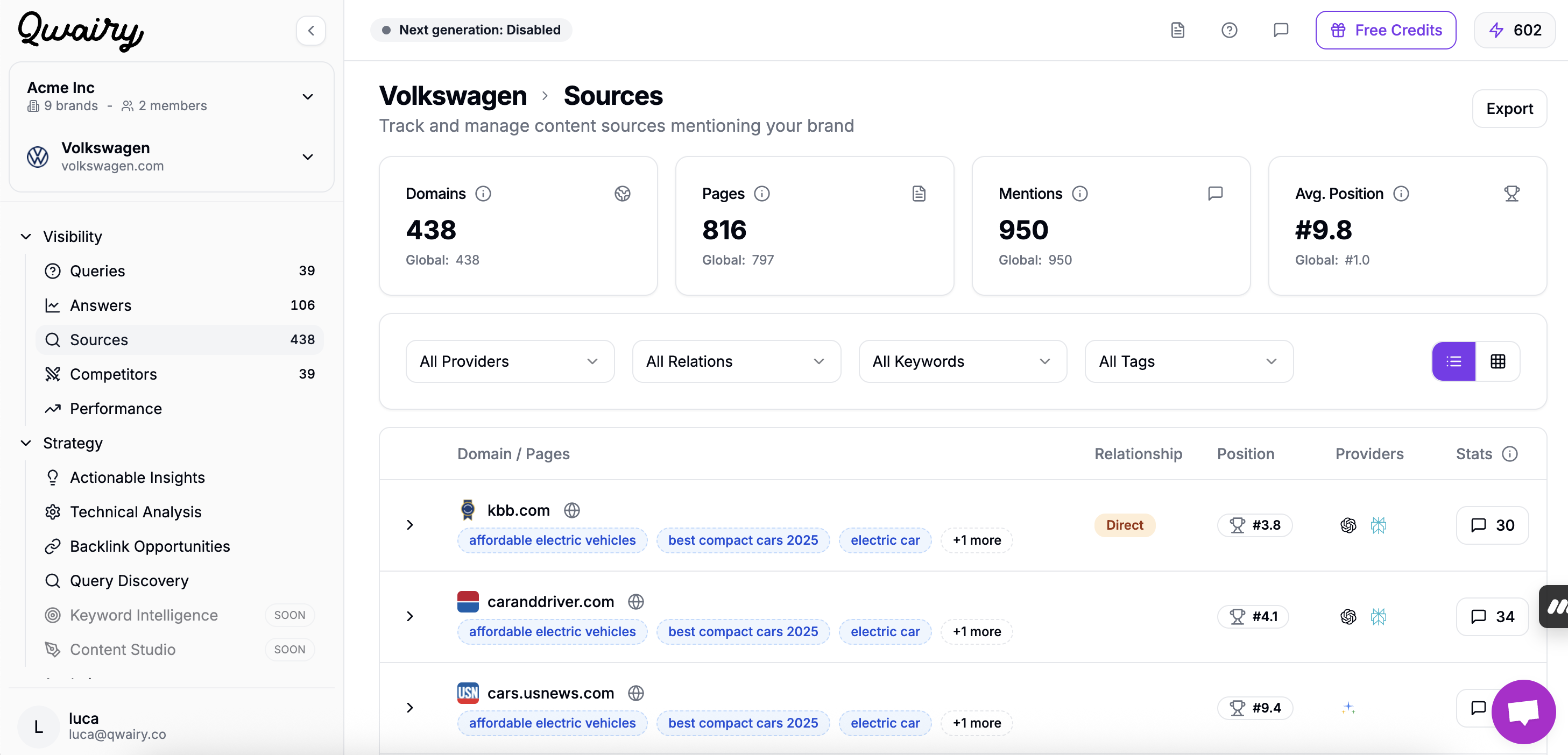
You'll discover which domains are:
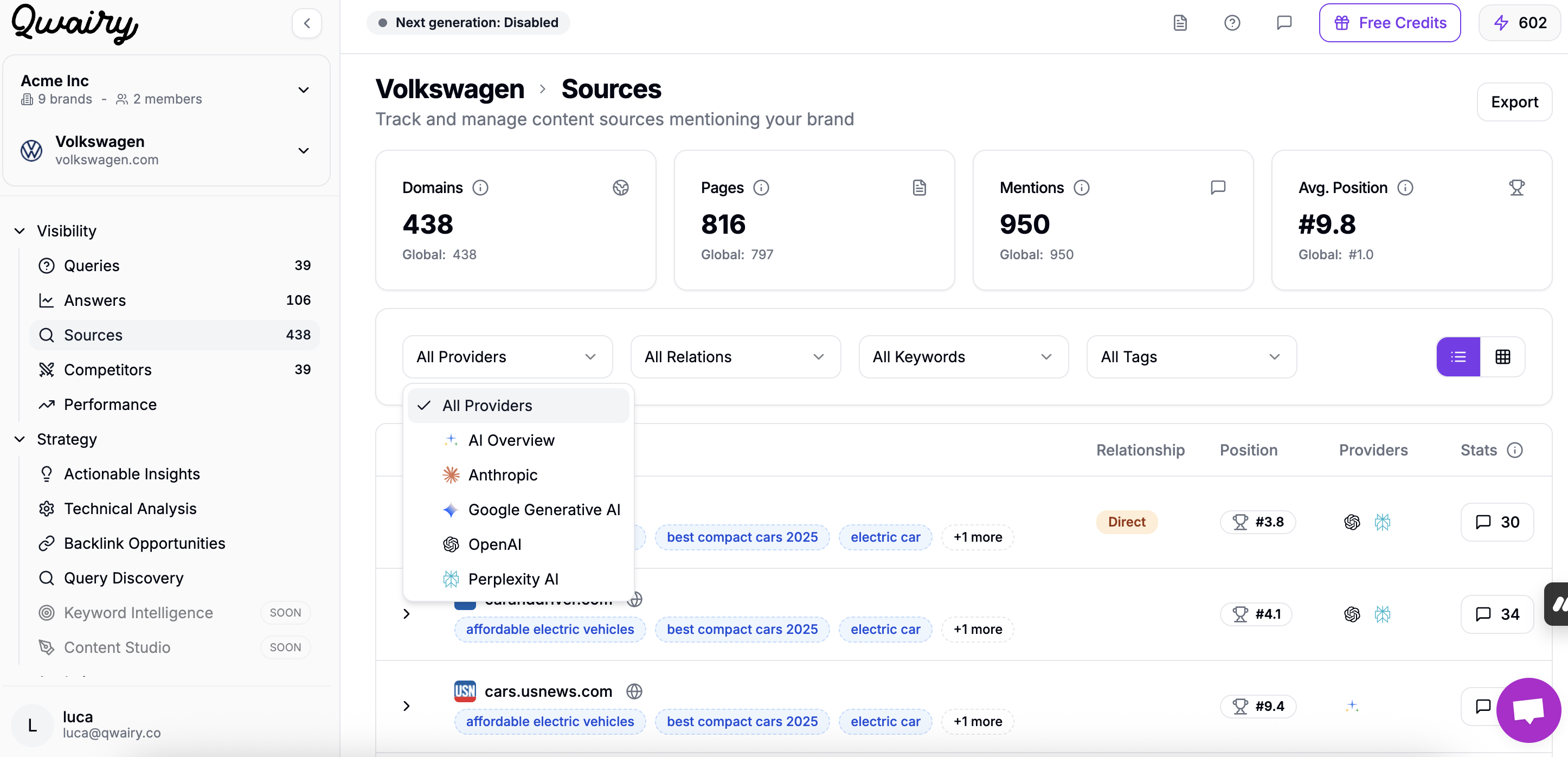
📸 Example: In the automotive space, sites like kbb.com, caranddriver.com, and usnews.com are among the most impactful.
You can also be more granular and see the urls that were used by different providers.
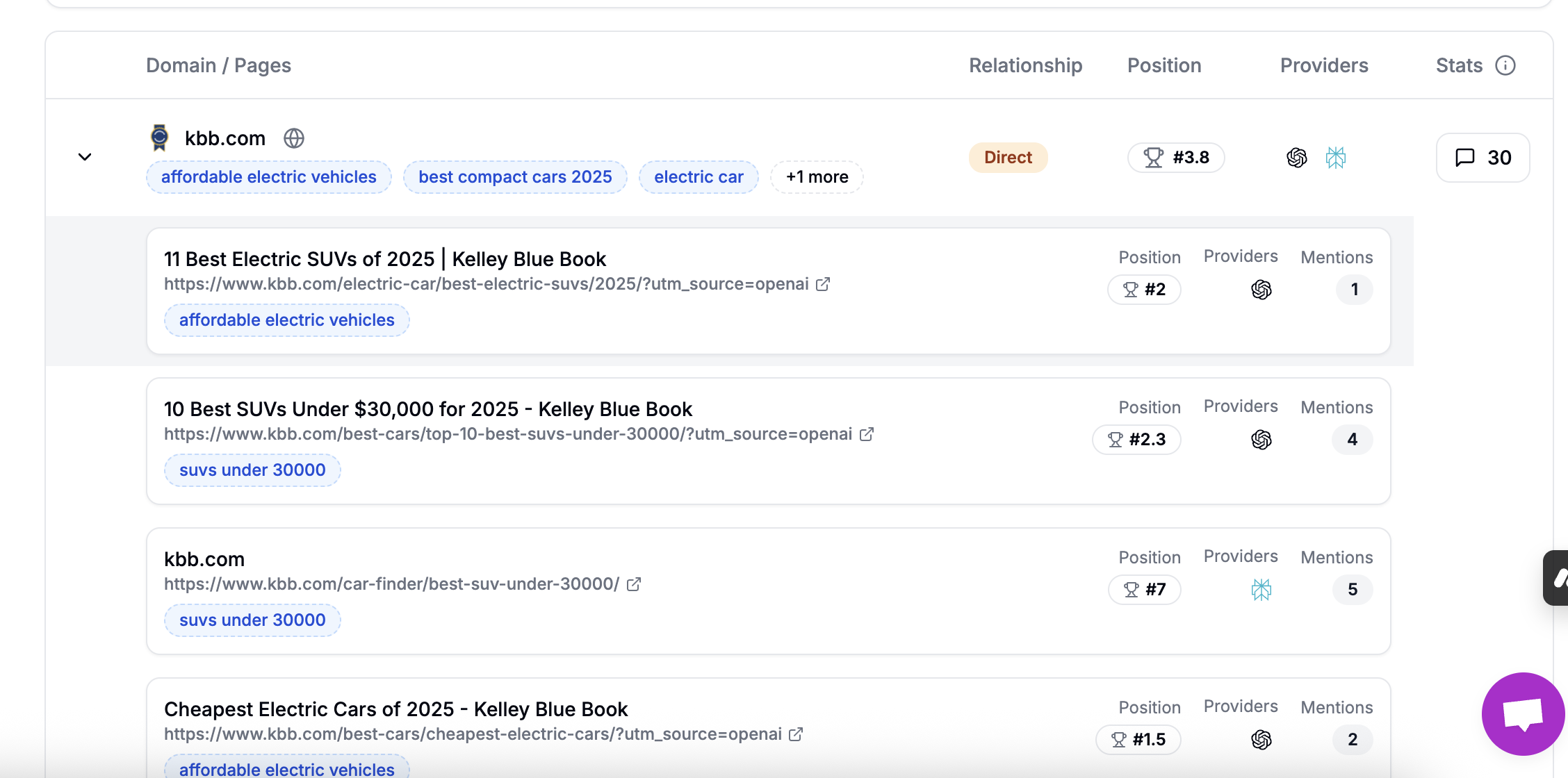
Qwairy tags sources based on:
✅ This lets you focus your PR, outreach, and content partnerships on the sources that actually influence LLM rankings.
While Qwairy's dashboard gives you a clear visibility scorecard, its real strength lies in what comes next: strategy. Qwairy doesn't just tell you where you are - it shows you how to improve it.
Think of this module as your GEO assistant. It automatically generates a prioritized action plan tailored to your brand's visibility gaps.
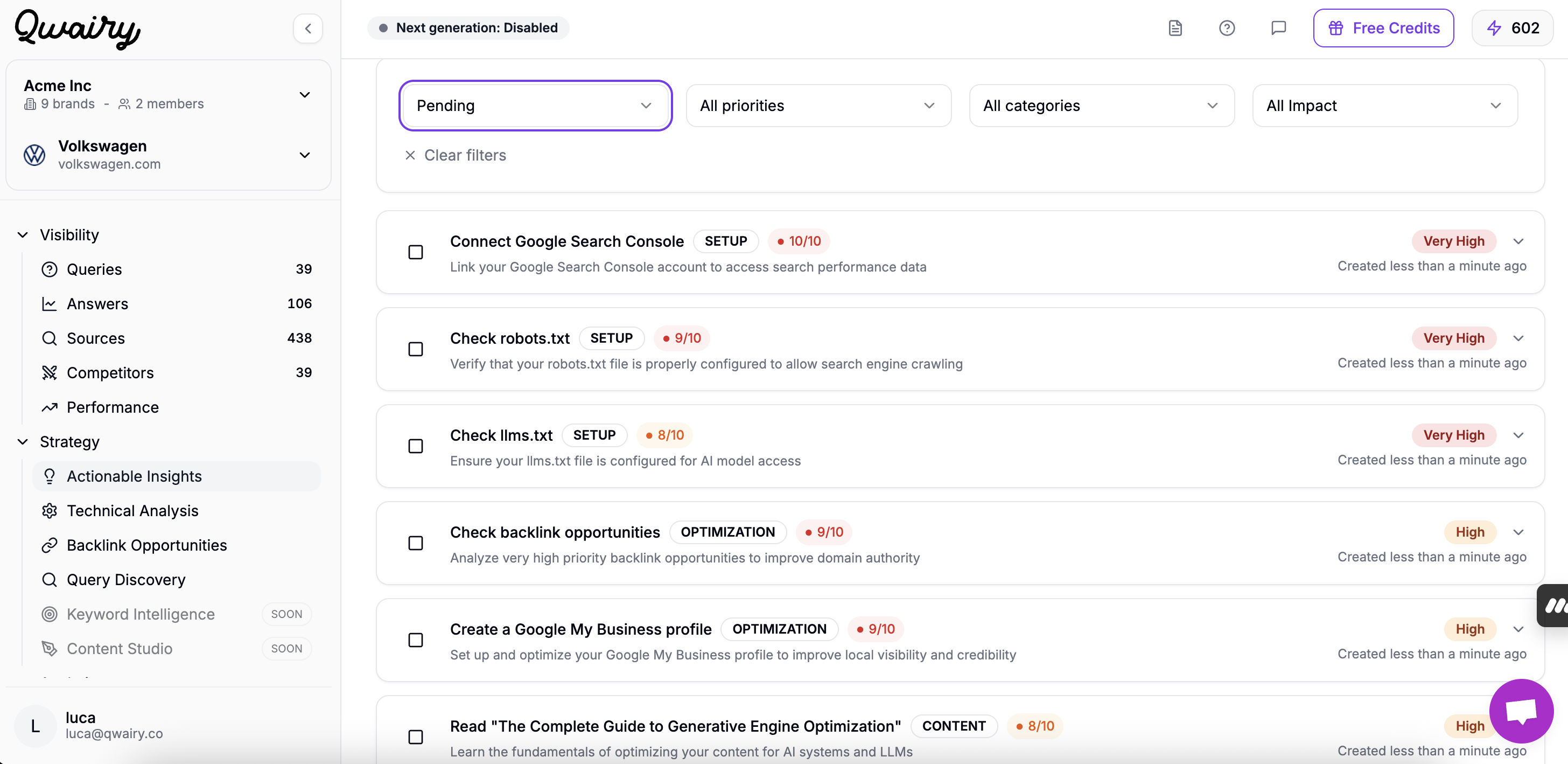
📸 Screenshot: For Volkswagen, Qwairy generated 15 custom insights, including 10 with high impact and 12 marked high priority.
Each task is rated by priority (urgency) and impact (potential visibility gain).
One of the most powerful features of Qwairy is how it helps you reverse-engineer the citation behavior of LLMs.

In the Backlink Opportunities module, Qwairy:
📸 In the screenshot: coltura.org has 11 mentions, cites 16 competitors, but Volkswagen is absent - a high-priority backlink opportunity.
Each opportunity includes:
This allows your team to:
🧠 This is not traditional link building. This is GEO-specific link building - targeting the sources LLMs actually use to generate responses.
See the web searches captured behind answers from supported models, and the content gaps they reveal.
Qwairy's AI Traffic Analysis module gives you deep insight into which LLMs are visiting your content, how often, and when. This is where you shift from "hope they index it" to "see them crawling it."
The module displays a clean, daily breakdown of visits from top AI bots such as:
Bot Name | Purpose | Example of Sample Visit Count |
GPTBot | OpenAI's main crawler for ChatGPT | 2,984 |
ChatGPT-User | AI visits triggered by ChatGPT users | 2,153 |
ClaudeBot | Anthropic's Claude engine crawler | 953 |
PerplexityBot | Perplexity's retrieval engine | 818 |
Google-Extended | AI-focused Google opt-in crawler | 661 |
Unlike traditional SEO tools, most companies don't even know if LLMs are crawling their sites. But with Qwairy:
💡 No visits from PerplexityBot? Maybe your robots.txt or llms.txt is blocking them.
Ready to start optimizing your brand's AI visibility? Here's how to get started:
The future of search is AI-powered, and brands that master AI visibility today will have a significant competitive advantage tomorrow. Qwairy provides the tools and insights you need to succeed in this new landscape. Start monitoring your AI visibility today and discover opportunities you never knew existed.
Track the questions that matter to your business, see which brands each answer mentions and which sources it cites, then work on the gaps.
Free plan with 120 initial credits • No credit card required
Other Articles
GEO Strategy: 5 AI Search Truths and a 4-Step Framework
Five truths about AI search shared at the SEO & GEO Summit in Paris, and the 4-step GEO framework Qwairy gives every client to get recommended by ChatGPT, Gemini and other AI engines.
The GEO Mistake Everyone Makes: Tracking Only the First AI Answer
Most AI visibility checks stop at the first answer. But AI assistants turn questions into conversations, and the follow-up questions they suggest decide which brands stay in the race.