Loading page

ChatGPT ads appear in 69.25% of US-monitored commercial answers but near zero in France. What US data reveals before the French launch, and how to prepare.
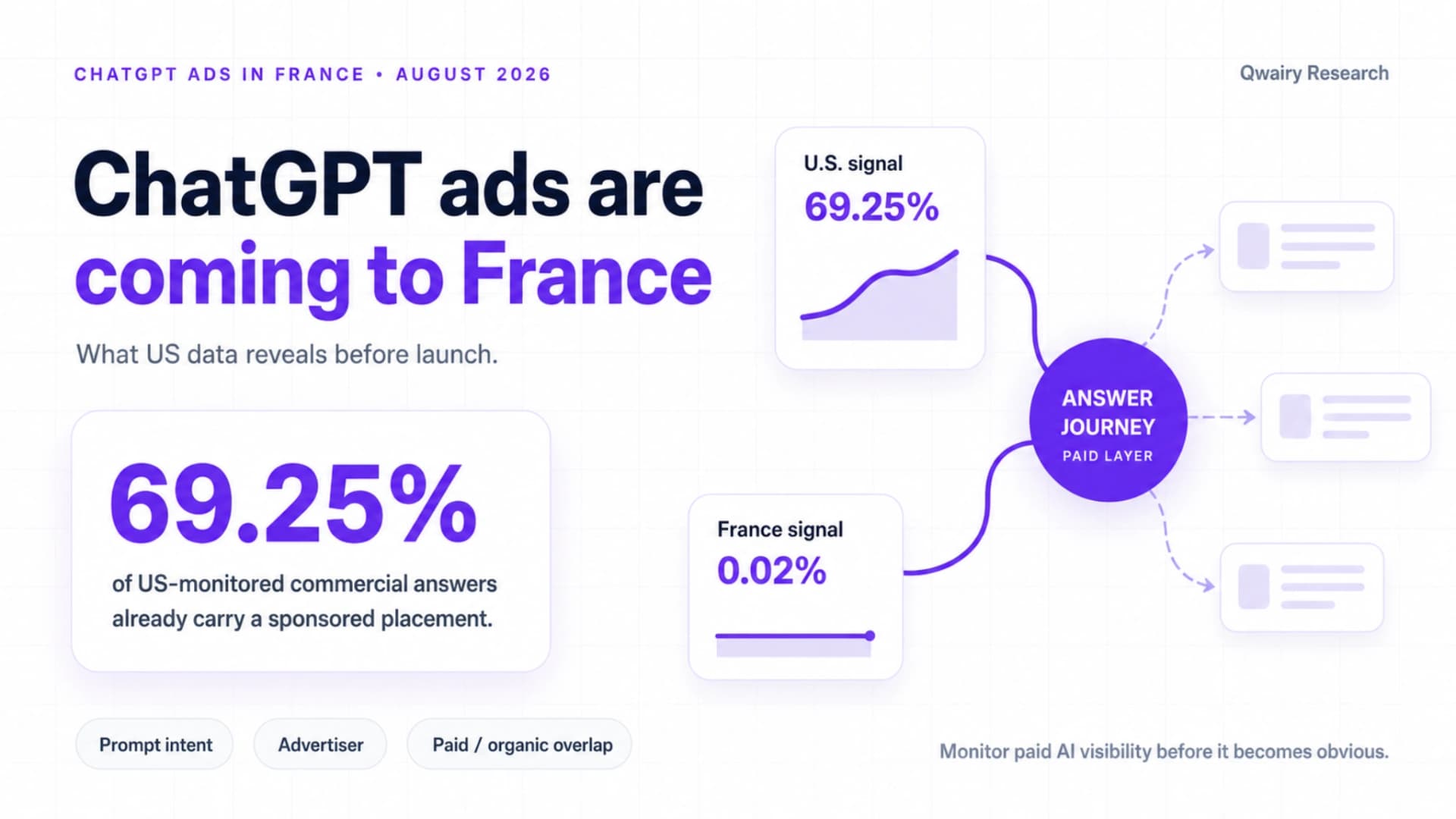
On one side of the Atlantic, ChatGPT has quietly become an advertising channel. On the other, the channel has briefly flickered, but sustained ad delivery has yet to begin. Over the last seven days, 69.25% of US-monitored ChatGPT answers in our corpus that triggered a web search carried at least one sponsored placement. In France-monitored answers, that rate was 0.02%. That gap is about to close. On August 15, OpenAI notified Free and Go users across the EEA and Switzerland by email that ads would start appearing “later this month,” France included, a notice confirmed in the OpenAI Help Center and covered by the French tech press . OpenAI's official ads page , whose latest update announced the August 11 expansion to the UK, Mexico, Brazil, Japan and South Korea, does not yet list France, but confirms more markets are planned this year. Press reports point to an activation on Monday, August 24. So what should French marketing teams expect? The shortcut is to project a single US benchmark, “an ad in one answer out of three,” onto France. The rigorous answer comes from analyzing every sponsored placement detected across our monitored answer corpus since late April. Five findings stand out:
The strategic implication runs through all five: ChatGPT Ads will not create a separate paid-media channel beside GEO. It adds a paid layer inside the same answer your organic visibility already lives in.
Ad-frequency numbers are only meaningful when the denominator is explicit. Ours is:
The share of monitored ChatGPT answers that both triggered a web search and contained at least one structured sponsored placement. This is not the share of all ChatGPT conversations, not user reach, not inventory sold, not OpenAI revenue.
Qwairy monitors prompts selected by brands, so the corpus over-represents commercial, category and recommendation intent.
Read our figures as a measurement of the brand-relevant surface, the part of ChatGPT marketers actually compete on. That single distinction explains why two valid studies can report very different numbers.
A widely shared Promptwatch analysis measured roughly one ad-bearing answer in three on its prompt set, and its companion Ads Radar study drew market-share conclusions from 32 “alternative to” prompts in a single category over five days.
We measure more than two in three on a prompt portfolio spanning many industries.
Neither is wrong.
They observe different slices of the same machine, and the slice changes the picture.
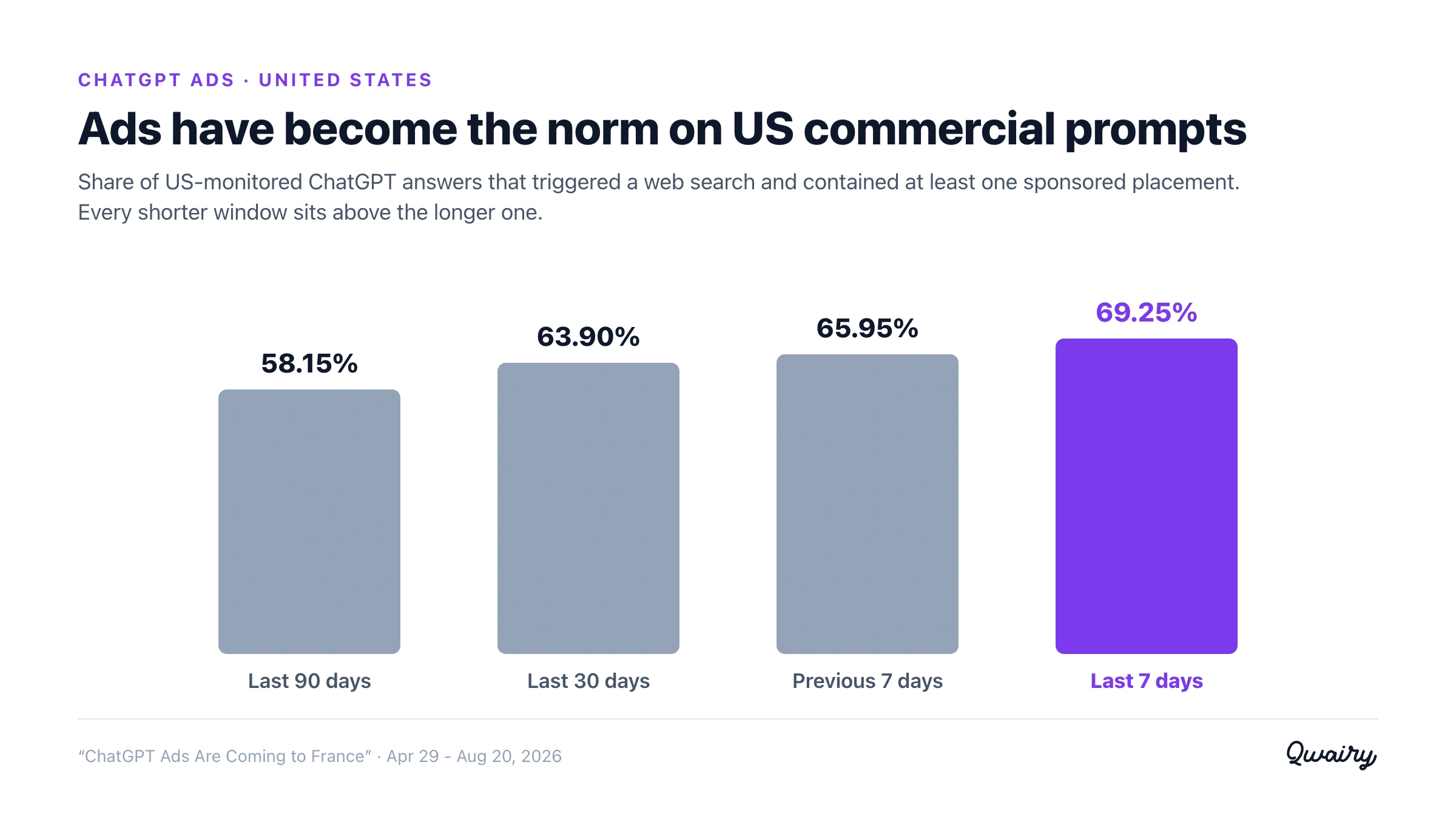
Across US-monitored ChatGPT answers that triggered a web search:
Window | Ad frequency |
Last 7 days | 69.25% |
Previous 7 days | 65.95% |
Last 30 days | 63.90% |
Last 90 days | 58.15% |
The week-over-week gain is 3.30 percentage points, and every shorter window sits above the longer one.
Within this corpus, this is not a spike. It is a channel still in expansion, months after launch. On the brand-relevant monitored surface, a paid placement has become the norm in a commercial ChatGPT answer.
Which yields the first lesson for France: the frequency you will experience depends on the prompts you choose to measure. A casual-usage corpus and a commercial-prompt corpus will tell two different stories, and both will be true.
Run a free audit: in a few minutes, ChatGPT, Gemini and Perplexity answer 8 buying questions about your market live, and you see who they recommend.
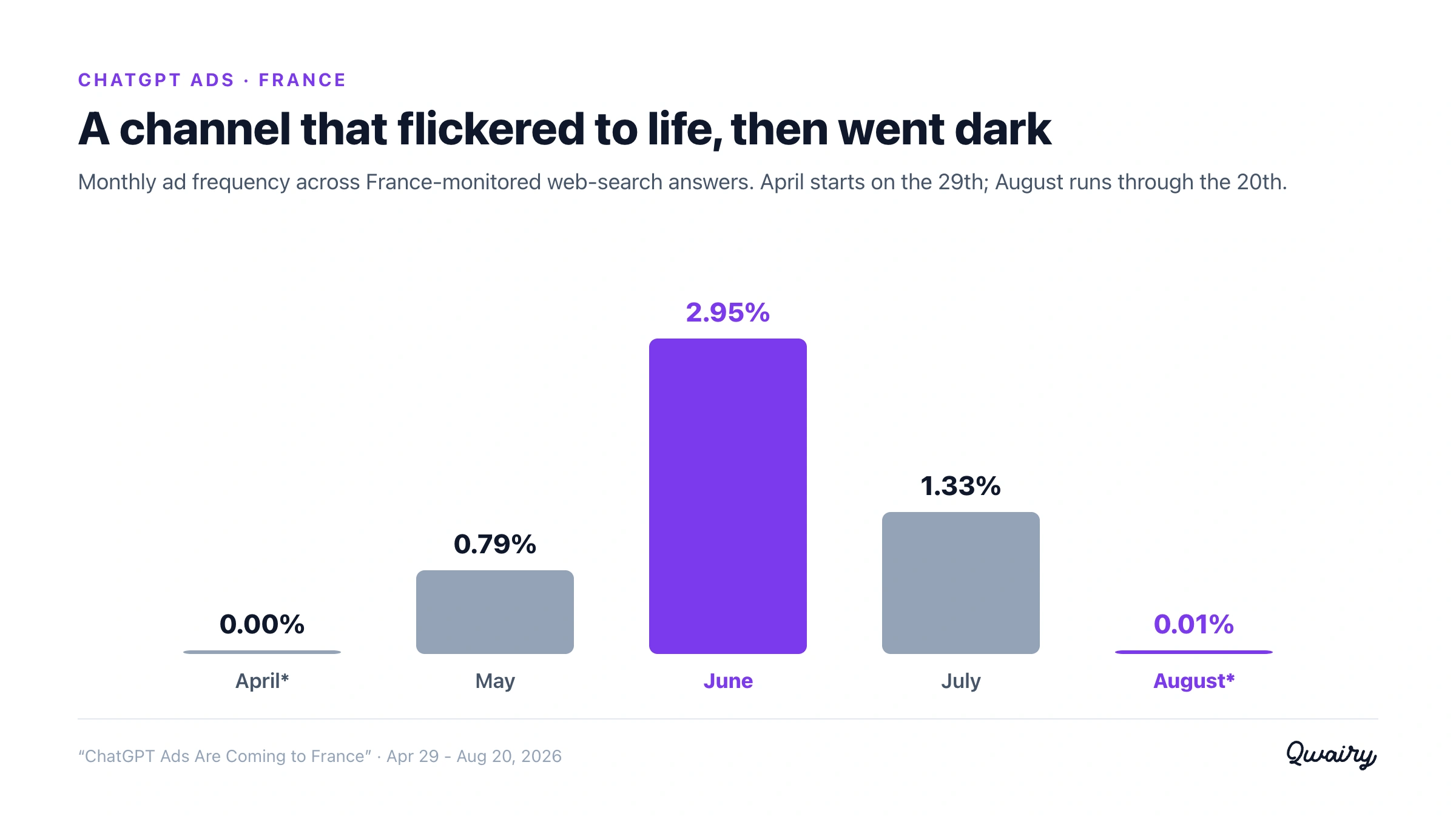
The current France-monitored rate is 0.021% over the latest seven-day window. The 90-day average looks unremarkable too, until you break it down by month. Then it reveals a regime change:
Month | Ad frequency |
April (from the 29th) | 0.000% |
May | 0.787% |
June | 2.950% |
July | 1.331% |
August through the 20th | 0.011% |
Sponsored activity appeared in France-monitored contexts in May, grew through June, faded in July, then almost vanished in August. Visibility data alone cannot explain why.
The spring signal could reflect market tests, rollout experiments, international inventory leaking into localized contexts, or changes in how the experience was served.
Calling it a secret French launch would be irresponsible. What the data does support is narrower and more useful:
As of August 20, sustained ChatGPT ad delivery was not yet established across Qwairy's France-monitored answer corpus.
That is exactly what makes this moment rare. When the rollout activates, the curve should show a clean break, not the continuation of an already mature market. French brands have something US brands never had: the chance to set a baseline at zero and measure the launch from day one.
Most GEO and paid-search teams start with the obvious commercial prompts: “best alternative to X,” “A vs B,” “best tool for Y.” Those prompts matter. They are not where most of the observed ad volume sits.
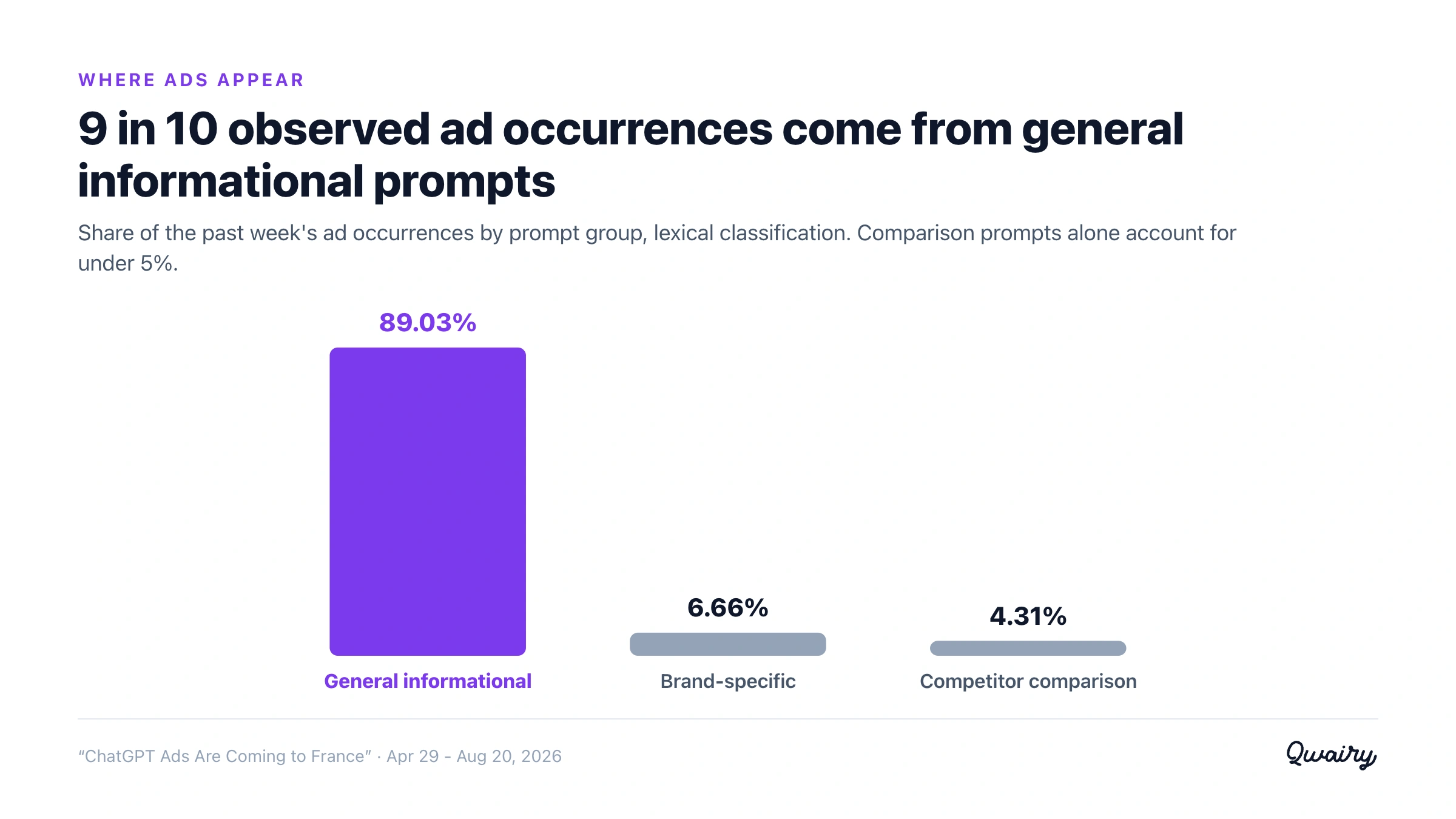
Classifying the past week's ad occurrences, where an occurrence is one advertiser appearing in one answer, into three prompt groups:
Prompt group | Share of ad occurrences |
General informational / organic | 89.03% |
Brand-specific | 6.66% |
Competitor comparison | 4.31% |
The pattern holds over 90 days, and it is even more pronounced in the French historical data: during the May-July window, 93.83% of France-monitored ad occurrences came from general informational prompts.
Our classification is lexical and does not replicate any other provider's taxonomy, so avoid comparing percentages line by line with other studies.
The directional conclusion, however, is hard to argue with: if your monitoring covers only “vs” and “alternative to” prompts, you are watching under 5% of observed ad occurrences.
Why does the informational surface dominate? Because a conversation can carry commercial context without a commercial phrase. “How can a small sales team improve lead quality?” reveals category, audience, constraints and intent.
In a contextual ad system, those signals are enough.
The practical shift is from keyword lists to prompt portfolios: monitoring the full problem space around a buyer, not only the final comparison query.
See the web searches captured behind answers from supported models, and the content gaps they reveal.
A narrow category study can make ChatGPT Ads look like a market owned by a handful of early buyers. Across a broad prompt portfolio, the structure is very different. Over the last seven days, the leading advertiser captured 11.20% of observed placements, the top five combined 21.66%, and the top ten 30.29%.
More than half of the week's advertisers appeared only once. Stretch the window to 90 days and the fragmentation deepens: the leader holds 1.73%, the top five 7.10%.
This does not contradict concentrated results from narrow studies.
It reveals the effect of scope: inside one commercial niche, a single aggressive advertiser can dominate; across many industries, dominance dissolves into a long tail.
For a CMO, the operative question is local, not global: who dominates the exact prompt cluster your buyers use?
And that answer can change in days, not quarters.
The current weekly leader, Marco Polo Circles, was nowhere near the top of the 90-day ranking; it reached its double-digit weekly share in under a week.
The creative market is even less diverse than the advertiser market.
The most repeated message of the past month, ZoomInfo's “#1 B2B Data. Use it anywhere.”, ran unchanged against hundreds of distinct prompts.
While creative competition is thin, one simple proposition can blanket a wide contextual surface. That is unlikely to survive maturity: as more advertisers enter, generic copy will lose to messages adapted to the user's problem, stage and constraints.
For French brands preparing now, the lesson is not to write fifty ad variants. It is to learn, before launch, which prompt contexts deserve a distinct message.
The most important finding is none of the above. Qwairy stores sponsored placements separately from the text of the AI answer, which allows a precise question:
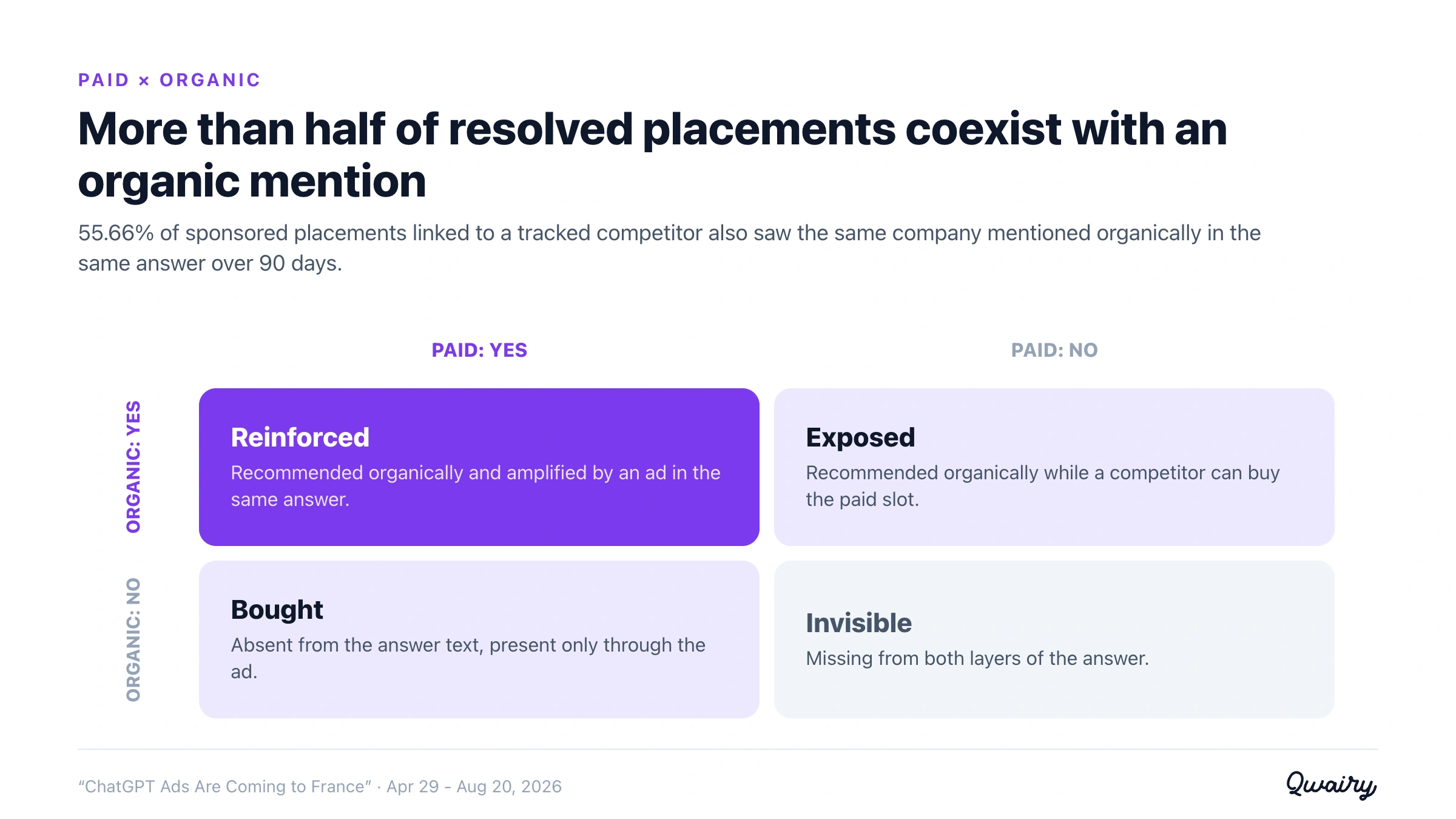
When an advertiser appears as a paid placement, is the same company also mentioned organically in the answer text? Over 90 days, among placements that could be linked to a competitor domain already tracked in Qwairy, 55.66% coexisted with an organic mention of the same domain in the same answer.
The split by market is striking: 53.19% in the US, and 92.71% in the French historical window, meaning that during the spring test period, almost every resolved placement ran inside an answer that already mentioned the advertiser organically.
Two caveats keep this honest.
The analysis covers only advertisers matched to tracked competitor domains, a selected population, so the figure does not generalize to all ChatGPT advertisers.
And the French subset is historical.
But within that population, the coexistence is not an interpretation: the ad comes from a structured sponsored-content field, the organic mention from the answer text. Two independent signals, one response.
This changes how GEO and paid teams should work.
Organic and paid visibility need separate metrics, because they are earned and bought through different mechanisms. But they cannot be managed in separate rooms, because the user experiences both at once.
In any given answer, a company can be: recommended organically and reinforced by an ad; recommended organically while a competitor buys the placement; absent organically but present as an advertiser; or visible in neither layer.
Those four states are the real dashboard.
The advantage of an unopened market is not cheaper media. It is measurement.
On every chart you publish, state the country scope, the prompt cohort and the time window, and flag incomplete periods. That is the difference between a market signal and a marketing statistic.
This study uses a read-only snapshot of Qwairy production data created on August 20, 2026, covering structured sponsored-content detections recorded between April 29 and August 20, 2026, with ChatGPT as the provider.
The denominator for every frequency is monitored answers that triggered a web search; the numerator is those that also contained sponsored content.
Occurrences are deduplicated by answer and advertiser. Prompt groups come from a lexical classification (comparison terms; explicit brand name; all remaining prompts as general informational). The paid-organic overlap only covers sponsored advertisers linked to a competitor domain already tracked in Qwairy.
Limitations. Qwairy measures detected visibility, not impressions, spend, clicks or conversions. The prompt corpus is intentionally brand-relevant and not representative of all ChatGPT usage. France figures refer to answers monitored for brands configured with France as their country, not a census of users located in France. August data runs through the 20th. Advertiser names and creative fields are observed labels.
The US market shows what an established paid AI channel looks like: high frequency on commercial prompt portfolios, advertiser attention that moves in days, heavy creative repetition, and paid placements intertwined with organic recommendations inside the same answer. France is not there yet. Today's France-monitored rate is a baseline, and baselines are the one thing you cannot recreate after launch. The old GEO question was: does the model recommend us? The next question is: who is paying to appear when the model answers our buyer? Qwairy already collects these sponsored placements as they appear, analyzes the advertisers, products, creatives and landing pages behind them, and tracks them over time alongside your organic AI visibility. See how sponsored content detection works , and watch this market form in France from day one.
Track the questions that matter to your business, see which brands each answer mentions and which sources it cites, then work on the gaps.
Free plan with 120 initial credits • No credit card required
Other Articles
The First Answer Isn't the Decision: How AI Assistants Keep Buyers Talking
AI assistants rarely end on an answer: 72% close by inviting another question. And once buyers answer, the shortlist reshuffles. Qwairy's benchmark shows what the next turn decides.
After the Sale, AI Sends Customers Back to Your Website. Until Something Breaks
After a purchase, 90% of AI answers cite the brand's own website, versus 17% before. But troubleshooting is the weak spot. Qwairy's benchmark maps who AI cites at every step after the sale.