The First Answer Isn't the Decision: How AI Assistants Keep Buyers Talking
AI assistants rarely end on an answer: 72% close by inviting another question. And once buyers answer, the shortlist reshuffles. Qwairy's benchmark shows what the next turn decides.
Nicolas Ilhe••13 min read•
Research
Summarize with AI
Most AI visibility reports freeze a single moment: one prompt, one answer, one list of brands. It is a useful snapshot, but it is not how people buy. Ask an AI assistant which CRM to choose or whether a vacuum is worth the money, and the answer rarely ends with a full stop. It ends with a question back to you.
We wanted to know how systematic that is, and what the next turn is actually for. So we ran a controlled benchmark: matched questions asked before and after a purchase, across four product categories and five AI engines, read in their public interfaces. The result is clear. The first answer opens the conversation. The decision happens later.
What we found
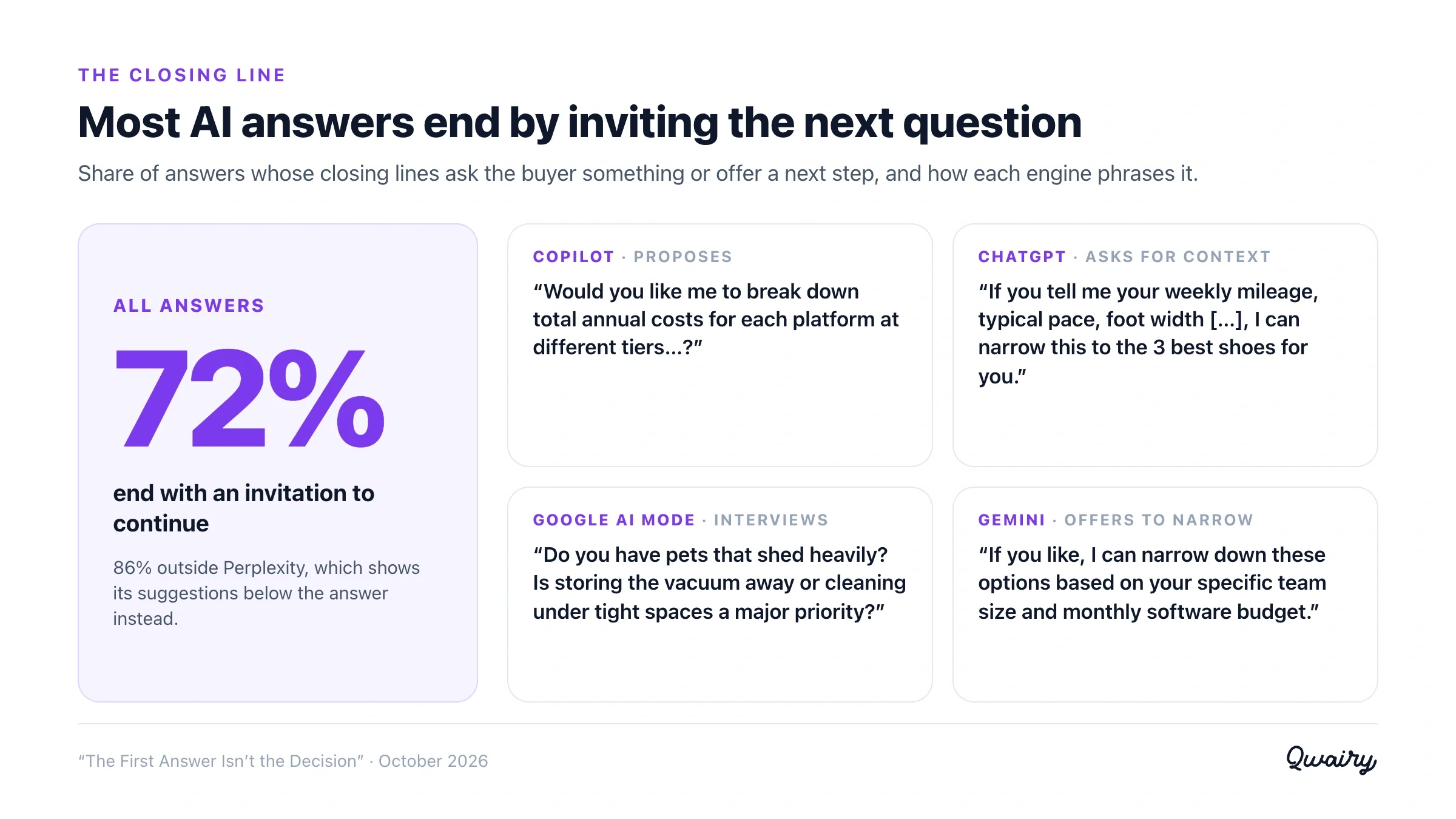
72% of AI answers end by inviting another question, and 86% outside Perplexity, which shows its suggestions below the answer instead. A repeat collection two days later found the same pattern.
The first answer is a shortlist. Pre-purchase answers name a median of three brands, and only 12% name a single one.
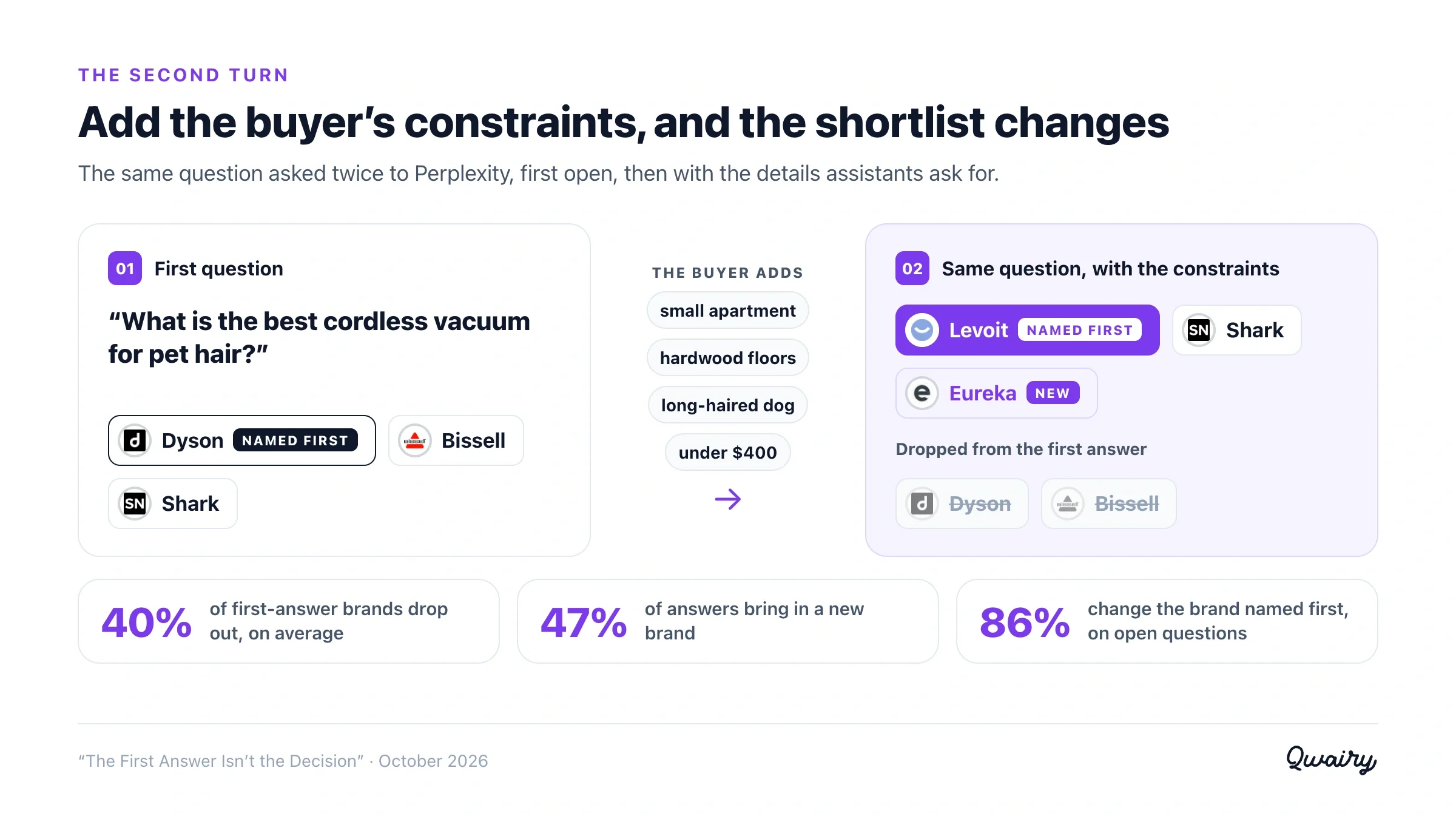
When the buyer answers, the shortlist reshuffles. Asked again with the buyer's constraints, answers drop 40% of the brands they first named on average, bring in a new brand in 47% of cases and change the first brand named in 86% of open questions.
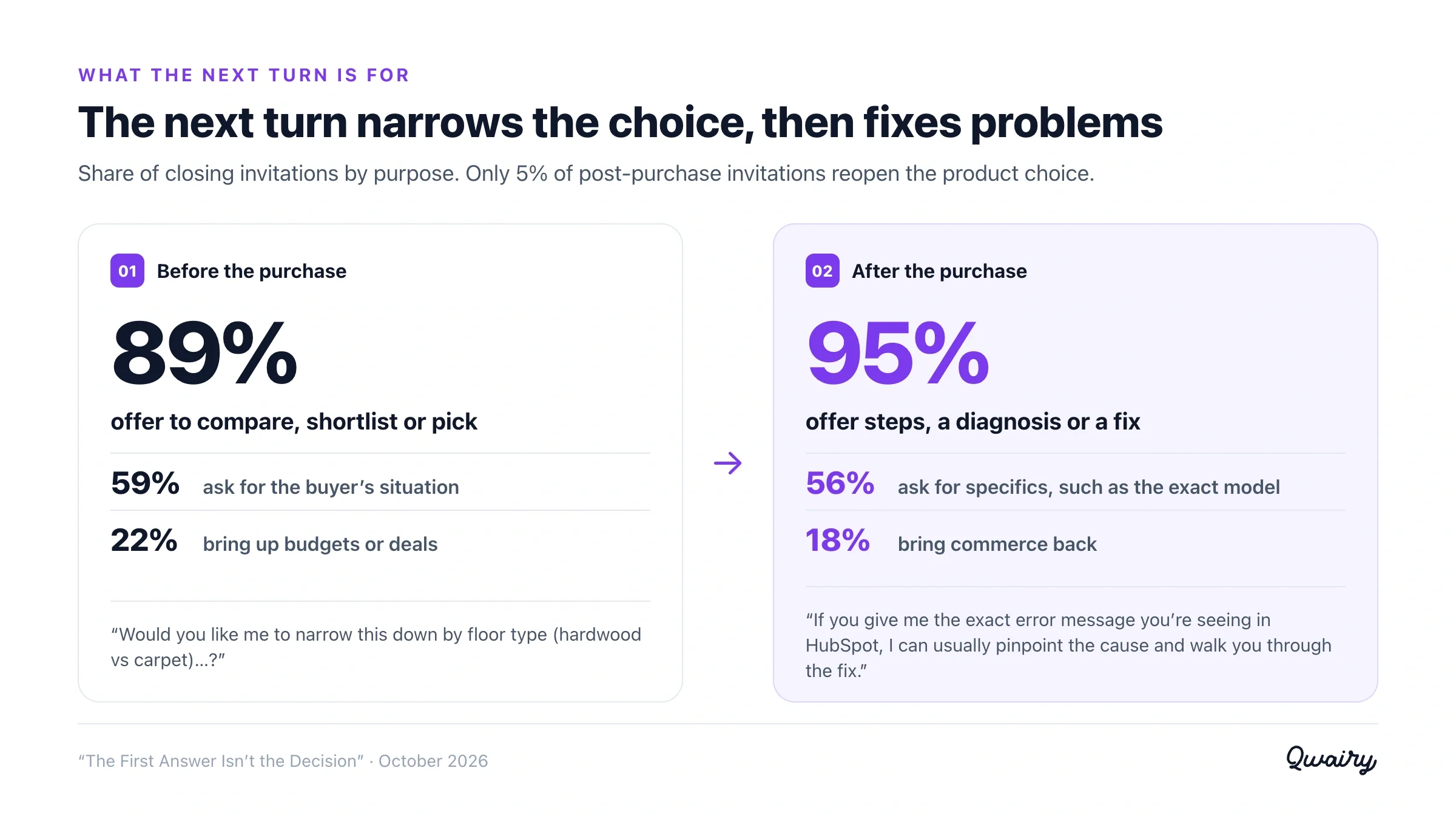
Before the purchase, the next turn narrows the choice. 89% of closing invitations offer to compare, shortlist or pick, and 59% ask for the buyer's situation: budget, team size, floor type, weekly mileage.
After the purchase, the next turn solves a problem. 95% of invitations offer steps, a diagnosis or a fix. Only 5% reopen the product choice.
Almost every answer ends with a question
Each engine has its own way of keeping the conversation going, and the patterns are remarkably stable across categories:
Copilot proposes. "Would you like me to break down total annual costs for each platform at different tiers so you can see the budget impact clearly?" Nearly every answer closes with an offer of this kind.
ChatGPT asks for context. "If you tell me your weekly mileage, typical pace, foot width, and whether you prefer soft/bouncy vs. firm/fast, I can narrow this to the 3 best shoes for you."
Google AI Mode interviews you. It often ends with a short list of qualifying questions: "Do you have pets that shed heavily? Is storing the vacuum away or cleaning under tight spaces a major priority?"
Gemini offers to narrow things down, and after a purchase it sometimes adds ready-made follow-up questions, such as "How do I get tough stains out of white mesh running shoes?"
Perplexity is the exception in the text, not in practice. Only 15% of its answers end with an invitation, because Perplexity displays its suggested follow-ups below the answer, in the interface.
This is not a stylistic tic. Presenting Alphabet's Q4 2025 results, Sundar Pichai said that AI Mode queries are three times longer than traditional searches and that a significant portion of AI Mode queries now lead to a follow-up question. People bring richer, more conversational questions to AI search, and assistants are built to keep that conversation going.
The first answer is a shortlist, not a verdict
Before a purchase, AI answers behave like a good salesperson's first pass: they lay out options. In our benchmark, pre-purchase answers named a median of three brands, a quarter named four or five, and 12% named six or more. Only 12% committed to a single brand, usually because the question itself named one ("Is the Samsung Galaxy S25 worth it?").
The shortlist often exists before the answer is even written. Asked for the best running shoes for a first marathon, ChatGPT searched for "best marathon running shoes 2026 first marathon Brooks Ghost ASICS Novablast Saucony Ride Hoka Clifton": four candidate models were already in its search query.
That changes what winning an AI answer means. Appearing in the first answer gets you on the shortlist. It does not get you chosen. The choice is made in the turns that follow, when the buyer adds the constraints the assistant asked for.
Before the purchase, the next turn narrows the choice
Look at what assistants ask for: a budget ("under $500, $800, $1,000"), team size, flooring, pets, running distance, foot width, whether the buyer already uses a Mac or an Apple Watch. 59% of pre-purchase invitations explicitly request this kind of personal context, and 89% offer to use it to narrow the list.
Money comes up early: 22% of pre-purchase invitations bring up budgets, deals or annual costs. Assistants anticipate that the next question will be about price, and they offer the breakdown before the buyer asks.
Each constraint turns into a new, narrower prompt. "Best CRM for a small business" becomes "best CRM for a 10-person outbound sales team that lives in Gmail". "Best cordless vacuum for pet hair" becomes "best cordless vacuum for a small apartment with hardwood floors and a long-haired dog". We tested what that does to the shortlist.
Does AI recommend your brand, or your competitors?
Run a free audit: in a few minutes, ChatGPT, Gemini and Perplexity answer 8 buying questions about your market live, and you see who they recommend.
To measure what the next turn changes, we asked every pre-purchase question a second time, adding the kind of constraints the assistants had asked for: a budget, a team size, a floor type, a foot width, a main use. "What is the best CRM for a small business?" became "What is the best CRM for a 10-person B2B sales team that sells outbound, uses Gmail and has a budget of about $50 per user per month?" Each engine answered both versions.
The lists got shorter: 2.7 brands on average instead of 3.4, and 49% of constrained answers named one or two brands, versus 32% for the original questions. But the bigger change is who stays on the list:
On average, 40% of the brands named in the first answer disappeared from the constrained answer.
In 47% of cases, the constrained answer named a brand that was absent from the first one.
The first brand named changed in 55% of question pairs, and in 86% of open questions such as "What is the best CRM for a small business?" or "What is the best cordless vacuum for pet hair?".
A brand that leads the first answer can lose the second, and a brand that was not in the first answer can win it. What decides the second turn is fit: whether the engine finds evidence that a product suits that budget, that team, that floor, that foot.
After the purchase, the conversation changes job
After a purchase, the same assistants keep asking, but for a different reason. 95% of post-purchase invitations offer step-by-step help, a diagnosis or a fix: "If you give me the exact error message you're seeing in HubSpot, I can usually pinpoint the cause and walk you through the fix." "Does it still pulse when you remove the wand and floor tool and run it bare?" Only 5% reopen the product choice.
Two details matter for brands. First, assistants keep asking for specifics (56% of post-purchase invitations do), most often the exact model or version: which Ghost generation, whether the battery has a release button or three screws. If your help content is not version-specific, the assistant will find a source that is. Second, 18% of post-purchase invitations bring commerce back: replacement batteries, current deals, extended protection plans. The conversation after the sale is also where accessories, upgrades and renewals get recommended.
We look at who gets cited in these post-purchase answers in a companion study: After the Sale, AI Sends Customers Back to Your Website .
Three traces around every answer
The conversation around an answer leaves three traces, and together they show how a decision is built:
Query Fan-Out, before the answer. The web searches the engine runs to build it. In our benchmark, 63% of ChatGPT's pre-purchase searches named the brand we followed in each category (Brooks, HubSpot, Samsung or Dyson), and every one of its post-purchase searches did.
The answer itself, with the brands and sources it cites.
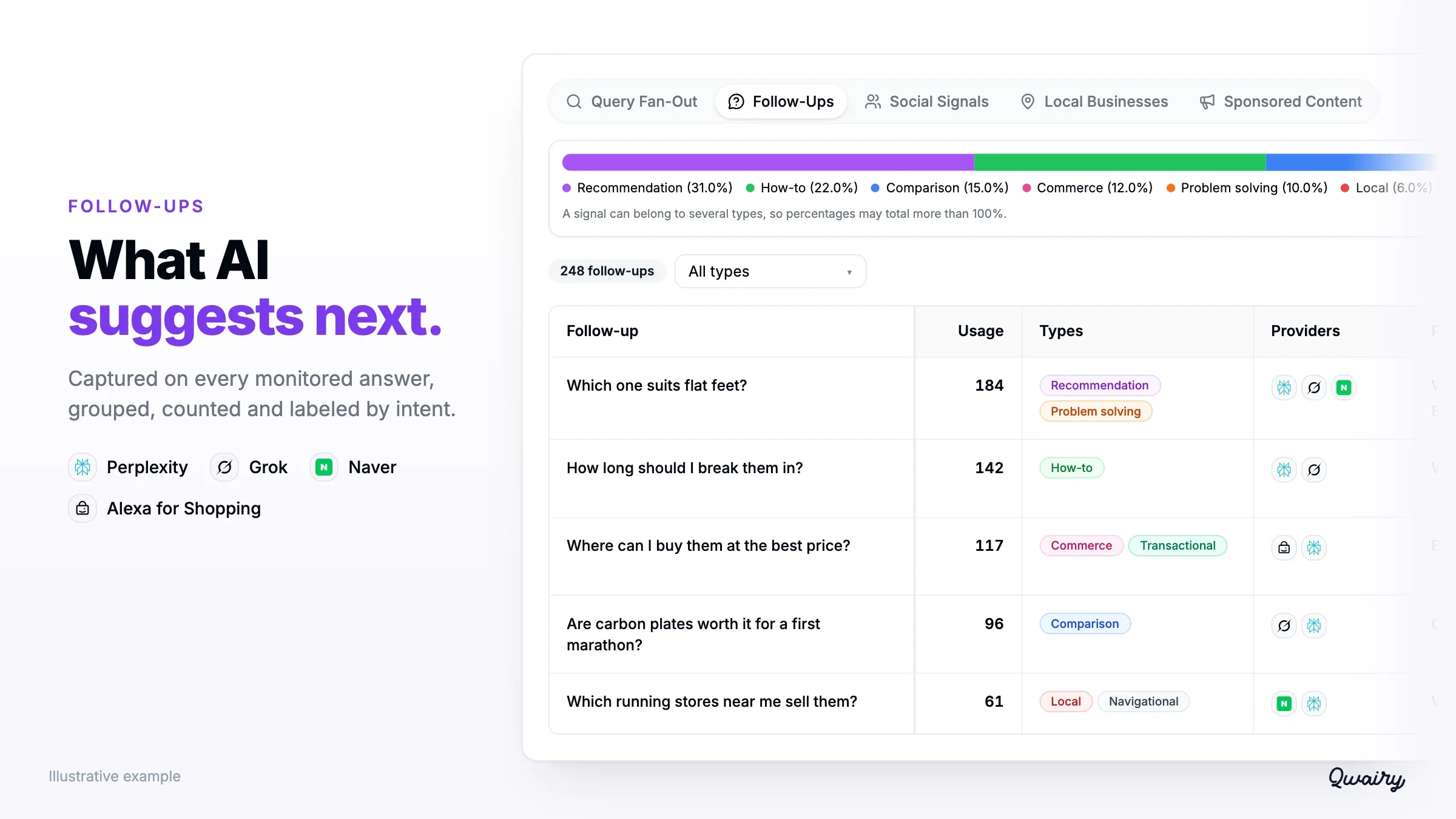
Follow-ups, after the answer. Either written into the text, as measured in this study, or displayed as suggested questions below it, as on Perplexity, Grok, Naver or Alexa for Shopping.
Suggested follow-ups are the most underrated of the three. They are the engine's own prediction of what buyers will ask next, phrased in buyers' words and repeated across answers. When the same suggestion keeps appearing next to the prompts of your category, it is telling you which question your content needs to answer next.
What this means for your AI visibility strategy
Track the second turn, not just the first. For each head prompt, add the constrained versions assistants push buyers toward: by budget, size, use case or ecosystem. That is where shortlists become decisions.
Publish the qualifying answers. Make it explicit who each product is for, and who it is not for: team sizes, budgets, floor types, foot shapes, integrations. "Best for" and comparison pages built around real constraints give assistants something to cite when they narrow the list.
Mine the follow-ups. Recurring suggested questions are free, high-intent research. Turn the ones that matter into prompts you monitor.
Don't stop at the sale. A large part of the conversation you need to win happens after the purchase. Track how-to, troubleshooting and policy questions as their own stage.
Measure by stage. A brand can lead at the bottom of the funnel and disappear from post-purchase answers. You only see it if prompts are tagged by stage.
How Qwairy helps
Qwairy reads answers in each engine's real interface, so you see what your buyers see, including the conversation around the answer:
Follow-Ups captures the questions engines suggest after their answers (Perplexity, Grok, Naver and Alexa for Shopping), groups identical suggestions and counts how often each one appears. Each follow-up gets up to three intent labels: Informational, Recommendation, Comparison, How-to, Problem solving, Transactional, Navigational, Local or Commerce. Open the source answer for context, then decide whether a follow-up deserves its own prompt.
Query Fan-Out lists the searches engines run before answering (ChatGPT, Claude, Perplexity, Grok, Naver and Wenxin), with the same intent labels.
Funnel stages, including Post-purchase, let you tag prompts and compare your visibility from discovery to after the sale.
Personas let you monitor the same prompt for different buyer profiles, so you see how the answer changes once the engine knows who is asking.
Follow-Ups, intent labels, the Post-purchase stage and the redesigned Personas are part of Qwairy v1.20 .
Does ChatGPT mention your brand while Gemini leaves it out?
Break your visibility down model by model to see where each AI mentions you and where it doesn't.
Questions. Matched questions in four categories: running shoes, CRM software, smartphones and cordless vacuums. Pre-purchase questions cover best options, head-to-head comparisons, value for money and specific needs. Post-purchase questions cover getting started, care, troubleshooting, returns, warranty, cancellation and support. Several questions name a widely known product so that the same brand appears before and after the purchase. The brands named were chosen as familiar examples; their presence implies no relationship with Qwairy.
Engines. ChatGPT (with search), Google Gemini, Google AI Mode, Microsoft Copilot and Perplexity, collected from their public web interfaces in the US, without login or personalization, on October 5, 2026, then again on October 7, 2026. One answer per question and engine in each collection; 97% and 98% of requests returned a usable answer.
Invitations. We analyzed each answer's closing passage after removing reference lists, detected questions to the user and offers of a next step, then reviewed every detected invitation manually. A manual check of answers without a detected invitation found only a few missed cases, so the rates are conservative. Purposes are multi-label: one invitation can both ask for context and offer to narrow the list.
Second turn. On October 7, 2026, each pre-purchase question was asked again as a standalone question adding the buyer's constraints (budget, size, use case, compatibility). The public interfaces were collected without a persistent conversation, so this approximates a second turn in which the buyer has answered the assistant's questions. Brand lists were compared answer by answer, for the same engine.
Repeat collection. The full benchmark was run again on October 7, 2026. The overall results held: 69% of answers ended with an invitation (72% in the first collection), and pre-purchase answers again named a median of three brands. Individual engines varied more (Gemini: 83%, then 68%), so engine-level rates are indicative. Figures in this article come from the first collection, whose invitations were reviewed manually.
Brands. Counted in the answer text with a dictionary of brands and product lines for each category. The first brand named is the brand mentioned earliest in the answer.
Limits. This is a controlled benchmark, not a measure of traffic or usage. Answers vary between runs, accounts and countries. Suggested follow-ups displayed in interfaces were not part of this text analysis. Percentages are rounded.
FAQWhat is a follow-up question in AI search?
It is the question that comes after an AI answer. Engines create it in two ways: by ending the answer with an invitation ("Would you like me to compare...?", "If you tell me your budget...") or by displaying suggested questions below the answer. In our benchmark, 72% of answers ended with an invitation to continue.
Why does Perplexity score so low in this study?
Perplexity rarely writes its invitation into the answer text (15% of answers). It shows suggested follow-up questions below the answer instead, in its interface. Those suggestions were not part of this text analysis, so the low figure reflects a format difference, not a lack of conversation.
Does ranking in the first answer still matter?
Yes, but it is only the entry ticket. The first answer builds the shortlist, and a brand missing from it has to win its way in later. Once buyers add their constraints, answers drop 40% of the brands they first named on average and change the first brand named in 86% of open questions. The choice is made in those following turns.
Which follow-up prompts should I track?
Start with the constraints assistants ask for in your category: budget ranges, team or household size, main use case, compatibility with tools people already use. Then add the suggested questions that recur next to your prompts, and the post-purchase questions your customers ask about setup, care, troubleshooting and policies.
How can I see the follow-ups AI engines suggest for my prompts?
In Qwairy, the Follow-Ups page lists the questions suggested by Perplexity, Grok, Naver and Alexa for Shopping after each monitored answer, grouped, counted and labeled by intent, with the prompt, engine, model and date they came from.
Track your AI visibility
What does AI tell your buyers about you, and who does it recommend instead?
Track the questions that matter to your business, see which brands each answer mentions and which sources it cites, then work on the gaps.