Audit your product visibility in AI shopping recommendations. Discover which products appear, which review sites drive recommendations, how competitors compare, and build an optimization plan for e-commerce AI visibility.
When someone asks ChatGPT "what's the best wireless headphone under $200" or tells Perplexity "find me a lightweight laptop for travel," AI engines **return product recommendations with specific brands, models, pricing, and purchase links. **
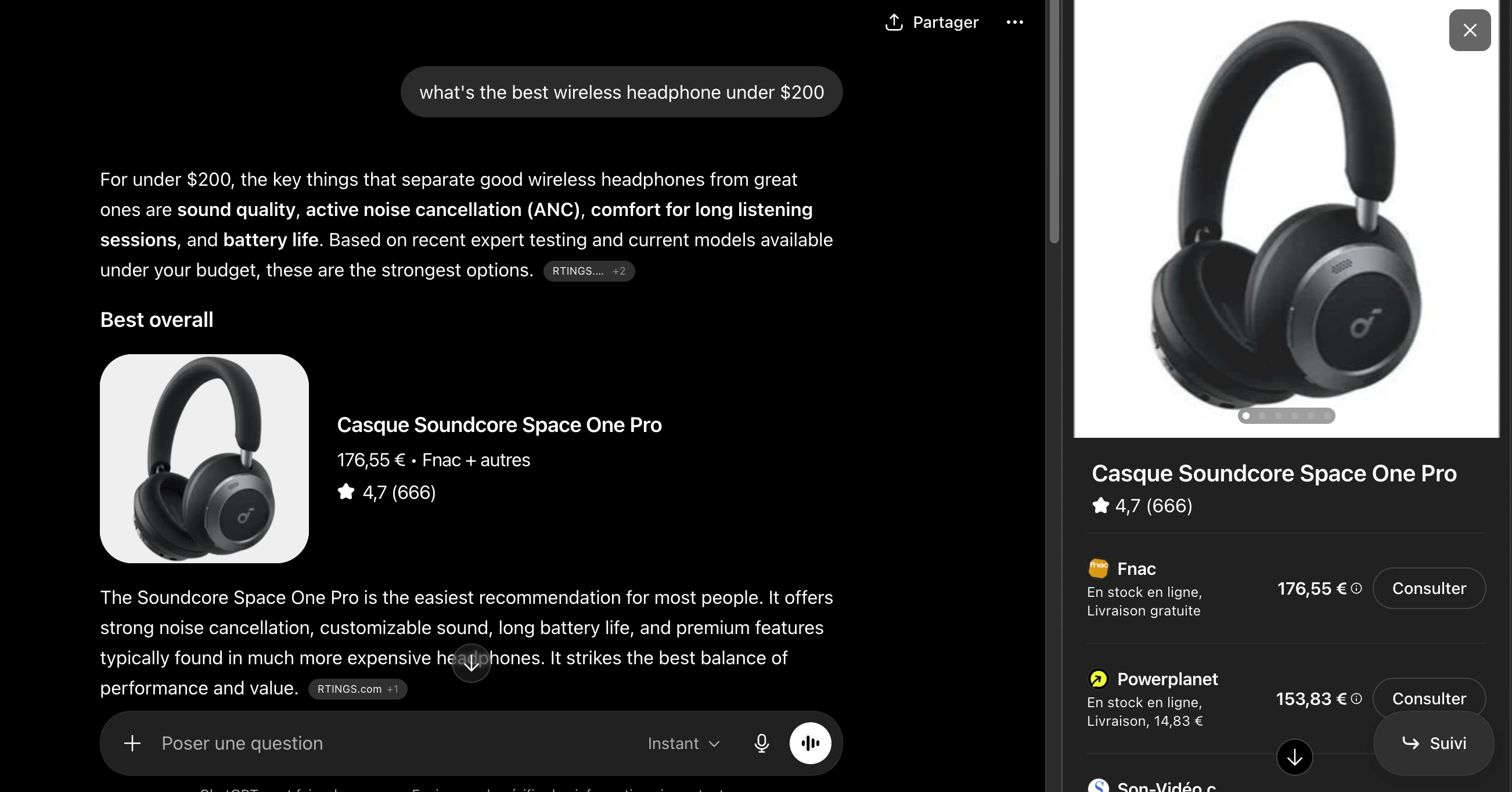
If your products don't appear in those recommendations, you're invisible at the moment of highest purchase intent.
This is **different from traditional e-commerce SEO. **
Google Shopping shows ads and product listings. **AI shopping recommendations are editorial, conversational, and citation-driven. **
They pull from review sites, comparison articles, Reddit threads, and retailer pages to synthesize a curated recommendation. The sources that influence AI shopping responses are not the same as the sources that drive Google Shopping rankings.
This playbook uses Claude + Qwairy's MCP server to discover whether your products appear in AI shopping recommendations, which competitors dominate, what sources drive the recommendations, and how to improve your product visibility across AI engines.
💡 TL;DR Connect Qwairy MCP to Claude Desktop, paste the complete prompt from the bottom of this article, and get a full e-commerce AI visibility audit with product gaps, source analysis, and optimization plan in under 15 minutes. Scroll to "The Complete Prompt" to skip straight to the copy-paste version.
Other Articles
How to optimize for AI Agents? (That Browse, Compare, and Buy) - With Qwairy’s MCP
Prepare your site for AI agents that browse, compare, and buy. Audit agent accessibility, analyze data extractability, and build a structured data roadmap for the next 12 months.
YouTube GEO Strategy: How to Get Cited by AI Answers
Use YouTube to become the most-cited brand in AI answers. Audit YouTube citation presence, analyze competitor video strategies, and build a transcript-optimized video plan for maximum AI visibility.
Traditional e-commerce optimization targets product pages, structured data, and merchant feeds. AI shopping recommendations work differently. When a user asks an AI engine for a product recommendation, the engine doesn't query a product database.
It synthesizes an answer from multiple sources: editorial reviews (Wirecutter, RTINGS, Tom's Guide), comparison sites (G2, Capterra, TrustRadius for B2B), community discussions (Reddit, specialized forums), and sometimes retailer pages (Amazon, Best Buy).
The AI engine reads these sources, extracts product mentions with their attributes (price, features, ratings), and compiles a conversational recommendation.
We also have evidence from different SEO on the web that ChatGPT uses Google Shopping to create his recommendations.
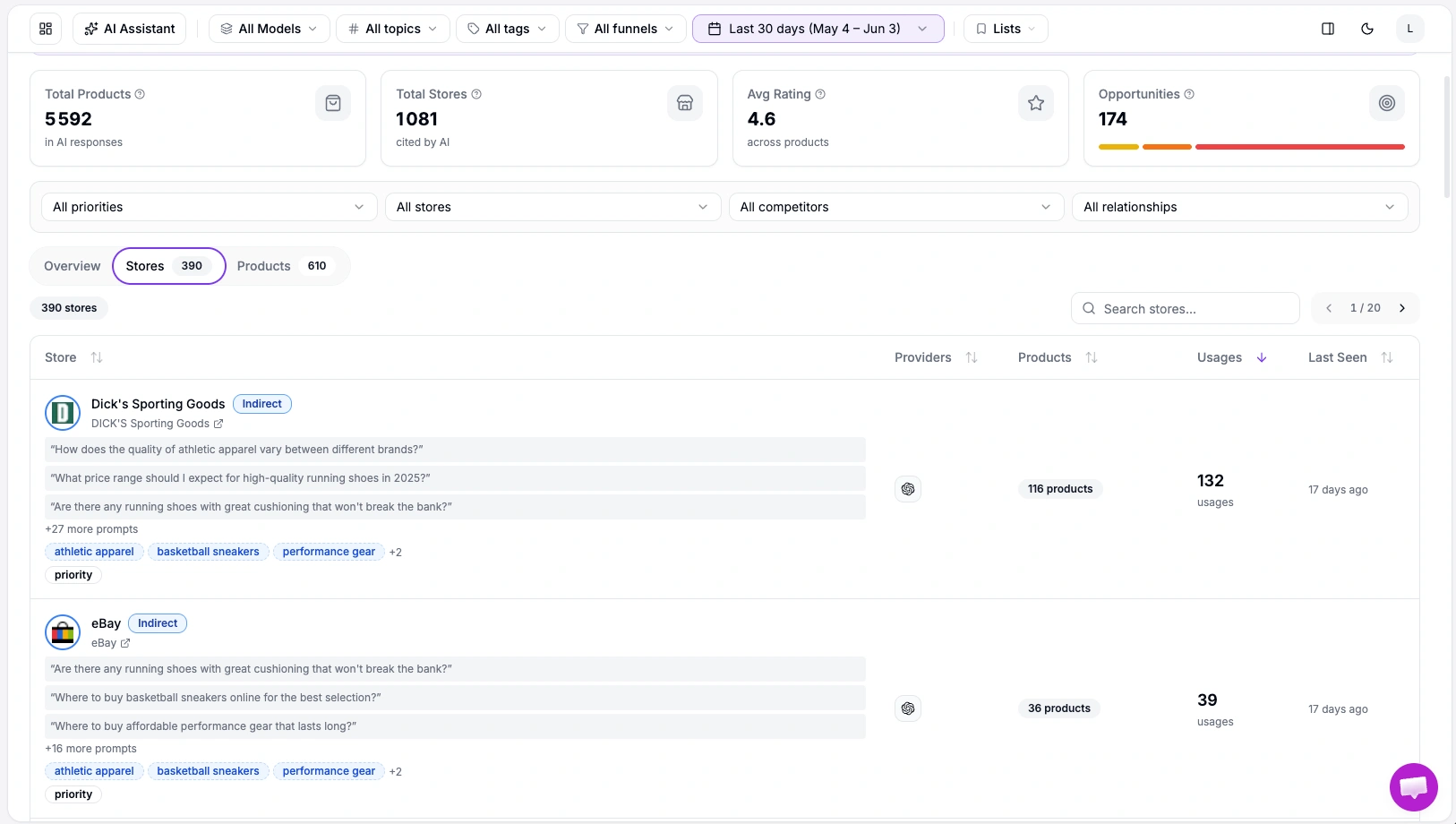
This means your product's visibility in AI shopping responses depends on which third-party sources mention it, how those sources describe it, and whether AI engines can access and parse that information. A product with excellent Google Shopping performance but no presence on editorial review sites can be completely invisible to AI recommendations. Qwairy's Shopping Insights and Local Insights tools monitor this layer specifically:
By the end of the workflow:
A product visibility map. Which of your products appear in AI shopping recommendations, and which are invisible.
A shopping source analysis. The review sites, comparison platforms, and retailers that AI engines cite when recommending products in your category.
A competitive product benchmark. Which competitor products appear, how they're positioned, and what sources power their recommendations.
A gap analysis. Specific product queries where competitors are recommended and your products are not.
An optimization plan. Targeted actions to get your products into AI shopping recommendations, prioritized by estimated revenue impact.
Three things need to be in place:
Qwairy account with active monitoring (Growth plan or above for MCP access). Prompts should include product-level and category-level shopping queries.
Claude Desktop with Qwairy MCP connected.
Claude Pro or Max subscription for extended conversations.
Run a free audit: see if ChatGPT, Gemini and Copilot recommend you, in about a minute.
What to ask Claude:
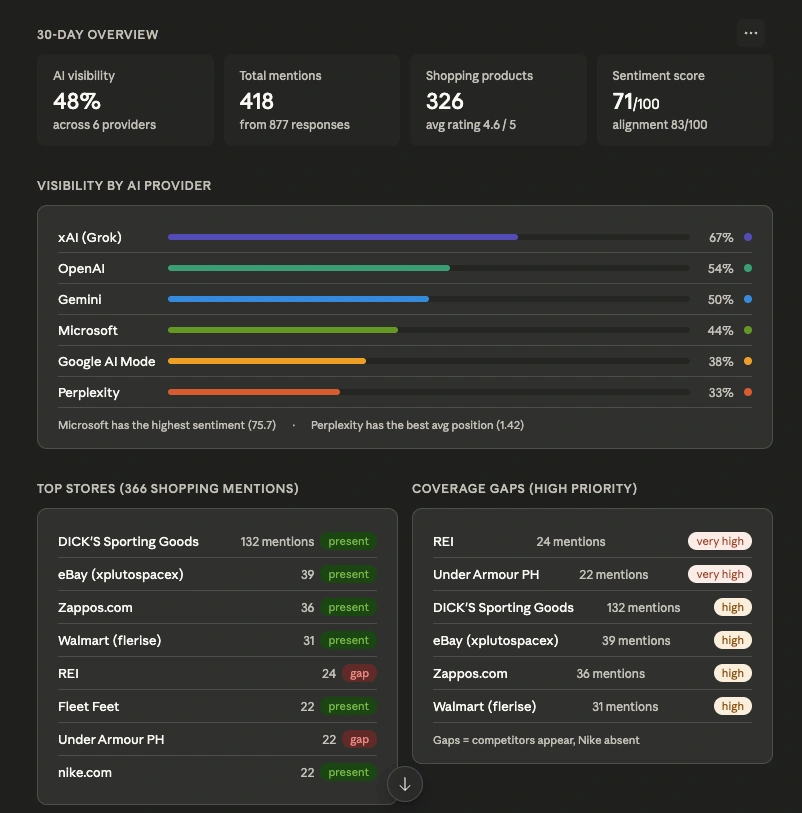
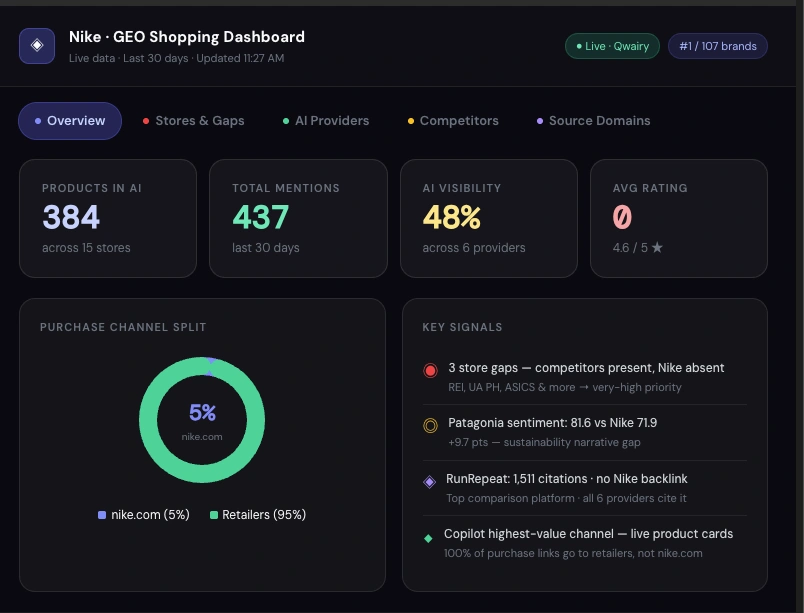
Pull my shopping insights for the last 30 days. Show me which of my products appear in AI shopping recommendations, how often they're mentioned, which AI providers recommend them, and how they're positioned relative to competitor products.
Tools Claude uses: get_shopping_insights
Shopping insights returns e-commerce-specific visibility data: products mentioned in AI responses, stores and retailers cited, product ratings referenced, pricing data extracted by AI engines, and the competitive landscape at the product level.
The reasoning behind this step: Before optimizing, you need to know which products AI engines already recommend and which they ignore. A brand might have 50 products but only 5 appear in any AI shopping response. Those 5 are the current assets. The other 45 are the opportunity. This step also reveals whether AI engines cite accurate pricing, features, and ratings, because outdated or incorrect product data in AI responses directly hurts conversion.
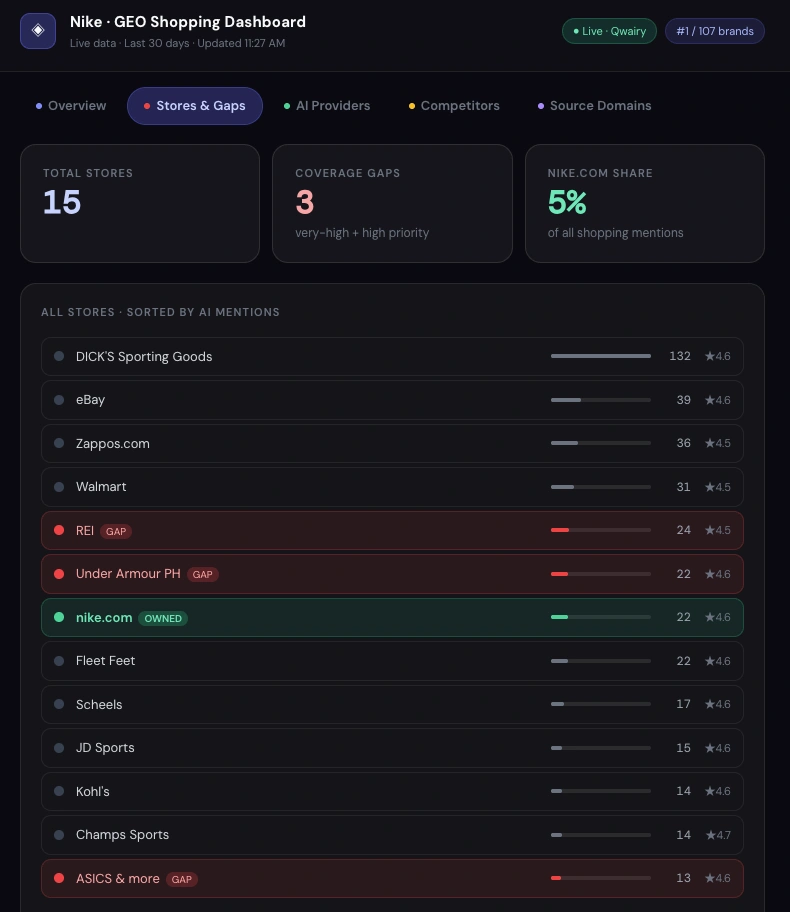
What to look for: Check three things for each product that appears. Is the pricing current? Are the features described accurately? Is the positioning favorable (recommended as "best for..." or mentioned as an afterthought)? For products that don't appear at all, note whether they're in a monitored category. A product that's invisible in AI responses for its primary use case is the highest-priority optimization target. Here is the kind of dashboard that was built by Claude:
What to ask Claude:
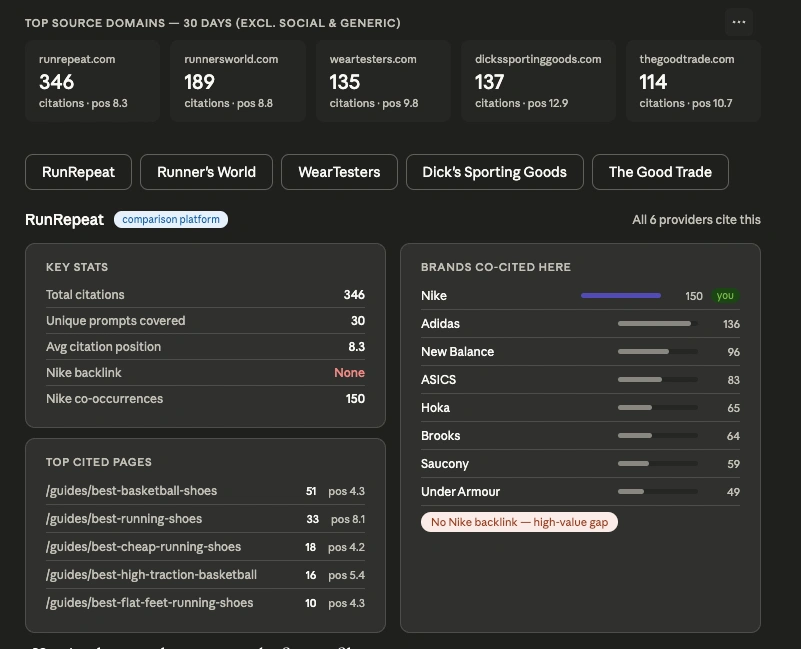
For the shopping-related prompts in my category, show me which source domains AI engines cite most. I want to see the review sites, comparison platforms, and retailers that power product recommendations. Run source profiles on the top 5.
Tools Claude uses: get_source_domains then get_source_profile
Source domains shows the most-cited sites for your shopping category. Source profiles dive deeper into each domain: specific URLs cited, products mentioned, co-cited competitors, and citation frequency.
The reasoning behind this step: AI shopping recommendations are only as good as the sources they draw from. If Wirecutter's "Best Wireless Headphones" article is cited by ChatGPT 20 times per month for headphone queries, being included in that single article is worth more than any amount of on-site optimization. This step identifies the "gatekeeper" sources for your product category.
What to look for: Categorize sources by type:
Editorial review sites (Wirecutter, RTINGS, Tom's Guide, The Verge). These carry the most weight in AI recommendations. Being reviewed and rated favorably on these sites is the single highest-leverage action for product visibility.
Comparison platforms (G2, Capterra, TrustRadius for B2B; BestProducts, ProductHunt for consumer). These provide the structured data (ratings, feature comparisons, pricing) that AI engines extract.
Community sources (Reddit, specialized forums). These provide authentic user opinions that AI engines synthesize into recommendation narratives.
Retailer pages (Amazon, Best Buy, direct brand sites). These provide pricing and availability data.
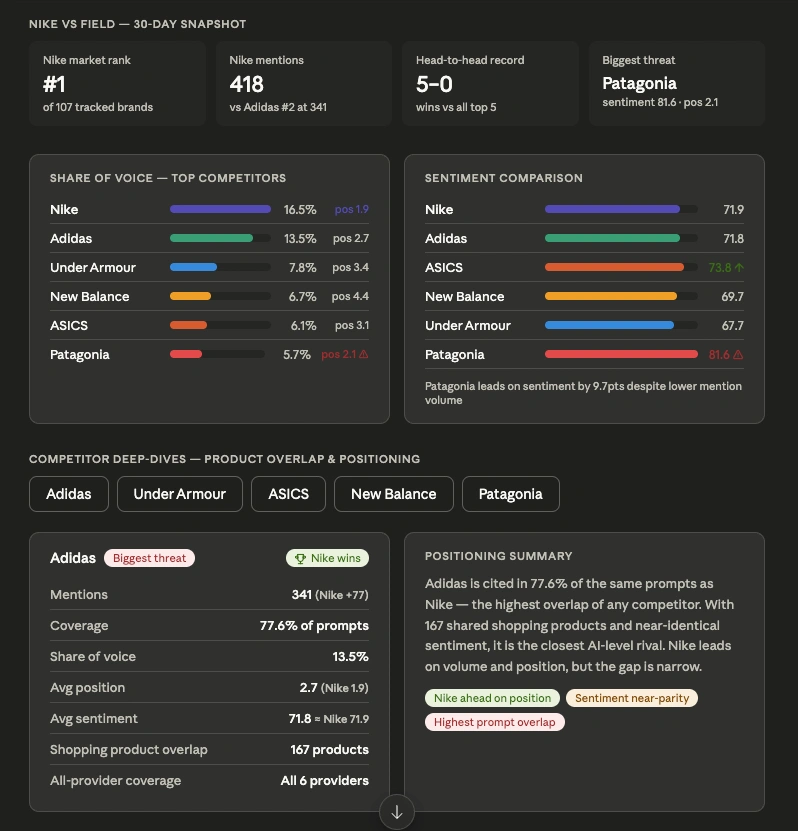
Note which of these sources mention your products and which mention only competitors. Again here is the kind of dashboard you will get from Claude:
What to ask Claude:
Run a competitor comparison focused on product-level mentions. Which competitor products appear most in AI shopping responses? How are they positioned? What's the average sentiment and rating AI engines associate with each competitor product?
Tools Claude uses: get_competitor_comparison then get_competitor_position
The competitor comparison shows brand-level shopping metrics. The position analysis dives into specific competitor products, showing which ones AI engines favor and the sources that power those recommendations.
The reasoning behind this step: Product-level competitive intelligence is different from brand-level. A competitor brand might have lower overall visibility than yours but dominate specific product categories. Or a competitor might lead because one specific product is reviewed on Wirecutter while yours isn't. Product-level granularity reveals tactical opportunities that brand-level data would miss.
What to look for: Identify the "product heroes" in your category. These are the 2-3 competitor products that appear most frequently in AI recommendations. For each one, trace which sources drive their visibility. If Competitor X's flagship product appears because it's the Wirecutter "Best Overall" pick, that's a specific editorial position to target. If Competitor Y's product appears because it has 5,000+ Reddit mentions, that's a community presence to build.
See your mentions across ChatGPT, Claude and Perplexity in real time, the moment buyers ask.
What to ask Claude:
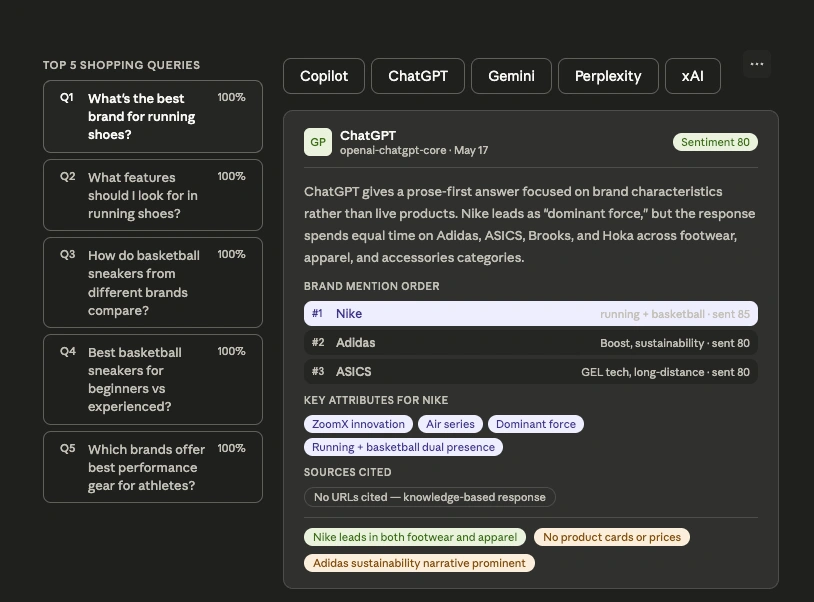
For the top 5 shopping queries in my category, pull the full AI responses from each provider. Show me how products are described, what attributes are highlighted, which products are recommended first, and what sources are cited. I want to see the actual shopping experience users get.
Tools Claude uses: get_prompt_answers then get_answer_details
This reads the actual AI shopping responses. Each response includes the recommended products, their described attributes, the recommendation order, and the cited sources.
The reasoning behind this step: AI shopping responses are structured differently from general recommendations. They typically include product names, price points, key features, pros/cons, and a "best for" categorization. Understanding this structure reveals what data AI engines extract and what attributes matter most for your category. A product without a clear price point in any source might be excluded simply because the AI engine can't provide the pricing data users expect.
What to look for: Note the attributes AI engines consistently include for recommended products. If every recommended headphone includes price, battery life, noise cancellation rating, and comfort score, your product pages and review profiles need to prominently feature those same attributes. Missing attributes mean the AI engine can't populate a complete recommendation, which reduces the probability of inclusion.
What to ask Claude:
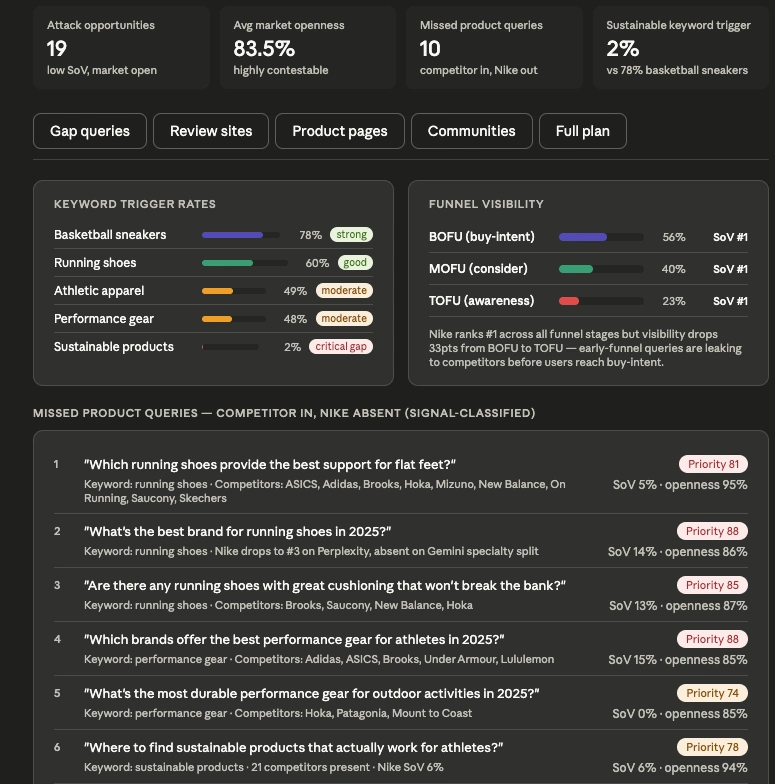
Pull my content opportunities filtered to shopping and product queries. Which product queries have competitor products recommended but mine absent? Run prompt signals to classify by value. Then build an optimization plan: which review sites to target, which product pages to improve, and which community discussions to participate in. Prioritize by estimated revenue impact.
Tools Claude uses: get_content_opportunities then get_prompt_signals then get_keyword_triggers
Content opportunities filtered to shopping queries shows product-level gaps. Prompt signals classifies them by strategic value. Keyword triggers reveals which product attributes (price, battery life, warranty, integrations) most frequently cause AI to mention specific products, showing exactly what data points your product pages need to surface. Claude synthesizes with the source and competitor data to produce an optimization plan.
The reasoning behind this step: E-commerce optimization for AI is about three levers: getting reviewed on the right editorial sites, ensuring product data is complete and current across all sources, and building authentic community presence. The plan should address all three, prioritized by which lever will move the most revenue.
What Claude should produce:
Editorial review targets. The 3-5 review sites that most heavily influence AI shopping recommendations in your category, with specific pitch angles for each. If Wirecutter doesn't review your product, that's the #1 target. If RTINGS has an outdated review, requesting an update is the action.
Product data improvements. Specific product pages (yours and on retailer sites) that need updated pricing, features, or structured data. AI engines extract product attributes from these pages, so missing or outdated information directly reduces recommendation quality.
Community engagement plan. Reddit threads and forum discussions where your product category is discussed but your brand is absent. Authentic, helpful participation (not promotional posts) builds the community signal that AI engines weight increasingly.
Revenue prioritization. Rank every action by estimated revenue impact based on the query volume and purchase intent of the gaps being closed.
Copy this into Claude Desktop with the Qwairy MCP server connected:
I want to audit my product visibility in AI shopping recommendations. Walk me through this step by step:

1. Pull my shopping insights for the last 30 days. Show me which products appear in AI shopping responses, how often, on which providers, and with what positioning.
2. Show me the source domains that AI engines cite for shopping queries in my category. Run source profiles on the top 5 review sites and comparison platforms.
3. Run a competitor comparison at the product level. Which competitor products dominate AI shopping responses? What sources power their visibility?
4. For the top 5 shopping queries, pull the full AI responses. Show me the product attributes highlighted, the recommendation order, and the cited sources.
5. Pull content opportunities filtered to shopping queries. Classify by value with prompt signals. Build an optimization plan: editorial review targets, product data improvements, community engagement, all prioritized by estimated revenue impact.

Explain what each step reveals before moving to the next.
AI shopping recommendations sit at the highest-intent point in the customer journey. When someone asks an AI engine "what's the best [product] for [use case]," they're ready to buy. Being recommended (or not) at that moment directly impacts revenue. The ROI calculation for e-commerce is more direct than for brand visibility. Each product gap represents a specific, quantifiable number of missed recommendations. If "best wireless headphones under $200" generates 50,000 AI queries per month and your product appears in 0% of responses while 3 competitors appear in 80%, the missed revenue opportunity is concrete. Editorial review placement has the highest ROI among all optimization tactics for e-commerce AI visibility. A single Wirecutter inclusion can change a product's AI recommendation rate from 0% to 40%+ across multiple providers, because AI engines weight Wirecutter as one of the most authoritative product review sources. The effort to pursue and achieve that inclusion is high, but the payoff is sustained over months or years. For e-commerce brands, compare the cost of AI visibility optimization to the customer acquisition cost of paid channels. If acquiring a customer through Google Shopping costs $15-30, and AI shopping recommendations drive qualified traffic at a fraction of that cost, the investment case writes itself. This playbook applies beyond traditional e-commerce. B2B SaaS companies face the same dynamics on G2 and Capterra, where review-driven recommendations determine which tools make the AI shortlist. Marketplace sellers on Amazon and Etsy need to understand how AI engines select which products to recommend from crowded categories. Agencies managing e-commerce clients can run this audit per product line to prioritize editorial outreach across portfolios. Compare that to Qwairy plans starting at 59€/month.
Track your mentions across ChatGPT, Claude, Perplexity and all major AI platforms. Join 1,500+ brands monitoring their AI presence in real-time.
Free trial • No credit card required • Complete platform access
