Loading page

After a purchase, 90% of AI answers cite the brand's own website, versus 17% before. But troubleshooting is the weak spot. Qwairy's benchmark maps who AI cites at every step after the sale.
Most AI visibility work stops at checkout. Brands track whether ChatGPT recommends them, how they compare with competitors, which sources shape the shortlist. Then the customer buys, and the tracking ends. The customer's questions do not. How long do these shoes take to break in? Why is my email sync not working? How do I register my vacuum for warranty? More and more of these questions go to an AI assistant before they ever reach a help center or a support agent. The answers shape how customers use the product, whether they get unstuck, and whether they come back. The economics are well known. Research by Frederick Reichheld of Bain & Company found that increasing customer retention by 5% can increase profits by 25% to 95%, and Harvard Business Review notes that, depending on the study and the industry, acquiring a new customer costs five to 25 times more than keeping one. So we asked a simple question: after the sale, who does AI send your customers to? We ran a controlled benchmark of matched questions asked before and after a purchase, across four product categories and five AI engines, read in their public interfaces. The answer is reassuring, with one important exception.
Before a purchase, AI answers are built from third parties. Media, review sites and comparison pages account for 86% of the cited domains. The brand's own website appears in only 17% of answers, and it is the first source in just 6%. B2B software is the partial exception. In the CRM category, 42% of pre-purchase answers cited the vendor's site, because software companies publish pricing pages, plan comparisons and "vs" pages that assistants use as evidence. In consumer categories, the figure fell to between 5% and 10%. Before the sale, AI trusts what others say about you.
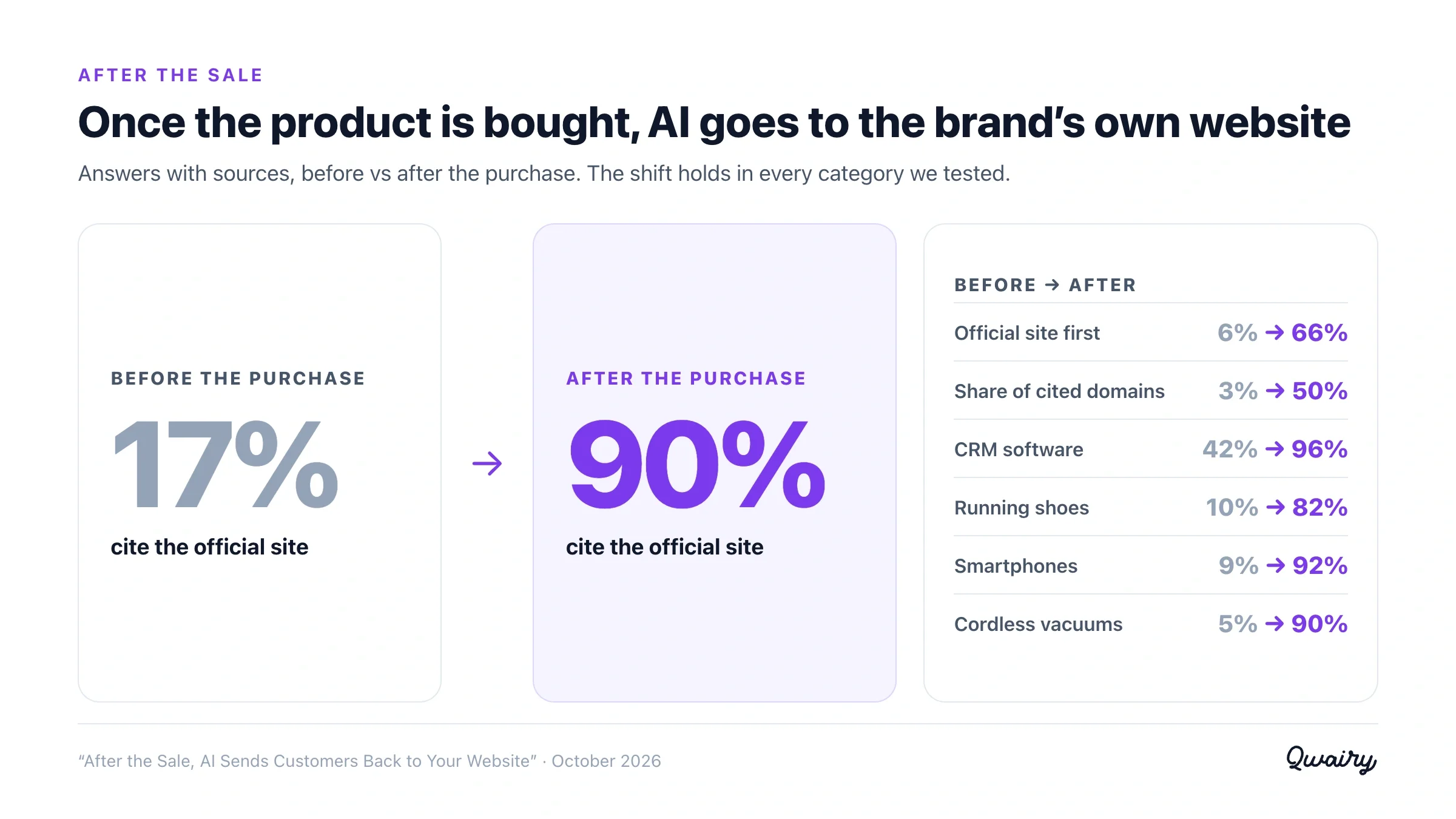
Once the question is about using the product, the picture flips. 90% of post-purchase answers with sources cite the brand's official site, and it is the first source in 66% of them. The shift holds in every category we tested: from 42% to 96% for CRM software, from 10% to 82% for running shoes, from 9% to 92% for smartphones and from 5% to 90% for cordless vacuums. Engines differ in degree, not in direction. After the purchase, ChatGPT and Google AI Mode cited the official site in every answer with sources, Perplexity in 95%, Gemini in 79% and Copilot in 74%. The behavior starts before the answer is written. When building post-purchase answers, every one of ChatGPT's background searches named the brand, versus 63% before the purchase. In three answers out of four, at least one search used a site: operator pointing at a specific domain, a search pattern we documented in our analysis of ChatGPT's collapse in Reddit citations . What AI cites on your site also changes. Before the purchase, the few official pages cited were mostly product, pricing and comparison pages: only 13% were help content. After the purchase, 89% of the official pages cited were help centers, support articles, warranty pages, manuals and account settings.
The sources that sold the product are not the ones that support it. Only 14% to 29% of the domains cited after a purchase were already cited before it, depending on the category. Review sites and comparison pages drop from 86% to 38% of cited domains. Retailers almost disappear, from 7% to 1%. Communities such as Reddit, YouTube and independent forums grow from 4% to 11%. This has a practical consequence. Your pre-purchase visibility tells you very little about your post-purchase visibility. A brand can dominate the "best of" lists and still lose its own customers to a third-party tutorial the day after delivery.
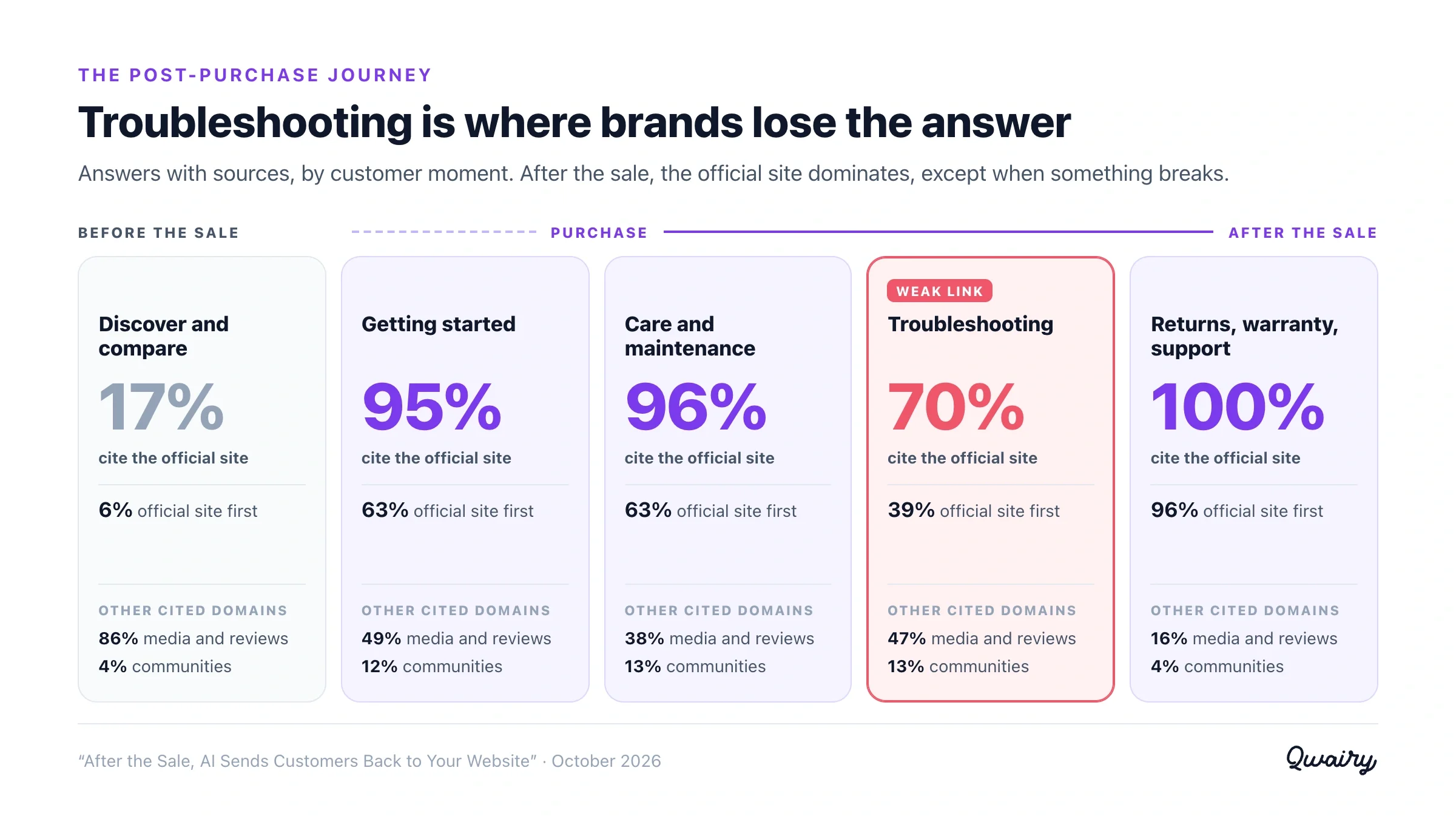
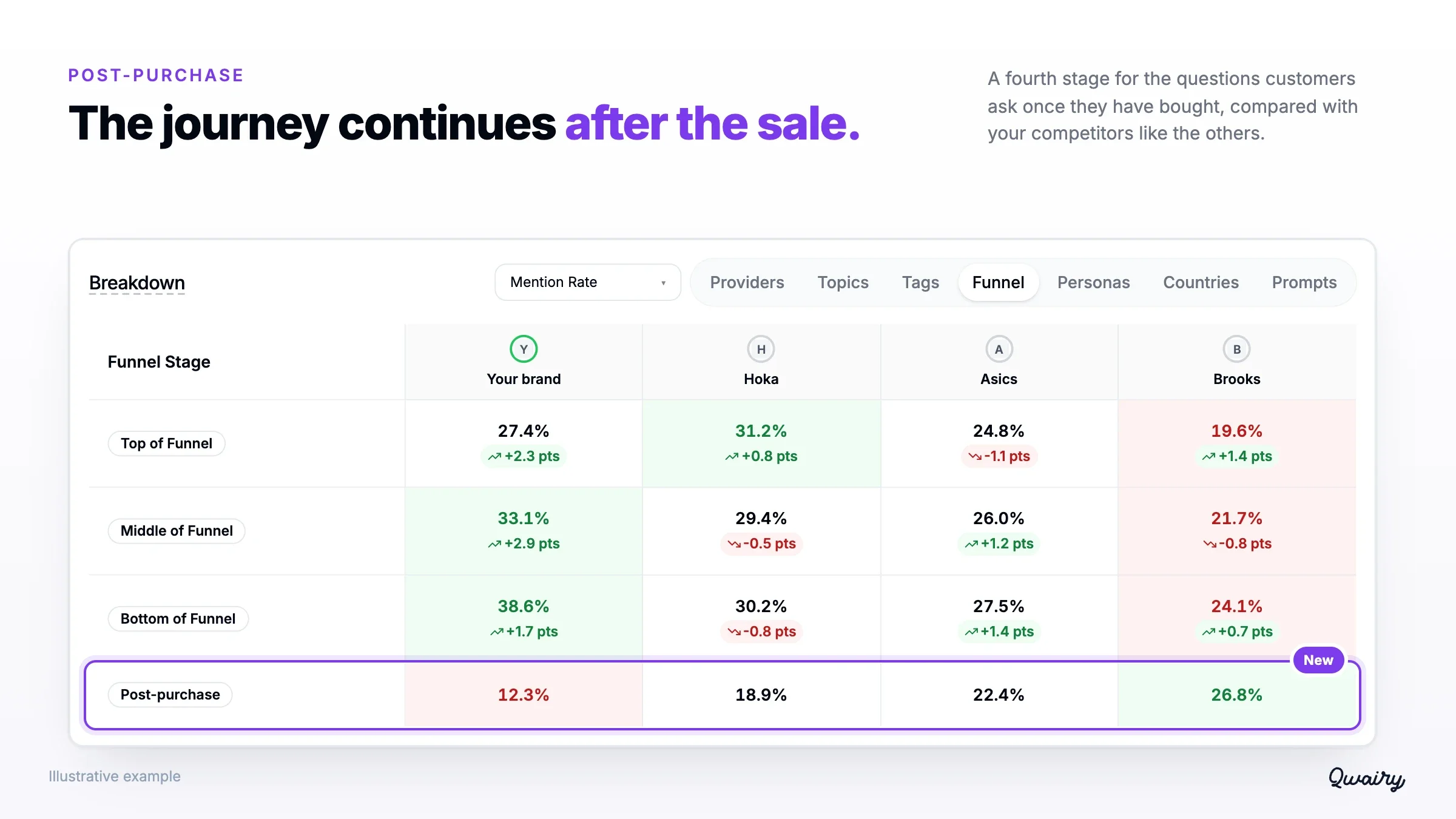
Splitting post-purchase questions by customer moment reveals where the risk is:
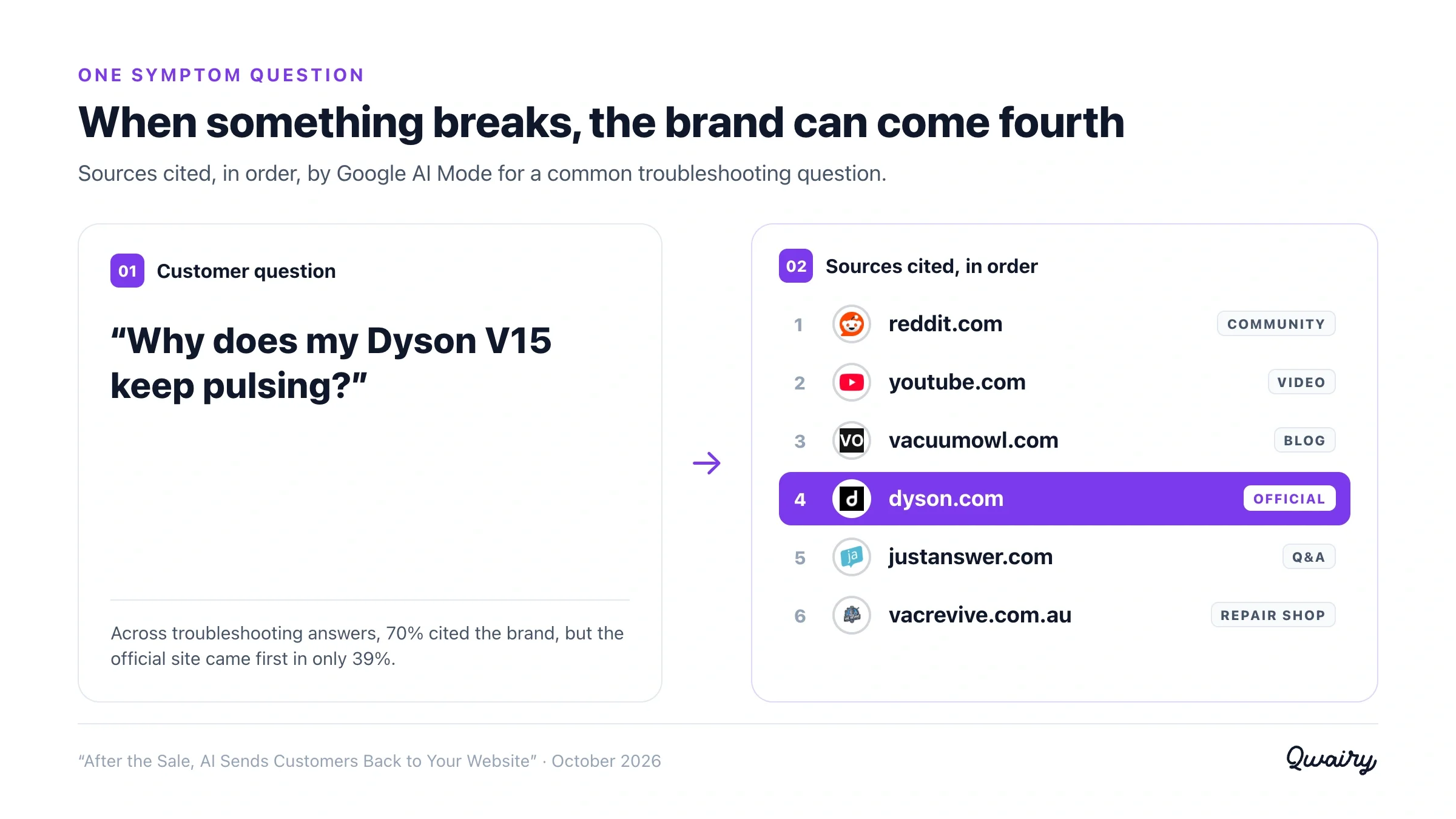
The repeat collection confirmed the gap. Troubleshooting was again the only moment where the brand was missing from a significant share of answers (76% cited it, versus 95% to 100% for the other moments), and the one where it came first least often (57%, versus 76% to 84%). Troubleshooting questions are written in the customer's words, around a symptom: "Why does my Dyson V15 keep pulsing?", "Why is my Samsung Galaxy S25 battery draining fast?", "Why is my HubSpot email sync not working?". Help centers are usually organized around features and settings. When no official page matches the symptom, assistants assemble the answer from tech media, YouTube tutorials and forum threads.
This is also where customers struggle most. A Gartner survey of 5,728 customers found that only 14% of customer service issues are fully resolved in self-service, while 73% of customers use self-service at some point in their customer service journey. Even issues customers describe as very simple are fully resolved only 36% of the time. AI assistants are becoming that self-service layer. If your troubleshooting content is not the one they cite, someone else's answer becomes your customer experience.
Run a free audit: in a few minutes, ChatGPT, Gemini and Perplexity answer 8 buying questions about your market live, and you see who they recommend.
Moment | What customers ask | What AI does | What to publish |
Getting started | Import, setup, data transfer, break-in period | Cites the brand in most answers, often next to tutorials | Step-by-step setup guides, one per starting situation (from Excel, from another CRM, from an iPhone) |
Care and maintenance | Cleaning, updates, when to replace | Relies on official care instructions | Care pages per model and version, with intervals and parts |
Troubleshooting | Symptoms: pulsing, draining, not syncing, blisters | Mixes official pages with media, videos and forums | Symptom-led articles titled in the customer's words, with diagnosis steps |
Policies and support | Returns, warranty, cancellation, contact | Goes straight to the brand's site | One canonical, up-to-date page per policy, with conditions and links |
Post-purchase answers rarely close the conversation. 68% of them end with an invitation to continue, and 95% of those invitations offer more help: a diagnosis, a checklist, the next step. More than half ask for specifics before going further, most often the exact model, version or purchase channel: which Ghost generation, whether the battery has a release button or three screws, whether the shoes were bought on the brand's site or from a retailer. Assistants are trying to match a precise situation. Generic help pages lose that match to sources that are specific. Commerce comes back too. 18% of post-purchase invitations bring up replacement batteries, current deals or extended protection plans. After the sale, AI is also deciding which accessories, upgrades and renewals your customers see. We explore how these follow-up turns shape decisions in a companion study: The First Answer Isn't the Decision .
See the domains and pages cited in the answers to your prompts, and how often each one comes up.
Qwairy reads answers in each engine's real interface, country by country, with their sources and links:
Track the questions that matter to your business, see which brands each answer mentions and which sources it cites, then work on the gaps.
Free plan with 120 initial credits • No credit card required
Other Articles
The First Answer Isn't the Decision: How AI Assistants Keep Buyers Talking
AI assistants rarely end on an answer: 72% close by inviting another question. And once buyers answer, the shortlist reshuffles. Qwairy's benchmark shows what the next turn decides.
ChatGPT Ads Are Coming to France: What US Data Reveals Before Launch
ChatGPT ads appear in 69.25% of US-monitored commercial answers but near zero in France. What US data reveals before the French launch, and how to prepare.