
Loading page
For 72 of 139 eligible product-brand domains, the recorded brand domain never appeared among 22,115 identifiable ChatGPT shopping destinations.

ChatGPT can recommend the product, name the brand, and still show shopping links that lead to other sites.
For 72 of the 139 brand domains eligible for analysis, no identifiable shopping destination matched the recorded domain. The median match rate was 0%.
Across 22,115 identifiable destinations attached to historical ChatGPT shopping results from December 1, 2025 to March 31, 2026, just 6.4% shared the product brand's recorded domain.
This is not a sales result. The study observes displayed shopping destinations, not impressions, clicks, purchases, orders, or revenue.
0% was the median share of shopping destinations matching the recorded brand domain.
51.8%, or 72 of 139, had no observed match.
0.3% of 7,551 product cards showed only links matching the recorded brand domain.
6.43% of all identifiable destinations matched the product brand's recorded domain.
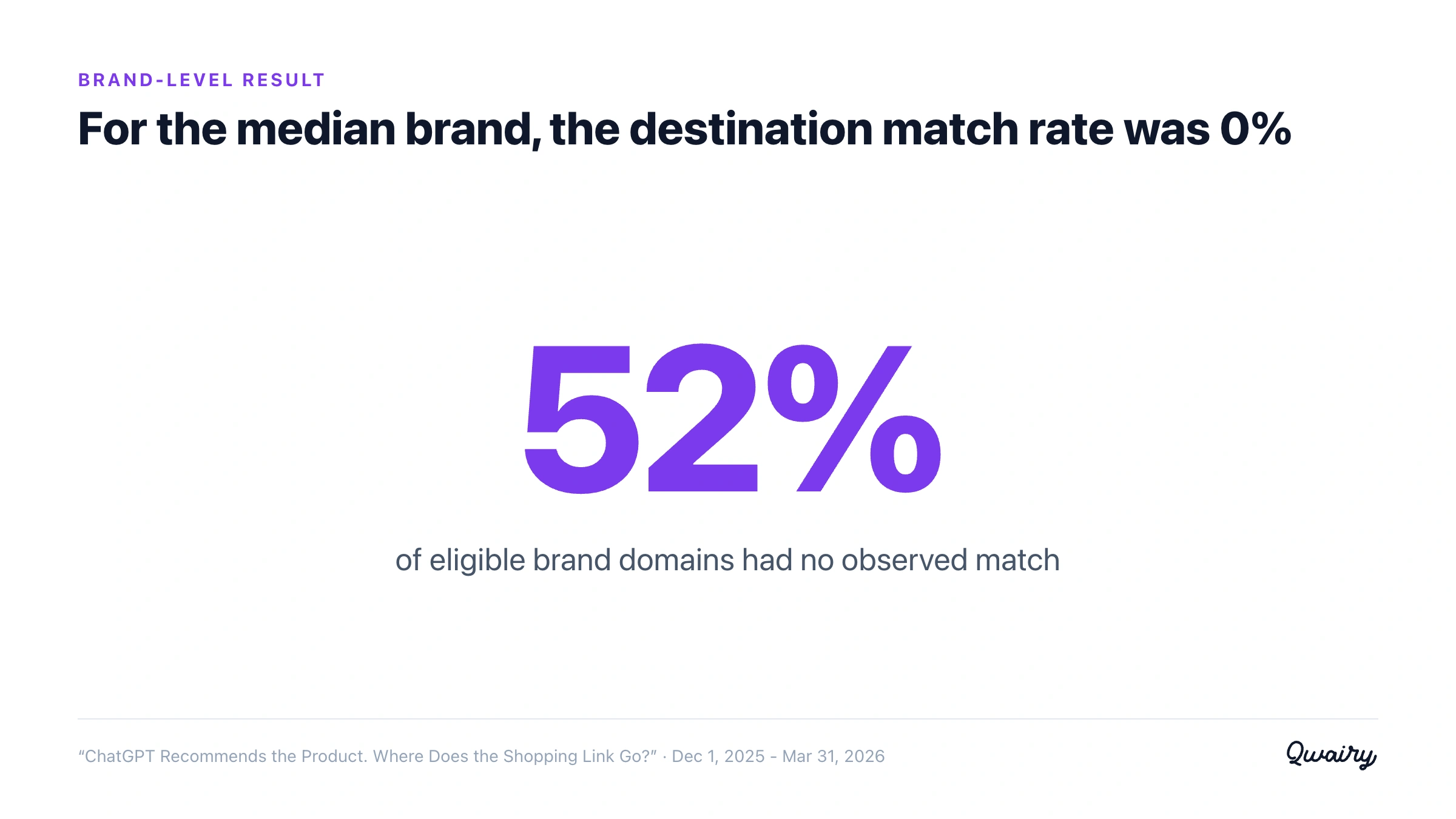
51.8%, or 72 of 139 eligible product-brand domains, had no observed match. A zero applies only to the products, prompts, markets, and dates represented in the panel.
In a July 2026 interface capture, ChatGPT recommends the Nike Pegasus 41. The visible shopping options shown beside it lead to Intersport, Sport 2000 and SportsShoes.com, while nike.com is absent from the visible list.
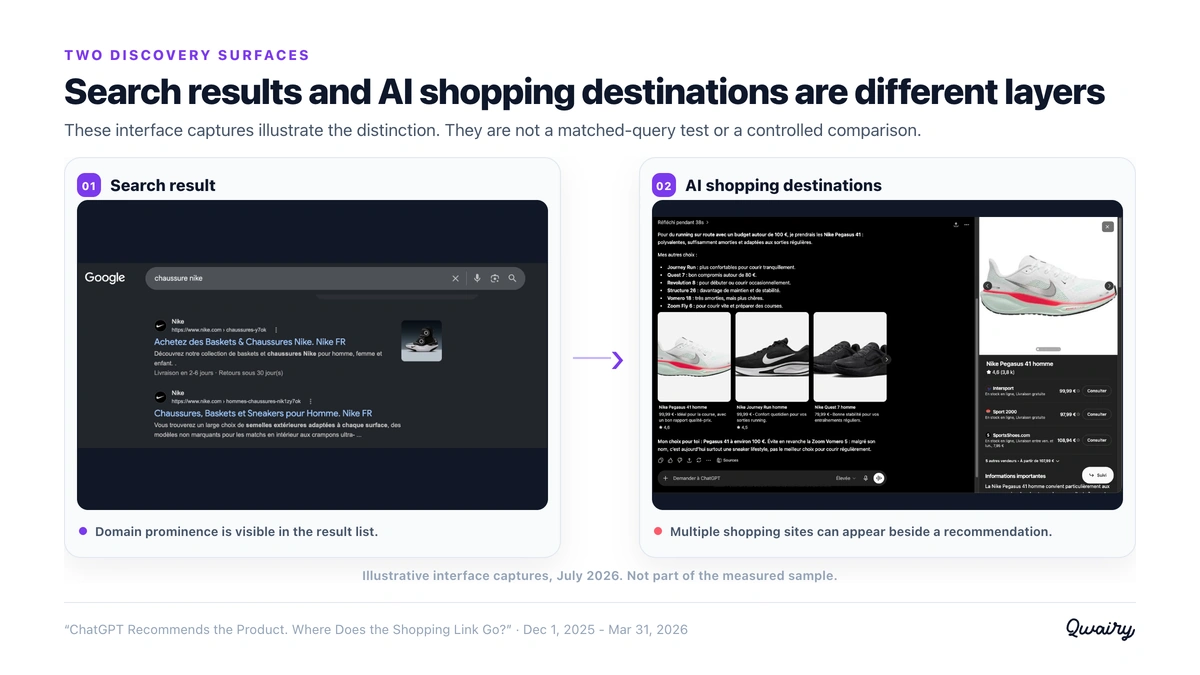
Illustrative interface captures from July 2026. They are outside the measured period and are not a matched-query test or a controlled comparison.
The example makes the mechanism tangible: the product recommendation and the shopping site are two different layers. It does not show that Nike lost a click or a sale, and it is not part of the measured sample.
OpenAI's current shopping documentation says ChatGPT can display product images, details, prices, and links to merchant sites.
When several merchants offer a product, the interface can present multiple options.
The current documentation also describes factors such as availability, price, quality, and whether a merchant is the maker or primary seller.
It was updated after the study period, so it does not prove that the same ranking rules applied from December 2025 to March 2026 (OpenAI Help Center ).
The distinction is simple:
OpenAI is still evolving that layer.
On March 24, 2026, it announced richer product comparison and additional ways for merchants to provide product data through the Agentic Commerce Protocol (OpenAI ).
This article is therefore a fixed historical benchmark, not a permanent description of today's interface.
An identifiable destination is a shopping URL that can be normalized to a hostname. Qwairy counted a destination as same-domain when that hostname equaled the product brand's recorded domain or was one of its subdomains. We describe the rest in plain language as other shopping domains. These can include marketplaces and resellers, but also regional domains, subsidiaries, parent-company sites, separate commerce properties, or marketplace storefronts. In the analysis, all of them are simply classified as non-matching hostnames. This is a technical comparison, not a complete map of ownership, authorization, fulfillment, or distribution. A hostname match also does not identify the final seller or prove where checkout occurred.
The primary observations covered 139 eligible product-brand domains. Their same-domain shares were highly uneven. The equal-weighted average was 5.7%, but the median was 0%. In total, 51.8%, or 72 of 139, had no observed same-domain destination in the panel. The 75th percentile was 9.1%.
Across the primary panel, 6.43% of identifiable destinations shared the product brand's recorded domain. Narrative figures in this article round that result to 6.4%.
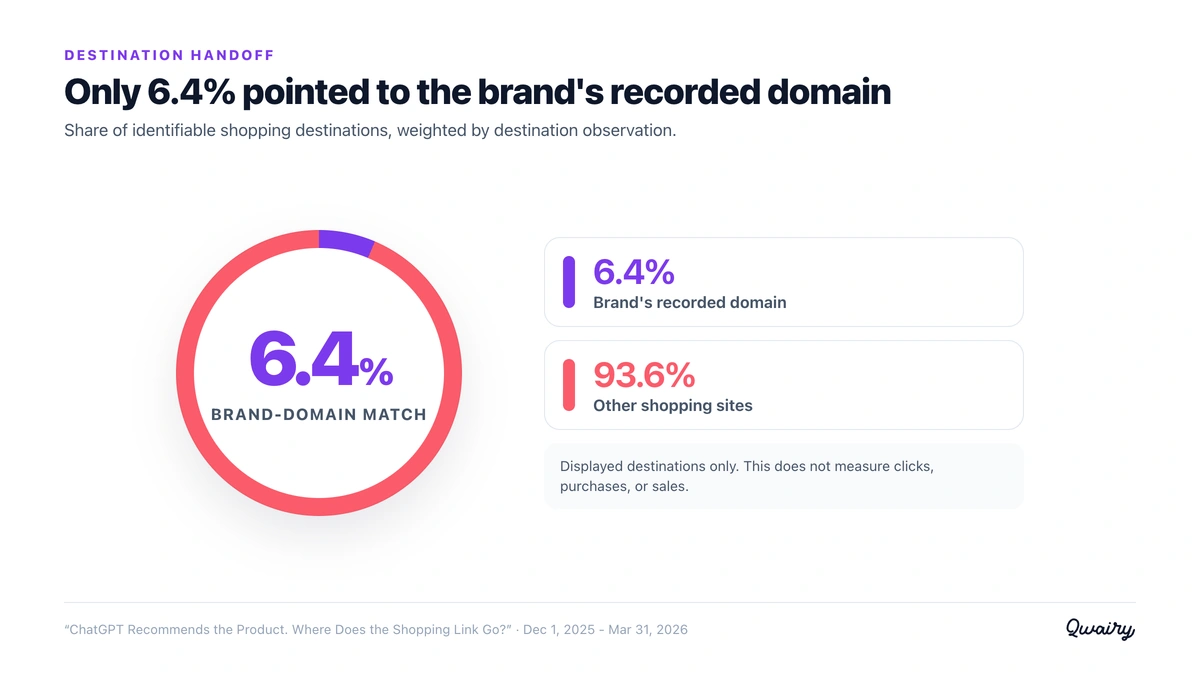
Destination-weighted result across 22,115 identifiable shopping destinations. Displayed destinations only, not clicks, purchases, or sales. The panel was not dominated by a single product-brand domain. The ten most-observed product-brand domains contributed 34.4% of eligible destinations, and the largest contributed 8.9%.
Run a free audit: see if ChatGPT, Gemini and Copilot recommend you, in about a minute.
The destination-level rate does not show whether the recorded brand domain and other shopping domains appeared together. Product-card composition does. Among 7,551 product cards with at least one identifiable destination:
81.2% showed only other shopping domains: every identifiable destination differed from the recorded product-brand domain.
18.5% were mixed: the recorded brand domain and other shopping domains appeared on the same card.
0.3% showed only the recorded brand domain: every identifiable destination matched.
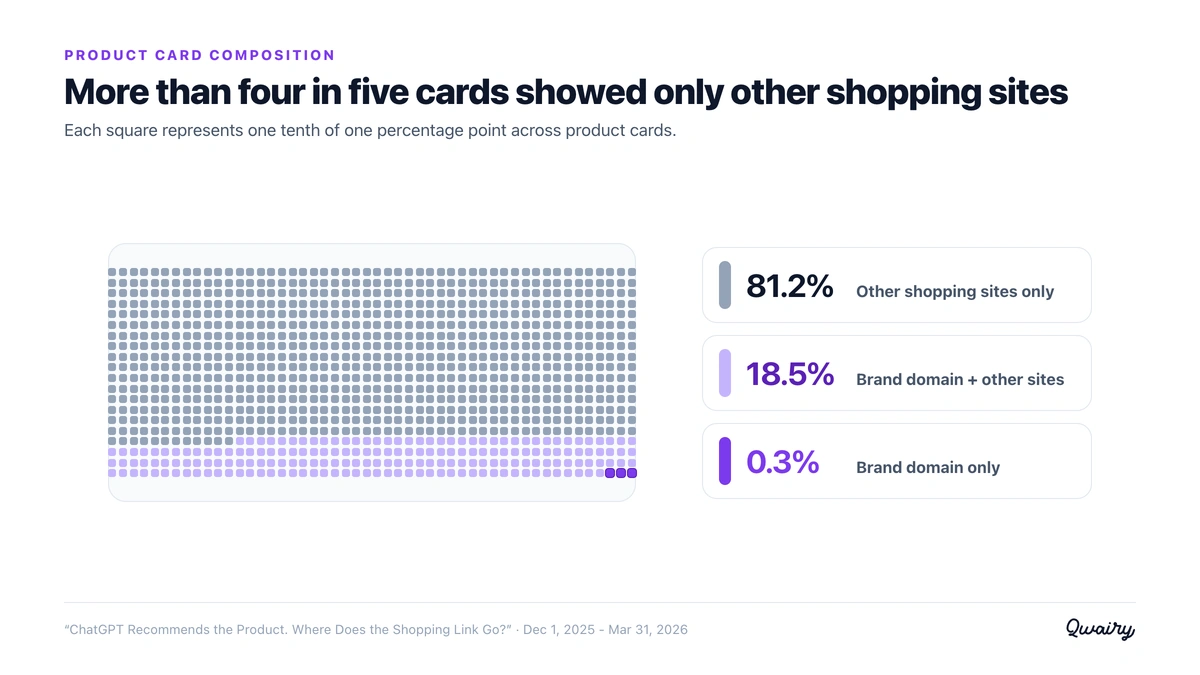
Cards are classified using every identifiable destination attached to each historical product card. “Brand domain” means the recorded product-brand domain or one of its subdomains. Mixed cards are important. They show that the shopping layer can present a choice of sites rather than a single link. Giving every card equal weight produced a 5.5% average same-domain share, close to the primary estimate.
Repeated observations create a weighting question. High-volume product brands, cards with many destinations, or repeated routes can influence a simple total. Qwairy therefore calculated the result through four lenses:
Analytical lens | Same-domain result | What it controls |
All identifiable destinations | 6.43% | Primary destination-level estimate |
Equal weight per product-brand domain | 5.7% | High-volume domains |
Equal weight per product card | 5.5% | Cards with many destinations |
10,785 unique product-to-destination routes | 6.5% | Repeated identical routes |
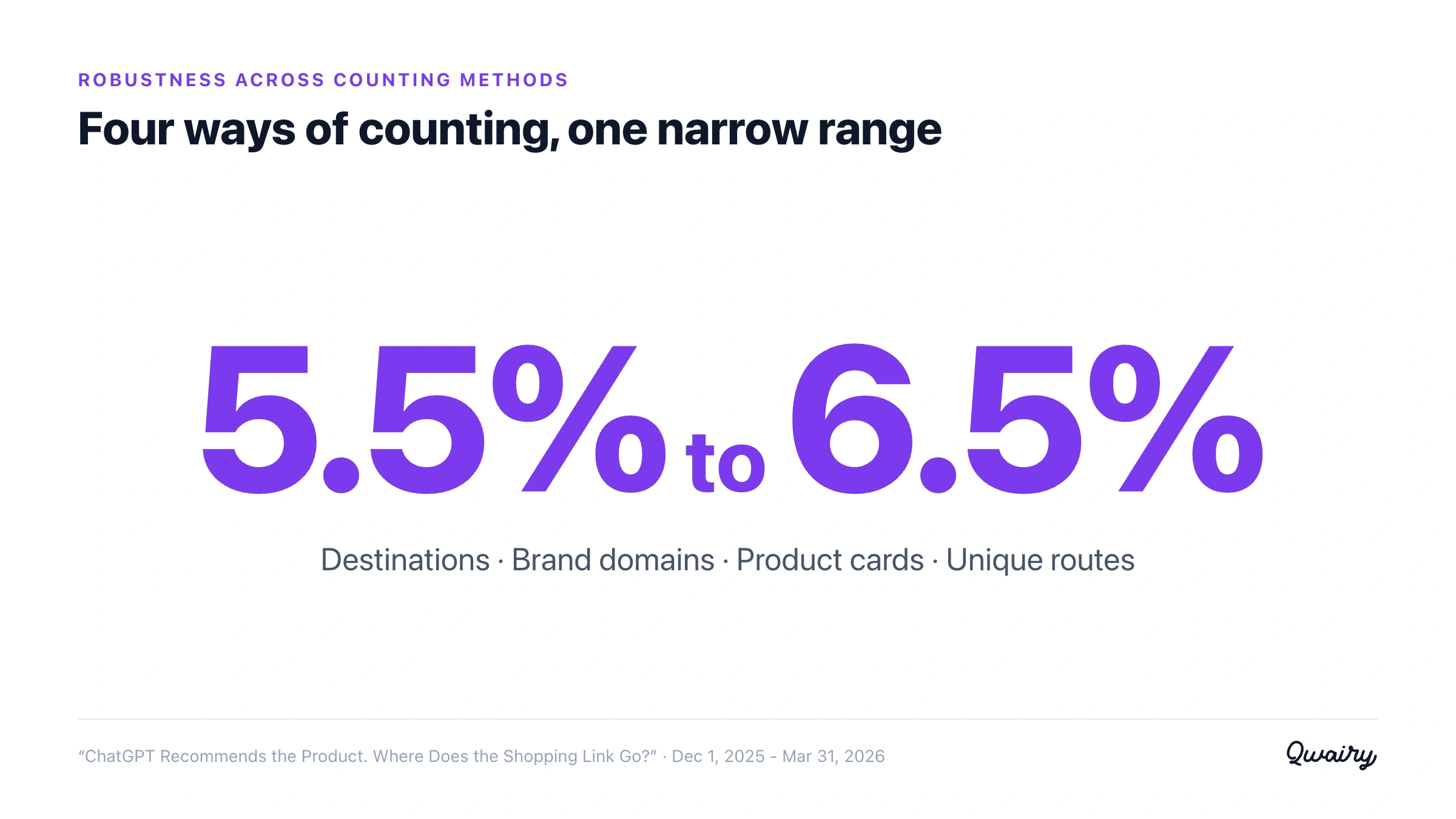
Changing the unit of analysis moved the estimate slightly, but did not reverse the result. Two sensitivity cohorts reached the same broad conclusion:
A wider rule requiring at least 20 destinations and 80% usable-URL coverage included 335 product-brand domains and 28,041 identifiable destinations, producing 6.8%.
A stricter title-prefix attribution, while retaining the primary thresholds of at least 50 captured merchant options and 95% usable-URL coverage, retained 116 domains and 18,001 identifiable destinations, producing 7.7%.
Qwairy also resampled at the product-brand-domain level to preserve within-domain correlation. The resulting 95% descriptive resampling interval was 4.53% to 8.42% around the 6.43% estimate. This is not a population confidence interval. It describes variation among the product-brand domains represented in the panel and does not remove the measurement limitations below.
External research reinforces the need to separate presentation, visit, and purchase. Adobe reported that AI-sourced traffic to U.S. retail sites rose 393% year over year in the first quarter of 2026 and converted 42% better than non-AI traffic in its March dataset. Those figures concern referral visits after a destination is selected, not destinations displayed in an answer (Adobe Digital Insights ). A June 2026 observational preprint associated recommendations with later brand searches and visits for users without recent observed brand engagement, but did not observe transactions (From Prompt to Purchase ). A separate Marketing Science study analyzed ChatGPT-attributed sessions and transactions from August 2024 to July 2025, an earlier stage of the channel (Marketing Science ). These results cannot be combined with Qwairy's 6.4%. They measure different stages of the journey.
The useful response is not to compress AI commerce into one metric. Track at least four layers:
Then investigate gaps without assuming their cause. Product data, machine readability, availability, delivery information, and regional-domain coverage are reasonable checks, but this study does not identify a ranking mechanism. Distribution strategy also changes the interpretation. A non-matching destination may be expected and valuable. A team prioritizing its own recorded domain may treat the same pattern as a presence gap worth examining.
See your mentions across ChatGPT, Claude and Perplexity in real time, the moment buyers ask.
This is a retrospective observational study of production ChatGPT shopping observations in the Qwairy panel. It does not include synthetic reruns created for this article. The primary window runs from December 1, 2025 through March 31, 2026, inclusive. Destination-field completeness and structure changed after March, so later observations were not pooled into the headline estimate. The scope is ChatGPT only. No cross-engine inference is made.
To enter the primary cohort, a product-brand domain needed at least 50 captured merchant options and at least 95% usable destination-URL coverage. The 95% threshold was calculated before URL-less options were removed. Those unknown URLs were then excluded from the match-rate denominator, leaving 22,115 identifiable destination observations. Product-brand attribution required a recorded brand name longer than three characters to appear in the product title. Normalized product titles that mapped to more than one product-brand domain were excluded. In the stricter title-prefix sensitivity test, the normalized product title had to begin with the recorded brand name. Each included relationship required an active domain record that passed technical validation at analysis time. This does not independently prove manufacturer ownership. Current domain and status records were applied retrospectively, so historical migrations may create mismatches.
Destination URLs and product-brand domains were normalized before comparison. A match required an equal hostname or a subdomain of the recorded domain.
The primary formula was:
same-domain identifiable destinations / all identifiable destinations
Alternative estimators used equal weight per product-brand domain, equal weight per product card, and unique routes. A unique route was defined by product-brand domain, normalized product title, country, and destination hostname.
The descriptive interval used bootstrap resampling at the product-brand-domain level, preserving all observations within each resampled domain cluster.
Presentation, not behavior: no impressions, clicks, purchases, orders, revenue, or incrementality were observed.
Strict domain matching: related regional, subsidiary, parent, marketplace, or alternate commerce domains can be classified as non-matching.
Lexical attribution: ambiguous names, sub-brands, collaborations, and complex brand structures can be misclassified or excluded.
Panel, not census: results reflect the prompts, products, markets, and brands monitored by Qwairy, not all ChatGPT shopping activity.
Historical and product-specific: current records were applied to a fixed past period, while ChatGPT's shopping experience continues to change.
Product presence and destination presence are separate layers of ChatGPT shopping. In this historical panel, 6.4% of identifiable destinations shared the product brand's recorded domain. The result remained consistent across domain, card, route, and sensitivity analyses. It does not reveal where anyone purchased. For e-commerce teams, the benchmark is not a universal target. The useful next step is to map the handoff across their own catalog. With Qwairy, teams can identify which prompts surface their products, which destination domains appear beside them, and where product presence is stronger than same-domain presence. Products that are frequently recommended but rarely accompanied by the recorded brand domain provide a practical starting point for investigation. Use that priority list to investigate product data, catalog-feed coverage, availability, delivery information, and regional-domain mapping. Then repeat the same monitored prompts to see whether destination presence changes over time. Qwairy measures the recommendation and destination layers. Clicks, checkouts, and revenue should remain validated through first-party analytics.
AI traffic grows but retail sites lag in AI search visibility, Adobe Digital Insights
From Prompt to Purchase: How AI Brand Recommendations Move Consumers on the Open Web, arXiv
Track your mentions across ChatGPT, Claude, Perplexity and all major AI platforms. Join 1,500+ brands monitoring their AI presence in real-time.
Free trial • No credit card required • Complete platform access
Other Articles
ChatGPT Ads Are Coming to France: What US Data Reveals Before Launch
ChatGPT ads appear in 69.25% of US-monitored commercial answers but near zero in France. What US data reveals before the French launch, and how to prepare.
ChatGPT Stopped Citing Reddit. Our Data Shows the Mechanism Behind the 95% Collapse
Reddit's share of ChatGPT Search citations collapsed 95% in one week in August 2026. Qwairy's citation data reveals the mechanism: a query fan-out change on August 8 that switched ChatGPT to direct site: interrogation, redistributing citations from discussion platforms to official sources.