
Loading page
A diagnostic guide to the six reasons your content is absent from Google AI Overviews, with a fix checklist for each. Learn how to get cited and how to measure it.

You ranked. You wrote the guide. And still, when you search your own topic, Google's AI Overview quotes three other sites and never mentions yours. That gap is now expensive. AI Overviews sit above the classic blue links, and they change how people behave: Pew Research Center found that users who saw an AI summary clicked a link only 8% of the time, versus 15% when no summary appeared - and clicked a link inside the summary just 1% of the time. If you are not one of the sources the AI cites, you are effectively invisible for that query. The good news: absence from AI Overviews is almost always diagnosable. It is rarely bad luck. It is usually a specific, fixable reason - your content can't be crawled, can't be extracted, isn't trusted, or doesn't match the question being asked. This guide walks you through the real causes, in the order you should check them, with a concrete fix checklist for each. It also covers the cases where inclusion is genuinely out of your hands, and how to actually measure whether you're being cited.
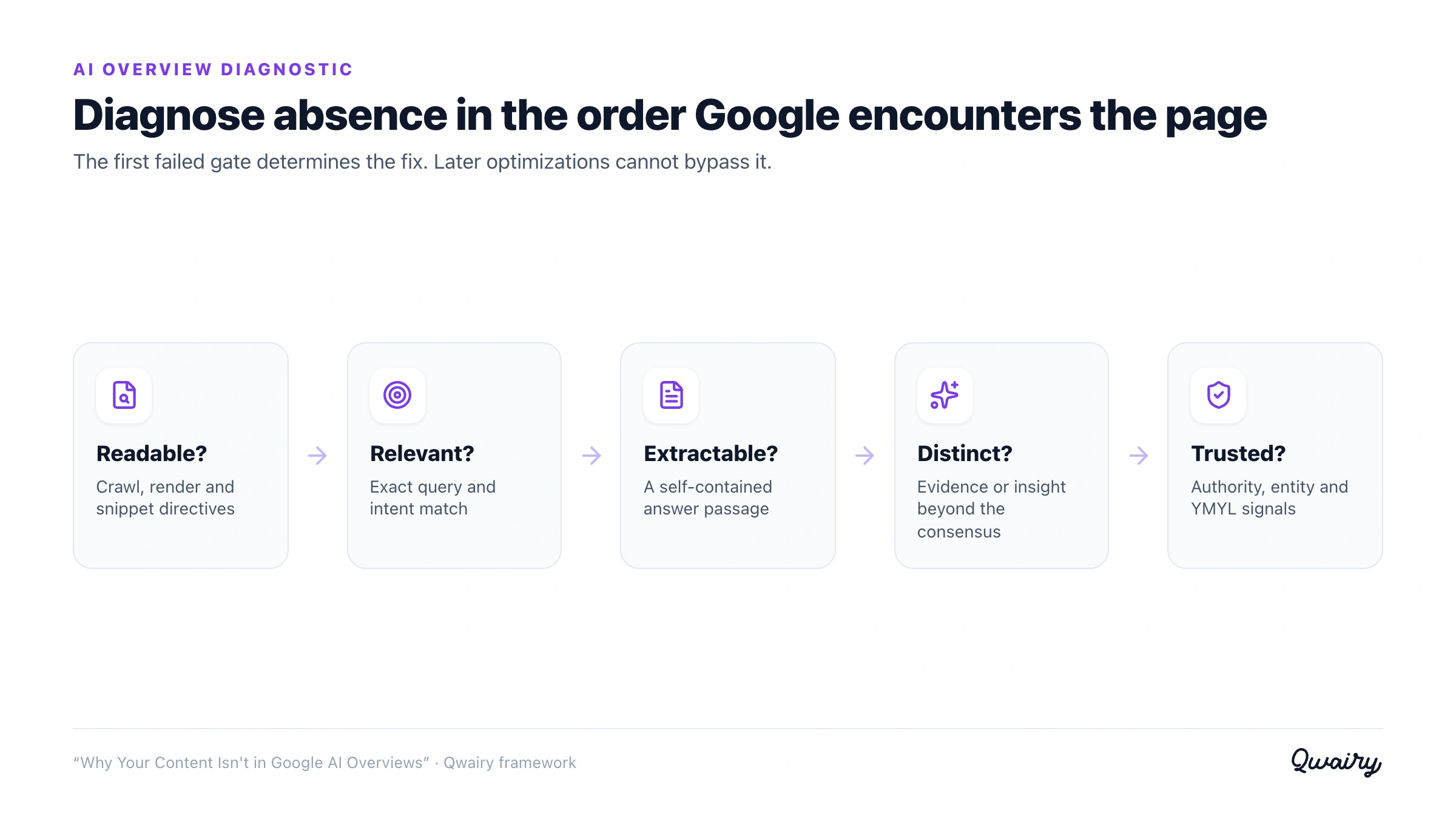
You can't fix your absence until you know what Google is selecting for. AI Overviews are built on a retrieval-and-synthesis pipeline: Google interprets the query, runs a "query fan-out" (breaking one question into many related sub-queries), retrieves candidate pages, extracts the most self-contained and relevant passages, and stitches a summary together with citations. Two facts about this process matter for diagnosis:
You don't have to rank #1. Google's own guidance stresses that appearing in AI features is grounded in ordinary Search systems, and analyses of live citations show many cited pages rank outside the top few positions. Ahrefs' March 2026 analysis of 4 million URLs found that only 37.9% of AI Overview citations come from pages ranking in the classic top 10 - down sharply from 76.1% in its July 2025 study (Search Engine Journal , Ahrefs ). The lever is passage quality, not just position.
No special file or markup buys you in. Google is explicit that there is no AI-specific schema, no llms.txt , and no secret markup that grants inclusion. The same fundamentals that earn organic visibility earn AI citations.
With that model in mind, here are the causes of absence - roughly ordered from most mechanical to most strategic.
If the crawler can't fetch or render the page, nothing else matters. This is the most common and most overlooked reason, especially on modern JavaScript sites. Two failure modes dominate:
Disallow in robots.txt, a noindex tag, a canonical pointing elsewhere, or auth walls all remove you from the candidate pool.Fix checklist:
Confirm the page returns 200, isn't noindex, and isn't blocked in robots.txt.
Use the URL Inspection tool in Search Console and view the rendered HTML - is your answer actually in it?
If the page is client-side rendered, move critical content to server-side rendering (SSR), static generation (SSG), or prerendering so the answer exists in the initial HTML.
Check that the page is indexed at all (site: search or Search Console coverage). No index, no citation.
AI Overviews quote passages, not whole pages. If your answer is buried three paragraphs into a section titled "Our Story," the model has to work to isolate it - and it will often prefer a competitor who put the answer up front. Signs you have this problem: long unbroken paragraphs, vague headings, the actual answer only implied, no definitions, no lists or tables where the question invites them.
Fix checklist:
Write answer-first: state the direct answer in the first sentence under a heading, then expand.
Make each section self-contained - a passage that makes sense if lifted out on its own.
Use question-shaped ##/### headings that mirror how people phrase queries.
Add lists, steps, and comparison tables for anything enumerable or comparative.
Keep answer blocks tight and factual rather than padded. Kevin Indig's analysis suggests focused pages can out-cite the sprawling "ultimate guide" format for AI citations - depth per question beats length for its own sake.
Run a free audit: see if ChatGPT, Gemini and Copilot recommend you, in about a minute.
AI synthesis rewards pages that contribute something the summary can't get elsewhere. If your article restates the same generic points as ten others, the model has no reason to cite you specifically - it can assemble that answer from higher-authority sources. This is the "informational commodity" trap: technically correct, competently written, completely undifferentiated.
Fix checklist:
Add first-hand substance: original data, tests, examples, screenshots, expert quotes, a clear point of view.
Answer the specific question more completely than the current sources - cover the edge cases they skip.
Follow Google's own north star: helpful, reliable, people-first content , not content reverse-engineered from a keyword.
For queries where being named matters (comparisons, recommendations, "best X"), publish genuinely comparative content - evaluative pages get brands mentioned far more than generic explainers.
Google cross-checks AI Overview claims and leans on trusted sources - and the bar rises for sensitive topics. For "Your Money or Your Life" subjects (health, finance, legal, safety), demonstrated experience, expertise, authoritativeness, and trust (E-E-A-T) weigh heavily. A thin, anonymous page on a medical or financial query rarely gets cited no matter how well formatted.
Fix checklist:
Put real, credentialed authors on the page with bylines, bios, and credentials.
Build off-site signals: earn mentions and links from sources your topic's audience already trusts. Being cited elsewhere correlates with being cited by AI.
Strengthen your entity footprint - consistent brand naming, an "About" page, Organization and Person/author structured data, and consistent presence across the web help Google trust who you are.
On YMYL topics, cite primary sources, keep facts current, and make accuracy verifiable.
You may be perfectly optimized for a query that never triggers an AI Overview, or for an intent that isn't the one being asked. AI Overviews don't appear for every search, and when they do, the fan-out often pulls sub-questions you never addressed.
Fix checklist:
Check whether the query even shows an AI Overview. If it doesn't, your absence there is expected - target queries that do.
Map the sub-questions around your topic (the "People also ask" and related-question space) and make sure your page or cluster answers them.
Match intent precisely: a commercial "best tools for X" query wants a comparison, not a definition.
Cover the topic as a cluster, not a single page - fan-out rewards breadth across related questions, so interlink supporting pages that each nail one sub-question.
Snippet and preview controls can quietly exclude you. If your pages carry nosnippet, a restrictive max-snippet, or data-nosnippet on the key content, you limit the text Google can surface - and AI features rely on that previewable text.
Fix checklist:
Audit your meta robots tags and headers for nosnippet / max-snippet / data-nosnippet directives.
Remove them from content you want surfaced. (Keep them only where you deliberately want text withheld - and accept the AI-visibility cost.)
Remember there is no partial "AI-only" opt-out that preserves normal snippets: preview controls apply broadly.
See your mentions across ChatGPT, Claude and Perplexity in real time, the moment buyers ask.
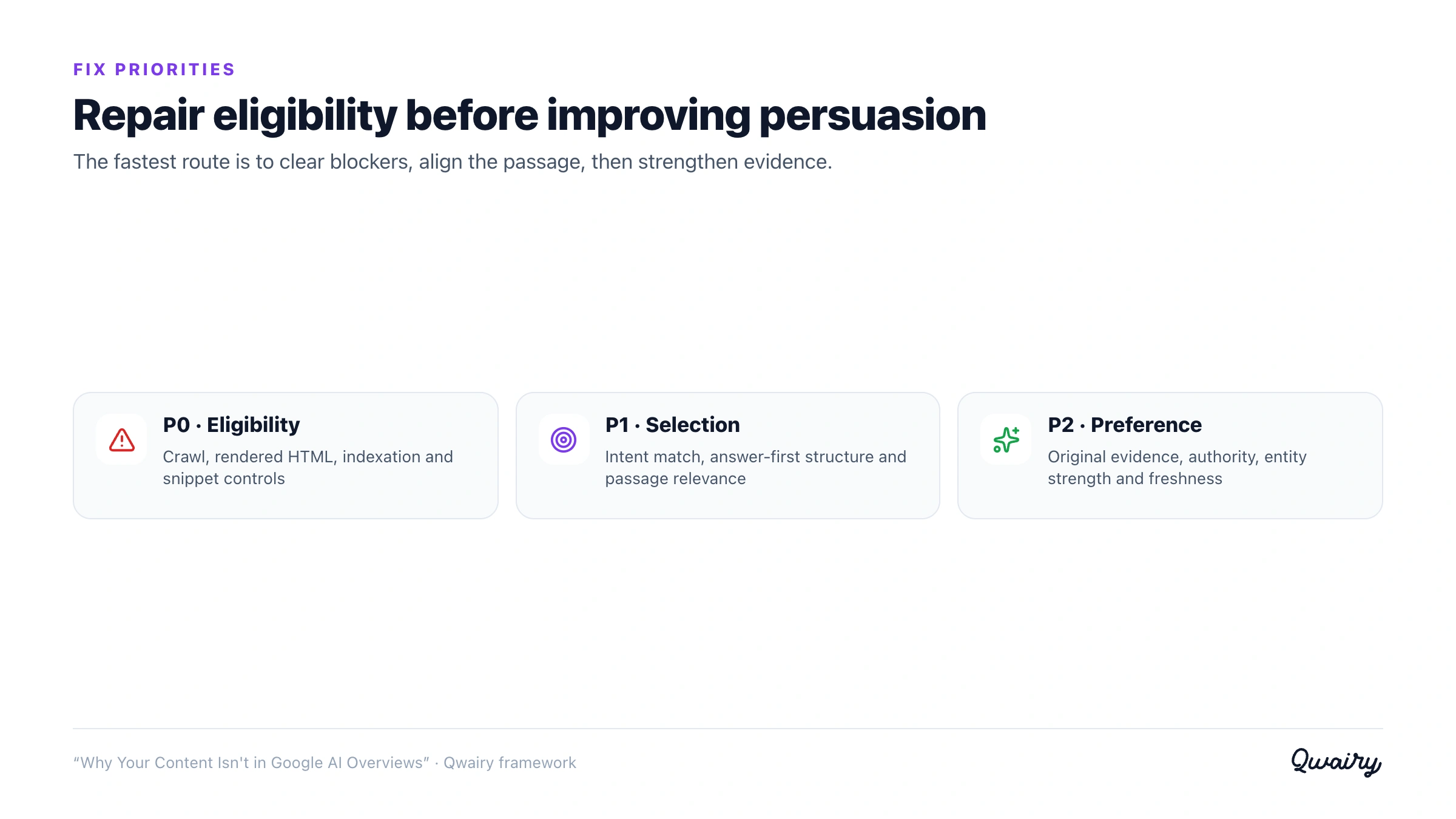
Work the causes in order - mechanical blockers first, strategy last. Here's the sequence to run for any page you want in an AI Overview:
200 status, indexed, not blocked, not noindex, canonical correct.nosnippet/data-nosnippet on the content you want cited.Run this as a repeatable audit, not a one-off. AI Overviews are volatile - citations shift as Google re-retrieves.
Some absence isn't your fault, and chasing it wastes effort. Be honest about these cases:
No AI Overview exists for the query. Google withholds them on many searches; you can't be cited in something that isn't shown.
The intent favors a different format. Some answers pull mostly from video, forums, or a source type you don't produce.
Volatility. You may be cited one week and dropped the next as retrieval reshuffles - a single check is a snapshot, not a verdict.
Entrenched authority. For some head terms, a handful of very high-authority sources dominate; realistic progress is on the long tail and sub-questions, not the one hero keyword.
The productive response is to focus on queries where an AI Overview exists, you can plausibly be the best passage, and you can measure movement.
You can't fix what you can't see - and eyeballing a few searches doesn't scale. AI Overview citations vary by query, location, personalization, and over time, so manual spot-checks miss most of the picture and can't tell you your share versus competitors. This is the measurement gap Qwairy is built to close: tracking whether your brand appears and gets cited across Google AI Overviews and the other major AI engines (ChatGPT, Perplexity, Gemini, Claude), which sources they pull from, how your citation share compares to competitors, and how sentiment and AI-driven revenue move as you make the fixes above. There's also an agent-native MCP so your own tools can query that data directly. Whatever you use, hold yourself to three questions: Am I cited for the queries that matter? Which sources are being cited instead of me? Is that changing as I ship fixes? For more on the underlying mechanics, the Qwairy blog goes deeper on how AI engines retrieve and cite.
Move from diagnosis to execution: Compare the AI Overview ranking factors , apply the canonical Google AI Overview optimization guide , and rule out crawl or rendering failures with the technical GEO checklist .
Being absent from Google AI Overviews is a diagnosis, not a mystery. Nine times out of ten it traces to one of six causes: the crawler can't read you, the model can't extract you, you add nothing new, you aren't trusted, you answered the wrong question, or you told Google not to preview you. Work them in order, structure your content answer-first, earn real authority, and measure whether the needle moves. Do that consistently and you stop guessing why the AI quotes everyone but you.
Ranking and AI citation are related but not the same. AI Overviews extract self-contained passages and run query fan-out across sub-questions, so a #1 page that buries its answer or misses the sub-questions can lose to a lower-ranked page that answers more cleanly. Restructure answer-first and cover the surrounding questions.
No. Google states there is no AI-specific file or markup that grants inclusion in AI features; the same crawlability, quality, and authority fundamentals apply. Structured data can still help Google understand your content and entity, but it isn't a magic switch for AI Overviews.
There's no fixed timeline. Google must re-crawl, re-index, and re-retrieve, and AI Overviews are volatile, so changes can surface in days or take considerably longer. Treat it as an ongoing audit and track citations over time rather than expecting an overnight flip.
It can be a factor. If you block AI-related crawlers or apply nosnippet/data-nosnippet to key content, you limit what can be surfaced. Review your robots.txt and preview directives and make sure the content you want cited is actually accessible and previewable.
Yes, and it's common. Because most users don't click through from AI summaries, a citation is often about visibility and brand presence more than raw clicks. That's exactly why measuring citation share - not just referral traffic - matters for judging AI-search performance.
Compare passages, not whole pages. Look at how directly they answer the specific question, how self-contained their sections are, and what authority signals (author, entity, off-site citations) they carry. Then check the mechanical basics on your side: indexability, rendering, and preview controls.
Track your mentions across ChatGPT, Claude, Perplexity and all major AI platforms. Join 1,500+ brands monitoring their AI presence in real-time.
Free trial • No credit card required • Complete platform access
Other Articles
Answer Engine Optimization (AEO): The Complete 2026 Guide
A complete, practitioner-level guide to Answer Engine Optimization: what AEO is, how answer engines like ChatGPT, Perplexity and Google AI Overviews select and cite content, the core levers, a step-by-step workflow, and how to measure it.
How to Set Up AI Referral Tracking in GA4, Plausible and Matomo
Most analytics tools miss or misclassify AI referral traffic by default. This step-by-step guide shows you how to properly track visits from ChatGPT, Perplexity, Claude, Gemini, and other AI platforms in GA4, Plausible, and Matomo.