
Loading page
What actually gets a page pulled into a Google AI Overview: the evidence-backed drivers, the overrated tactics, and a repeatable audit method you can run this week.

Google's AI Overviews rewrote the first page. Instead of ten blue links competing for a click, a synthesized answer now sits on top of many results and cites a handful of sources it decided were worth pulling in. If your page is one of them, you get visibility and referral traffic. If it isn't, you can rank third organically and still be invisible above the fold. The stakes are no longer theoretical. A Pew Research Center study found that when an AI summary appeared, users clicked a traditional result in only 8% of visits, versus 15% when no summary appeared - and just 1% clicked a link inside the AI Overview itself. When the answer is assembled for the user, being in the answer is the whole game. So every SEO and content lead is now asking the same thing: what actually gets a page pulled into an AI Overview? There is no published "AI Overviews ranking factors" list from Google, and there won't be one in the classic sense. But there is a growing body of real evidence - from independent studies and from Google's own documentation - that shows which levers move the needle and which are noise. This article reframes "ranking factors" for the AI Overview era. You'll get the evidence-backed drivers, the things practitioners consistently over- and under-rate, and a concrete audit method you can run on your own content this week. One honest caveat up front: AI Overviews are non-deterministic, vary by query, and change fast. Treat everything here as directional, not a formula. Where a specific number matters, verify it against the source before you repeat it.
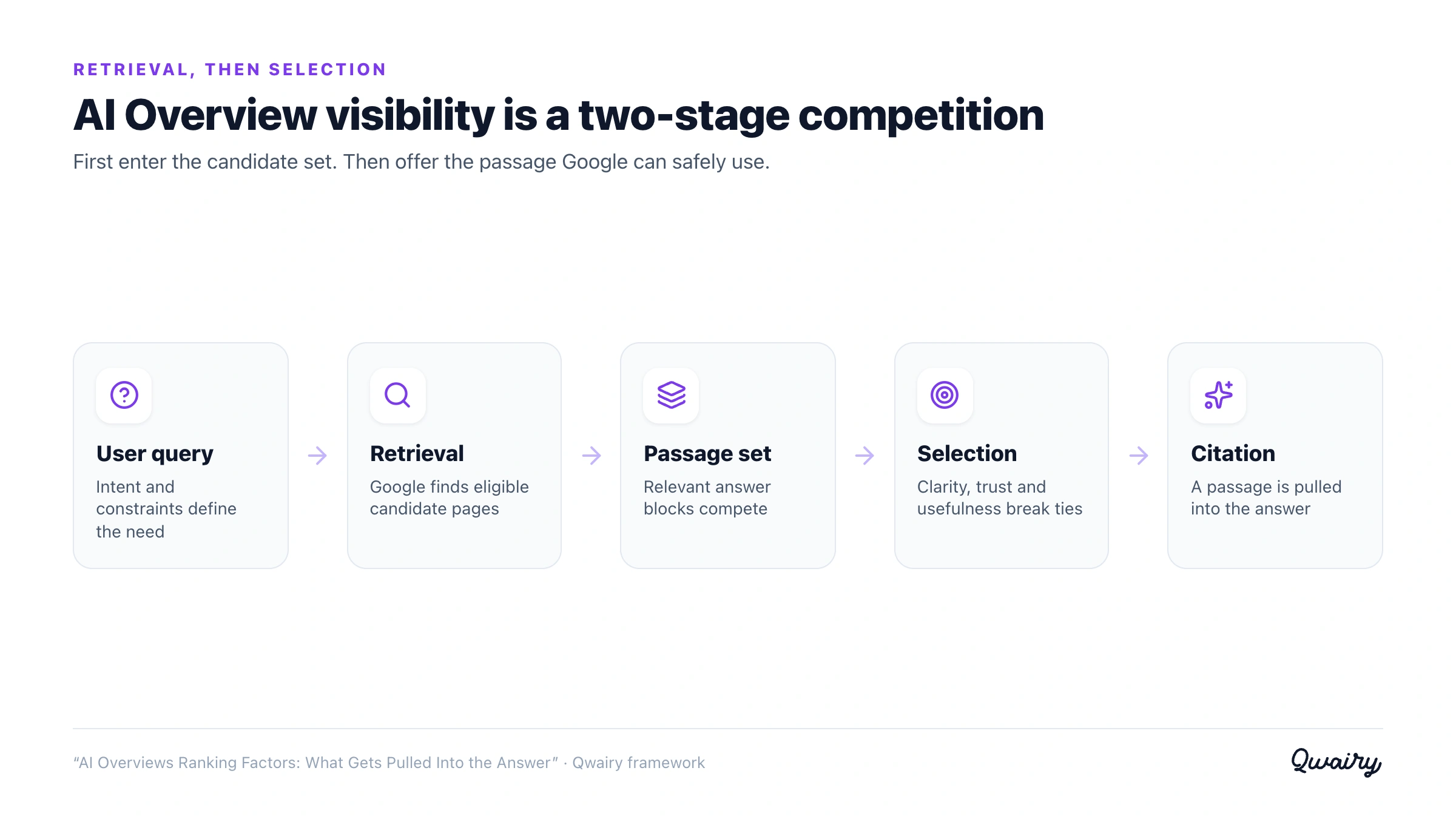
AI Overviews don't "rank" pages the way the classic algorithm does - they retrieve candidates and then select which ones to ground the answer in. Understanding those as two separate stages is the single most useful mental model you can adopt.
Retrieval. Grounded in Google Search, the system pulls candidate pages and passages from the index that are relevant to the query and its sub-questions. If you're not retrievable and relevant here, nothing else matters.
Selection. A generative layer synthesizes the answer and decides which sources to cite alongside it. This is where extractability, clarity, and trust signals decide whether your passage is the one that gets surfaced.
That two-stage split is why a page can rank well and still never appear, and why a modestly ranked page with one perfectly matched, quotable passage sometimes does. "Ranking factors" for AI Overviews really means two questions: Can you be a candidate? and Are you the passage worth citing? The most important verifiable fact in this entire discussion comes from Google itself. Per Google's AI features and your website documentation, there is no special schema, markup, or file you need to add to appear in AI Overviews or AI Mode - you don't opt in, and there's no "AI Overviews SEO" toggle. The same Search Essentials that govern organic ranking govern AI features. Google's AI optimization guide reinforces the point: ensure crawling is allowed in robots.txt and your infrastructure, make content findable through internal links, and follow the fundamentals. Anyone selling you a secret markup trick is selling snake oil.
The strongest, best-documented driver is whether you already rank on page one. Multiple independent analyses converge on a heavy overlap between AI Overview citations and top organic results - though they disagree on the exact magnitude, which tells you something in itself.
Ahrefs' most recent analysis (March 2026, 4 million URLs across 863,000 SERPs) found that 37.9% of AI Overview citations also rank in the top 10 - down sharply from the 76.1% it reported in July 2025 across 1.9 million citations. Ahrefs attributes the drop to improved citation parsing and to query fan-out: Google increasingly pulls from the SERPs of sub-queries rather than from the original query.
Authoritas reported that about 60% of AI Overview results come from the top 10, leaving 40% from pages outside it.
Other studies land in between, roughly 38-60% depending on method and measurement date.
The direction of travel matters more than any single figure: the overlap is falling, not rising. On the most recent data, a clear majority of AI Overview citations now come from pages outside the top 10. Strong organic rankings still raise your odds and remain the base layer - but they are no longer the dominant gate, which is precisely why passage-level extractability, the next factor, has become the higher-leverage lever.
AI Overviews assemble answers from specific source material, so a single well-matched section can earn a citation even when the page ranks modestly. Google's ranking systems guide confirms that passage ranking identifies individual sections of a page to understand their relevance. The practical standard for AI answers is the same: provide a self-contained passage that resolves the exact sub-question. The practical implication is to write for the sub-question, not just the head term. Give each likely question its own clearly labeled section with a direct, complete answer in the first sentence or two - one that makes sense lifted out of the page entirely. Burying the answer three paragraphs into a section optimized for a broad keyword is how well-ranked pages lose the citation to a smaller competitor who simply answered faster.
If a model can't cleanly lift a self-contained answer from your page, it won't cite you - no matter how good the underlying content is. Extractability is an underrated ranking factor because it's a formatting discipline, not a content one.
Lead with the answer: state the conclusion first, then explain (the inverted pyramid).
Use descriptive H2/H3 headings that mirror how people phrase questions.
Keep one idea per paragraph and favor short, declarative sentences.
Use lists and tables for comparisons, steps, and specs - structures models parse and reproduce easily.
Define terms crisply; a clean one-sentence definition is highly quotable.
None of this requires special markup. It's about making the best answer trivially easy to identify and quote.
Run a free audit: see if ChatGPT, Gemini and Copilot recommend you, in about a minute.
What the rest of the web says about you feeds both retrieval and the model's sense of who is authoritative, and the data suggests it is one of the most underrated levers. Ahrefs' study of 75,000 brands found branded web mentions strongly correlated with visibility across AI Overviews, AI Mode, and ChatGPT. For AI Overviews specifically, the reported Spearman correlation was 0.656; branded anchors and branded search volume also correlated positively. This is observational evidence, not proof of a direct ranking factor. Correlation isn't causation, and these are observational studies - but the direction is consistent across research: being talked about across the web, not just linked to, tracks with showing up in AI answers. Practically, that means digital PR, earned mentions on authoritative pages, consistent entity naming, and presence in the sources AI systems trust (industry publications, reputable directories, community platforms) all compound. This is where AEO/GEO work diverges most from classic link-building.
For anything consequential, Google leans on signals of experience, expertise, authoritativeness, and trust before it will put your words in a synthesized answer. This is most visible in Your-Money-or-Your-Life (YMYL) topics - health, finance, legal, safety - where Google is demonstrably more conservative about which sources it surfaces. Clear authorship, credible citations, first-hand experience, and a strong site reputation all raise the odds that your passage is deemed safe to quote.
For queries where recency matters, freshness acts as a visible tiebreaker. "Best," "2026," pricing, news, and fast-moving how-tos reward genuinely updated content - real updates with new information, not a changed date stamp. For evergreen definitional queries, freshness matters far less, so don't churn stable pages just to look recent.
A lot of AI Overview advice optimizes the wrong things. Here's where attention is commonly misallocated.
Overrated
llms.txt as a ticket in. Google's AI features guidance explicitly says you do not need an AI text file or special machine-readable file to appear in AI Overviews or AI Mode. Chrome Lighthouse now treats llms.txt as an optional emerging convention, not an inclusion or ranking signal.
Exotic schema as a magic key. Google states plainly that no special structured data is required for AI features. Schema helps understanding and rich results; it is not a hidden AIO switch.
Keyword-stuffed "AIO pages." Trying to game the feature with thin, over-optimized answer pages ignores the authority and trust signals that actually correlate with inclusion.
Underrated
Passage-level answer design. The highest-leverage on-page work most teams skip.
Off-site brand mentions and entity consistency. The strongest correlate in the data, and the hardest to fake.
Information gain. Genuinely new data, original analysis, or first-hand experience gives a model a reason to cite you specifically rather than the consensus.
Crawlability and rendering. If AI crawlers can't fetch or render your content, you're not even a candidate - a boring problem that silently caps everything else.
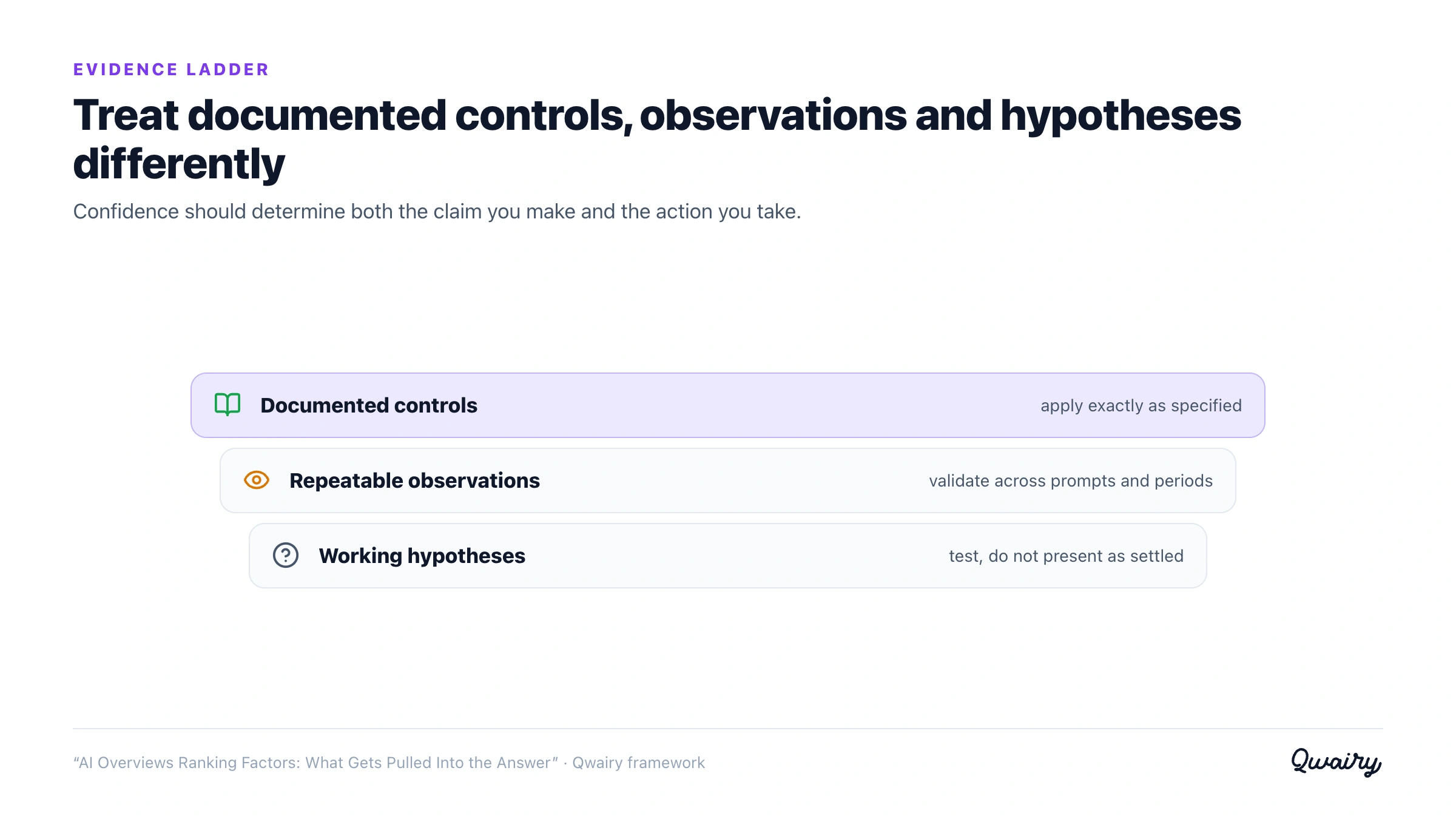
The AI Overview SERP is full of confident claims built on very different levels of evidence. Label every tactic before it enters the roadmap.
Tier | Evidence | How to use it |
1. Confirmed requirement or control | Google documentation on crawling, indexing, textual availability, internal links, preview controls, and structured-data parity | Implement as a baseline requirement. A failure can directly exclude or limit the page. |
2. Repeated observational signal | Independent citation studies, correlation research, and recurring patterns across tracked queries | Prioritize as a strong hypothesis, then validate against your own prompt set. |
3. Practitioner hypothesis | Anecdotes, isolated tests, vendor claims, and mechanisms inferred from adjacent search behavior | Run a bounded experiment. Do not present it as a ranking factor. |
Apply one rule: no tactic enters the backlog without an evidence tier and a falsifiable outcome. “Add llms.txt” becomes Tier 3 with a crawler-log test. “Make important content available as text” is Tier 1 with a rendered-HTML check. “Increase branded mentions” is Tier 2 with a citation-share baseline and a defined outreach cohort. This ladder is the difference between an evidence-based AI Overview program and a checklist that merely repeats the market's latest theory.
See your mentions across ChatGPT, Claude and Perplexity in real time, the moment buyers ask.
Run this as a repeatable pass on any priority page or query cluster.
You can't optimize what you can't see, and AI Overviews are notoriously hard to observe by hand - they vary by query, location, and moment. Google's Search Console folds AI-feature impressions into the overall "Web" search type, so it won't isolate AI Overview presence or tell you which passages got cited. That visibility gap is the problem Qwairy is built to close: tracking whether and where you appear across AI engines and AI Overviews, which of your URLs and passages get cited, how your citation share compares with competitors, and how that presence trends over time. Instead of spot-checking queries in an incognito window, you get a measurable baseline to act on - and an agent-native interface so your own tooling can query the same data. If the goal is to be in the answer, the first step is being able to prove whether you are.
Turn the factors into a workflow: Use the canonical Google AI Overview optimization guide , troubleshoot pages that are missing from AI Overviews , and expand coverage for Google AI Mode and query fan-out .
There is no secret AI Overviews ranking factor - and that's good news, because it means the levers are knowable. Be retrievable and relevant enough to be a candidate (strong organic base, clean crawlability), then be the passage worth citing (answer-first structure, off-site authority, entity clarity, trust, and freshness where it counts). The single most underrated move is building genuine brand presence across the web, since that correlates more strongly with AI visibility than backlinks ever did. Optimize for being the best, most extractable answer - and measure relentlessly, because in a feature this volatile, monitoring is the strategy.
There's no official list, but the evidence points to a consistent set: strong existing organic rankings, passage-level relevance to the specific sub-question, clean answer-first structure that's easy to extract, off-site authority and brand mentions, E-E-A-T/trust signals (especially for YMYL topics), and freshness for time-sensitive queries. Think of it as two stages - being retrievable, then being the passage worth citing.
No. Google's own documentation states there is no special structured data, markup, or AI text file required to appear in AI Overviews or AI Mode. Schema can still help Google understand your content and support eligible search features, but it is not a hidden switch. Chrome Lighthouse describes llms.txt as optional and does not present it as an AI Overview inclusion signal.
No. Ahrefs' most recent analysis (March 2026, 4 million URLs) found that only 37.9% of AI Overview citations also rank in the top 10 - down from 76.1% in its July 2025 study. Ranking still helps, but the majority of citations now go to pages outside the top 10, so passage relevance and extractability matter more than position.
Usually extractability or specificity. AI Overviews cite passages, not domains, so if a lower-ranked competitor answers the exact sub-question more directly and self-containedly, their passage can win the citation. Off-site authority and freshness can also tip the balance. Rewrite the relevant section answer-first and check that a single clean block fully answers the question out of context.
They appear to matter substantially. An Ahrefs study of 75,000 brands found branded web mentions strongly correlated with AI visibility, including a 0.656 Spearman correlation for AI Overviews. That does not prove causation, but it supports investing in relevant, authoritative mentions and consistent entity naming instead of chasing backlink volume alone.
Search Console reports AI-feature traffic within the overall "Web" search type but won't isolate AI Overview presence or cited passages, and manual checks are unreliable because results vary by query, location, and time. A dedicated AI-visibility platform such as Qwairy monitors where you appear across AI engines and AI Overviews, which URLs get cited, and how your citation share trends against competitors - turning a guessing game into a measurable baseline.
Track your mentions across ChatGPT, Claude, Perplexity and all major AI platforms. Join 1,500+ brands monitoring their AI presence in real-time.
Free trial • No credit card required • Complete platform access
Other Articles
Answer Engine Optimization (AEO): The Complete 2026 Guide
A complete, practitioner-level guide to Answer Engine Optimization: what AEO is, how answer engines like ChatGPT, Perplexity and Google AI Overviews select and cite content, the core levers, a step-by-step workflow, and how to measure it.
How to Set Up AI Referral Tracking in GA4, Plausible and Matomo
Most analytics tools miss or misclassify AI referral traffic by default. This step-by-step guide shows you how to properly track visits from ChatGPT, Perplexity, Claude, Gemini, and other AI platforms in GA4, Plausible, and Matomo.