
Loading page
Speed-first framework to get cited by ChatGPT, Perplexity, and Claude. Based on 950K AI citations and 102K query analysis. Actionable tactics with timeline.
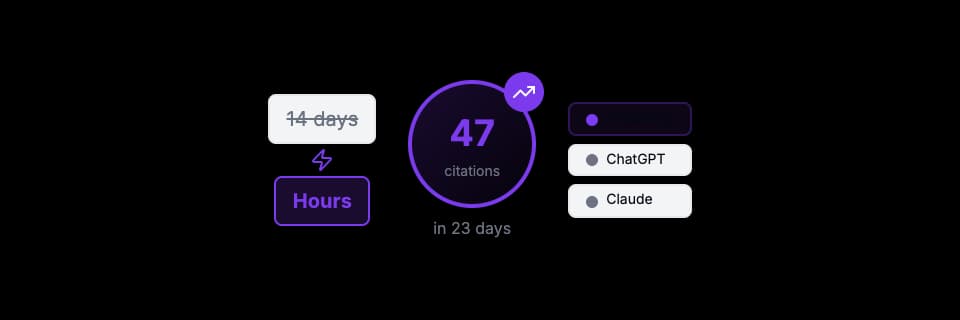
TL;DR: The fastest path to AI citations is structured content + immediate indexing + Perplexity-first validation. Analysis of 950K citations shows 97.5% come from specialized sites, not Wikipedia or Reddit.
AI citation patterns are not random. When multiple sources cover the same topic, AI models develop preferences based on which source they encounter first with sufficient quality signals.
The citation lock-in effect:
Phase | What Happens | Timeline |
Discovery | AI encounters your indexed content | Day 1-7 |
Initial citation | AI cites you in responses | Week 1-2 |
Pattern formation | AI associates your content with the topic | Week 2-4 |
Reinforcement | Subsequent queries reinforce the pattern | Ongoing |
Competitors publishing similar content weeks later must surpass established sources—matching quality isn't enough.
Supporting data: Conductor's 2026 AEO/GEO Benchmarks found optimized content is discovered up to 10x faster by generative engines than content relying on organic crawling alone.
Different AI platforms have different architectures, which determines citation speed.
Platform | Architecture | Time to First Citation |
Perplexity | Real-time web search | Hours to days |
Google AI Overviews | Google Search index | Hours to days for websearch |
ChatGPT (browsing) | Bing or Google (most probably) | Hours to days for websearch / Month if websearch is not activated |
Gemini | Google ecosystem | Hours to days / Month if websearch is not activated |
Claude | Training data + search | Hours to days for websearch / Month if websearch is not activated |
Perplexity searches the live web for every query—no training data delay. If your content is indexed, Perplexity can cite it within hours. This makes Perplexity the optimal validation platform:
Fastest feedback loop (hours vs weeks)
Tactics that work on Perplexity transfer to other platforms
Higher citation density (21+ sources per response vs 8 for ChatGPT)
From our 102K query analysis : Perplexity generates 2.24 query fan-out per prompt (70.5% single-query), meaning ranking for the exact query matters most. ChatGPT generates 3.51 queries per prompt, requiring broader semantic coverage.
Before optimizing, understand where citations come from.
Source Type | Share of Citations | Average Position |
Specialized vertical sites | 97.5% | 5.25 |
Wikipedia | 1.7% | 3.28 |
Academic sources | 0.4% | 4.38 |
Forums | 0.2% | 6.16 |
Reddit | 0.1% | 7.30 |
Source: Qwairy 950K Citations Analysis , Q3 2025
Wikipedia: High positioning (3.28 average) but low volume (1.7%). AI uses Wikipedia as a "foundation layer" for context, then pivots to specialized sources for specific information.
Reddit: Not a citation driver at 0.1% share. Appears late in responses (position 7.30) as supplementary content, not primary source.
Specialized sites: 97.5% of citations come from sites with deep vertical expertise—not broad generalist content.
Run a free audit: see if ChatGPT, Gemini and Copilot recommend you, in about a minute.
Not all content has equal citation potential. Prioritize based on:
Signal | What It Means | Priority |
Competitors cited, you're not | Direct citation opportunity | Highest |
Few authoritative sources cited | Low competition | High |
High search volume | More AI queries on topic | Medium |
Time-sensitive topic | Freshness advantage | Medium |
How to find gaps:
AI models don't read content—they extract snippets. Structure determines extraction probability.
Content formats ranked by extractability:
Format | Extractability | Best Use Case |
Comparison tables | Highest | Product/feature comparisons |
Pricing tables | Highest | Cost information |
Step-by-step lists | High | How-to processes |
FAQ pairs | High | Direct Q&A |
Definition boxes | High | Concept explanations |
Prose paragraphs | Low | Narrative context |
The optimal template:
## [Question as H2]

**Short answer:** [Direct answer in 1-2 sentences with key data]

| Factor | Value | Source |
|--------|-------|--------|
| Data point 1 | X | Link |
| Data point 2 | Y | Link |

### Detailed Explanation

[Comprehensive analysis for readers who want depth...]
Why this works: Princeton's GEO research found:
TL;DR in first 60 words = +35% citation probability
Structured hierarchies = +40% citation probability
Statistics with sources = +115% citation likelihood
AI can only cite indexed content. The gap between publishing and indexing is where competitors win.
Indexing methods compared:
Method | Time to Index | Best For |
Wait for crawl | 7-14 days | Low-priority pages |
Google Search Console URL Inspection | 1-3 days | Individual pages |
IndexNow (Bing/Yandex) | Hours to 1 day | Bing-dependent platforms |
Google Indexing API | Minutes to hours | News, job postings (limited) |
Priority pages to index immediately:
New cornerstone content (guides, comparisons)
Updated pricing or product information
Content targeting high-gap queries
Pages with new backlinks (the backlink page needs indexing too)
See your mentions across ChatGPT, Claude and Perplexity in real time, the moment buyers ask.
Don't publish and hope. Validate citation appearance systematically.
Validation checklist:
Day | Action | What to Check |
1 | Publish + index | Confirm indexation in Search Console |
3 | Search Perplexity | Does your content appear? What position? |
7 | Search ChatGPT (browsing) | Any early citations? |
14 | Full audit | Compare your citations vs competitors |
If not cited after 14 days:
Check if page is actually indexed
Compare your content structure to cited competitors
Add missing data/tables that competitors have
Update with fresher statistics and re-index
AI systems automatically inject temporal signals into queries.
From our 102K query analysis :
Finding | Data |
Queries with year added automatically | 28.1% |
"2026" vs "2025" frequency | 184x more "2026" |
Freshness boost for time-sensitive queries | ~3x more citations |
Freshness sensitivity by content type:
Content Type | Update Frequency | Freshness Impact |
Product comparisons | Monthly | Very High |
Pricing information | When changed | Very High |
Statistics/benchmarks | Quarterly | High |
How-to guides | Quarterly | Medium |
Concept definitions | Annually | Low |
Implementation:
dateModified schema when making substantive updates90% of ChatGPT citations come from outside the top 20 search results. Only 20% of AI citations overlap with the #1 Google result.
Fix: Prioritize content structure and extractability alongside ranking efforts.
Many focus only on ChatGPT because it has 87% of AI referral traffic. But Perplexity's real-time search provides the fastest feedback loop.
Fix: Use Perplexity as your validation platform. What works there transfers to other AI platforms.
Waiting for organic crawling costs 7-14 days. During that time, competitors can establish citation patterns.
Fix: Submit important pages for indexing immediately after publishing.
AI extracts snippets, not full paragraphs. Information buried in prose has low extraction probability.
Fix: Lead with tables, TL;DR, and structured data. Put prose explanations below.
This guide synthesizes:
950K Citations Analysis : Source distribution across ChatGPT, Perplexity, Gemini, Claude (Q3 2025)
102K Query Fan-Out Study : How AI rewrites and expands user queries (Sept-Nov 2025)
Princeton GEO Research : Citation boost factors from content optimization
Conductor 2026 AEO/GEO Benchmarks : Market data on AI search behavior
Want to track your AI visibility automatically? Qwairy monitors brand citations across 10+ AI platforms and identifies content gaps.
Track your mentions across ChatGPT, Claude, Perplexity and all major AI platforms. Join 1,500+ brands monitoring their AI presence in real-time.
Free trial • No credit card required • Complete platform access
Other Articles
Answer Engine Optimization (AEO): The Complete 2026 Guide
A complete, practitioner-level guide to Answer Engine Optimization: what AEO is, how answer engines like ChatGPT, Perplexity and Google AI Overviews select and cite content, the core levers, a step-by-step workflow, and how to measure it.
How to Set Up AI Referral Tracking in GA4, Plausible and Matomo
Most analytics tools miss or misclassify AI referral traffic by default. This step-by-step guide shows you how to properly track visits from ChatGPT, Perplexity, Claude, Gemini, and other AI platforms in GA4, Plausible, and Matomo.