
Loading page
A complete, data-backed guide to Generative Engine Optimization (GEO) for SEOs. Covers how LLMs consume and select content, semantic optimization, E-E-A-T signals, page typology, and content maintenance — with primary sources throughout.
For the past two decades, getting found online meant one thing: ranking on Google. As SEO’s we optimized our title tags, built backlinks, analyzed search intent, and we prayed to the algorithm gods. That playbook still matters — but it's no longer enough. A growing share of search is happening inside AI engines. ChatGPT, Perplexity, Google AI Overviews, Gemini. These systems don't rank pages. They read them, extract what's credible, and cite sources they find useful. The signals they respond to overlap with SEO, but they are not identical. And the trend is only accelerating: ChatGPT grew its weekly active user base from approximately 100 million in January 2024 to approximately 780 million by September 2025 as mentioned on this study . Also a large-scale analysis of 815,000 query-page by Kevin Indig found that the "ultimate guide" strategy (covering every possible subtopic) produces worse citation results than a focused, shorter page. Pages covering 26–50% of subtopics get cited more than pages covering 100%. After reading +100 different studies about how LLMs rank content and analyzing +1 million queries for our own studies we decided to build this massive guide on how to create content that get cited by LLMs. This guide covers what the data actually says: how LLMs consume and select content, how structure and semantic density drive extractability, how E-E-A-T signals work differently in a generative context, and what a realistic GEO content workflow looks like in 2026.
Before optimizing for GEO, you need to understand something fundamental: LLMs don't consume content the way Google does. Google crawls your page, indexes it, and scores it against hundreds of ranking signals. An LLM does something structurally different. When a user asks a question, the model either answers from memory — its training data — or retrieves content in real time, extracts the most relevant passages, and synthesizes a response. These are two completely separate pathways, and they require different optimization strategies.
Before optimizing for GEO, you need to understand something fundamental: LLMs don't consume content the way Google does. Google crawls your page, indexes it, and scores it against hundreds of ranking signals. An LLM does something structurally different. When a user asks a question, the model either answers from memory (its training data) or retrieves content in real time, extracts the most relevant passages, and synthesizes a response. These are two completely separate pathways, and they require different optimization strategies.
Pathway 1: Parametric knowledge (memory)
This is what the model learned during training. If your brand, your content, or your ideas were frequently cited in high-authority sources before the model's training cutoff, there's a good chance the model has encoded some representation of that. As of February 2026, according to a study from Semrush, ChatGPT enables its web search feature on just 34.5% of queries — down from 46% in late 2024 — meaning most responses still rely on training data alone. For the majority of queries, no retrieval happens at all. The model answers from what it already knows. This has an underappreciated implication: brand mentions in authoritative publications, Wikipedia, industry reports, and high-traffic sites don't just build SEO authority. They shape what LLMs "know" about you at a parametric level. Digital PR and off-site presence matter for GEO in a way that goes beyond backlinks.
Pathway 2: Retrieval-Augmented Generation (RAG)
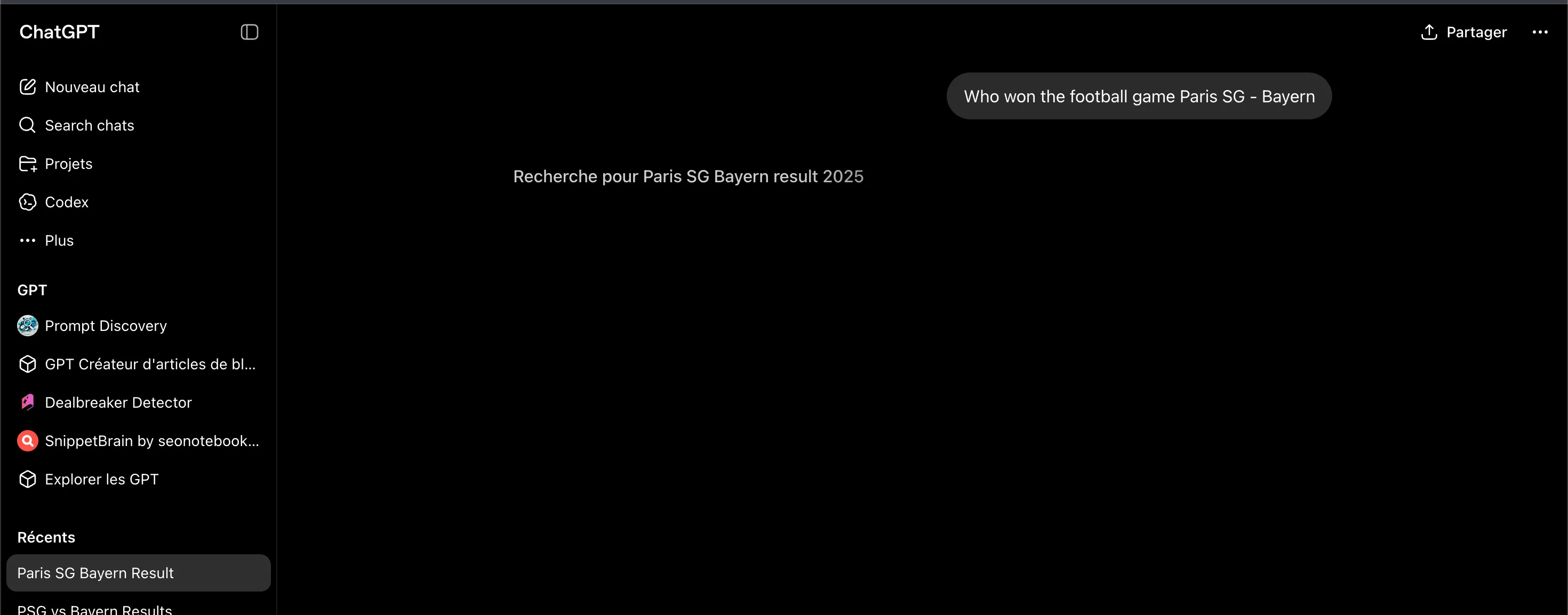
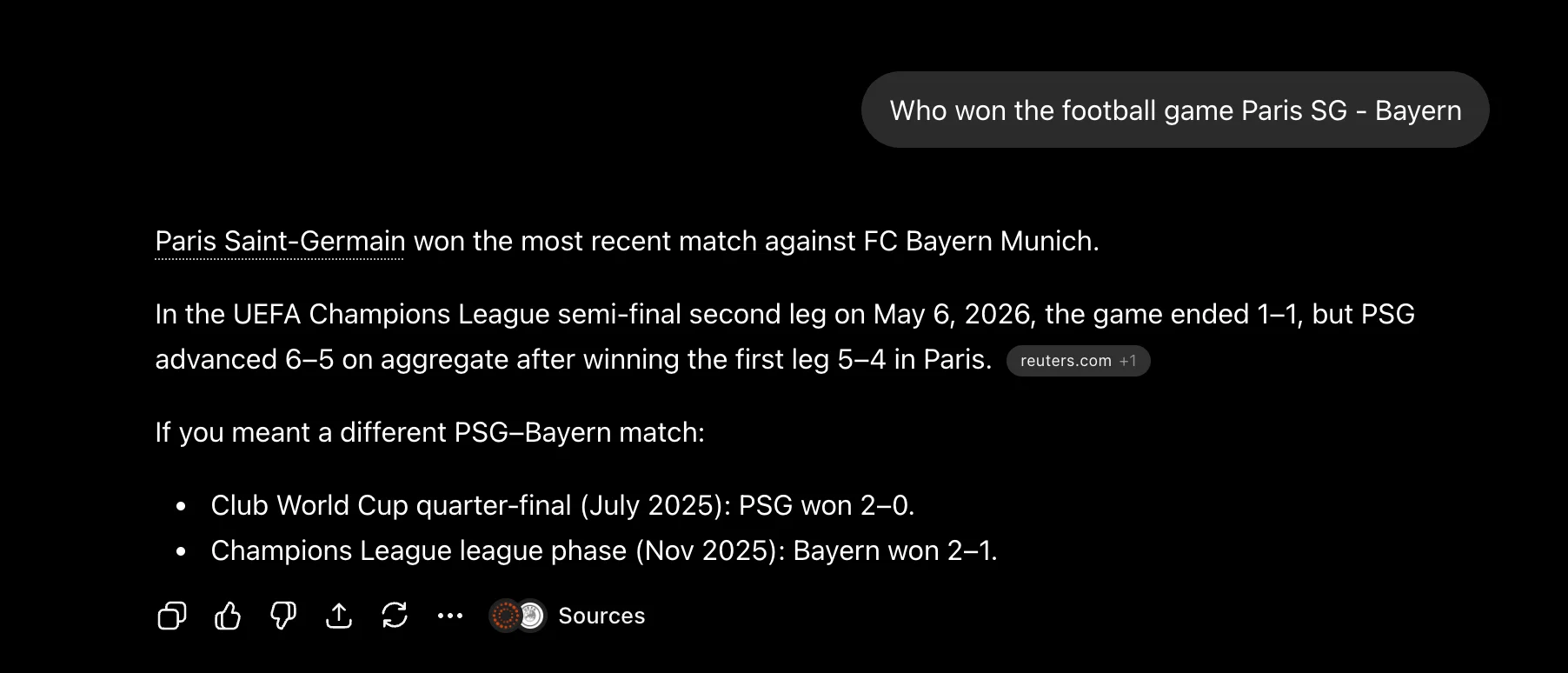
When a query requires fresh or specific information, the model triggers a web search, retrieves a set of URLs, reads the content, and selects what to include in its response. But it doesn't just run one search. It decomposes your query into multiple sub-queries — what's known as query fan-out — and runs them simultaneously before synthesizing an answer.
An analysis of 102,018 AI queries by Qwairy found that query fan-out behavior varies significantly by provider: Perplexity generates exactly one search query for 70.5% of prompts, while ChatGPT does the same for only 32.7% — meaning ChatGPT far more frequently breaks a single user question into multiple parallel sub-searches.
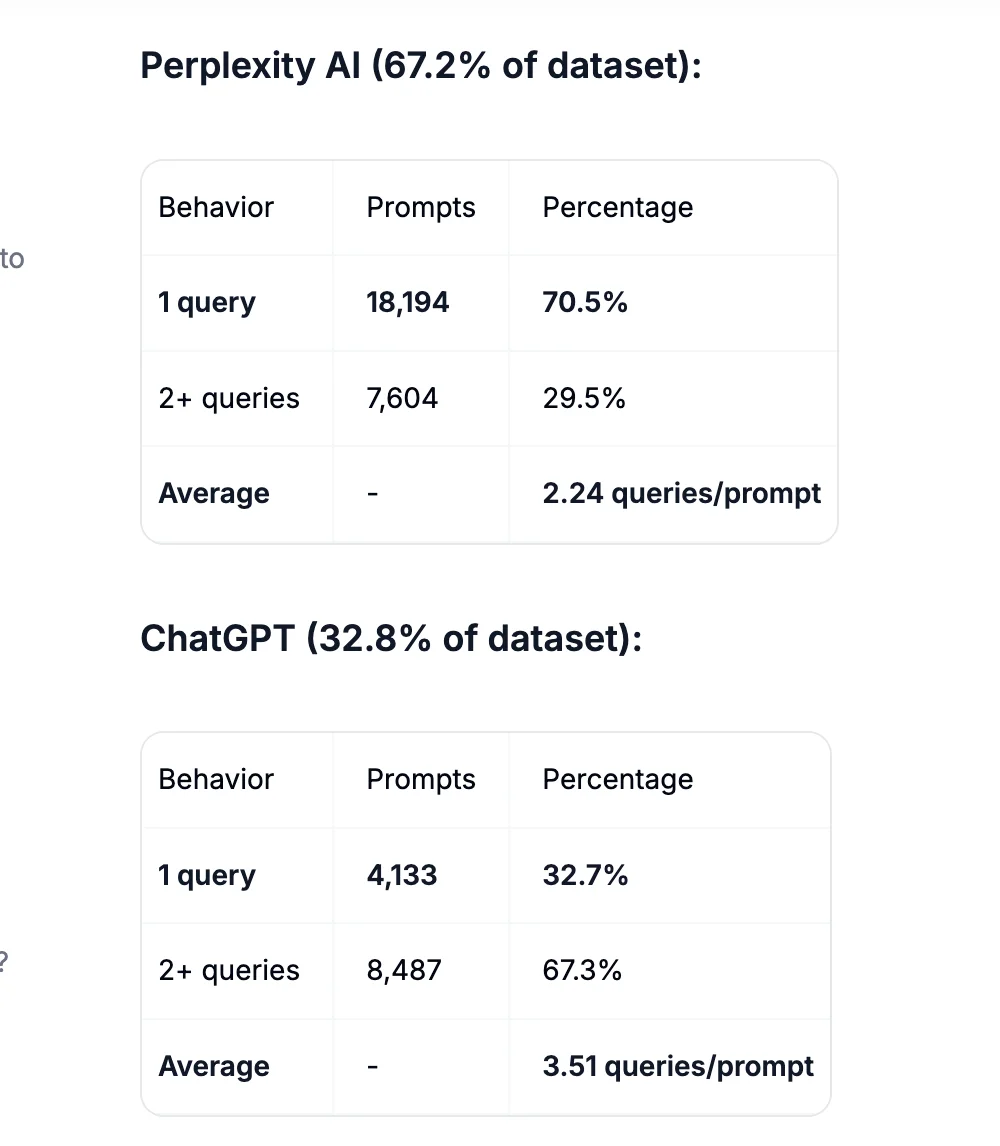
The practical implication: a brand that covers only the surface-level framing of a topic may show up for Perplexity, but be consistently invisible in ChatGPT because it's missing the sub-query variations ChatGPT actually retrieves. Prompts containing words like "top" or "best" generate up to 14x more sub-queries than simple factual questions — meaning competitive, commercial queries are exactly where broad topical coverage matters most. This is where your content structure becomes critical. The model doesn't read your page the way a human does — top to bottom, with patience. It extracts chunks. Content structured so that individual paragraphs can stand alone as citable units — each one comprehensively answering a potential query — performs significantly better in retrieval pipelines. A wall of interlinked prose that requires reading three sections to understand one point is expensive to process. A competitor who makes the same point in two clean, self-contained sentences will get cited instead.
The cost-of-extraction principle This is the core mental model for GEO. Every AI engine — whether it's ChatGPT retrieving via Bing (or Google), Perplexity crawling its own index, or Google AI Mode pulling from its search graph — is making a cost-benefit calculation when it decides what to cite. The benefit is the quality and relevance of your content. The cost is how much computational effort it takes to extract that value. Poor HTML structure, JavaScript-rendered content, bloated code from copy-pasted Google Docs, dense unbroken paragraphs — all of these raise the extraction cost. And unlike a human reader who might push through out of interest, if you don't structure your content in the way LLMs prefer, you simply won't get cited — because a competitor who does will always be the lower-cost option. Here's what lowering that cost looks like in practice:
Use semantic HTML5 properly. Don't just make text look like a heading by bolding it and increasing the font size. Use actual <h1>, <h2>, <h3> tags in a coherent hierarchy. Wrap your main content in a <main> tag, use <article> for editorial content, <header> and <footer> where appropriate. These tags don't just help humans navigate — they tell the retrieval system exactly what part of the page to prioritize. A page where the main content is clearly labelled costs less to parse than one where everything lives inside generic <div> containers.
Keep your heading hierarchy readable as a standalone outline. If someone reads only your H1, H2s and H3s in sequence, they should understand what the article covers and what each section answers. Three to five levels of headings is the practical range. Beyond that, you're adding structure that doesn't help navigation — it adds noise. Think of it as the table of contents of a well-edited book: clear, logical, self-explanatory.
Avoid JavaScript-rendered content for anything you want cited. When a page's content is generated client-side by JavaScript, a retrieval system that doesn't execute JS will see an empty page. Some crawlers handle this — but it's slower, more expensive, and less reliable. If you're using a modern JS framework like Next.js or Nuxt, use server-side rendering (SSR) so the HTML is fully formed when the crawler arrives. The content needs to exist in the raw HTML response, not appear after the browser runs a script.
Clean up your markup before publishing. This is more impactful than it sounds. We ran a token count test on a real WordPress article using Gutenberg — the same editorial content, compared in two versions: the raw Gutenberg output versus a cleaned semantic HTML version. The results:
Gutenberg (original) | Clean HTML | |
Characters | 11,503 | 8,994 |
Estimated tokens | ~2,875 | ~2,248 |
Reduction | −21.8% |
The difference came entirely from markup noise — not content. Gutenberg generated 94 block comments (<!-- wp:paragraph -->, <!-- /wp:paragraph --> and so on), 6 redundant <strong> tags nested inside heading tags, and 4 presentational classes on headings. Zero editorial value. Pure processing overhead.
That 22% of tokens the LLM had to process contained no information whatsoever. On a longer article, or on a site with thousands of pages, that overhead compounds. You can verify the token count of any page yourself using OpenAI's public tokenizer — paste your raw HTML source and compare it against a cleaned version.
Write in self-contained paragraphs. Each paragraph should make a complete point that can be extracted and cited independently. If understanding paragraph four requires having read paragraphs one through three, you've written prose — not citable content. This doesn't mean oversimplifying. It means restating context where necessary, defining terms when you introduce them, and treating each paragraph as a unit that could theoretically stand alone in someone else's answer. Think Lego bricks, not a single poured concrete slab.
The "Lost in the Middle" effect
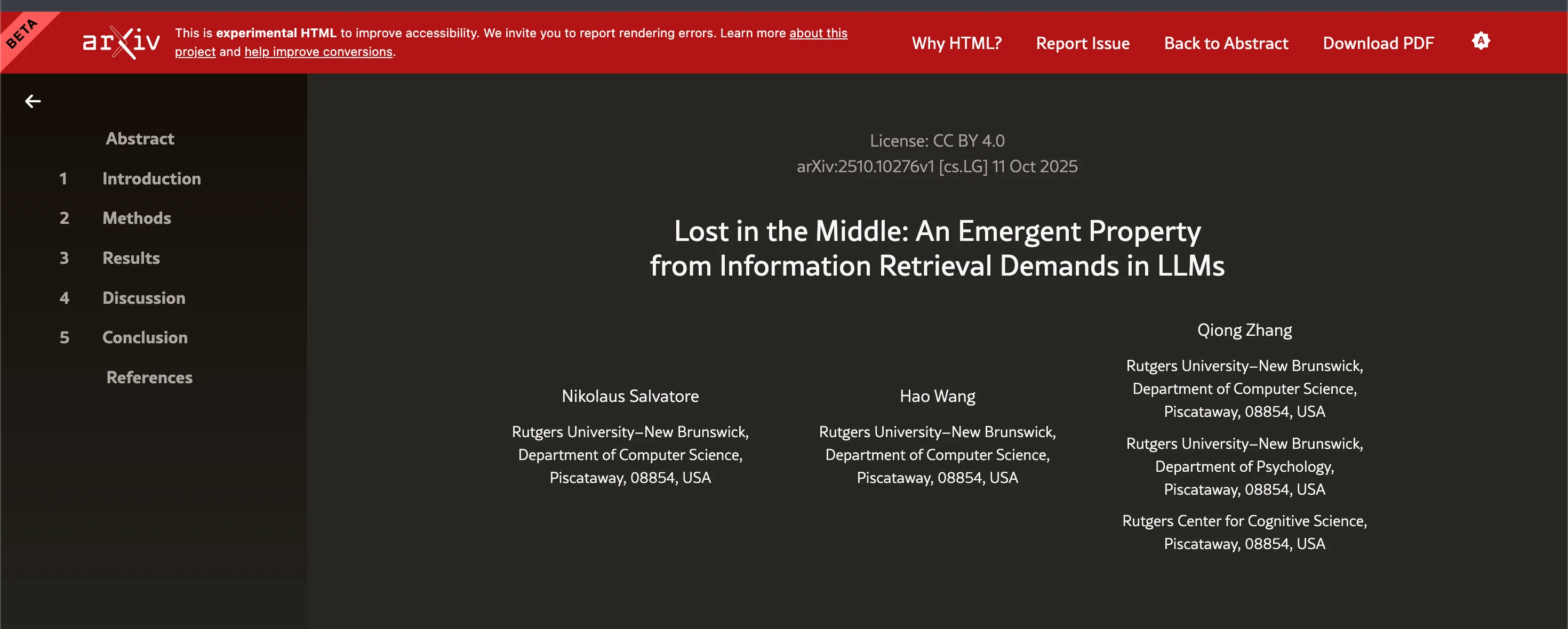
There's a well-documented bias in how LLMs process long documents. Research shows that LLMs exhibit a "lost in the middle" phenomenon: accuracy drops significantly for information located near the center of the context window, while content at the beginning and end receives disproportionately more attention. This follows a U-shaped curve — performance is strong at the start, degrades through the middle, then recovers at the end — and has been consistently observed across GPT-3.5, Claude, and other major models. For content creators, this translates to one concrete rule: the answer goes first. Your most important claim, definition, or insight belongs in the opening lines of every section — not buried after three paragraphs of context-setting. The middle of your article will always receive less weight. That doesn't mean you shouldn't write it. It means you shouldn't rely on it.
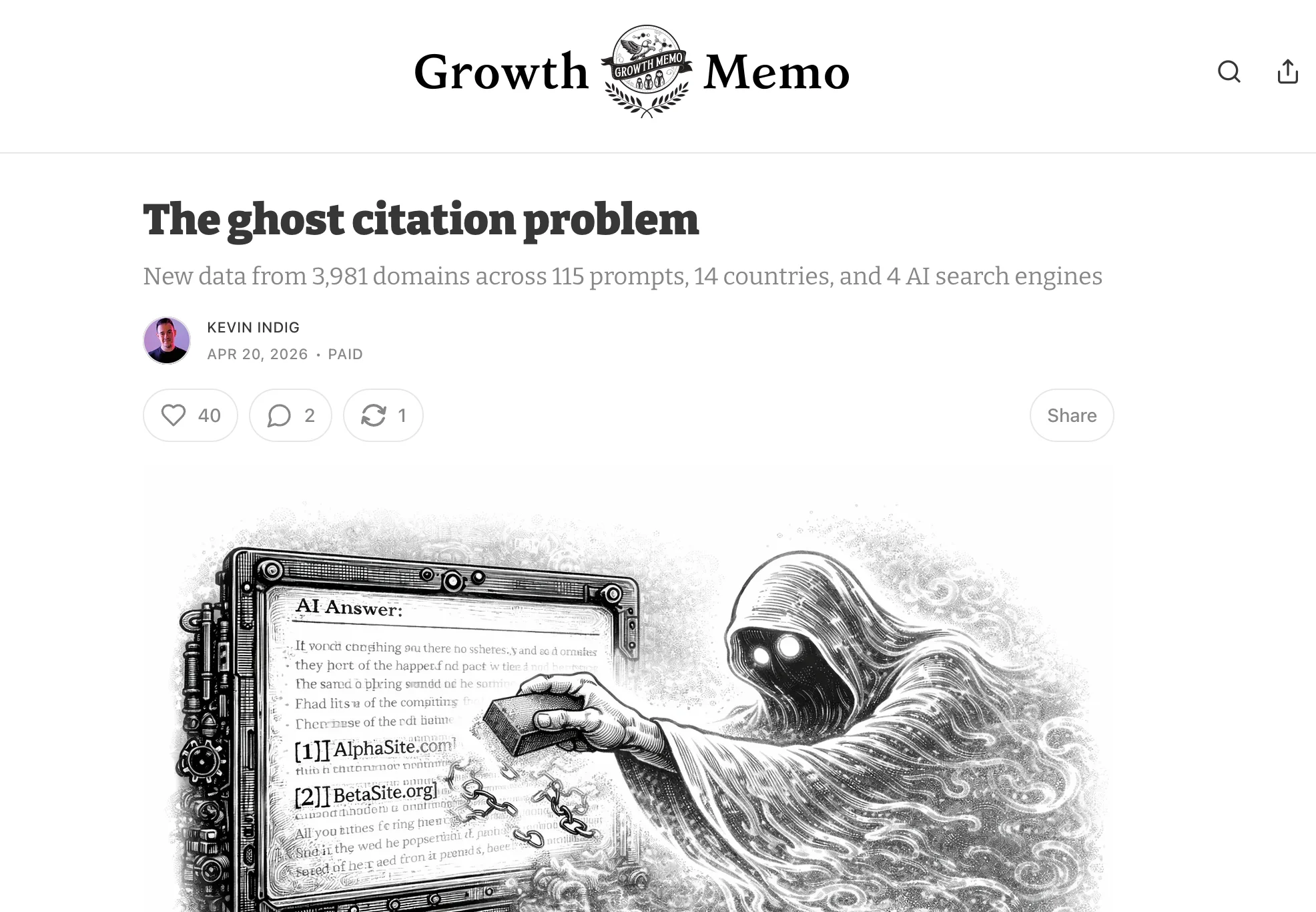
Each engine works differently One thing the data makes clear is that ChatGPT, Perplexity, Google AI Overviews, and Gemini are not interchangeable targets. Research across 3,981 domains by Kevin Indig found that Gemini names brands in 83.7% of appearances but only generates a citation link 21.4% of the time, while ChatGPT is the inverse — it cites 87.0% of the time but mentions brands in only 20.7% of answers. Optimizing for one does not automatically help with the other.
Perplexity is designed as a citation-first engine and shows the strongest alignment with Google's top organic results. ChatGPT applies its own selection layer on top. Google AI Mode draws from Google's own index but with looser URL-level overlap than AI Overviews. These are different retrieval architectures with different biases — a point we'll return to throughout this guide. Understanding this landscape is the prerequisite for everything that follows. GEO isn't about gaming a single system. It's about making your content structurally easy to extract, semantically clear, and credible enough that any retrieval system — regardless of its underlying architecture — finds it worth citing.
Understanding how LLMs read content is one thing. Changing how you write it is another. This section covers the three structural principles that have the most direct impact on citation rates and that require no technical knowledge to implement.
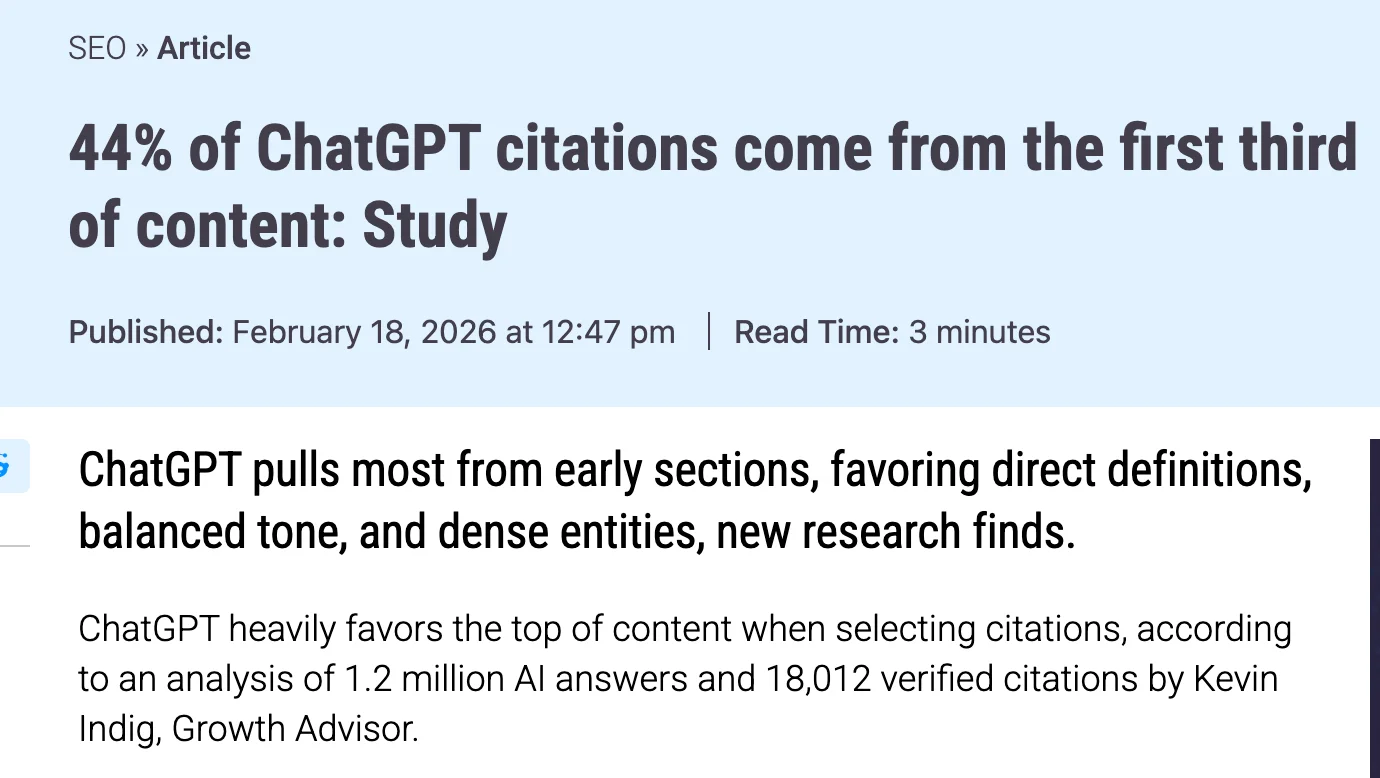
BLUF stands for Bottom Line Up Front. It's a communication principle borrowed from the military: state the most important information first, then provide the context and reasoning. For content GEO, it's not a stylistic preference — it's a technical requirement. The data behind this is unusually clear. An analysis of 1.2 million ChatGPT responses and 18,012 verified citations by Kevin Indig found that 44.2% of all citations originate from the first 30% of webpage content — a pattern he describes as a "ski ramp" distribution that held across all validation batches with statistical significance. The beginning of your content is disproportionately where citations come from. The middle is where they go to die.
This connects directly to the study Lost in the Middle effect covered in Part 1 . But the implication here is editorial, not technical: the way most SEO content has been written for the past decade - with a long introduction, gradual context-setting, and the key insight buried three scrolls down - is structurally misaligned with how LLMs extract information. Content that forces a retrieval system to parse 500 words of backstory before finding the answer is consistently retrieved less frequently for definition-based queries. In 2026, content that requires a "scroll for value" interaction is often abandoned by retrieval agents entirely. The fix is straightforward to describe, harder to internalize if you've spent years writing the other way:
Every article should open with a direct, 40–60 word answer to the question it targets — before any context, history, or framing.
Every H2 section should open with its conclusion in the first sentence. State what the section establishes, then explain why.
Never save the insight for the end. A conclusion that only appears in the final paragraph will rarely be cited, regardless of its quality.
Cited content was also found to be 2x more likely to include a question mark, and 78.4% of citations tied to questions came from headings — suggesting that AI often treats H2s as prompts and the paragraph immediately following as the answer. If your headings are vague labels ("Background", "Overview", "More information") rather than direct questions or declarative statements, you're leaving citations on the table.
RAG pipelines don't read your article. They extract chunks — typically at the paragraph or heading-section level — and evaluate each chunk independently for relevance to the query. This has a concrete implication for how you write. If your paragraphs are too long or cover multiple ideas, models struggle to decide which sentence best answers a query. Short, self-contained paragraphs give LLMs clear boundaries and make it easier to extract relevant insights without losing context. Think of each paragraph as a Lego brick. A brick has a defined shape and connects cleanly to others. It can be picked up and used independently. A paragraph that requires the reader to have absorbed the three paragraphs before it to make sense is not a brick — it's part of a pour. You can't extract it. You can't cite it cleanly. An LLM faced with that paragraph will either reformulate it heavily or find a better-structured competitor. In practice, this means:
One idea per paragraph. If a paragraph makes two distinct points, split it.
Restate context where necessary. Don't assume the reader has read the previous section. If a paragraph references "this method," name the method again explicitly.
Define terms on first use within a section, not just at the article level. A term defined in your introduction may not be in context when a retrieval system extracts your fourth section independently.
Keep paragraphs to 40–80 words as a working target. Long enough to be substantive, short enough to be extractable as a single unit.
This is the biggest writing habit to break for experienced SEO content writers. The flowing, connective prose style that reads well as a long-form article — with callbacks, anaphora, and ideas that build across paragraphs — is actively penalized in retrieval contexts. Readability for humans and extractability for machines are not always the same thing. Where they conflict, structure wins.
Your heading structure should function as a table of contents that a machine — or a human skimming in three seconds — can use to understand the full scope of your article without reading a single body paragraph. Pages with headlines that directly answer the question get cited 41% of the time. Pages with loosely related headlines drop to 29%. That 12-point gap comes entirely from how well the heading matches the query — not from word count, domain authority, or the quality of the body text beneath it. The practical rules:
Use 3 to 5 levels of headings maximum. H1 for the article title, H2 for major sections, H3 for subsections within those. Beyond H4, you're adding hierarchy that adds cognitive load without aiding navigation. More levels means more noise for a retrieval system trying to understand your content architecture.
Write headings as direct answers or direct questions, not labels. Compare:
❌ <h2>Page Speed</h2>
✅ <h2>Does page speed affect LLM citation rates?</h2>
❌ <h2>E-E-A-T Overview</h2>
✅ <h2>How E-E-A-T signals influence GEO visibility</h2>
The first version tells the machine a topic. The second tells it a claim or a question — which is what a retrieval system is actually looking for when it evaluates whether your content matches a user query.
Read your headings in sequence without the body text. If the outline doesn't make logical sense on its own — if you can't follow the argument from H1 to final H2 without reading a single paragraph — your structure needs work. A well-structured article is navigable at the heading level alone. That navigability is exactly what makes it easy for a retrieval system to identify the right chunk to extract for any given sub-query.
There's a category of content changes that stands apart from all others in GEO research: they require minimal rewriting, apply to almost any content type, and have the most consistent impact across different LLMs and query domains. They are also the most frequently ignored by content teams focused on structure and semantics. Adding precise statistics and expert citations to your content is the highest-ROI GEO tactic available. Here's what the evidence actually says.
What the Princeton Study Found The foundational GEO research — published at KDD 2024 by teams from Princeton University, IIT Delhi, Georgia Tech, and the Allen Institute for AI — tested multiple content optimization strategies across a large-scale benchmark of diverse queries. Three strategies consistently outperformed all others across domains: adding citations from reliable sources, incorporating quotations from relevant experts, and including precise statistics. These three methods boosted source visibility by up to 40% in generative engine responses, while requiring minimal changes to the underlying content. Two things are worth noting about these findings before applying them. First, the magnitude varies by domain. Citation optimization was most effective for factual search queries. Statistics addition proved especially beneficial for law and government-related content. The "authoritative" optimization — using more persuasive language — worked best for historical content. The principle applies broadly, but the emphasis shifts depending on your topic area. A legal publisher and a SaaS company should weight these tactics differently. Second, the study measured visibility in generative engine responses — meaning word-level presence in the AI's answer, not just whether you received a citation link. This distinction matters. The goal isn't just to be listed as a source. It's to have your specific content surfaced in the answer itself.
Run a free audit: see if ChatGPT, Gemini and Copilot recommend you, in about a minute.
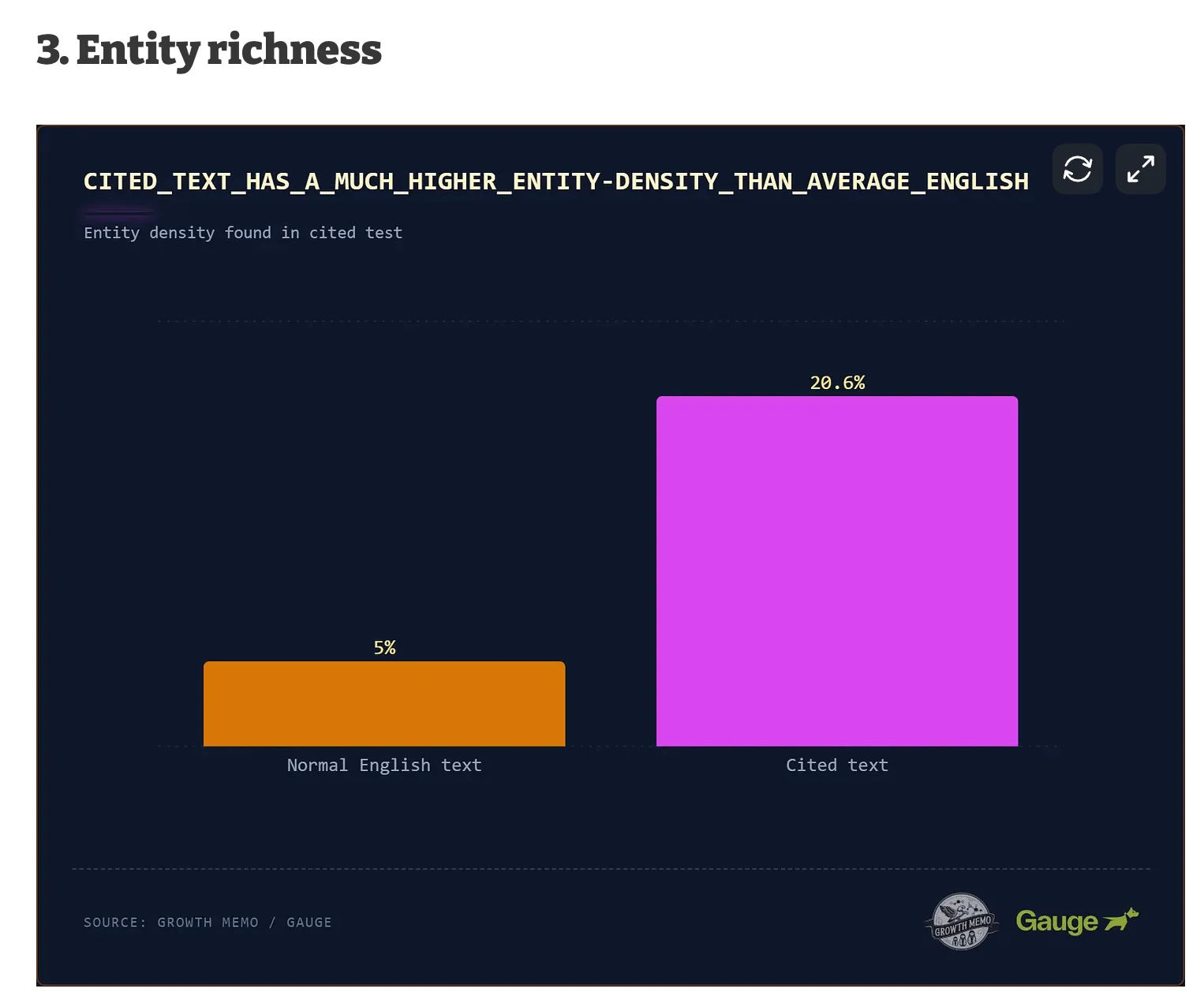
When an LLM synthesizes an answer, it is trying to provide the most verifiable, information-dense response possible. A specific statistic — a named number, with a named source, from a named date — does three things simultaneously: it grounds the claim, it signals source quality, and it gives the model something concrete to extract and attribute. Heavily cited content has an entity density of 20.6% , compared to 5–8% for normal English text. LLMs prioritize sentences that contain anchors — proper nouns, brands, specific figures — because they lower the perplexity of the answer. A sentence with three entities carries more information bits than a sentence with zero.
In practice, this means replacing vague references with specific, named ones:
❌ "a popular tool" → ✅ "Screaming Frog"
❌ "a recent study" → ✅ "an Ahrefs study from July 2025"
❌ "some companies" → ✅ "HubSpot, Salesforce, and Pipedrive"
❌ "many queries" → ✅ "53.5% of commercial queries"
This is not keyword stuffing — it's the opposite. It's replacing vague language with precise, citable units that give the model something concrete to extract and attribute. "Conversion rates improved" gives a model nothing to work with. "Conversion rates improved by 34% over 90 days, according to a 2025 HubSpot benchmark study" gives it a number, a timeframe, and a named source — all in one sentence. That's a citable unit. The practical rule: never state a quantifiable claim without a number, and never state a number without a source. Vague claims get absorbed into the answer anonymously. Sourced statistics get extracted and attributed.
The mechanism behind expert quotes is slightly different. It's not primarily about entity density — it's about credibility transfer. LLMs are designed to provide evidence-based responses. When evaluating competing sources on the same topic, a model will favor content that demonstrates it has engaged with authoritative voices in the field. An expert quote signals that the content is not just an opinion — it is an opinion anchored to a named, verifiable person with relevant standing. The Princeton study listed quotation addition among the top three GEO strategies , alongside cite sources and statistics addition. These 3 strategies can boost content visibility up to 40%. Good thing: All three requiring minimal changes to actual content while significantly improving visibility in generative engine responses. This also connects to the E-E-A-T framework we'll cover in Part 4. An article that quotes a named researcher, practitioner, or industry authority on a contested point is structurally more credible than one that paraphrases the same information without attribution. The quote serves as social proof — not for the human reader, but for the retrieval system evaluating whether this content is worth surfacing.
The failure mode here is mechanical insertion: dropping statistics randomly into paragraphs and adding quotes that interrupt the flow. Neither works. A statistic that doesn't connect to the surrounding argument adds clutter. A quote that requires three sentences of context to make sense is not a citable unit. The correct integration pattern follows the BLUF principle from Part 2:
For statistics:
Example:
Most LLM retrieval happens without any web search. As of early 2026, ChatGPT enables web search on only 34.5% of queries, down from 46% in late 2024 (Growth Memo, 2026). For the majority of responses, the model answers entirely from training data — making parametric knowledge and brand presence in authoritative sources the primary visibility lever.
For expert quotes:
A quote introduced as "John Smith, CEO of Acme, said..." is weaker than "John Smith, who led the product team behind the first large-scale RAG deployment in financial services, described the problem this way:..." The credential that matters is the one relevant to the claim.
Both have a place, and they serve different functions in a GEO-optimized article.
Academic sources (peer-reviewed papers, conference proceedings, university research) carry the highest credibility signal for LLMs trained on scholarly text. They work best for foundational claims — establishing that a principle is real, that a mechanism exists, that an effect has been measured. The Princeton GEO study itself is a good example of how to use academic sourcing: cite the paper, cite the institution, cite the specific finding.
Industry sources (company reports, practitioner studies, platform data) work best for current, applied claims — what's happening now, what practitioners are seeing in the field, what specific tools or platforms have measured. A Semrush study on ChatGPT citation patterns or a Kevin Indig analysis of 1.2 million responses carries more practical authority than an academic paper published two years ago for time-sensitive claims. The strongest content uses both in combination: academic sources to establish the mechanism, industry data to show current real-world application. This mirrors how a well-researched analyst report is written — and that analyst voice, as the Kevin Indig citation data showed, is exactly what LLMs are trained to recognize and reward. One practical note: always cite the original source, not a secondary one. If you read about a Princeton study in a marketing blog, find the original paper and link to that. LLMs trained on the web have seen the primary source far more than the summary of it. Citing the original increases the chance that your reference is recognized as authoritative.
Semantic optimization is the area where GEO diverges most sharply from classical SEO intuition — and where the gap between practitioners who understand the underlying mechanics and those who don't is widest.
Traditional SEO operates on a retrieval model: Google matches keyword signals against indexed pages and ranks them by authority. The game is to be the most relevant document for a given query string. LLMs operate on a synthesis model. They use dense embedding search, which matches content based on semantic meaning rather than keyword overlap. A page can rank for "field sales tracking software" in Google through keyword optimization, but an LLM might retrieve it for "how do outside sales teams monitor rep activity" because the semantic meaning aligns. Keyword stuffing actively hurts — LLMs parse meaning, not keyword frequency. This distinction has a concrete implication. The question is no longer "does this page contain the right keywords?" It's "does this page cover the right conceptual space?" LLMs use semantic clustering — grouping content by underlying meaning rather than matching keywords — achieved through vector search and entity recognition. Concepts are assigned numerical embeddings on a multi-dimensional graph, and the distance between embeddings determines whether two ideas are related. A page that covers semantically adjacent concepts signals comprehensive understanding of a topic, not just surface-level keyword presence. For SEOs who have worked with topical authority for Google, this is familiar territory — but the bar is higher. Semantic proximity matters in LLM retrieval: it's not just about the volume of topic coverage, but about meaningfully addressing subtopics and related questions — token overlap and topic-model similarity between your content and the ideal coverage for a given topic. A well-structured pillar page that covers a topic from multiple angles will consistently outperform a keyword-optimized page that only addresses the primary query.
Of all the content signals that predict LLM citation, semantic completeness is the one with the strongest measured correlation. The core concept here is semantic completeness: does each section of your content provide a complete, self-contained answer without requiring external context? This is what RAG pipelines are built to evaluate. A retrieval system extracting a chunk from your page will score that chunk independently against the query. If the chunk only makes sense in the context of the three paragraphs before it, it fails that evaluation. What does semantic completeness look like in practice? A section on "how LLMs retrieve content" that defines RAG, explains the chunking process, and gives a concrete example is semantically complete. A section that says "LLMs use retrieval techniques (see Part 1)" is not — it requires external context to be understood, which increases the cost of extraction and reduces citation probability. The practical writing target: each section should be able to stand alone as a short, self-contained answer to a specific sub-query. Define terms when you introduce them. Restate context where necessary. Don't assume the reader — or the retrieval system — has read what came before.
Beyond topical coverage, there is a second, more granular semantic signal: entity density. As established in Part 3, heavily cited content has an entity density of 20.6%, compared to 5–8% for normal English text. LLMs prioritize sentences that contain anchors — proper nouns, brands, tools, people, specific concepts — because they lower the perplexity of the answer. This is not about keyword stuffing — it's about the opposite. Specific named entities replace vague generalities. "Many tools can help with this" becomes "Tools including Screaming Frog, Ahrefs, and Semrush address this differently." The second sentence is more useful, more citable, and more semantically grounded in the LLM's vector space. The practical implication for content review: scan your paragraphs for entity density. Paragraphs that contain no proper nouns, no named studies, no specific figures, no named tools — these are semantically thin. They may read fluently, but they give the model nothing concrete to anchor to.
One of the most common semantic optimization mistakes is concentrating keyword and entity work at the ends of articles — loading a FAQ section with all the semantic terms that "felt missing" after the main content was written. This is the wrong approach for two reasons. First, it violates the ski ramp principle: content in the first 30% of an article is cited 44% of the time . Loading semantic density into a terminal FAQ means your strongest signals are in your weakest citation zone.
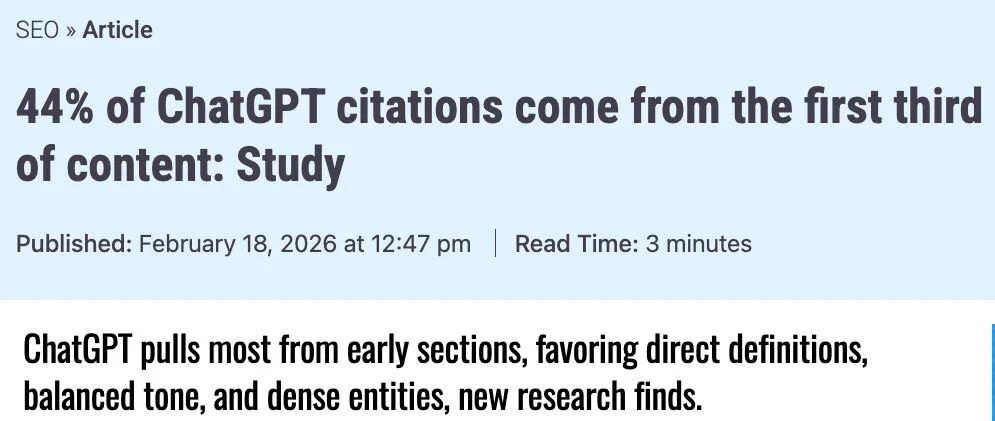
Second, it creates an inconsistent semantic profile across the article. Semantic proximity is measured at the chunk level, not the document level. An intro that is semantically thin will underperform in retrieval even if the rest of the article is strong. A retrieval system that extracts your introduction as a candidate chunk will score it against the query independently — and if that chunk lacks the semantic density of your competitors' introductions, it won't be selected, regardless of how strong your FAQ is. The correct approach is to distribute semantic coverage evenly, section by section:
Introduction: define the core entities and concepts of the topic directly. Name the key players, tools, and frameworks within the first 150 words.
Each H2 section: open with the key concept of that section stated explicitly — not implied, not referenced from a previous section, stated again.
Avoid orphan paragraphs: a paragraph that introduces a new entity or concept without defining it is a semantic dead end. Every new entity introduced needs a grounding sentence.
There is a subtler dimension to semantic optimization that goes beyond entity density and keyword coverage: the conceptual associations that a given LLM has built around your topic through training. When an LLM answers a query, it doesn't search for matching keywords, it predicts which tokens are most likely to follow, based on patterns absorbed during training. Concepts are assigned numerical embeddings, and the model measures the distance between embeddings to understand relationships. If your content uses the same conceptual language that the model has learned to associate with a topic, your content occupies a closer position in the model's semantic space — increasing the probability that it gets retrieved and cited for that query. In practice, this means writing with the full vocabulary of a topic, not just its primary keywords. An article about GEO that covers RAG, parametric knowledge, chunking, entity density, semantic completeness, and citation attribution is occupying more of the relevant conceptual space than an article that only covers "how to rank on ChatGPT." The first article matches more of the semantic associations the model has built around the topic. The second only matches one narrow surface. This is why topical depth — genuinely engaging with the full intellectual scope of a subject — remains the most durable GEO strategy. AI search optimization is less about gaming an algorithm and more about publishing the type of content that could realistically pass a strict peer review . Content that covers a topic comprehensively, uses precise terminology, and engages with the real complexity of the subject will occupy more of the relevant semantic space — and be cited more as a result.
E-E-A-T — Experience, Expertise, Authority, Trustworthiness — has been a Google content framework since 2018. Most SEOs know the acronym. Fewer understand how differently it operates in a generative context, or how much farther it goes than the standard checklist of "add an author bio and some schema." In GEO, E-E-A-T isn't just a quality signal for ranking. It's a credibility filter that determines whether a retrieval system trusts your content enough to cite it — and whether, when it does, it names you or anonymously absorbs your content into its answer.
Google's E-E-A-T framework was designed for human quality raters. LLMs apply a structurally similar but more automated version of the same logic: they are designed to avoid amplifying misinformation, which makes source credibility a first-order concern in every retrieval decision. The mechanism is architectural: LLMs are trained to minimize hallucination and prefer claims they can independently verify. Anonymous content — an article with no named author, no stated credentials, no external references — gives the model nothing to verify against. A named author with a consistent presence across the web, schema markup connecting their content to their professional profiles, and third-party mentions in authoritative sources gives the model multiple independent confirmation points. The credibility signal is not declared — it's triangulated. The practical gap between doing E-E-A-T correctly and doing it superficially is large. Adding a name to an article byline is the minimum. What actually moves the needle is building a verifiable entity graph — a set of consistent, machine-readable signals that allow LLMs to independently verify who wrote your content, what their credentials are, and whether the broader web confirms that credibility.
E-E-A-T work splits cleanly into two dimensions, each requiring a different type of effort.
Onsite credibility is what your content itself demonstrates. A well-sourced article that cites named studies, includes first-hand examples, references real experiences, and is written by an identifiable author with stated credentials is intrinsically more credible than one that makes the same claims anonymously. This is the editorial layer — and it connects directly to Parts 3 and 4: precise statistics, expert citations, and entity density are not just semantic optimization tactics. They are also E-E-A-T signals.
Offsite authority is what the rest of the web says about you. An analysis of 680 million citations across ChatGPT, Google AI Overviews, Perplexity, Gemini, and Claude by 5WPR found that the top 15 domains capture 68% of all AI citation share — a concentration far more extreme than anything Google PageRank produced. The brands that occupy that space got there because they are consistently referenced, discussed, and cited by other authoritative sources — not because they optimized a single page correctly. This has a counterintuitive implication for smaller publishers. Your content strategy and your PR strategy are now the same strategy. Every press mention, every podcast appearance, every expert quote in an industry publication, every conference talk that generates coverage — these are not just brand awareness activities. They are offsite E-E-A-T signals that directly influence whether LLMs include you in their trusted source set.
Schema markup is the technical infrastructure that makes your E-E-A-T signals machine-readable. It doesn't create credibility — it communicates it. Microsoft's Fabrice Canel, principal product manager at Bing, confirmed in March 2025 at SMX Munich that schema markup helps Microsoft's LLMs understand content for Copilot. However, a December 2024 study from Search Atlas found no correlation between schema markup coverage and citation rates. Sites with comprehensive schema didn't consistently outperform sites with minimal or no schema markup. The interpretation is clear: schema is necessary infrastructure, not a citation lever in isolation. A page with no E-E-A-T substance but perfect schema implementation will not outperform a credible, well-sourced page with minimal schema. Schema helps LLMs parse what you're telling them — it doesn't substitute for having something credible to say. The baseline schema implementation for GEO credibility:
Person schema on every author page — with name, jobTitle, knowsAbout, sameAs linking to LinkedIn, professional profiles, and any Wikipedia presence
Organization schema on your site — with sameAs linking to Wikidata, Crunchbase, LinkedIn company page, and any authoritative directories relevant to your industry
Article schema on every piece of content — with author referencing the Person entity, datePublished, dateModified
The sameAs property is the most underused element here. When you wrap information in Organization schema with a sameAs property pointing to a Person schema, you've created a verifiable, machine-readable fact that AI systems can cross-reference against external sources to confirm with confidence. Without it, an LLM can read your claims about your expertise — but it can't verify them independently.
According to Ahrefs' Brand Radar analysis of 76.7 million AI interactions in June 2025 , Wikipedia is the most cited domain across ChatGPT, Perplexity, and Google AI Overviews — with ChatGPT citing it at a 16.3% mention share, the highest of any platform. This dominance is confirmed by independent data: Qwairy's analysis of AI citation patterns across GEO-focused queries places wikipedia.org in the top 10 most-cited domains with an average citation position of 6.3 — higher authority positioning than most commercial sources. For most brands, getting a Wikipedia entry is not realistic. But the underlying mechanism is instructive: LLMs trust encyclopedic, factual, well-referenced content with clear entity definitions. You can replicate that structure without having a Wikipedia page. The practical equivalent is what some practitioners call an "entity hub" — a single, well-structured page on your own domain that defines your brand as an entity: what it is, what it does, when it was founded, who leads it, what it's known for, with external references that corroborate those claims. Not a marketing page. An informational page structured the way Wikipedia structures entries, with the same commitment to factual precision and external sourcing.
There is a final E-E-A-T dimension that most GEO guides ignore: the difference between being cited and being named. When an AI answers a question using your content, it usually cites you with a source link. What it doesn't do, 62% of the time, is say your name — as documented by Kevin Indig's ghost citation research . The link is there. The brand mention is not. This is the ghost citation problem. Your content builds the AI's answer. Your brand gets no credit in the text. The pattern varies dramatically by platform. Research across 3,981 domains found that Gemini names brands in 83.7% of appearances but only generates a citation link 21.4% of the time, while ChatGPT is essentially the inverse — it cites 87% of the time but mentions brands in only 20.7% of answers. Optimizing for one doesn't automatically improve the other — they require different approaches. Reducing ghost citations requires moving beyond content optimization into entity building: being named in third-party sources that LLMs trust, so that the model has learned to associate your brand name with the claims you make. When a model has encountered your brand name repeatedly in the context of a specific topic — in press coverage, expert quotes, industry reports, conference proceedings — it is more likely to mention you by name when it cites your content, rather than treating you as an anonymous source. This is where E-E-A-T and offsite authority converge. The brands that get named are the brands that have been talked about. Digital PR is not optional in GEO — it's the mechanism by which you convert ghost citations into attributed ones.
There is a category of GEO mistake that no amount of semantic optimization, E-E-A-T work, or BLUF structuring can fix: targeting the right topic with the wrong type of page. Before any optimization question — how long, how structured, how many entities — there is a prior question: is this the right shell for this query?
One of the most actionable findings from the Kevin Indig / AirOps study of 16,851 ChatGPT queries and 353,799 pages is about page focus. The pages that win consistently are focused. Mixed pages — "ultimate guides" that cover every possible subtopic — have the highest word counts, the most headings, and the highest domain authority in the dataset. They are also the least reliable performers in ChatGPT. This has direct implications for how you structure your content library. The instinct that built SEO content strategies for a decade — create one comprehensive hub page that ranks for every variation of a topic — actively hurts GEO performance. A page that adequately answers twenty questions will be consistently outperformed by a page that definitively answers one. The practical consequence: where your SEO strategy has hub pages with broad topical coverage, your GEO strategy should have satellite pages — each one built around a single, specific query. Not "the complete guide to remote work tools," but separate pages for "best project management tools for remote teams," "how to run async standups," and "video conferencing tools compared." Each page targets one question, answers it definitively in the first 30% of the content, and lets the heading structure communicate the answer without requiring the body. One important nuance: this applies to citation consistency, not citation volume. According to Kevin Indig's follow-up study on how AI picks its sources , a single evergreen page covering 10+ query intents is worth more in AI citation reach than 10 single-intent pages — but those evergreen pages earn their breadth through structural depth, not shallow coverage. The distinction is between a page that definitively answers one question per section versus a page that vaguely mentions twenty topics. Depth per section, not breadth of topics, is what earns consistent citations.
The audit process is straightforward but requires running it directly in the LLMs you want to appear in — not inferring from Google rankings.
Step 1: Run your target queries in ChatGPT and Perplexity. Don't just ask "what is X." Ask the queries your audience actually uses: "best X for Y," "how do I X," "X vs Y," "is X worth it." For each, note which pages are cited and what type of page they are — article, comparison, guide, product page, homepage.
Step 2: Map the dominant page type per query. If 4 out of 5 cited results for "best project management tools" are comparison roundups, and you have a blog post, you have a typology mismatch. The fix is not to optimize the blog post — it's to create a comparison page.
Step 3: Check subtopic coverage against fanout queries. Each query ChatGPT receives generates an average of 2 fanout sub-queries, and ChatGPT retrieves roughly 10 URLs per sub-search before selecting which ones to cite. Run your target query, note the fanout sub-queries that appear, and check whether your page has sections that directly match those sub-queries. If your page doesn't have a heading that maps to a fanout sub-query, it won't be retrieved for that sub-query — and therefore has no chance of being cited for it.
Step 4: Check the intent signal of your opening content. Pages that lead with pricing send a commercial intent signal and get categorized as sales pages rather than reference sources. Review the first 150 words of any page you want cited. If it reads like a product pitch, a landing page, or a sales argument, reclassify it — or create a parallel informational version that covers the same topic without the conversion framing.
Step 5: Compare your page type against the top cited result. If the top cited result is a 2,000-word comparison guide and yours is a 500-word FAQ, the gap is typological before it's a content quality issue. Match the format first, then optimize the content.
GEO is not a one-time optimization. It's an ongoing competition against competitors who are also updating, improving, and competing for the same citation slots. A page that earns citations today will lose them if it stops earning them — and the freshness data makes clear how quickly that can happen.
In traditional SEO, a well-optimized page can hold a ranking position for months or even years with minimal maintenance. The signals that drive organic rankings — backlinks, domain authority, topical depth — are slow to change. GEO doesn't work that way. A Seer Interactive study analyzing 5,000+ URLs across ChatGPT, Perplexity, and AI Overviews found a stark recency bias: nearly 65% of AI bot hits targeted content published within the past year, 79% from the last two years, and 89% from the last three years. Only 6% of AI interactions involved content older than six years. Ahrefs' analysis of 17 million citations across AI platforms confirms the pattern: AI-cited content is 25.7% fresher on average than content cited in traditional organic Google results. ChatGPT shows the most aggressive recency bias, with 76.4% of its most-cited pages updated within the last 30 days. Perplexity is even more extreme, with approximately 50% of all its citations coming from current-year content alone. The implication is structural. A page that hasn't been touched in twelve months is operating at a significant citation disadvantage, regardless of its original quality. AI crawlers are literally spending less time on stale pages. When a fresher competitor covers the same topic, the stale page falls out of citation rotation quickly — and rarely recovers without direct intervention. This doesn't mean you need to rewrite everything constantly. The freshness signal rewards genuine content improvement, not cosmetic date changes. The December 2025 Core Update introduced a fake freshness penalty: sites that changed published dates without meaningful content updates received trustworthiness signal reductions and ranking demotions for recency-sensitive queries. Date changes without corresponding content changes are detectable and penalized.
See your mentions across ChatGPT, Claude and Perplexity in real time, the moment buyers ask.
The recency requirement is not uniform. Seer Interactive's vertical analysis found that financial services demand extremely fresh content due to fast-changing regulations, while travel allows more leeway with evergreen content still performing well. Energy demonstrates a longer content lifespan, especially for educational and evergreen pieces. The practical framework for update cadence:
Monthly: financial services, legal, technology, anything with rapidly changing data, pricing, or regulation
Quarterly: SaaS, marketing, general B2B — the practical minimum for citation retention in competitive query categories
Bi-annually: travel, education, evergreen topics where facts change slowly
The quarterly threshold is not absolute, but it establishes the floor. Pages not updated quarterly are three times more likely to lose AI citations per AirOps and Kevin Indig's 2026 State of AI Search research . Once a fresher alternative is available, stale pages fall out of citation rotation quickly and rarely regain visibility without direct intervention.
The competitive logic of GEO maintenance is simple: you need to be better than your current competitors, not just better than your past self. Every update cycle should include a competitor audit — running your target queries in ChatGPT and Perplexity to see what's being cited now and why. Beyond the competitor check, here's what to re-evaluate on every substantive update:
Statistics and data. This is the highest-ROI update you can make. Replace every outdated statistic with current data, with source and date. A page that cited "AI Overviews appeared in 31% of searches in early 2025" should now say "AI Overviews appear in approximately 50% of all searches as of 2026." These updates take 20 to 30 minutes per post and consistently produce measurable AI citation improvements within six weeks . Current data signals current expertise — AI systems reward both.
Search intent alignment. Query behavior evolves. A query that was primarily informational eighteen months ago may now have commercial intent. Run your target queries again and check whether the dominant page type in cited results has shifted. If competitors have moved from blog posts to comparison guides, your page typology is now misaligned.
Semantic coverage. New subtopics emerge as a field evolves. Run your target queries in ChatGPT and note the fanout sub-queries — these are the sub-topics the model considers relevant to the main query. Check whether your page has sections that address each fanout. If three new sub-queries have appeared since your last update and your page doesn't address them, your semantic coverage has decayed relative to newer content that does.
E-E-A-T signals. Check whether any statistics, expert quotes, or external citations you included have become outdated or whether the sources have changed. A 2023 study cited as "recent research" in 2026 actively undermines credibility. Refresh the sources that date-signal your content as stale.
Technical freshness signals. Update the dateModified field in your Article schema when you make substantive changes. This is the strongest machine-readable freshness signal for AI crawlers. Pair it with a visible "Last updated" annotation near the top of the page — both for human readers and for retrieval systems evaluating recency.
Not everything needs to be kept relentlessly current. The practical approach is to concentrate update resources on the pages that matter most. Focus on your top 20% of pages by traffic first. The pages with the highest citation rates and highest traffic are the ones most at risk from freshness-based displacement and most worth defending. A content library with 200 pages does not need 200 quarterly updates. It needs 40 pages maintained on a tight cadence and the rest monitored for decay signals. The visible symptom of citation decay often appears in organic metrics before it appears in AI citation tracking: a declining click-through rate on a previously stable page, a drop in impressions for the primary query, increasing competition from newer pages. These are signals that freshness-based displacement has begun. Treat them as update triggers rather than waiting for a scheduled review cycle. The brands that maintain GEO visibility over time are not the ones that publish the most. They are the ones that treat their content library as a living asset — with assigned ownership, decay tracking, and a systematic process for keeping their most important pages better than whatever their competitors published last quarter.
Use this checklist to audit any existing page or review new content before publishing. Work through it in order — the earlier items are foundational; the later ones compound on them.
Content is server-side rendered — no key text hidden behind JavaScript
HTML is clean: no Gutenberg block comments, no redundant <strong> inside headings, no presentational classes on heading tags
Heading hierarchy uses H1 → H2 → H3 coherently, max 4–5 levels
Headings read as a logical outline when viewed in sequence without body text
Article schema is implemented with author, datePublished, and dateModified
Person schema exists for the author, with sameAs linking to LinkedIn or professional profiles
Organization schema exists on the site, with sameAs linking to Wikidata, Crunchbase, or equivalent
dateModified is updated every time a substantive change is made
The article opens with a direct 40–60 word answer to the target query — before any context or framing
Every H2 section opens with its conclusion or direct answer in the first sentence
Each paragraph makes one self-contained point that can be extracted independently
Paragraphs are 40–80 words (no unbroken walls of text)
Terms are defined on first use within each section — not just at article level
Headings are written as direct questions or declarative statements, not generic labels
The introduction names the key entities, tools, and frameworks of the topic within the first 150 words
Each H2 section restates its core concept explicitly — not by reference to a previous section
No paragraph is semantically empty (no proper nouns, no named studies, no specific figures)
The article uses the full vocabulary of the topic — not just the primary keyword
Run the target query in ChatGPT, note the fanout sub-queries, and verify the article has a heading matching each one
Every quantifiable claim includes a specific number
Every number is attributed to a named source with a date
At least one academic or peer-reviewed source is cited for foundational claims
Expert quotes are attributed with a relevant credential (not just a job title)
All citations link to the original source — not a secondary blog that summarized it
No statistic is older than 18 months for fast-moving topics (technology, AI, marketing)
The article has a named author with a linked author page
The author page includes credentials relevant to the topic
First-hand experience, examples, or original data is present in the content
The article is not anonymous — it can be traced to a real person or organization
The brand or author has at least some offsite mentions in authoritative sources (press, directories, industry publications)
Run the target query in ChatGPT and Perplexity — confirm the dominant page type matches yours (guide, comparison, definition, etc.)
The opening 150 words contain no pricing, CTAs, or sales language
The page answers one primary question well — not twenty questions superficially
The page title and URL slug are semantically aligned with the target query
All statistics have been checked and updated within the last 6 months
The dateModified schema field reflects the last substantive update
A visible "Last updated" annotation appears near the top of the page
The article has been re-run in ChatGPT and Perplexity to check current citations since the last update
Track your mentions across ChatGPT, Claude, Perplexity and all major AI platforms. Join 1,500+ brands monitoring their AI presence in real-time.
Free trial • No credit card required • Complete platform access
Other Articles
Answer Engine Optimization (AEO): The Complete 2026 Guide
A complete, practitioner-level guide to Answer Engine Optimization: what AEO is, how answer engines like ChatGPT, Perplexity and Google AI Overviews select and cite content, the core levers, a step-by-step workflow, and how to measure it.
How to Set Up AI Referral Tracking in GA4, Plausible and Matomo
Most analytics tools miss or misclassify AI referral traffic by default. This step-by-step guide shows you how to properly track visits from ChatGPT, Perplexity, Claude, Gemini, and other AI platforms in GA4, Plausible, and Matomo.