
Loading page
Comment Meilleurtaux, leader de la comparaison de crédits immobiliers en France, a utilisé Qwairy pour mesurer et améliorer sa visibilité dans les moteurs IA.
Customer Story — Meilleurtaux × Qwairy In a market where every basis point matters, Meilleurtaux — France's leading mortgage and insurance comparison platform — gained 3 points of Share of Voice in AI-generated responses in just 6 months. On one of the most competitive verticals in French fintech.
But what makes this story worth telling isn't just the number.
It's that Thomas Casiez, SEO & Content Manager at Meilleurtaux, had already built his own AI monitoring tool before using Qwairy. A custom Python script. A Streamlit interface. Real data, real dashboards, already shared internally. He knew exactly what he was doing.
And he still chose Qwairy.
This is how Meilleurtaux went from a homemade monitoring setup to a structured GEO strategy — and what it took to move the needle in AI search.
Thomas Casiez has spent nearly 15 years in SEO, a decade in agencies, then a pivot to the brand side through travel, and for the past 5 years, a home at Meilleurtaux as Head of SEO & Content. Meilleurtaux is France's reference for financial product comparison — mortgage rates, insurance, savings and investment. The platform covers three core verticals: credit, insurance, and wealth management, with a team of 7 SEO and content specialists. The group also expanded into the Benelux market with operations in Belgium and Luxembourg. Over the past two years, Thomas built an in-house Content Factory pairing SEO specialists with dedicated writers to produce editorial content, infographics, podcasts, and videos. Thomas wears two hats: Head of SEO and content strategist. And it's precisely that dual perspective that shaped how Meilleurtaux approached GEO from day one.
Before Qwairy, Thomas wasn't flying blind. He had built something. A custom Python script, wrapped in a Streamlit interface to make it shareable and presentable internally. It pulled data from the Google Gemini API, tracked brand mentions across a set of prompts, and produced charts and dashboards clean enough to bring to an Executive commitee meeting.
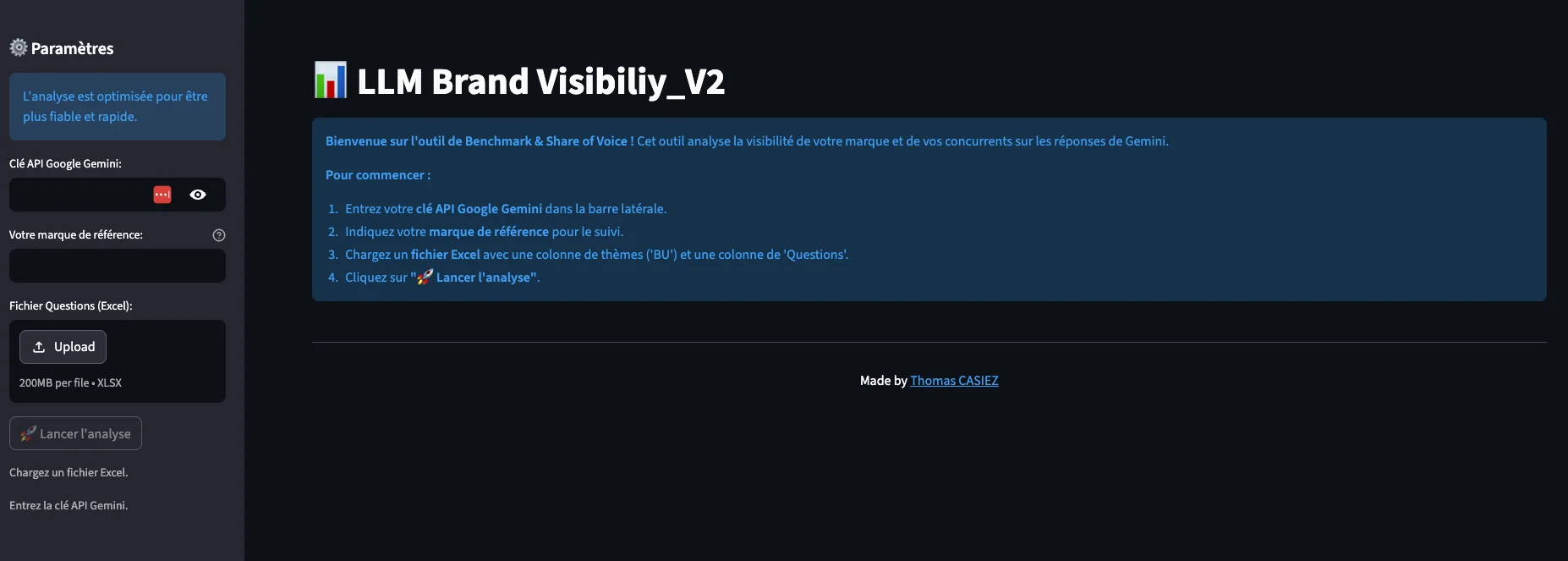
But it had limits. The prompt set was restricted by API key constraints. The tool was fragile: a 401 error, a rate limit, and suddenly the data stopped flowing. And every new feature Thomas wanted to add meant going back to development, writing a brief, and waiting. The tool was his to maintain, his to fix, his to evolve.
"The advantage was that we had imagined a lot of features. The disadvantage was that implementing them would have required a dedicated developer and that comes with a cost." More than anything, the tool couldn't scale. Meilleurtaux wasn't just one site. It was multiple verticals, multiple markets, a growing team that needed access to the same data. A homemade script wasn't built for that. That's when Qwairy entered the picture.
The decision wasn't about replacing something broken. It was about replacing something that had hit its ceiling. Thomas wasn't looking for a tool to convince him that GEO mattered — he already knew. He was looking for something robust enough to grow with, shareable enough to drive alignment internally, and smart enough to keep up with a market moving faster than any in-house build could. Qwairy checked all three boxes.
"It was about robustness. Having not just an Excel file with a score, but an interface with charts, shareable reports, viewer mode. The ability to say: here's this report for this segment, this tag, this funnel level. We didn't have that before." But there was a second reason, less obvious and arguably more strategic: R&D. By choosing Qwairy, Meilleurtaux wasn't just buying a tool. It was plugging into a product that was actively evolving, shaped by the collective experience of its users. "Since September, Qwairy has evolved a lot. It was also about being part of that dynamic. Benefiting from other clients' feedback, other use cases, and not having to build everything ourselves." The proof came quickly. Features Thomas hadn't anticipated became part of his workflow. The GEO Matrix. Content Opportunities. Social Signals. None of these were on his roadmap when he signed up. All of them ended up changing how his team worked.
From day one, Qwairy gave Meilleurtaux something their homemade tool never could: a single place to see everything, share everything, and act on everything. As the team grew into the platform, new features kept unlocking new workflows and the way they use Qwairy today reflects just how far that journey has taken them.
Run a free audit: see if ChatGPT, Gemini and Copilot recommend you, in about a minute.
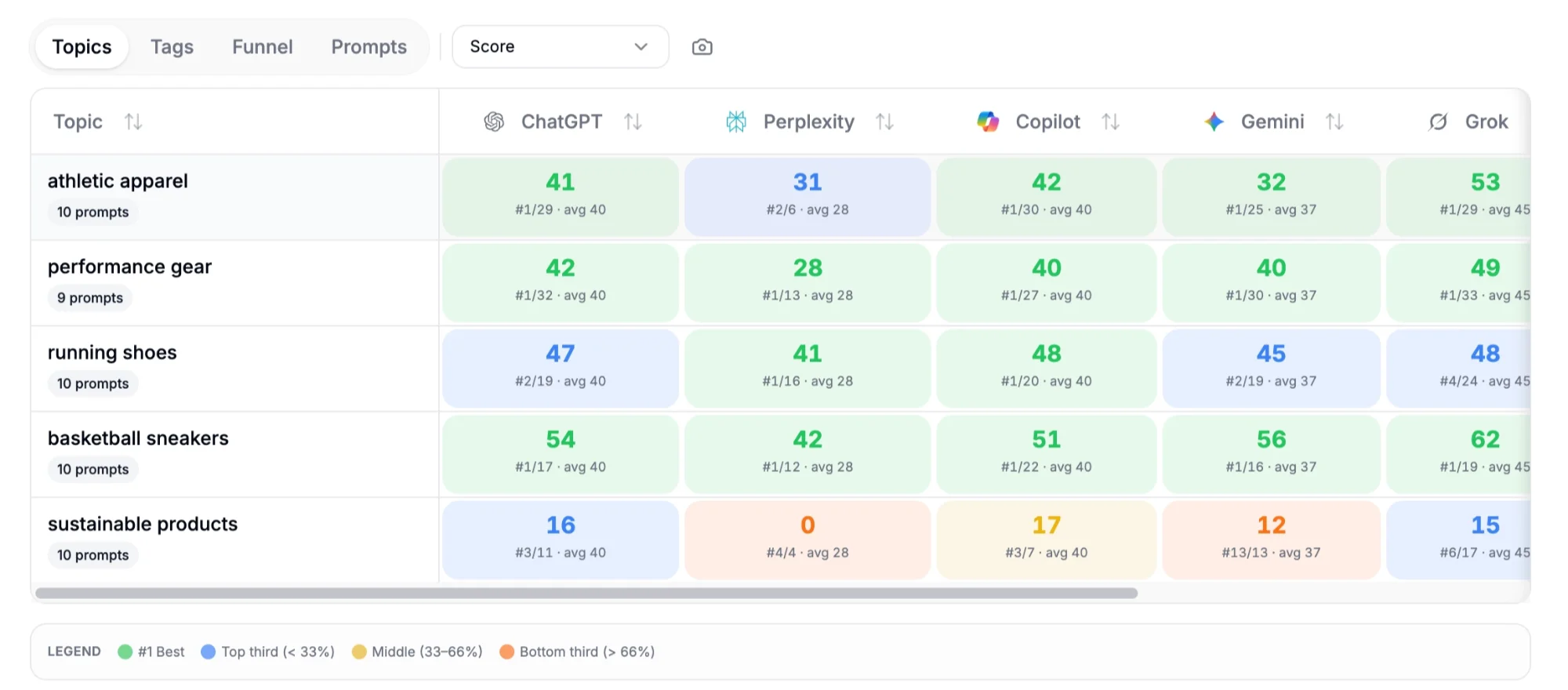
The first feature that landed internally was the GEO Matrix. Simple, visual, immediately shareable — a side-by-side view of where Meilleurtaux stood versus its competitors across every tracked prompt.
"It's very simple, very synthetic. A comparison table, easy to share in a meeting. Internally, that always lands well." For a team that needed to build internal buy-in around GEO, having a single slide that told the whole story was worth more than a hundred data exports.
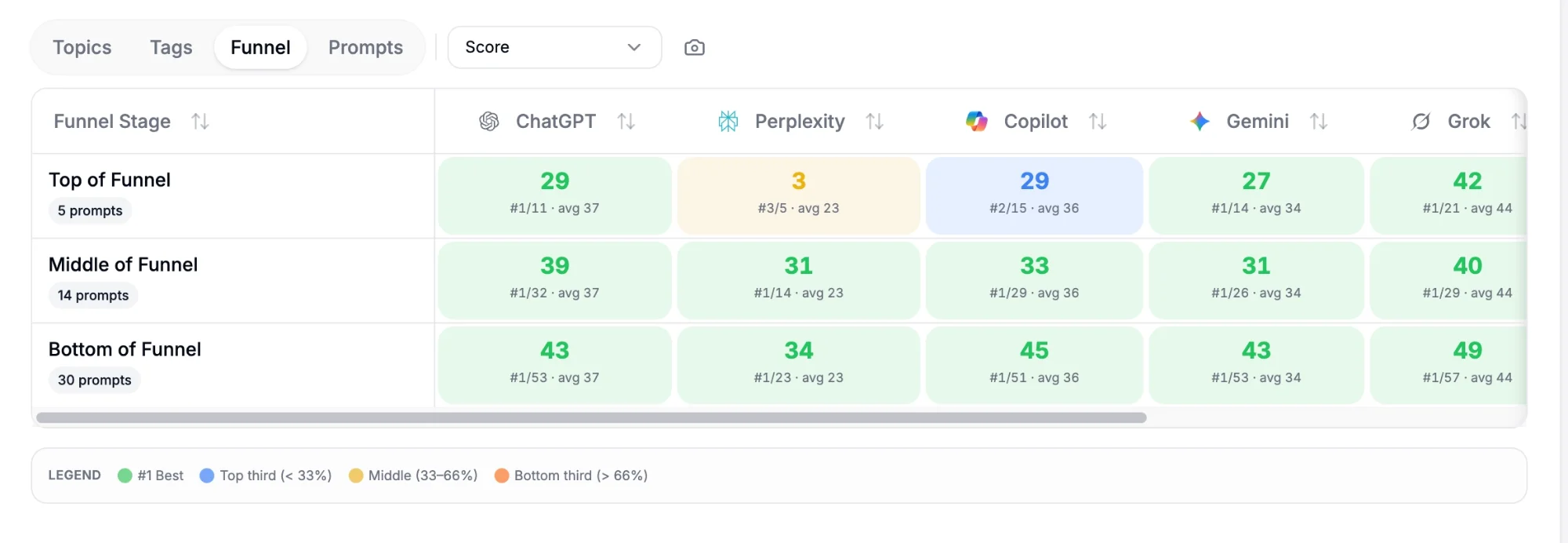
As the team matured, Thomas shifted from tracking vanity metrics to asking harder questions. Where exactly in the SEO funnel was Meilleurtaux visible. The answer was clear: strong on middle and bottom funnel, where transactional queries and brand recognition were already established. Weaker on top of funnel, where broader, more generic queries set the agenda.
"On top of funnel, we're less strong. That's partly in the nature of the site. So how do we use content levers to make sure we're in people's minds earlier in the journey?" Qwairy's funnel-level breakdown became the compass for that shift.
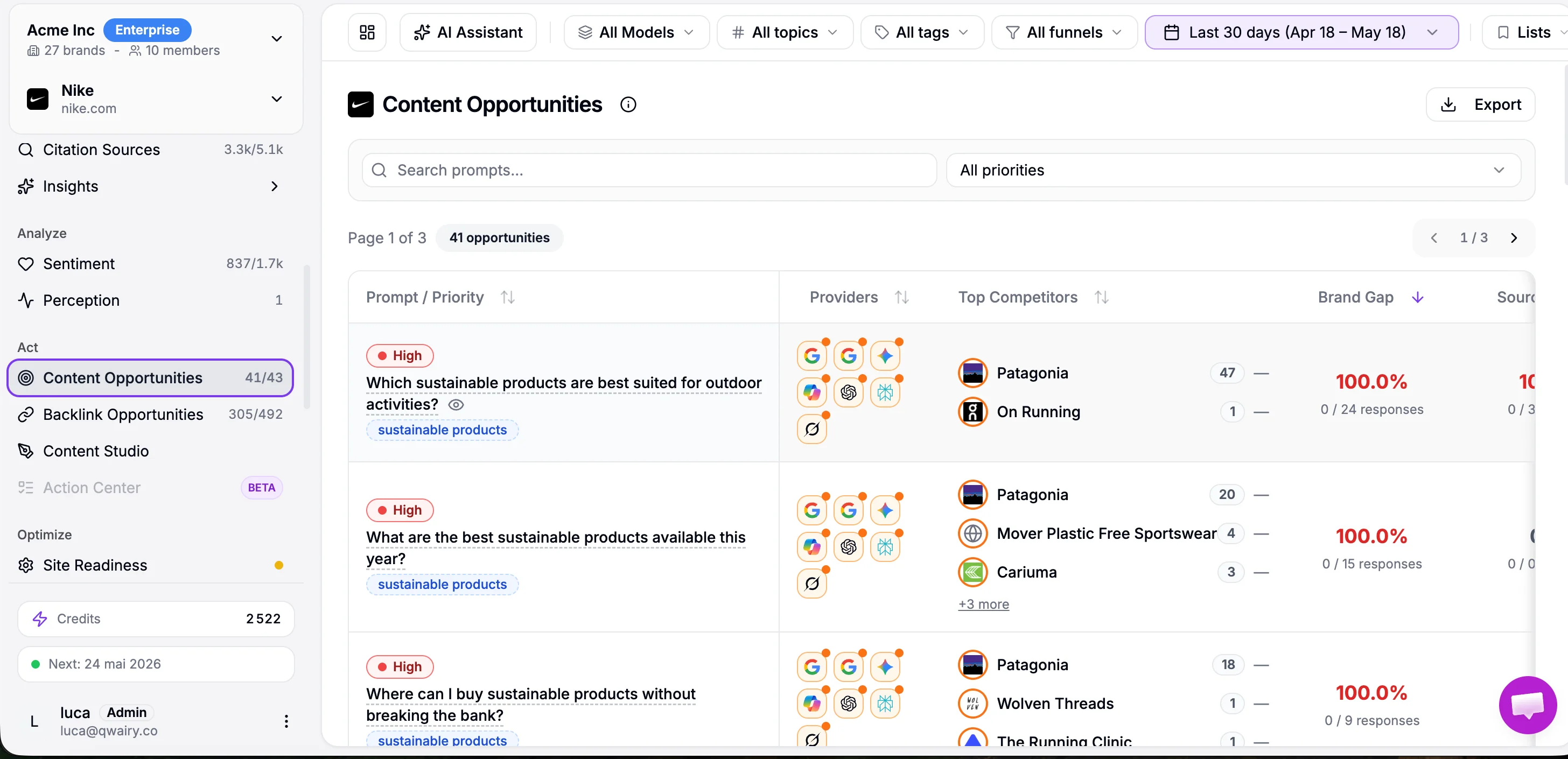
With a full Content Factory running in-house, Thomas needed a systematic way to identify gaps not just on Meilleurtaux's own pages, but across the sources that AI models were actually citing. The Content Opportunities and Backlink Opportunities features gave him exactly that.
"My competitors are there, I'm not. What can I do to close that gap? Which sources carry authority? Which ones can help me surface too?" Every week, the Content Factory now has a cleaner brief informed not just by keyword data, but by what the AI is actually reading and recommending.
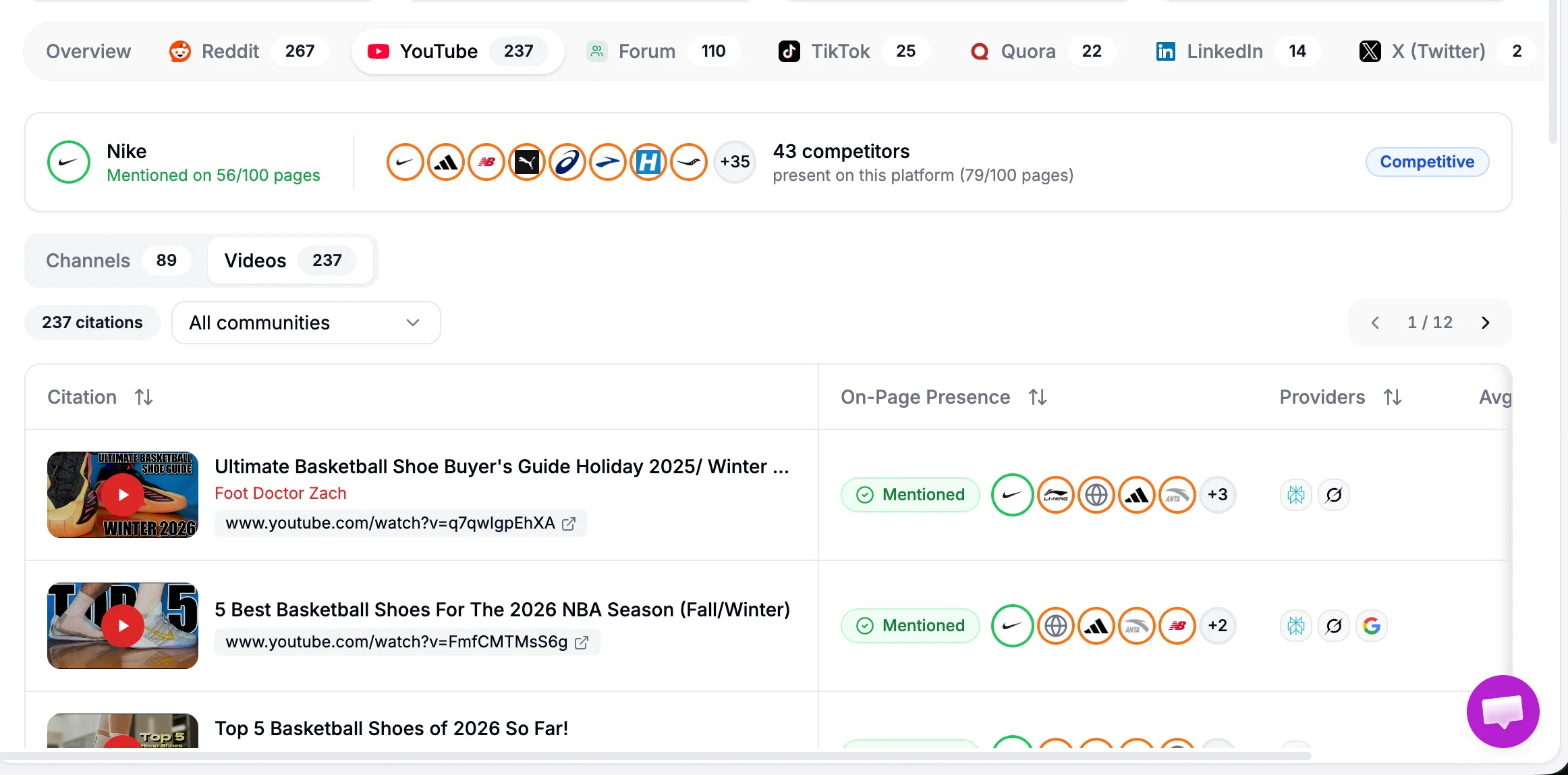
One of the more unexpected use cases came from the Social Signals feature. Thomas started using it to identify YouTube video opportunities, cross-referencing what competitors were doing on video with what topics were gaining traction in AI responses.
"We look at what others are doing, adapt it to our angle, and recreate similar videos on the Meilleurtaux channel. Social Signals helps us identify which topics are worth going after." It's a small workflow change with a compounding effect: every video produced is now anchored in real signal, not instinct.
For Thomas, the most forward-looking use of Qwairy has been the MCP integration . He ran a proof of concept crossing Qwairy's Share of Voice data with Google Search Console metrics and internal Piano analytics trying to trace a direct line from AI citation to organic visit to lead. The goal was to see the potential correlations between AI visibility and organic traffic: am I cited because I'm mentioned in AI responses? And at the end of the chain — is it actually generating leads through AI search? The POC is still early. But the ambition is clear: move from monitoring to attribution. From knowing you're visible to knowing it drives revenue.
Most companies starting with GEO pick their prompts by instinct. Thomas built his systematically. The starting point was Meilleurtaux's Google Search Console data. Thomas exported everything, clustered queries by search intent and mapped them to funnel stages. Then, instead of tracking keywords directly, he used Google's NLP API to transform each cluster into a natural language question. The kind a real person would actually type into ChatGPT or Perplexity.
"I extracted all our GSC data, tried to cross it and create clusters by search intent. Then I used the Google NLP API to transform them into natural language questions — what would a person actually ask? And from there I validated the hypothesis directly in the different AI models." The result: a structured prompt set of around 50 prompts per site, organized by vertical and funnel level, that became the foundation of Meilleurtaux's GEO monitoring. A process that Thomas built manually and that Qwairy's prompt suggestion features can now help any team replicate in a fraction of the time. But the prompt set didn't stop there. More recently, Thomas added a new layer: real customer questions. Pulled from Reddit threads, from support tickets, from actual user interactions. These prompts live in a separate campaign on Qwairy, clearly tagged, so their signal doesn't get mixed with the rest. "We re-added prompts that emerged from real customer questions. It's interesting to be able to take them, run a dedicated campaign, and ask: what does this actually tell me? Because these are real customers. Real data." It's a small detail that says a lot about how Meilleurtaux thinks about GEO. Not as a separate discipline, but as a direct extension of understanding what their users actually want.
See your mentions across ChatGPT, Claude and Perplexity in real time, the moment buyers ask.
Tracking visibility is one thing. Moving it is another. Over the past year, Meilleurtaux has run a structured GEO program across its sites and the results on Share of Voice are starting to show.
If Thomas had to pick one action that moved the needle most, it's this one. Meilleurtaux built a system to generate and publish fresh, proprietary data every week — real prices, real comparisons, filtered by profile and product type. Car insurance for young drivers. Senior health coverage. Savings rates by profile.
"This is the big change that drove results on the insurance comparator. Structured data deployment associated with this proprietary data. We generate refreshed data every week, every month — and that's pure gold for LLMs." Structured, fresh, ownable data. Exactly what AI models look for when deciding what to cite.
Alongside the data work, the team restructured key pages to better match search intent — cleaning up the HTML, improving readability for AI crawlers, and adding proper semantic markup throughout. Not glamorous. But foundational.
Across all sites, the team deployed a series of editorial upgrades informed directly by what Qwairy's data was surfacing: summary blocks at the top of pages, better content chunking for LLM extraction, and FAQ sections rolled out systematically. Writers were also given access to Google patent data and research to help them go beyond generic content — that 20% of additional insight that separates a citable page from a forgettable one.
The one area still in progress is offsite. Partnerships, PR, external citations — Meilleurtaux started this work four or five months ago and is now accelerating.
"We're not going fast enough yet on offsite. But it's the next big brick." It's the honest admission of a team that knows exactly where they are — and where they need to go next.
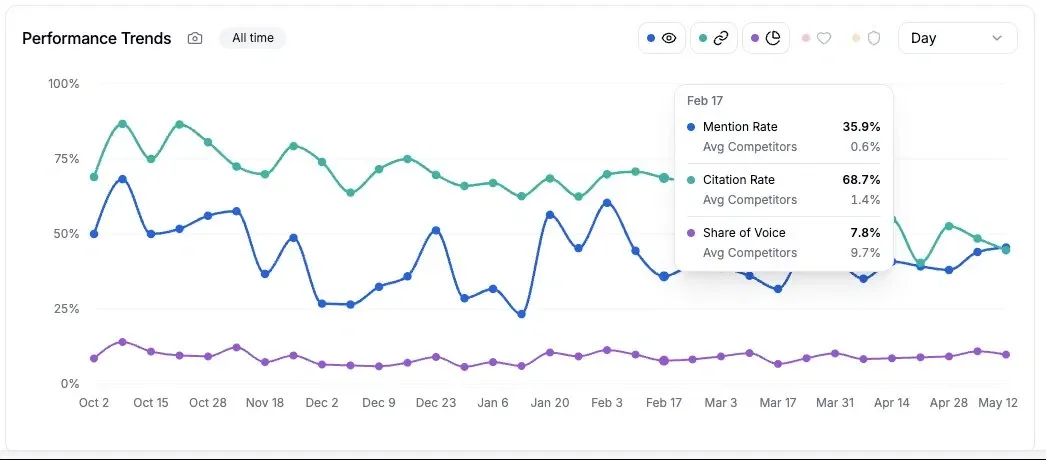
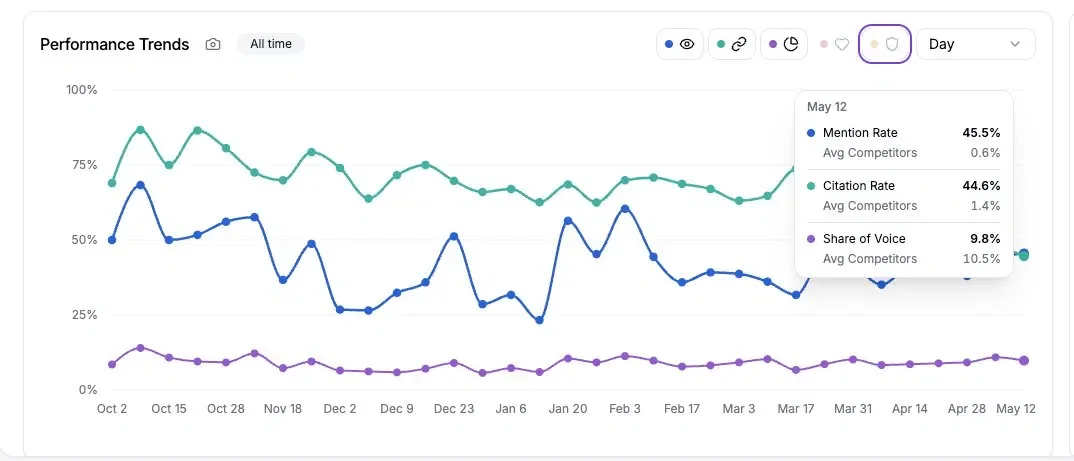
Meilleurtaux gained 3 points of Share of Voice and nearly 10 points of Mention Rate between february and may 2026. To understand why these numbers matter, it's worth explaining how Qwairy measures them. For every tracked prompt, Qwairy queries multiple AI models — ChatGPT, Perplexity, Claude, Gemini, and others — and records two things: whether the brand is mentioned anywhere in the response (Mention Rate), and whether it's explicitly cited as a source or recommendation (Citation rate). Both metrics are calculated across all prompts and all models. On a hyper-competitive vertical like life insurance, where established players have years of content authority and every LLM response is contested, moving both needles in 6 months is significant.
"We were able to gain 3 points of Share of Voice and 10 Points of Mention Rate in 6 months, which is not bad on a mega competitive vertical." Beyond the headline numbers, the team also observed a broader shift: AI models are increasingly citing comparison platforms as preferred sources on insurance queries. As Thomas put it at the end of our conversation: "We're not behind. We have the tools. We're making moves. Our Share of Voice has improved. We're equipped."
Meilleurtaux didn't wait for GEO to become mainstream. Thomas started monitoring AI visibility before most teams had even heard the term — first with a homemade tool, then with Qwairy. And that head start is now a structural advantage. Because in GEO, data compounds. Every month of tracking is a month of historical signal that a late mover simply cannot buy. A competitor starting today has no baseline, no trend lines, no before-and-after. They're starting from zero. Meilleurtaux is starting from months of accumulated insight — knowing which prompts move, which verticals are contested, which actions actually drove results. That's the hidden value of moving early. Not just the 3 points of Share of Voice gained. Not just the 10 points of Mention Rate. It's the depth of understanding that sits behind those numbers — and the compounding advantage it creates going forward.
"The people who started early have an advantage. A competitor starting today doesn't have a year of data to look back on. That's not something you can catch up on overnight." For Meilleurtaux, GEO is no longer an experiment. It's a core part of how they compete — in search, in AI, and in the minds of French consumers navigating one of the biggest financial decisions of their lives. And they're just getting started.
Track your mentions across ChatGPT, Claude, Perplexity and all major AI platforms. Join 1,500+ brands monitoring their AI presence in real-time.
Free trial • No credit card required • Complete platform access
Other Articles
How Ornikar Engineered Brand Citations in AI Search and Built the Playbook to Get There
How Ornikar, France's online driving-school leader, built an operational GEO playbook to become a cited brand in AI answers across driving education and car insurance — with traffic and conversion gains following.
How a GEO Consultant 3x'd a Brand's AI Mentions in Less Than 3 Months
SEO/GEO consultant Thibaut Huertas shares how he tripled Bluecoders' brand mentions and source citations across AI models in under 3 months, using Qwairy to identify high-value prompts and authority backlink targets.