Loading page

AI Revenue moves to GA with three-layer attribution and a self-serve GA4 setup, the Action Center leaves beta on every paid plan, and a new Pitch Audit lets agencies run one-shot GEO audits on prospects. Plus a refreshed Premium Models catalog and the MCP server now available from Starter.
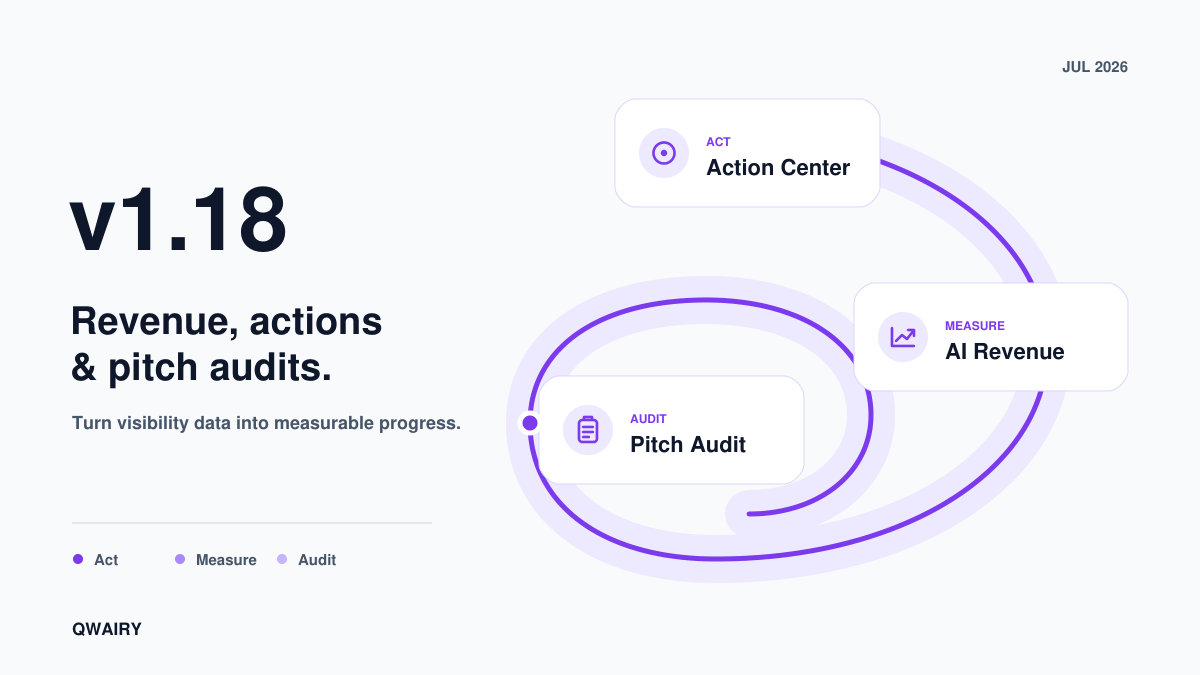
This release brings two features to general availability, plus a new Pitch Audit built for agencies.
AI Revenue moves from beta to the centerpiece of the Measure module, with a transparent three-layer attribution model and a self-serve GA4 setup.
The Action Center also leaves beta and is now available on every paid plan, turning your monitoring data into a prioritized, measurable action plan.
Pitch Audit lets agencies run one-shot, live GEO audits on prospects in about two minutes, kept entirely separate from monitored workspaces.
Plus the MCP server now available from Starter, a redesigned AI Crawler Readiness check, a global ⌘K search, and a refreshed premium model lineup.
Knowing where your AI visibility stands is only half the job.
The Action Center turns everything Qwairy monitors (prompts, answers, sources, competitors, site diagnostics, search demand) into a prioritized, measurable plan of what to do next.
It is now out of beta and available on every paid plan!
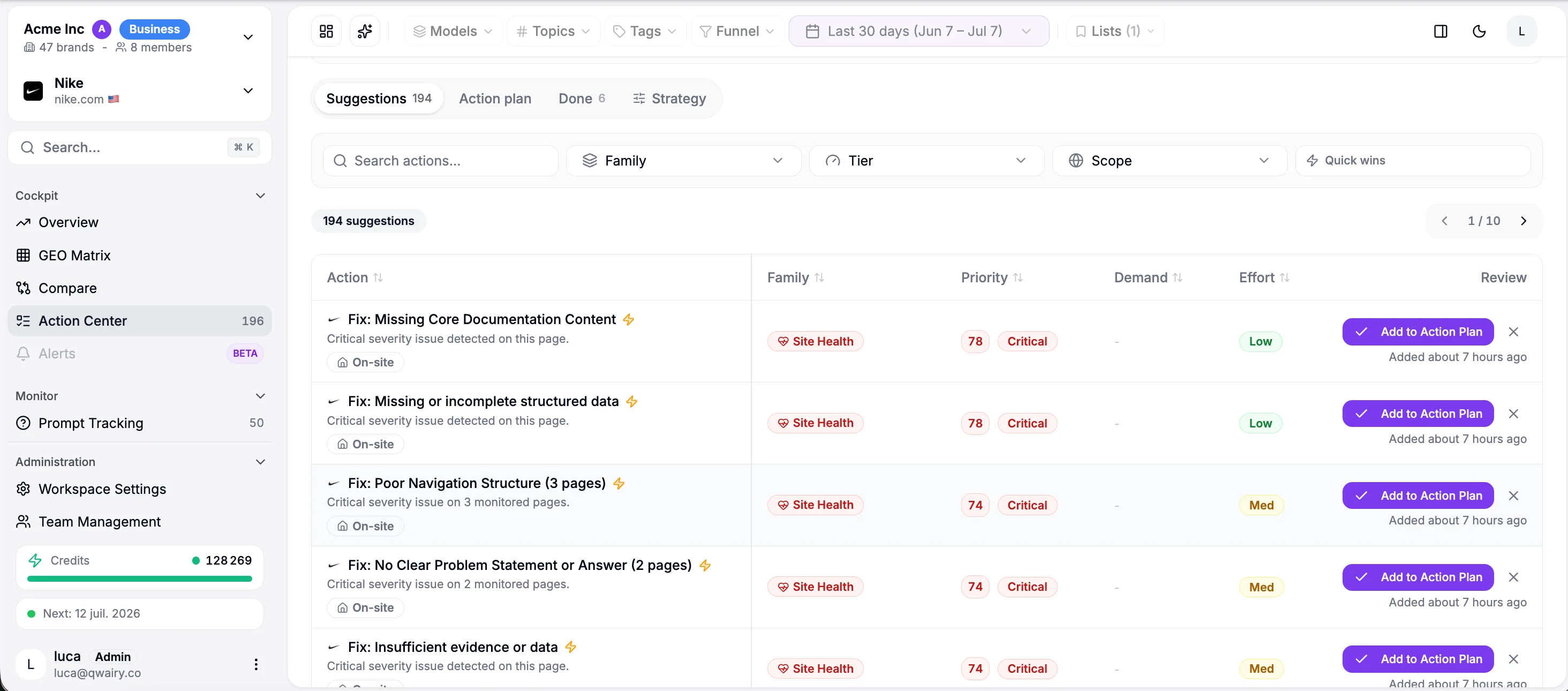
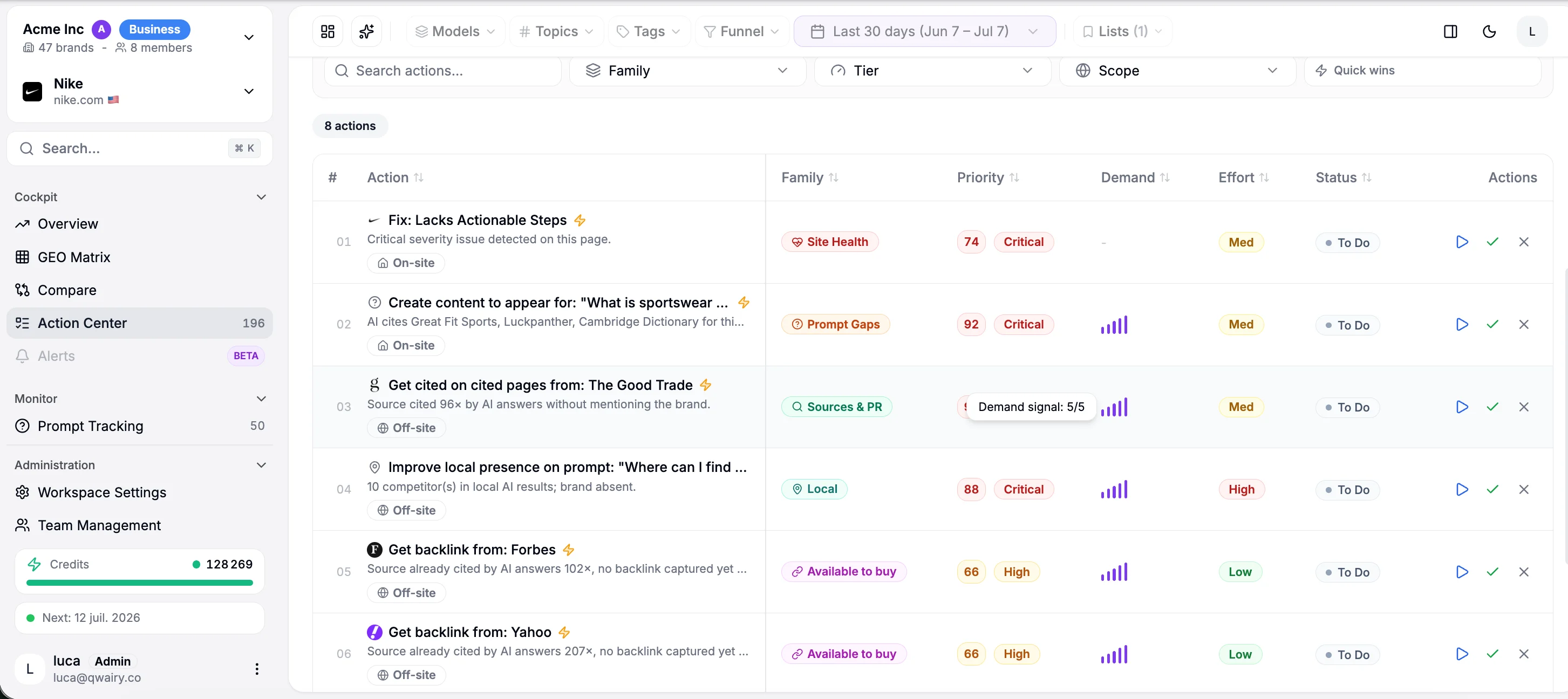
The recommendations are generated deterministically from your own data: the same data always produces the same actions, each with a quantified justification and the exact signals behind it.
No black box, no generic advice.
What sets the engine apart is that it diagnoses which lever actually moves each gap, not just that a gap exists.
When AI cites independent publishers that ignore you, it routes you to outreach. When the answer is driven by forums and communities, it points you there.
When competitors simply own the content, it tells you to publish the definitive answer.
It even flags the actions worth skipping, like a paid placement on a low-authority source that will not pay back.
Most tools stop at telling you what is wrong; the Action Center tells you what to do, in what order, and whether it worked.
A priority score you can sort by: every action carries a 0-100 score anchored to a Critical, High or Standard tier, plus a 1-5 demand signal, so the highest-value move is always at the top. When a priority shifts, the action's History names the signal that moved it.
Quick Wins first: high-impact, low-effort actions are surfaced up front, so there is always something worth doing today.
Ready to execute, not just to read: every action ships with a step-by-step guide tailored to your data, and many come with a paste-ready artifact, an FAQ schema block, an outreach email draft or a community engagement plan. You can also hand any action to the Qwairy AI assistant to turn it into a full plan from your brand data.
From suggestion to done: triage fresh suggestions in one click, then run accepted work through a focus list or a To Do, In Progress, Done board.
Proven, not assumed: when you complete an action, the engine re-measures the metric it was meant to move (prompt mention rate, search position, pages fixed) for 90 days, so you see the real outcome instead of a vanity checkmark.
The Action Center is also available programmatically through the REST API and the MCP server, so your own tools and AI assistants can pull the prioritized queue directly. Navigate to Cockpit > Action Center to explore.
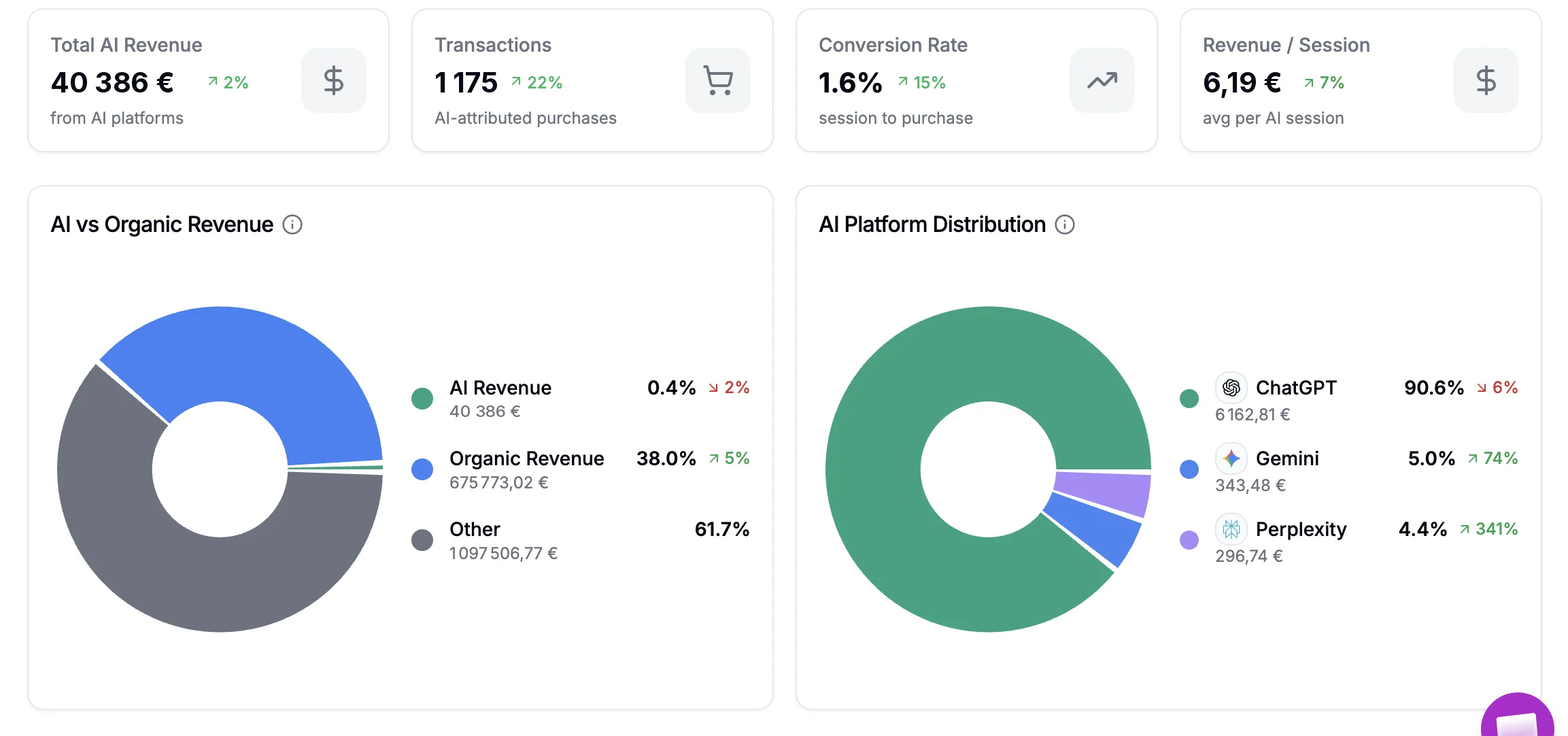
AI search visibility is one thing. Traffic to your website from AI assistants is another. Revenue recorded in your analytics from that traffic is yet another.
The bottom line is the one your CFO cares about: the revenue and conversions your analytics attribute to AI-driven visits.
Not estimates, not impressions, but outcomes already measured in your existing setup.
That is what turns AI visibility into a business case.
Crawler Coverage: which AI bots crawl your website, how often, on which pages. If AI assistants cannot read your content, they cannot recommend you.
AI-Referred Visits: sessions arriving on your website from ChatGPT, Perplexity, Gemini, Copilot and other AI sources, pulled live from Google Analytics 4.
AI-Influenced Revenue: conversions and revenue already tracked in your Google Analytics 4 property, segmented by AI-referred traffic.
For e-commerce websites, this means purchases and revenue; for lead-generation businesses, form submissions or other conversion events, using the values configured in GA4.
Run a free audit: in a few minutes, ChatGPT, Gemini and Perplexity answer 8 buying questions about your market live, and you see who they recommend.
What is the ROI of my AI visibility? Put a revenue figure on your GEO investment and defend the budget with outcomes already measured in GA4, not with impressions.
Is my AI traffic converting? Compare AI-driven sessions, conversions and revenue against the rest of your traffic, broken down by AI source.
Which AI source drives the highest value? ChatGPT, Perplexity, Gemini and Copilot do not deliver the same audience. Some drive more revenue, others higher conversion rates. Now you can see which.
Where should I double down? Cross AI Revenue with Crawler Coverage to spot AI sources that visit you a lot but convert poorly, or convert well but visit too little.
AI Revenue requires a clean GA4 setup.
To remove the friction, the whole flow runs in-app, right on the AI Revenue page: connect via OAuth, pick your property, verify your conversion events, and detect AI traffic that is not yet tagged. Navigate to Measure > AI Revenue to explore.
Agencies pitch new brands constantly.
Until now that meant building a GEO audit by hand for every prospect, or spending a monitored workspace slot on a brand that might never sign.
Pitch Audit fixes that.
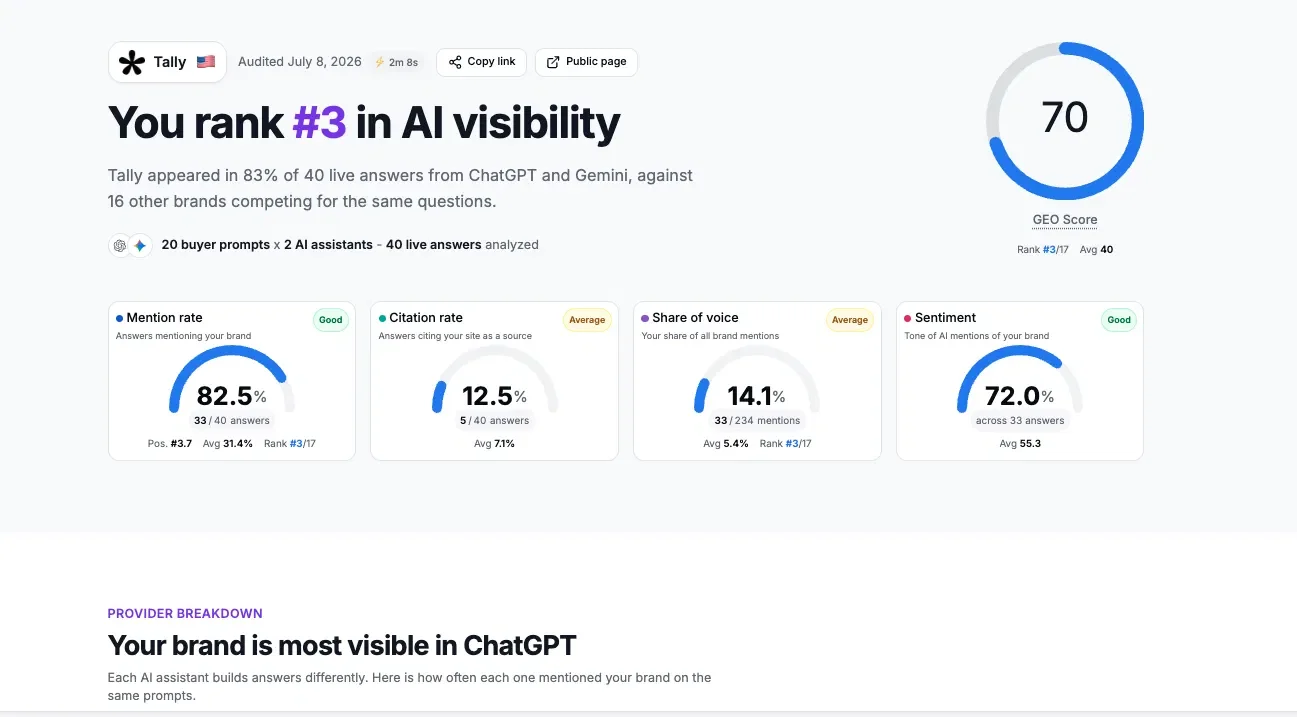
From Supervision, agencies can now run a full, live GEO audit on any prospect in about two minutes, kept entirely separate from their monitored workspaces.
Every pitch audit sends a set of buyer-intent prompts, reviewable and editable before it goes live, to real AI assistants such as ChatGPT and Gemini, then scores the prospect exactly like a monitored brand:
GEO Score and rank: the prospect's overall score, positioned against every competing brand the audit surfaces on its own. No manual competitor list required.
Core metrics: mention rate, citation rate, share of voice and sentiment, each benchmarked against the market average and broken down by AI provider.
Competitor leaderboard: every brand mentioned across the live answers, ranked and compared on the same metrics, often a dozen or more competitors per market.
Brand perception: a radar of how AI assistants describe the prospect (value, quality, innovation, usability, market position, trust), plus the specific positive and negative signals pulled straight from the answers.
Cited sources: the websites AI assistants cited while answering, ranked by citation share, including which of them offer paid placement opportunities.
Every prompt and answer: the full text of what each AI assistant actually said, so the audit is auditable, not just a set of numbers to take on faith.
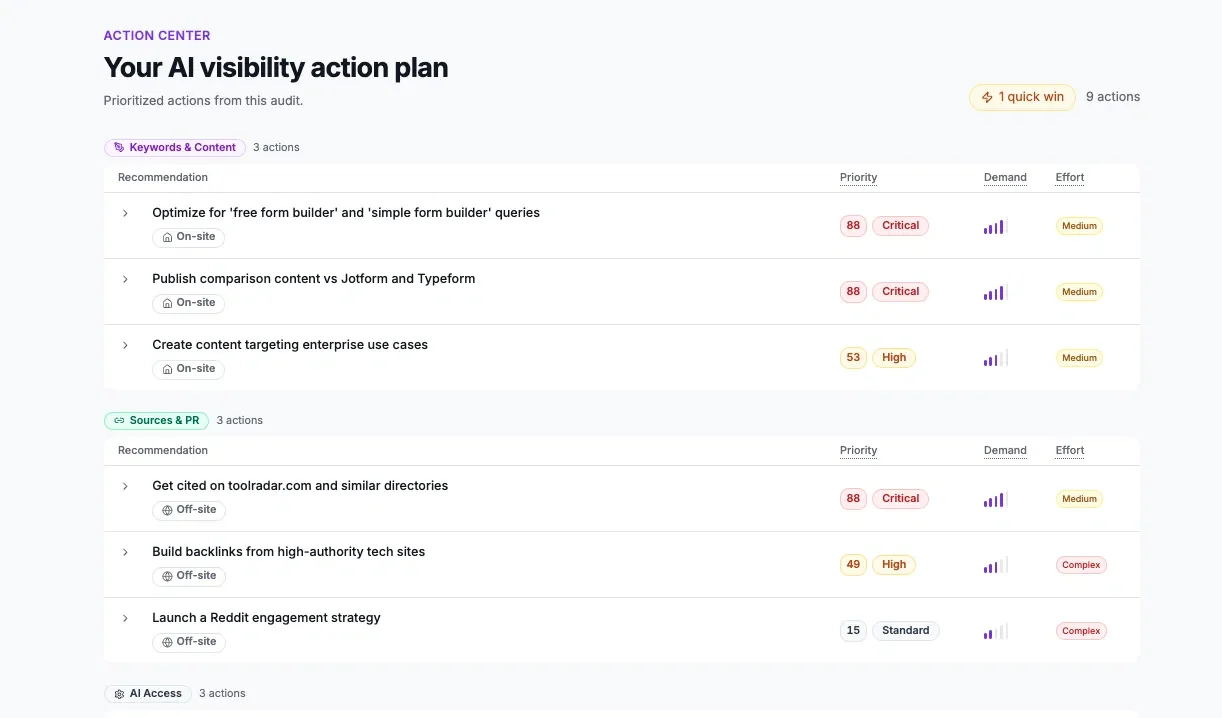
Each pitch audit closes with a prioritized action plan generated by the same Action Center engine described above, grouped by Keywords & Content, Sources & PR and AI Access, with every action scored and tiered.
It is the fastest way to turn an audit into a pitch: show the prospect exactly where they stand today, and exactly what an engagement would fix first.
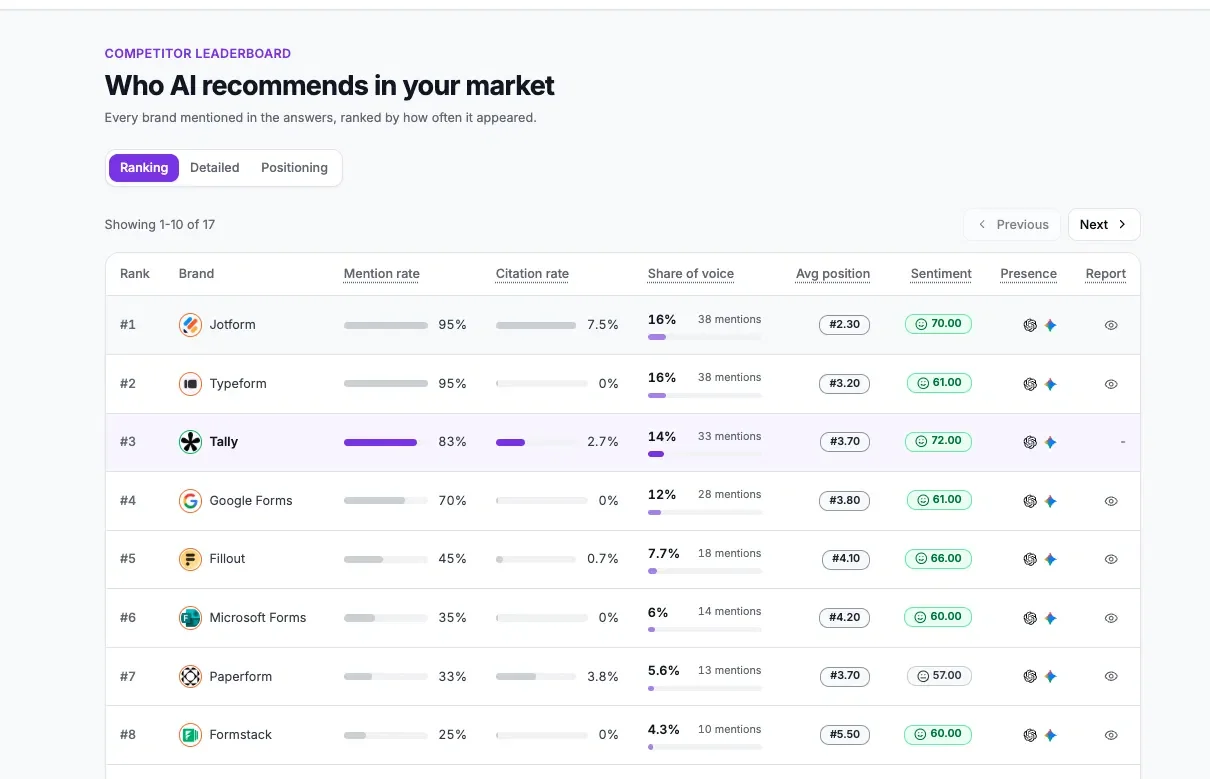
Pitch audits live in their own list under Supervision, separate from the monitored Workspaces they do not count against.
Each completed audit can be shared as a public page with a single link, ready to drop into a proposal or a sales deck, no login required on the other end. Navigate to Supervision > Pitch audits to create your first one.
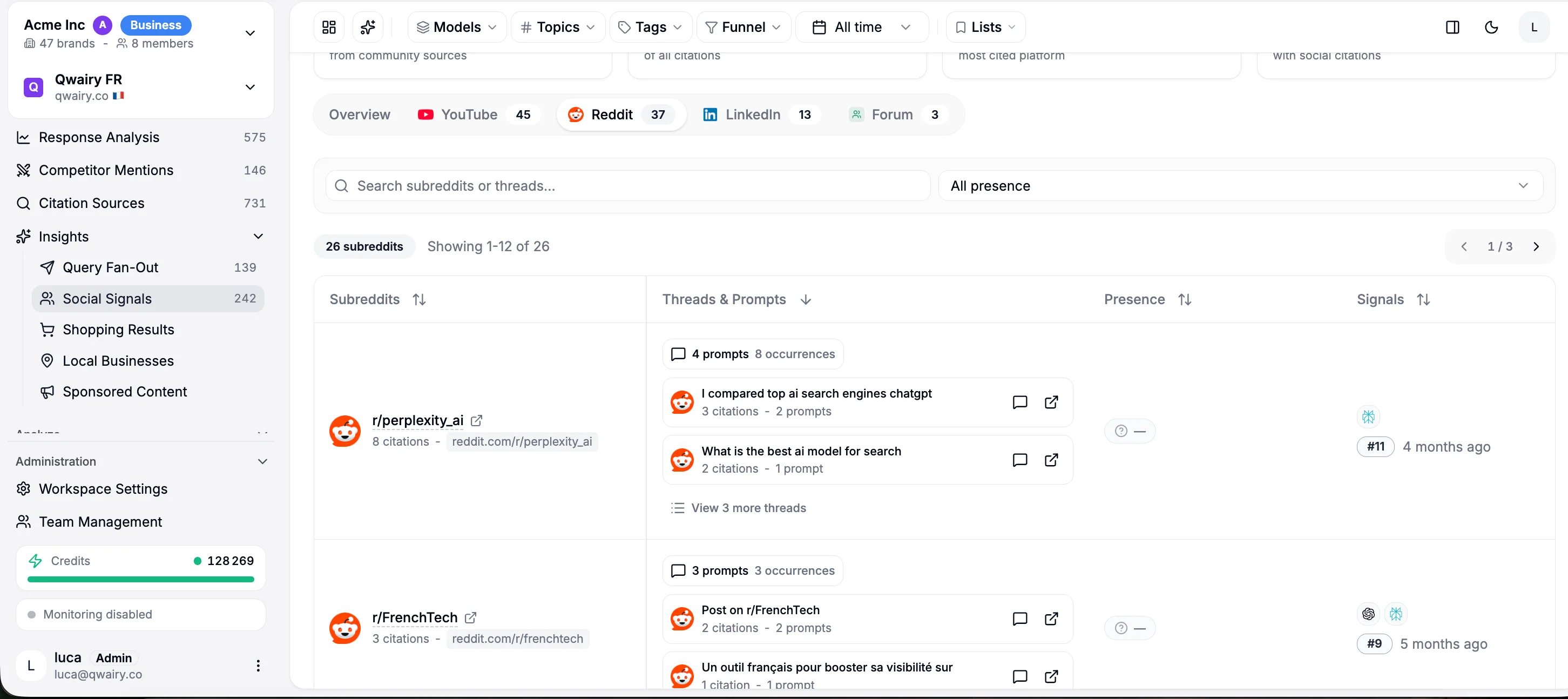
Social Signals now makes social citations easier to act on by bringing communities, URLs, prompts, opportunities, and engagement cues into clearer, consolidated views.
Teams can inspect the prompts behind each cited social URL and preview video/social sources directly from the insight tables, making it faster to spot where to build presence or close competitor gaps.
Qwairy's native MCP server, which lets Claude, Cursor and any MCP-compatible assistant query your visibility data in natural language, is now available from the Starter plan and up (previously Growth and above).
It exposes 40+ specialized tools spanning your visibility scores, competitors, sources, prompts, perception and prioritized actions, all secured with OAuth 2.1.
v1.18 adds nine new tools, so assistants can pull your off-AI analytics alongside your AI visibility: a Measure cluster (get_search_console_metrics, get_bing_metrics, get_referrer_analytics, get_ai_revenue, get_crawler_activity, get_page_performance) plus get_sponsored_content, get_backlink_opportunities and get_site_diagnostics.
A new user-scoped personal access token also lets headless clients connect across every team you belong to with a single key. The REST API stays on Growth and above.
Before an AI engine can cite you, its crawler has to be allowed to read your site.
The redesigned AI Crawler Readiness view, in the Optimize module, now checks your robots.txt against 63 known AI crawlers, from the engines behind ChatGPT, Claude, Gemini, Perplexity, Copilot and Mistral to the long tail.
For each one it shows whether it is allowed or blocked, the exact rule that applies, and what the crawler is for, organized by priority tier so the engines that matter most are front and center.
You can also generate an llms.txt to point AI systems at your best content.
Each crawler also shows a last seen time pulled from your connected server logs, so the view bridges to Crawler Coverage above: readiness tells you who is allowed in, and last seen shows who actually came.
Track the buying questions that matter in your market and see which brands each AI answer mentions, yours included.
We refreshed the premium model catalog: the latest Claude Opus models are now available, a few older variants were retired, and we adjusted some premium model credit costs to reflect current provider pricing.
Core models (ChatGPT, Gemini, Perplexity, AI Overview, Copilot, AI Mode, Grok in their default web interface) stay at 1 credit per query.
Jump to any page, prompt, competitor, source or documentation article from anywhere in your workspace with the new command palette.
Press ⌘K (Ctrl+K) or click Search in the sidebar.
Everything above is live. Pick what matters most:
Already on Qwairy? All features are in your dashboard now. New here? Start free | Book a demo | GEO Guide
Track the questions that matter to your business, see which brands each answer mentions and which sources it cites, then work on the gaps.
Free plan with 120 initial credits • No credit card required
Other Articles
Qwairy v1.20: Follow-Ups, Multi-country Workspaces & Post-purchase
Qwairy v1.20 adds Follow-Ups, multi-country workspaces, a Post-purchase stage and personas, with a catalogue of 18 AI engines from 15 providers, including Claude in its real interface.
Qwairy v1.19: Source Authority, Agent Skills & Connected Analytics
Qwairy v1.19 introduces Source Authority, 36 Agent Skills, rebuilt Crawler Analytics and broader analytics connections to turn AI visibility data into action.