Loading page

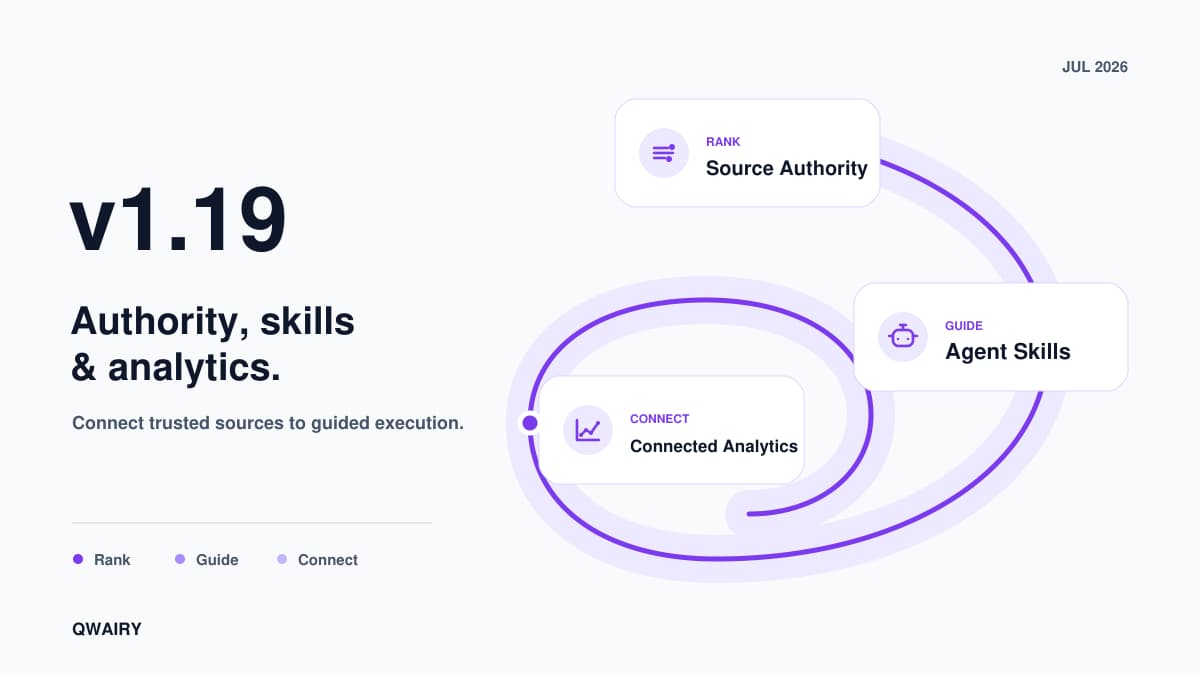
Qwairy v1.19 introduces Source Authority, 36 Agent Skills, rebuilt Crawler Analytics and broader analytics connections to turn AI visibility data into action.
AI visibility becomes useful only when it changes a decision.
Knowing that a brand appeared in an answer is not enough.
Teams still need to know which sources shaped that answer, whether AI crawlers can reach the right pages, what happened after an AI referral, and what to do next.
Qwairy v1.19 connects those questions into a single operating loop.
Source Authority reveals the domains that influence AI answers.
Agent Skills turn complex GEO work into guided analyses.
A rebuilt Crawler Analytics makes observed bot activity easier to understand.
Broader analytics connections link AI visibility to visits, conversions, and revenue.
The result: less time interpreting disconnected dashboards, and more confidence in the next move.
Citation volume tells you how often a source appears.
It does not tell you whether that source consistently shapes important answers across topics and AI providers.
Source Authority gives every cited domain a score from 0 to 100 based on its observed influence in your monitored AI landscape.
It considers:
Reach: how broadly the domain appears across answers and monitored questions.
Prominence: whether it tends to earn stronger citation positions.
Provider consensus: whether several AI engines rely on it.
Momentum: whether its influence is recent and sustained.
Breadth: whether authority comes from one isolated page or a deeper set of cited content.
This is not another name for Domain Rating or Domain Authority.
Those metrics estimate backlink strength across the web. Source Authority measures influence inside the AI answers your audience actually sees.
A specialist publication can therefore matter more to your brand than a much larger website if AI engines repeatedly trust it for the questions you monitor.
The score appears alongside citation usage in Monitor > Citation Sources, as well as in exports, Looker Studio, the REST API, and the MCP server.
More importantly, Source Authority now informs the Action Center when it prioritizes source, outreach, and backlink opportunities. Instead of treating every missing mention as equally valuable, Qwairy can bring the sources with the strongest expected influence to the top.
You can protect the sources already working for you, close meaningful authority gaps, and avoid spending time on placements unlikely to change an answer.
Run a free audit: see if ChatGPT, Gemini and Copilot recommend you, in about a minute.
A blank AI chat is flexible. It also makes every user invent the right analysis from scratch.
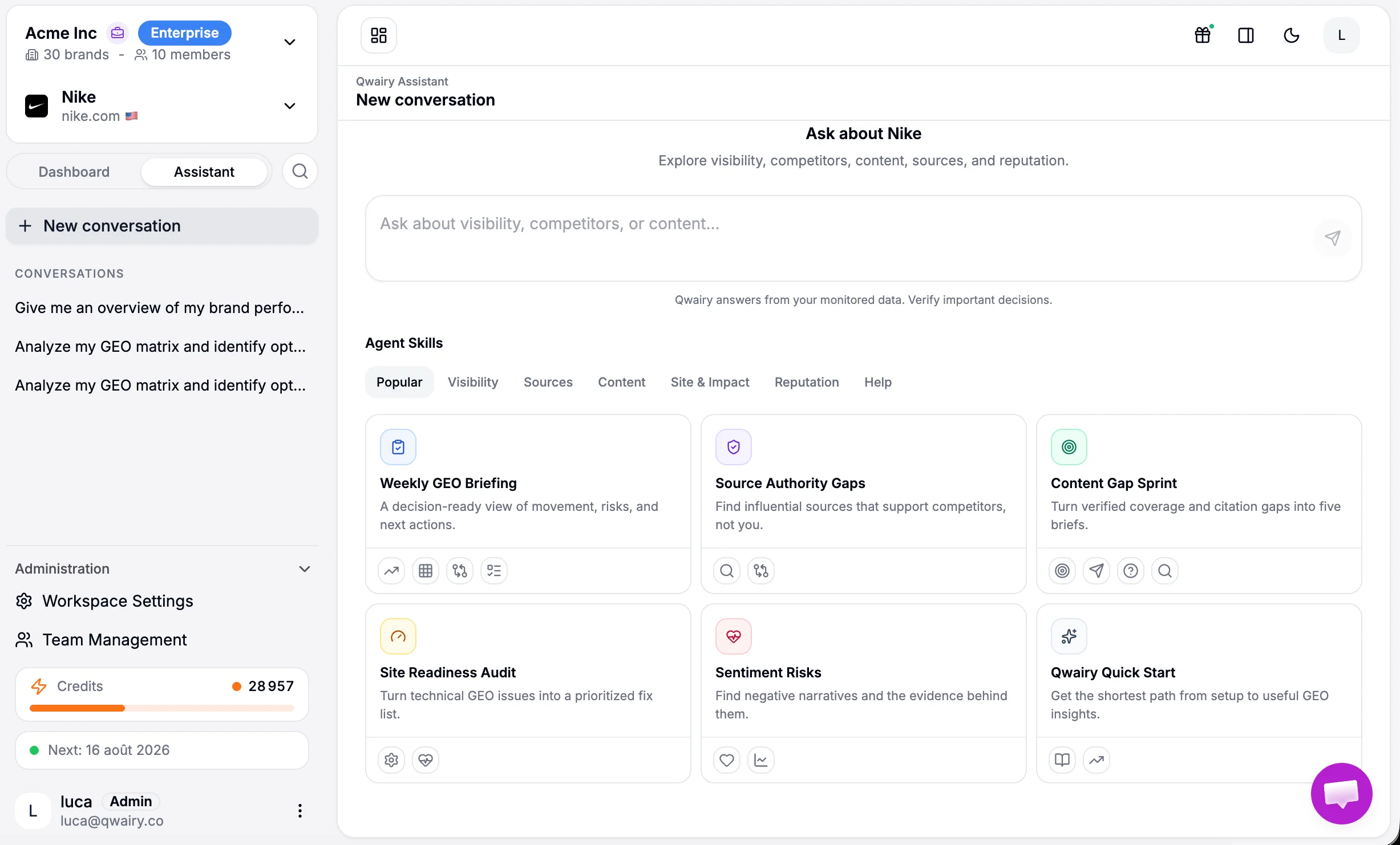
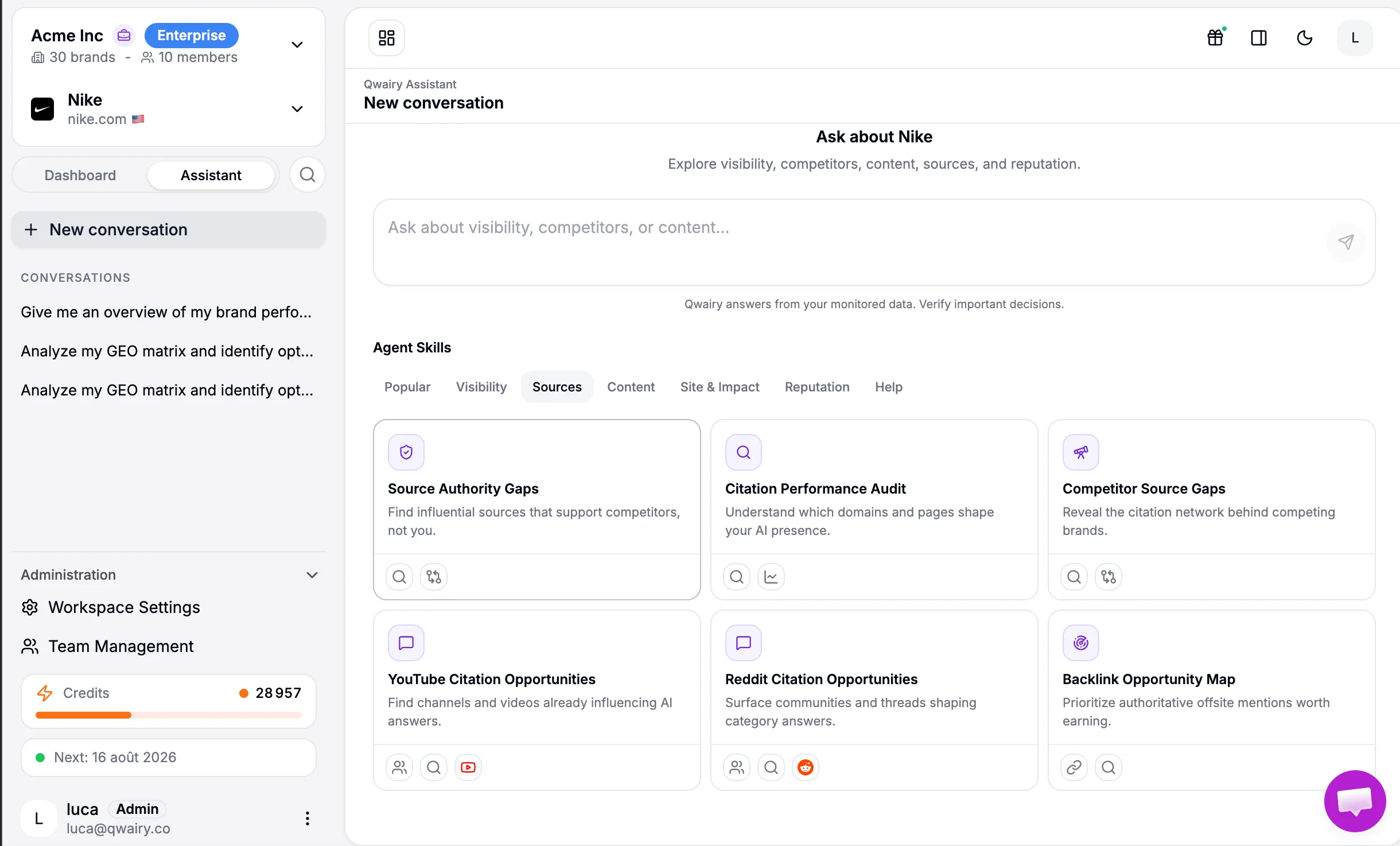
v1.19 replaces generic suggested prompts with 36 Agent Skills, organized into six categories: Visibility, Sources, Content, Site & Impact, Reputation, and Help.
Each skill is a carefully structured analysis request with a clear goal, relevant evidence, and useful constraints. You can start with jobs such as:
building a weekly GEO briefing;
diagnosing model-specific visibility gaps;
finding authoritative sources that cite competitors but not your brand;
identifying pages that are losing citations;
planning an AI-ready FAQ from real questions;
understanding a Qwairy score, integration, or monitoring workflow.
Selecting a skill prepares the full prompt in the composer. It never sends the message automatically. You can review it, adapt the scope, and decide when to run it.
The Qwairy Assistant responds in the language of your message and works from the workspace data you are allowed to access.
Where useful, it can render a focused chart or table, surface the supporting answers and sources, and separate verified evidence from hypotheses.
Agent Skills do not hide the prompt behind automation. They make strong analytical methods reusable while keeping the user in control.
Being allowed by robots.txt and being crawled are two different signals.
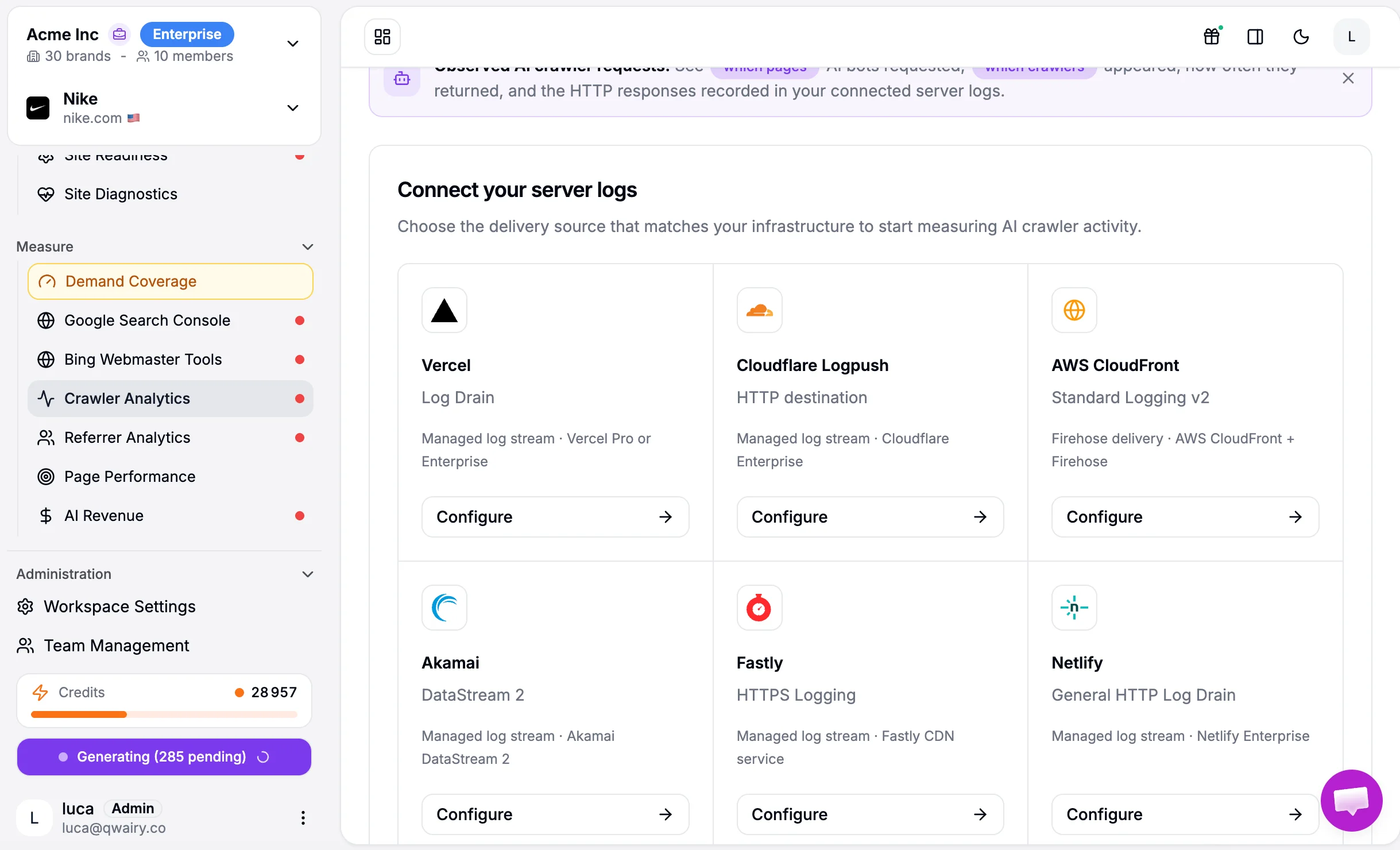
The rebuilt Crawler Analytics shows which recognized AI bots requested your site, which pages they visited, how often they returned, and whether those requests succeeded, redirected, or failed.
Coverage and freshness are visible, and the timeline stays focused on the periods teams use most: 24 hours, 7 days, and 30 days.
The setup directory covers the infrastructure teams already operate, including Cloudflare, Vercel, AWS CloudFront, Akamai, Fastly, Netlify, and generic HTTP pipelines.
The interpretation remains deliberately clear:
A crawler request is evidence of access, not proof that a page was indexed or cited.
Human visits arriving from ChatGPT, Perplexity, and other assistants remain separate in Referrer Analytics.
Page-level views connect crawl activity with citations and performance without turning raw server logs into the product experience.
This makes Crawler Analytics useful for practical decisions: fix a blocked or failing route, strengthen pages that bots visit but never cite, and investigate valuable pages that appear invisible to AI crawlers.
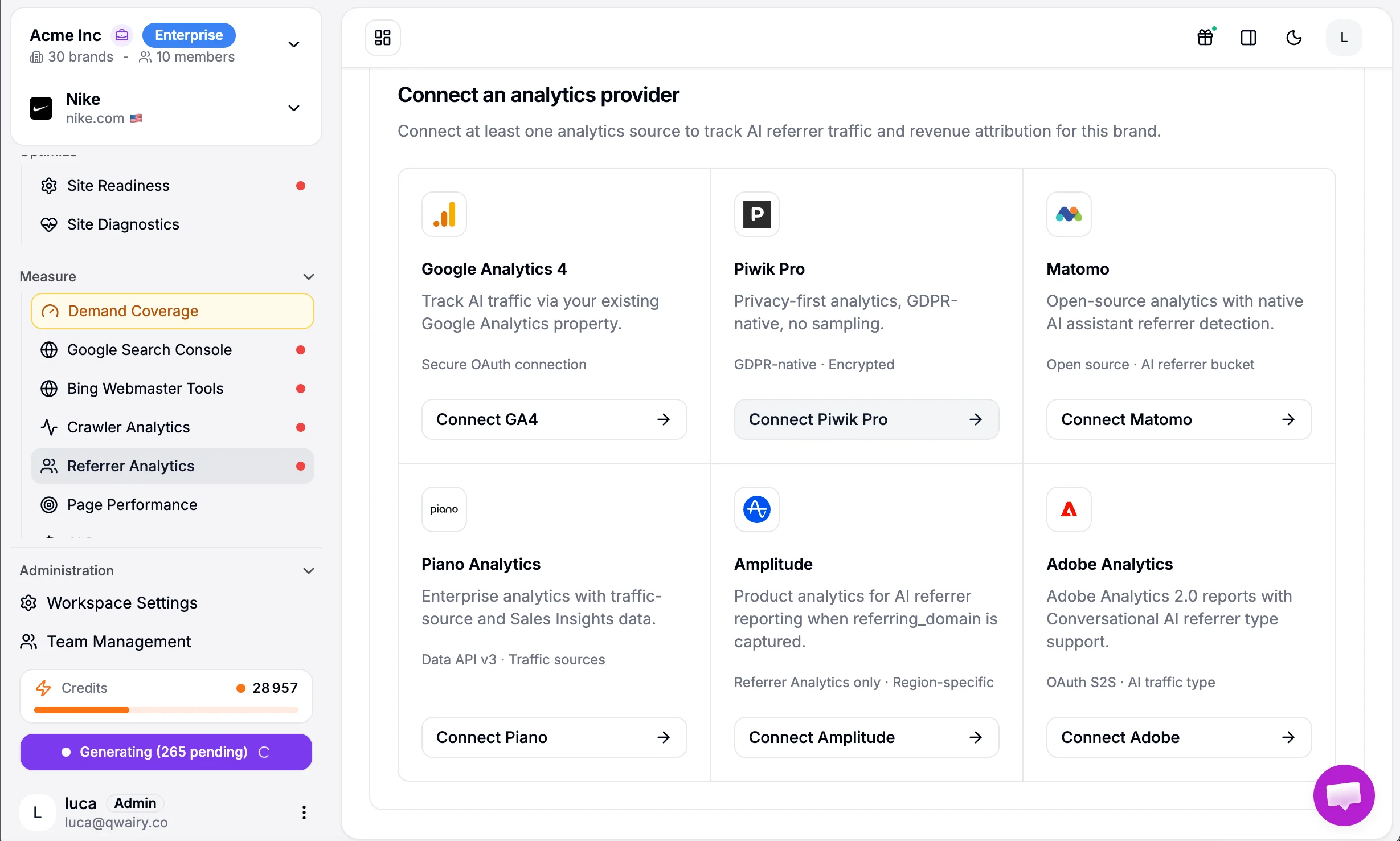
AI visibility matters differently once it produces a visit, a lead, or a purchase.
v1.19 expands Qwairy's analytics connections beyond Google Analytics 4 and Piwik Pro with support for Matomo, Piano Analytics, Adobe Analytics, and Amplitude.
Each connection exposes the capabilities its platform actually provides, so referral-only data is never presented as revenue.
AI Revenue is now configurable for both ecommerce and lead-generation journeys.
Teams can choose the purchases, events, goals, or provider metrics that represent a conversion. When native revenue is unavailable, a fixed estimated value can be assigned without mixing it with measured revenue.
Piano Analytics can contribute revenue data when Sales Insights is available.
Together, the Measure workspace keeps three stages distinct:
That separation makes the funnel easier to trust. Qwairy does not collapse access, traffic, and outcomes into one ambiguous attribution number.
See your mentions across ChatGPT, Claude and Perplexity in real time, the moment buyers ask.
Expanded MCP and REST analysis: query Source Authority, crawler activity, page performance, AI referrals, revenue, actions, and Pitch Audits from connected workflows.
Clearer integration access: MCP Server, REST API, and Looker Studio are directly available from the dashboard, with plan requirements and documentation visible during setup.
A persistent Release Center: product updates remain accessible after the announcement disappears, with a history of previous releases.
Broader Viewer access: Viewer users can explore more read-only analytics and use the Assistant without gaining mutation rights.
Richer exports: Source data, Brand Perception, and Pitch Audits can be exported in formats designed for deeper analysis and client reporting.
Refreshed GEO Playbooks and Integrations hubs: workflows and connections are easier to discover without navigating a directory of fragmented detail pages.
v1.19 brings the main layers of an AI visibility program into one workflow:
Most visibility tools end at reporting. Qwairy v1.19 is designed to make the next decision clearer, and the next action easier to defend. Start with Qwairy | Book a demo | Explore integrations
Track your brand's visibility across ChatGPT, Claude, Perplexity and other AI platforms. See how your presence evolves over time.
Free plan • 120 initial credits • No credit card required
Other Articles
Qwairy v1.18 Product Update: AI Revenue & Action Center
AI Revenue moves to GA with three-layer attribution and a self-serve GA4 setup, the Action Center leaves beta on every paid plan, and a new Pitch Audit lets agencies run one-shot GEO audits on prospects. Plus a refreshed Premium Models catalog and the MCP server now available from Starter.
Qwairy v1.17: AI Assistant & Ads Monitoring for Everyone
Launch your agency practice with pitch workspaces and a public directory. Run full GEO audits on any competitor with PDF export. Per-prompt monitoring frequency, redesigned Social Insights, and an AI Assistant now open to every user.