
Loading page
Top AI brand monitoring tools in 2026 reviewed. Track brand mentions in ChatGPT, Gemini & Perplexity. Compare features, pricing & LLM visibility trackers.
A complete guide for marketing teams, agencies, and enterprise businesses ready to track brand visibility across ChatGPT, Gemini, Perplexity, Google AI Overviews, and every major LLM.
TIn 2026, generative search engines — ChatGPT, Google AI Overviews, Perplexity, Gemini, Claude — have fundamentally changed how consumers discover brands. Traditional SEO tracking tools were built for a world of blue links. That world is shrinking fast. Today, when a potential customer queries "best project management software for remote teams," they're increasingly reading a generated response — not clicking ten organic results. If your brand isn't cited in that answer, you've lost the moment. If it's mentioned incorrectly, you've lost trust. And if a competitor's brand is cited instead of yours — you've lost market share, silently. AI brand monitoring is the discipline of tracking, analyzing, and improving how your brand appears inside AI-generated responses. It covers LLM mention tracking, sentiment analysis, citation health, share of voice in generative engines, and the competitive intelligence needed to understand why rivals are beating you in AI-generated answers. This comprehensive article reviews the best AI brand monitoring tools available in 2026, built for marketing teams who need actionable insights — not just dashboards full of data.
AI brand monitoring is the continuous process of identifying how your brand is perceived and represented across artificial intelligence platforms. Unlike social media monitoring or traditional brand tracking, it focuses specifically on:
LLM visibility monitoring: Does your brand appear in ChatGPT, Perplexity, Gemini, Claude, and Google AI Overviews?
Citation tracking: When AI models mention your brand, are they citing reliable sources — or hallucinating?
Sentiment analysis in generated responses: Is the perception and visibility of your brand positive, neutral, or harmful inside AI-generated content?
Share of voice vs. competitors: Who wins the citation battle at the prompt level?
Brand health across conversational AI: How does your brand perform across the full spectrum of consumer-facing AI tools?
The impact of AI on brand tracking goes far beyond what SEMrush, Ahrefs, or Clearscope were designed to handle. These traditional SEO tools are limited to indexable web content. AI brand monitoring tools are designed to analyze brand mentions inside model outputs — a fundamentally different challenge.
Before reviewing specific platforms, here's a features-of-monitoring-tools scorecard to guide your decision. Use this to pick the right solution for your team.
The tool must monitor multiple AI engines natively: ChatGPT, Perplexity, Google AI Overviews, Gemini, Claude, and emerging LLMs. Multi-platform coverage at prompt level is non-negotiable. Ask vendors for a coverage map with sampling frequency.
Does the tool analyze brand sentiment in generated responses — not just count mentions? Effective brand mention analysis requires classifiers tuned to AI output patterns, including hallucination detection when a model invents false claims about your brand.
Speed matters in reputation management. Alert systems should be flexible, configurable by severity and reach, and integrated with your team's workflow via email, Slack, or ticketing systems. Target: critical mentions surfaced within 15–60 minutes.
Raw data without guidance is noise. The best tools provide AI-driven recommendations tied to specific content gaps. Competitor benchmarking features let you understand why rivals gain citations while you don't. A good dashboard surfaces the why, not just the what.
Monitoring must connect to business outcomes. Look for tools that link visibility tracking to conversions, email campaign performance, and purchase attribution. Stakeholders need to see ROI, not impression volume.
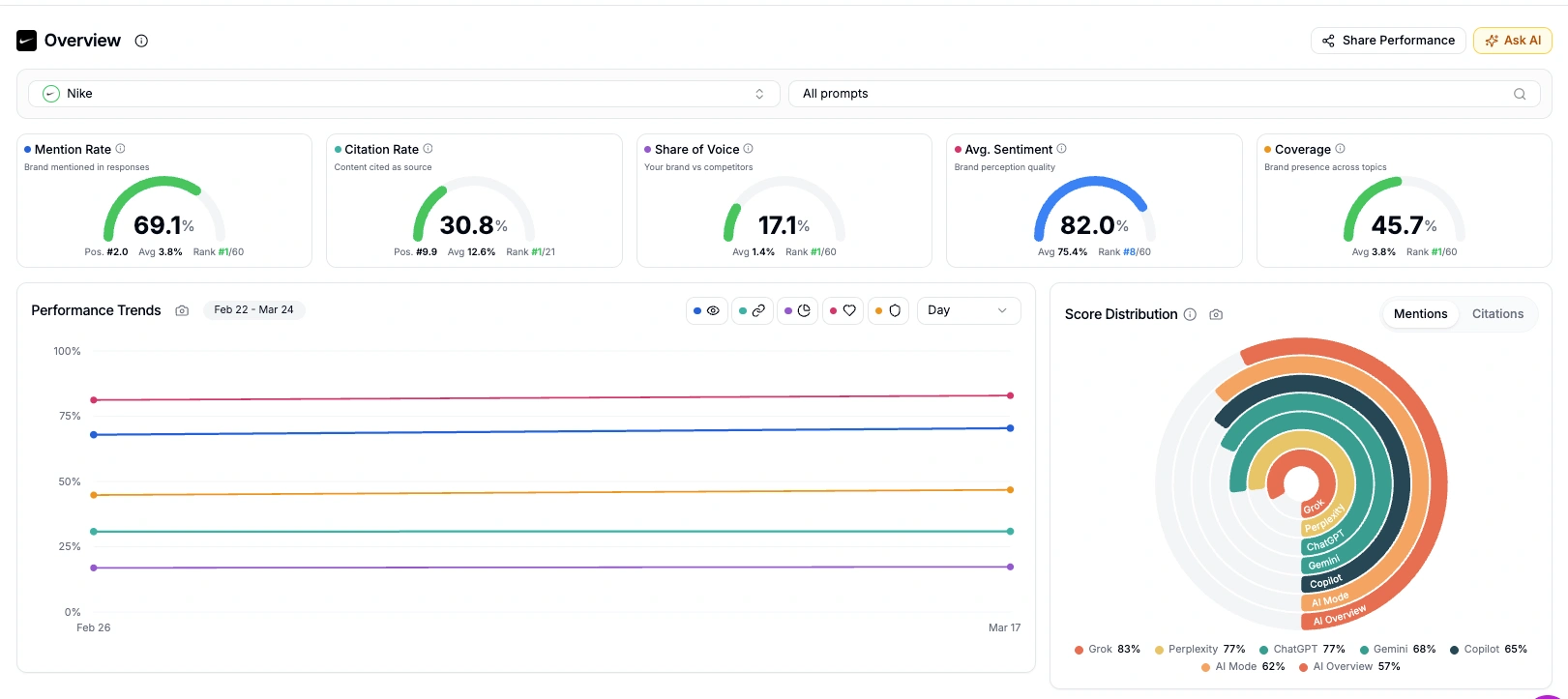
Overview: Qwairy (qwairy.co) is a Paris-based SaaS platform purpose-built for brands that need to improve visibility on generative search. It monitors more than 15 AI platforms in real time and is uniquely designed to bridge the gap between monitoring insights and content optimization — making it the most complete visibility tool for teams focused on outcomes.
Key Features:
Generative engine optimization (GEO) recommendations tied to specific AI engines
LLM mention tracking across ChatGPT, Perplexity, Google AI Overviews, Gemini, and more
Citation health scoring and source authority analysis
Content gap identification at the query and topic level
ROI analytics linking visibility changes to conversions
Sentiment Analysis on every prompt
Social Media analysis : discover which reddit thread and youtube video are the most used by llms
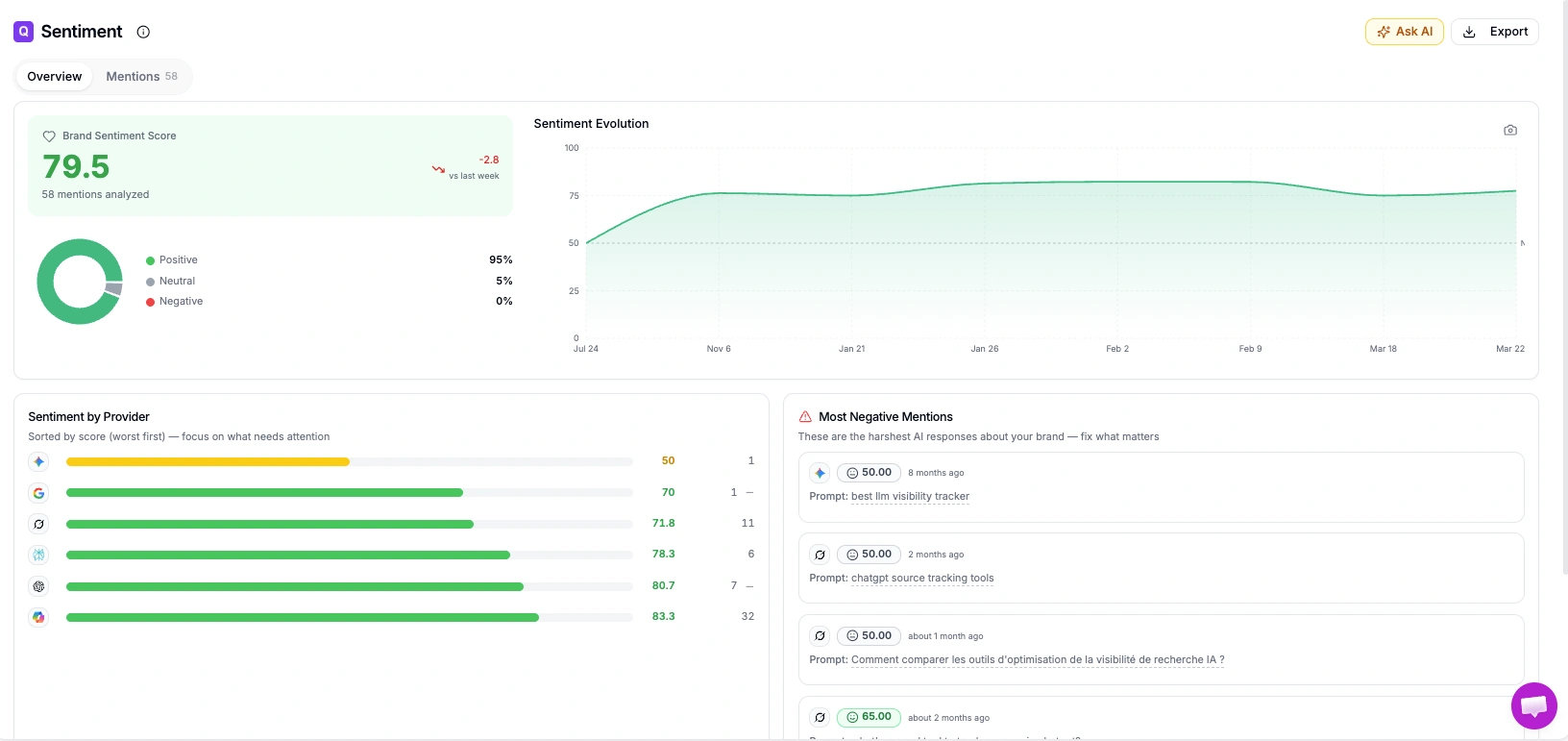
Who it's built for: Marketing teams, SEOs, SEO agencies, and enterprise companies that want a dedicated solution connecting brand monitoring to AI-optimized content — not just a tracker that reports brand mentions without guidance on how to improve.
Pros:
Deepest GEO and LLM visibility coverage available
Actionable content recommendations, not just dashboards
Backlinks Marketplace
Conversion tracking built in — easy to demonstrate ROI to stakeholders
Advanced competitor benchmarking features
Designed for continuous improvement, not one-time audits
Looker Studio and MCP
Already used by companies like Match group, Total and leading SEO agencies
Cons:
Custom pricing may require a sales conversation to start
Primary focus is generative search; broader social media monitoring is limited
Best for: Brands serious about AI visibility strategy — especially those in competitive markets where citation placement drives purchase intent.
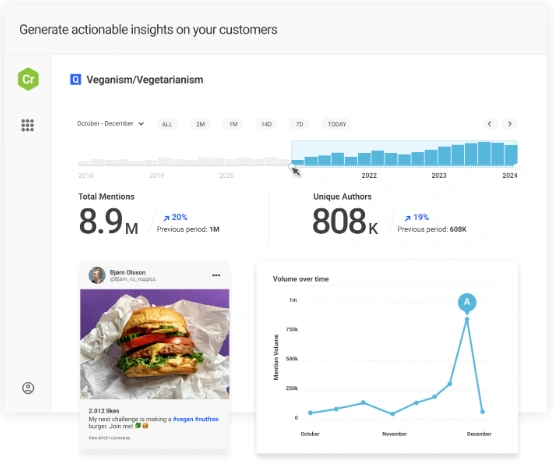
Overview: Brandwatch is a comprehensive enterprise suite for social listening, social media management, and influencer marketing. Part of the Cision group — which recently acquired Trajaan to strengthen its search intelligence capabilities — Brandwatch is trusted by two-thirds of the most powerful Forbes 100 brands. The platform is built around three distinct modules: Consumer Intelligence (social listening and brand reputation), Social Media Management (formerly Falcon), and Influence (formerly Paladin).
Key Features:
Deep **social listening **and consumer intelligence across major platforms
**Sentiment analysis **and custom classifiers powered by their proprietary Iris AI
Unified** social media management from a single dashboard**
Integrated influencer marketing solution
Compliance and governance features for regulated industries
Extensive historical data for trend analysis and competitive benchmarking
Strong stakeholder reporting capabilities
Pros:
Most complete enterprise suite for **social media monitoring **and consumer intelligence
Established trust among global marketing, PR, and insights teams
The Trajaan acquisition adds a meaningful search intelligence dimension
Ideal for teams that want to centralize social listening, publishing, and influence in one platform
Cons:
No dedicated LLM/GEO tracking module — AI answer monitoring is not the platform's core focus
Enterprise custom pricing with no public overview — requires a sales conversation to start
Overkill for SMBs, mid-market companies, or smaller agencies with limited budgets
Teams specifically looking for generative search visibility tools will need to complement Brandwatch with a dedicated solution like Qwairy
Best for: Large enterprises that need a unified suite for social listening, social media management, and influencer marketing — backed by robust consumer intelligence and compliance-ready reporting.
Run a free audit: see if ChatGPT, Gemini and Copilot recommend you, in about a minute.
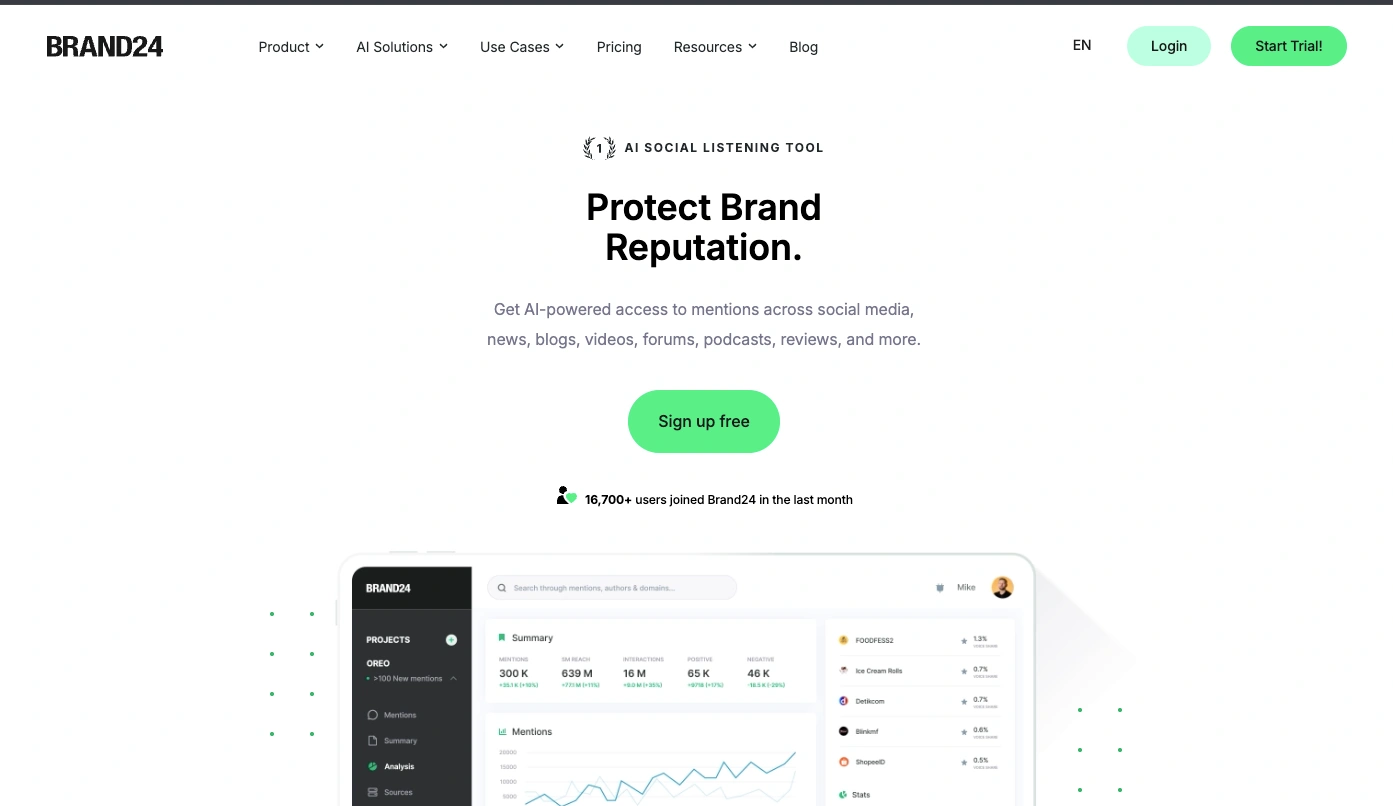
Overview: Brand24 is an AI-powered social listening platform that monitors brand mentions across 25 million+ online sources in real time — including social media, blogs, news, forums, podcasts, and video. In 2026, it added a dedicated AI Visibility module that tracks how LLMs like ChatGPT, Gemini, Perplexity, Claude, Grok, Copilot, and Google AI Overviews mention and recommend your brand. It's a strong mid-market solution that sits between lightweight tools and enterprise platforms like Brandwatch.
Key Features:
Real-time brand mention tracking across 25M+ sources
AI-powered sentiment analysis in 108 languages (positive, neutral, negative)
AI Visibility module: Share of Voice by AI Chatbots, LLM mention tracking, and misinformation detection in model responses
Presence Score: a 0–100 benchmark against thousands of brands
AI Brand Assistant: query your monitoring data in natural language
Brand24 MCP: connect monitoring data directly to ChatGPT, Claude, or other AI agents (launched January 2026)
Competitor benchmarking and share of voice tracking
Custom alerts, Slack integration, and daily reporting
Influencer identification and reach metrics
Pros:
One of the most accessible tools that now genuinely covers LLM visibility
Strong reputation management with fast real-time alerts
AI Brand Assistant makes insights easy to read without deep analyst skills
MCP integration is a forward-looking differentiator for AI-native teams
Good value for mid-market companies — significantly cheaper than Brandwatch
Cons:
Monitoring only — no publishing or engagement features; you'll need a separate tool like Sprout Social to respond to mentions
Keyword limits feel tight on entry plans (3 keywords on Individual, 7 on Team)
Sentiment accuracy can be inconsistent for nuanced or industry-specific language
12-month data retention limit on most plans
Pricing starts at $149/month (annual) — steep for startups with low mention volumes
Pricing: Plans start at $149/month (billed annually). 14-day free trial available, no credit card required.
Best for: Marketing teams and agencies that want solid AI social listening combined with genuine LLM visibility tracking — without the complexity or cost of an enterprise platform like Brandwatch.
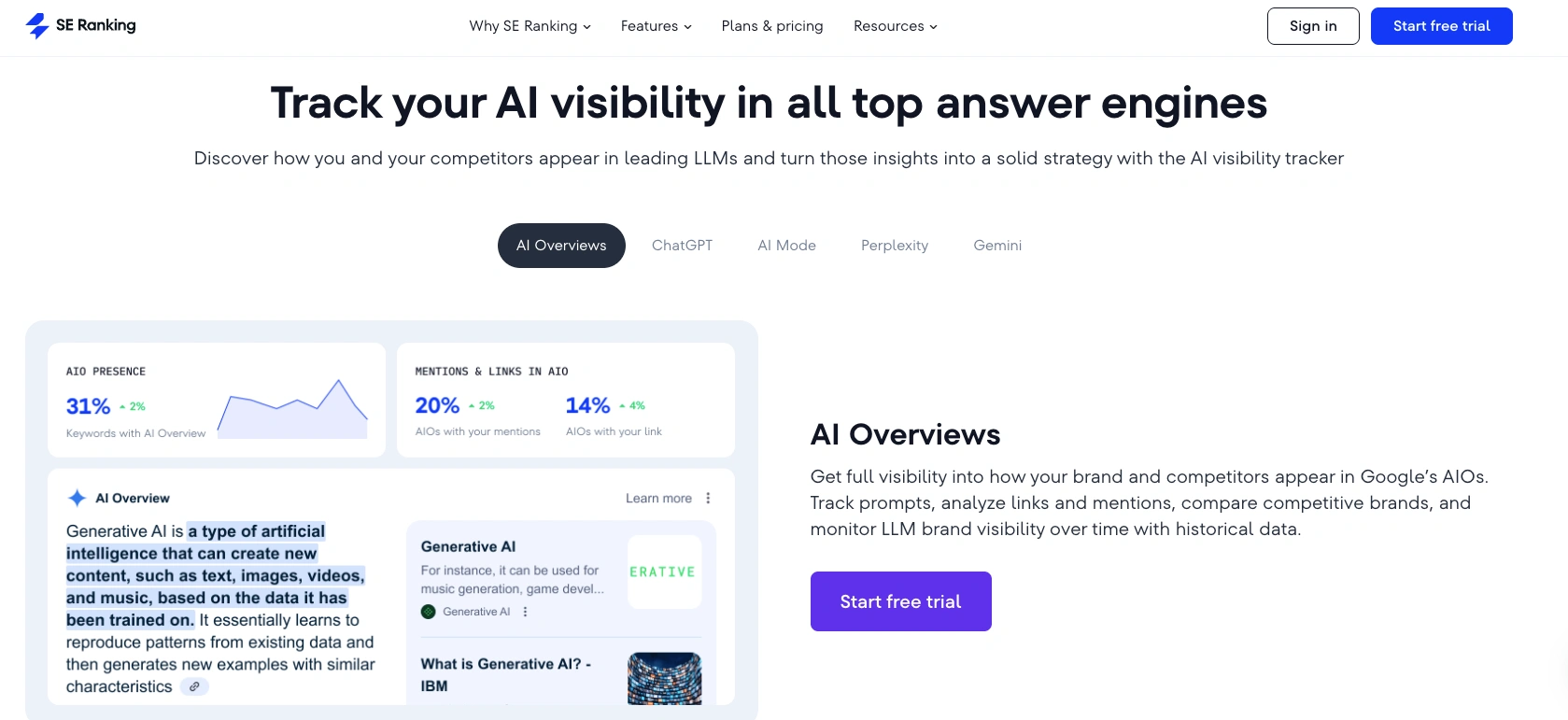
Overview: SE Ranking expanded its well-known visibility toolkit to include AI answer tracking and visibility scoring. It maps keyword volume and intent to AI answer prevalence, showing exactly where generative results displace traditional organic listings.
Key Features:
Visibility scoring for traditional and generative search results
Keyword-level recommendations to improve position in AI answers
SERP snapshots capturing model answers over time
Integration with existing SE Ranking SEO workflows
Competitor benchmarking for AI-generated result coverage
Overview dashboards for tracking tools performance over time
Pros:
**Familiar interface for SEO teams **already using SE Ranking
Strong keyword volume and intent data combined with LLM tracking
Practical for agencies managing multiple clients across traditional and AI search
Cons:
Sentiment analysis and hallucination detection are limited
Built primarily for SEO-trained teams — less suited to PR or brand strategy users
Coverage of AI ecosystems (chatbots, voice, syndication) is narrower than dedicated tools
Best for: SEO agencies and in-house SEO teams that want to extend their traditional search tracking strategy to include AI visibility without switching platforms.
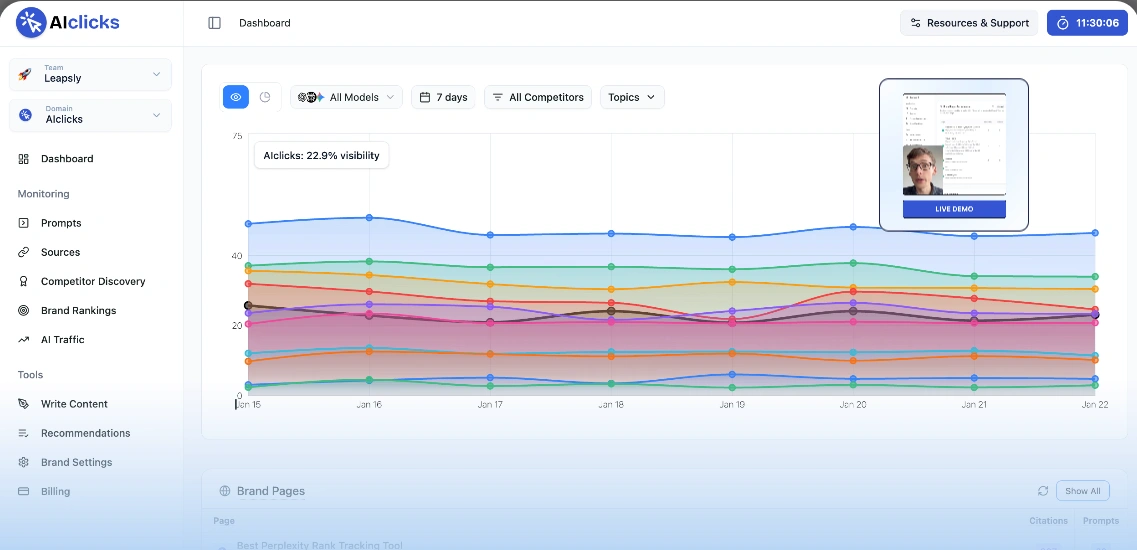
Overview: AIclicks (aiclicks.io) is a dedicated AI search visibility and Answer Engine Optimization (AEO) platform built natively for the generative search era. Rather than adapting a legacy SEO tool, it was purpose-built to track how brands appear inside AI-generated answers at the prompt level — then turn that data into actionable content workflows. It covers ChatGPT, Perplexity, Gemini, Google AI Overviews, Claude, Copilot, and more, with daily monitoring refreshes and unlimited seats.
Key Features:
Prompt-level visibility tracking across all major LLMs and AI search engines
Share of voice by AI platform — see exactly which prompts trigger your brand vs. competitors
Citation source intelligence: identify which sources influence AI answers
Sentiment monitoring inside AI-generated responses
Content gap detection with AI-powered blog and content generation to close gaps automatically
Competitor benchmarking at the prompt and topic level
Country-based monitoring and daily data refresh
AI Search Visibility Dashboard combining GEO and traditional SEO signals
Pros:
Most granular prompt-level tracking available — built specifically for GEO, not retrofitted
Actionable by design: surfaces exactly what content to create and where to earn mentions
AI agents write content automatically to close visibility gaps
Strong for agencies managing multiple clients with unlimited seats
Accessible pricing for the depth of features offered
Cons:
Not designed as a replacement for traditional SEO tools — best paired with Google Search Console or Ahrefs for full coverage
Newer platform — less historical data depth than established enterprise tools
Primarily focused on AI search visibility; does not cover social media monitoring or traditional brand mentions
Pricing: Starts at $79/month (promotional Starter plan at$39/month). Full refund guarantee included.
Best for: Marketing teams, SEO agencies, and growth-focused brands that want deep, prompt-level AI visibility tracking combined with built-in content optimization workflows — without enterprise-level complexity or cost.
Overview: Passionfruit (getpassionfruit.com) is a solution founded by Stanford and CMU alumni that combines tracking, strategy, analysis, and execution across both traditional SEO and Answer Engine Optimization (AEO). Rather than a standalone monitoring tracker, Passionfruit owns the full stack — from visibility data to Reddit engagement, designed for brands that want a dedicated partner to execute across generative and traditional search.
Key Features:
AEO and SEO tracking combined in a single intelligence layer
Reddit engagement strategy — a differentiator for consumer-facing brands
Full-stack execution: strategy, content, and optimization included
Competitive intelligence across generative and standard search
Trusted by major global brands (backed by top investors)
Contact-based pricing (book a call model)
Pros:
Rare combination of monitoring + execution — not just a reporting dashboard
Reddit-native strategy is a unique asset for brands targeting conversational audiences
Founded by technical alumni with strong credibility in the market
Well-suited for brands that want agency-level support with proprietary intelligence tools
Cons:
Not a self-serve SaaS tool — requires engaging their team to start
Custom pricing with no public overview — harder to compare quickly
Less suited for teams that want a standalone app they can configure independently
Best for: Growth-stage and enterprise brands that want a high-touch partner to manage both AI visibility tracking and the execution of SEO and AEO strategies — including Reddit as a channel.
See your mentions across ChatGPT, Claude and Perplexity in real time, the moment buyers ask.
Overview: Profound is a niche but valuable tool for brands whose content is frequently republished across AI syndication networks. It tracks how third-party AI tools and apps redistribute brand content, and whether those redistributions convert to traffic and pipeline.
Key Features:
AI syndication monitoring across third-party apps and platforms
Conversion tracking from syndicated AI content
Alert system for misattributions in republished content
Privacy policy compliance tracking across distribution networks
Pros:
Uniquely focused on downstream AI distribution — a gap most tools miss
Conversion tracking directly tied to syndicated AI exposure
Good for brands with extensive content footprints across the web
Cons:
Very specialized — not a complete brand monitoring solution on its own
Limited social media monitoring and sentiment analysis
Less relevant for brands with limited third-party content distribution
Best for: Enterprises and publishers whose content is widely syndicated and who need visibility into how AI republication affects brand perception and conversion.
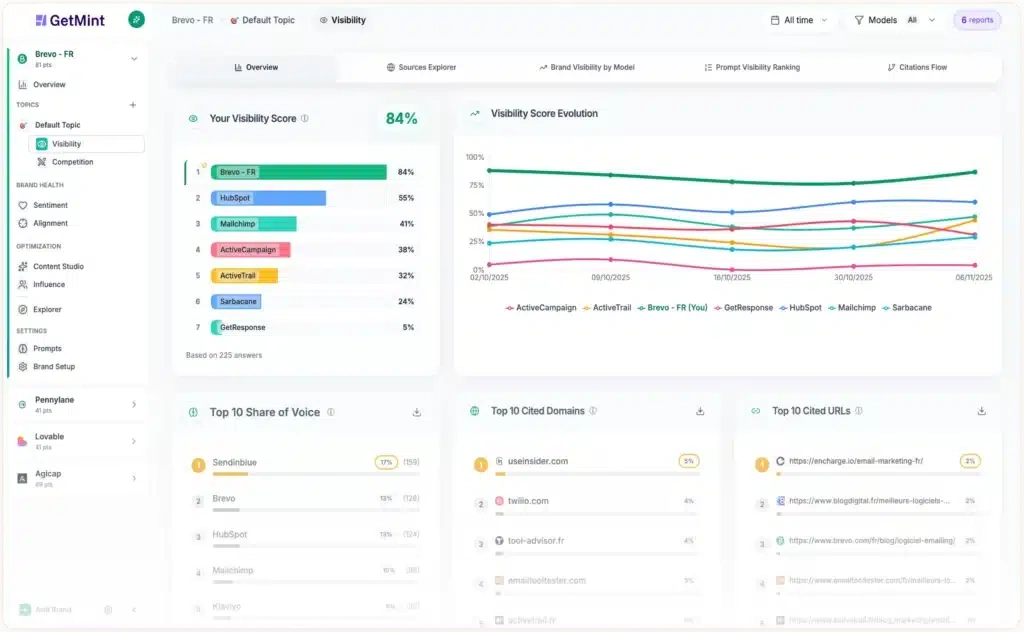
Overview: GetMint (getmint.ai) is a purpose-built AI brand monitoring and GEO platform that goes a step further than most visibility trackers: it doesn't just show where your brand appears in AI answers — it identifies the exact source URLs feeding those AI models. If ChatGPT references an old, incorrect article about your brand, GetMint helps you locate and address that "zombie source. It also connects monitoring to content distribution across 150K+ partner media outlets, making it one of the most end-to-end solutions available.
Key Features:
LLM visibility monitoring across ChatGPT, Claude, Gemini, Perplexity, Grok, Copilot, Meta AI, and more
Generative share of voice tracking vs. competitors
Source diagnosis: identify which URLs and domains are influencing AI answers about your brand
Content gap detection with optimization and creation credits built into every plan
Content distribution network (150K+ partner media outlets) to directly influence LLM citation sources
Sentiment tracking, competitive benchmarking, and brand alignment tools
Growth and Pro plans feature unlimited seats with project-based scaling, recognizing that AI brand management requires company-wide access G2
Instant setup — enter your URL and start collecting visibility data immediately
Free trial available
Pros:
Uniquely forensic: traces AI answers back to their source URLs — a capability few tools offer
End-to-end platform: monitoring → content optimization → content distribution in one place
Unlimited seats on Growth and Pro plans — no per-user pricing headaches
Covers the broadest range of LLMs including Mistral and DeepSeek on higher tiers
Strong fit for agencies: cited by agency users as the tool they actively recommend to clients
Cons:
Strictly focused on AI and search — does not track social streams like X or TikTok, which may be a drawback for brands needing broader social listening Scopic Studios
Requires a shift from traditional mention counting to more sophisticated AI overview tracking, which may involve a learning curve for some teams Scopic Studios
Not designed for PR or crisis reputation management in the traditional sense
Pricing: 4 pricing tiers from free to €499/month. Starter at €99/month (2 seats), Growth at €229/month (unlimited seats, 5 projects, daily updates), Pro at €499/month (unlimited seats, 15 projects, on-demand refresh, unlimited AI models). All paid plans include a 20% annual discount.
Best for: Brands and agencies that want to go beyond surface-level visibility tracking — specifically those who need to understand why AI models say what they say, fix the source content feeding those answers, and distribute new content that directly influences future LLM citations.
Choosing right among these platforms depends on what your team is trying to execute. Here's a practical framework:
Start with your primary use case:
If your goal is to improve visibility in ChatGPT, Google AI Overviews, and Perplexity → Qwairy
If you need to integrate AI monitoring into existing enterprise social listening → Brandwatch
If daily reputation alerts and brand mention tracking is the priority → Brand24
If your team lives in SEO tools and wants LLM tracking added → SE Ranking
If you need insight summaries without heavy analysis work → AiClicks
If you produce high-volume content and need CMS-connected monitoring → Passionfruit
If your brand is heavily syndicated across AI networks → Profound
Run a pilot before committing: Test 2–3 tools over 30 to 60 days on 10–20 high-intent queries and brand assets. Use a weighted scorecard (coverage 25%, accuracy 20%, alert speed 15%, actionability 20%, integration 20%) to identify the best fit before signing annual contracts.
Pricing overview tip: Most enterprise tools use custom pricing based on query volume, platforms monitored, and team size. Brand24 and SE Ranking offer the most transparent tiered pricing for agencies and mid-market teams. Qwairy, Brandwatch, and Profound typically require a sales consultation to size correctly.
Select your tool based on the scorecard above
Configure tracking for brand name, key products, and top competitor names
Set up daily and real-time alerts for your team
Identify your baseline: share of voice, citation rate, sentiment score
Connect monitoring insights to content updates
Identify gaps in FAQ pages, product copy, and blog posts that AI engines ignore
Use competitive intelligence to understand which content formats earn citations
Implement GEO-specific recommendations (especially if using Qwairy)
Link visibility improvements to traffic and conversion metrics
Build stakeholder dashboards showing share of voice trends over time
Establish response SLAs for negative AI-generated mentions
Expand monitoring to regional teams and additional LLM platforms
Assign clear ownership: marketing owns visibility tracking, PR owns reputation alerts, legal reviews policy-sensitive AI-generated content. Define severity levels and create playbooks for the three most common scenarios: hallucinations about your brand, competitor over-representation, and sentiment decline.
Most monitoring tools identify problems. Qwairy solves them. The platform is uniquely built around a detect → analyze → recommend → implement → measure loop that closes the gap between insight and action. When a query reveals that ChatGPT is citing an outdated product description, Qwairy doesn't just flag it — it recommends specific content edits, tracks the update, and measures the visibility lift in subsequent monitoring runs. For brands that view generative search as a channel — not just a threat to manage — Qwairy provides the deepest competitive intelligence, the most actionable guidance, and the clearest ROI reporting available. It's a solution designed for teams that want to improve outcomes, not just monitor them. Visit qwairy.co to start a pilot and see how your brand currently performs across 15+ AI platforms.
In 2026, LLM visibility is not optional. Every brand that relies on search-driven demand needs to understand how AI models perceive and represent them — and have a clear strategy to improve that representation. The best ai brand monitoring tools share three qualities: they cover multiple AI engines at the prompt level, they deliver actionable insights not just raw metrics, and they connect monitoring to measurable business outcomes. Whether you're a lean marketing team at a fast-growing company, an agency managing multiple clients, or an enterprise brand protecting a global reputation, the right visibility tracking tool is one of the highest-ROI investments available in digital marketing today.
Key takeaways:
Track brand visibility across ChatGPT, Gemini, Perplexity, Google AI Overviews, and Claude — not just Google Search
Analyze brand mentions for sentiment, citation accuracy, and competitive position
Choose tools that provide guidance and ROI measurement, not just dashboards
Run a 30–60 day pilot with a weighted scorecard before committing
For teams that want to convert AI visibility into revenue: evaluate Qwairy first
Track your mentions across ChatGPT, Claude, Perplexity and all major AI platforms. Join 1,500+ brands monitoring their AI presence in real-time.
Free trial • No credit card required • Complete platform access
Other Articles
ChatGPT Ads Are Coming to France: What US Data Reveals Before Launch
ChatGPT ads appear in 69.25% of US-monitored commercial answers but near zero in France. What US data reveals before the French launch, and how to prepare.
ChatGPT Stopped Citing Reddit. Our Data Shows the Mechanism Behind the 95% Collapse
Reddit's share of ChatGPT Search citations collapsed 95% in one week in August 2026. Qwairy's citation data reveals the mechanism: a query fan-out change on August 8 that switched ChatGPT to direct site: interrogation, redistributing citations from discussion platforms to official sources.