Loading page

Generative Engine Optimisation refers to the set of strategies used to optimize your brand's presence in AI-generated answers.

In the rapidly evolving landscape of online search, a new discipline has emerged: Generative Engine Optimization (GEO). GEO refers to the set of strategies used to optimize your brand's presence in AI-generated answers. As traditional SEO struggles to maintain traffic amid the rise of AI search engines like ChatGPT, Perplexity, and Google's AI Overviews, GEO is becoming essential for brands who want to stay visible in the age of large language models (LLMs). In this guide, we'll cover:
What GEO is and why it matters
How it differs from SEO
How to start optimizing your brand for LLMs
The tools and tactics to build GEO authority
GEO stands for Generative Engine Optimization. It refers to the set of strategies used to optimize your brand's presence in AI-generated answers, especially those delivered by large language models like ChatGPT, Claude, or Gemini. Unlike SEO, which is about ranking web pages in search engine result pages (SERPs), GEO focuses on ranking entities (brands, products, people) within AI-generated content. These models don't just provide links - they summarize answers, often pulling information from multiple sources and delivering it conversationally. That means if you're not mentioned in the response, you're invisible.
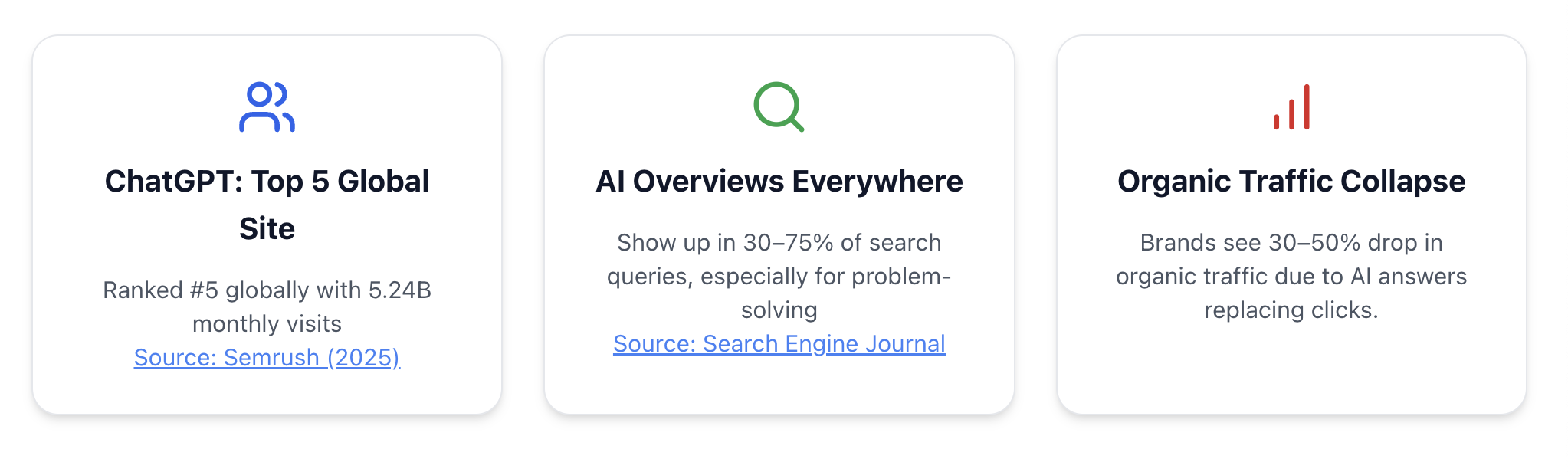
AI-driven search engines are exploding:
According to Semrush (April–May 2025) data, ChatGPT's website chatgpt.com ranked #5 worldwide, with approximately 5.24 billion monthly visits, sitting right behind Instagram and ahead of Wikipedia.
A Search Engine Journal report (Jan 2025) states that AI Overviews appear in about 30 % of searches, and are triggered in **74 % of problem-solving queries. Source : **SearchEngine Land
With less visibility and fewer clicks from traditional Google search, brands must shift their focus. GEO is no longer optional - it's your new visibility strategy.
Traditional SEO focuses on optimizing pages. GEO goes further - it's about influencing how AI understands and references your brand in its own words. For detailed methods to discover the prompts users ask about your industry, check our comprehensive guide: How to Identify Prompts to Track on AI Search Engines . To help you we built an entire dashboard about the differences between GEO and SEO :
Dimension | SEO (Search Engine Optimization) | GEO (Generative Engine Optimization) |
Objective | Rank web pages in Google/Bing results | Be cited or ranked in AI-generated responses (text, cards, summaries) |
User Interface | List of links (SERP) | Direct answers with citations, branded mentions, or summaries |
Optimization Target | Keywords, technical structure, links | Entities, facts, clarity, prominence of brand mentions |
Link Importance | High - backlinks are central for PageRank and authority | Medium - links are used mostly as source signals, less for direct traffic |
Brand Mentions | Helpful, but secondary to backlinks | Crucial - LLMs rely heavily on co-occurrence and entity associations |
Content Granularity | Pages optimized for a keyword | Passages optimized for a question or prompt |
Click Behavior | Users choose what to click | Often zero-click - the answer is given directly |
Update Cycle | Fast: new content can rank in days | Slower for static LLMs (e.g. Claude), but fast for AI searches (e.g. ChatGPT Search, Perplexity) |
Citations | Not required; Google rarely cites sources | Essential in hybrid LLMs (ChatGPT, Perplexity), with inline citations or footnotes |
UX Factors (CTR, Bounce Rate) | Significant - affects rankings | Unknown or minimal (at least for now) |
Technical SEO | Crucial: structure, schema, speed, robots.txt | Important for crawlability, especially to LLM bots (e.g. GPTBot, ClaudeBot) |
Impact of Schema Markup | Enhances SERP appearance (FAQ, stars) | May influence how content is interpreted by LLMs (FAQ schema, definitions) |
Discovery Process | Index \> Rank \> Click | Crawl \> Ingest \> Generate answer from internal + external sources |
Feedback Loop | Through CTR, engagement, and Google updates | Through RAG systems, citations and retraining (for static LLMs) |
Strategic Horizon | Medium to long term | Long term (training impact) + short term wins via source ranking |
There are two types of LLMs:
In this part of the article we will give you a detailed step by step process to create your first GEO strategy. If you want to learn more about how to create a GEO audit you can read our guide: How to rank your brand on LLMs .
Identify the actual prompts and questions your audience asks LLMs (not just keywords), to ensure your brand appears in their answers.
Unlike traditional SEO, where users search with 2–4 word queries, LLM interactions are conversational and complex. That changes everything. LLMs are designed to respond to prompts like:
"What is the best project management tool for startups?"
"Compare Trello and Asana features."
"Who are the top digital marketing agencies in Europe?"
These aren't just keyword searches - they're natural language questions, often reflecting a deeper intent (comparisons, opinions, recommendations).
Run a free audit: in a few minutes, ChatGPT, Gemini and Perplexity answer 8 buying questions about your market live, and you see who they recommend.
Qwairy analyzes your brand visibility across LLMs and shows you:
Prompts your brand appears in
Missing prompts your competitors rank for
Weekly tracking of your visibility on ChatGPT, Gemini, Perplexity
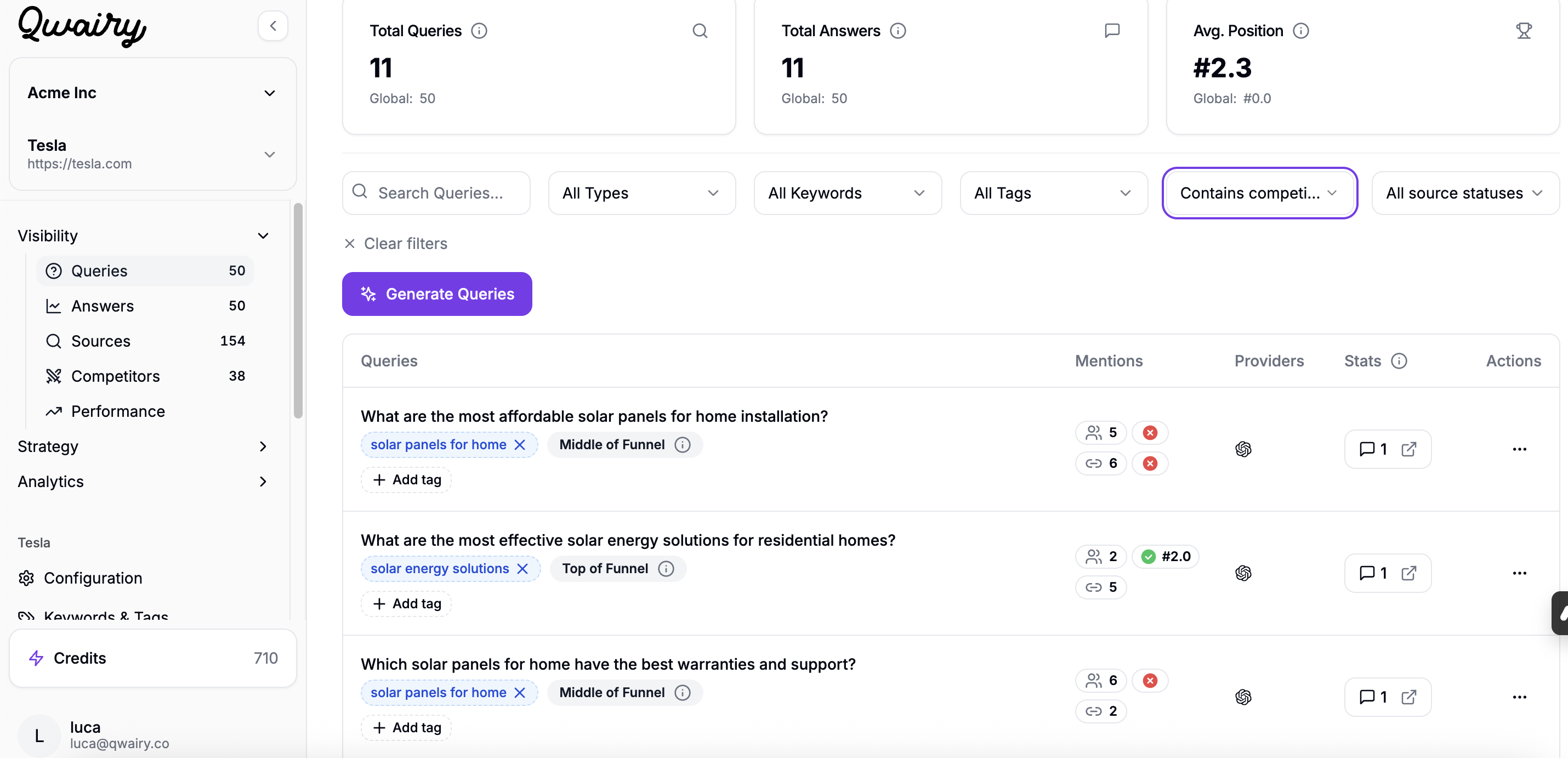
Even if GSC doesn't show LLM data directly, it reveals natural language queries users type on Google, many of which also surface on ChatGPT.
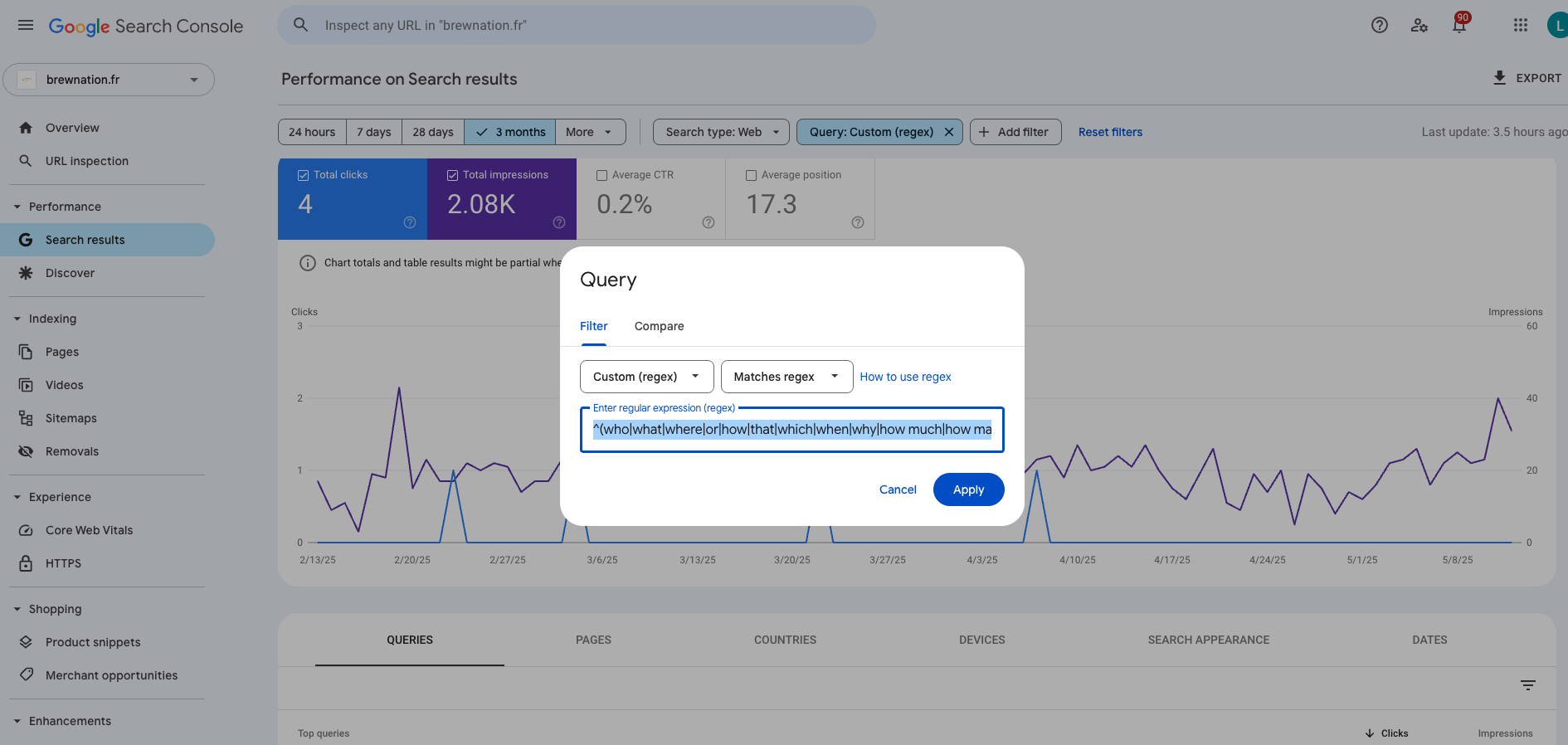
Use these REGEX filters:
^(who|what|where|when|how|why|can|should|best|top|compare)+\s
And for comparison-style prompts:
^(best|vs|or|top|cheapest|most recommended)+\s
Export queries from GSC, clean them, and match them with ChatGPT/Perplexity behavior.
Start typing your industry topic and let ChatGPT suggest completions. This gives a real-time sense of how users formulate prompts.
Example: Type "best CRM for" and you might see:
- "... for small business"
- "... for agencies"
- "... with email automation"
These are pure gold for content targeting.
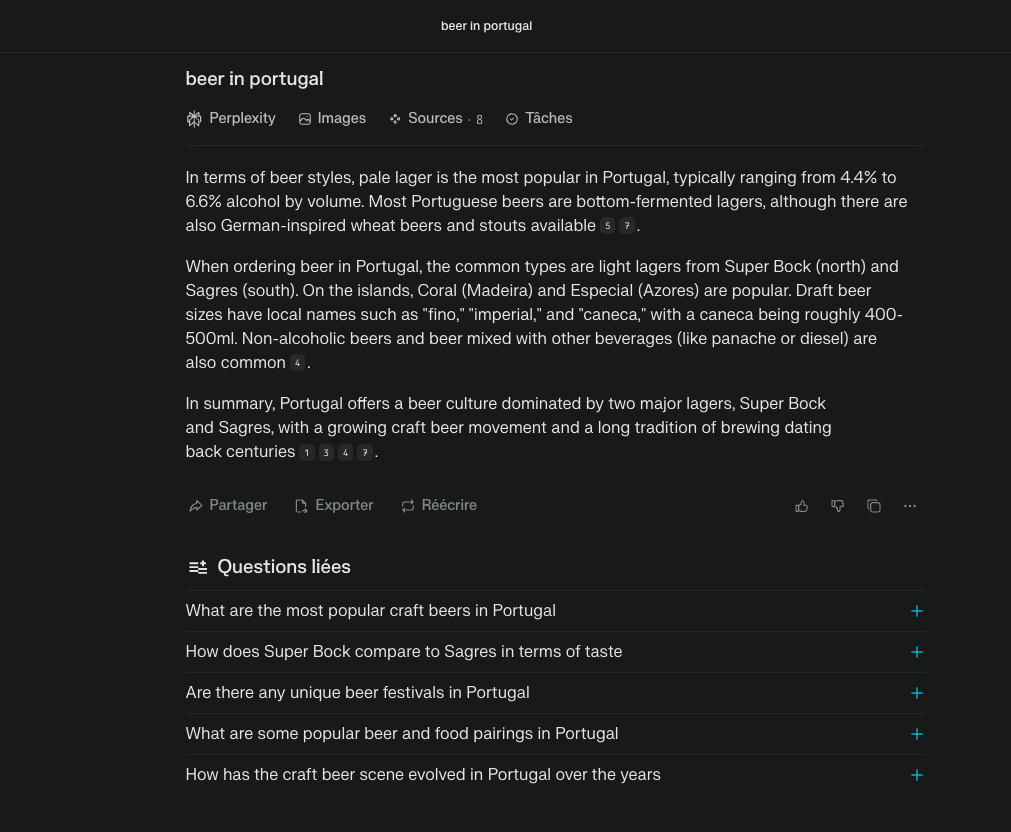
When you search in Perplexity, it often shows:
Similar questions people ask
Follow-up queries
Related topics
Use it to reverse-engineer clusters of prompts around your brand or offer.
By the end of Step 1, you should have:
A list of 50–100 real LLM prompts
Tagged by intent (comparison, informational, transactional)
Matched with existing or missing content on your site
Before you can improve your presence, you need to know where you stand. This step is about measuring how often and how well your brand is mentioned in LLM-generated content - either as a source or as a brand.
In LLMs, your brand can appear in two primary ways:
These two appearances are not interchangeable - they impact brand visibility differently. A source citation may bring referral traffic and authority; a brand mention reinforces your recognition and trustworthiness.
The most efficient way to monitor your presence is to use a specialized tool like Qwairy. It scans across major LLMs (ChatGPT, Gemini, Claude, Perplexity, etc.) and tells you:
On which prompts your brand appears (or not)
Whether you're mentioned as a source or a brand
How your competitors are performing on the same prompts
Which answers you're missing out on
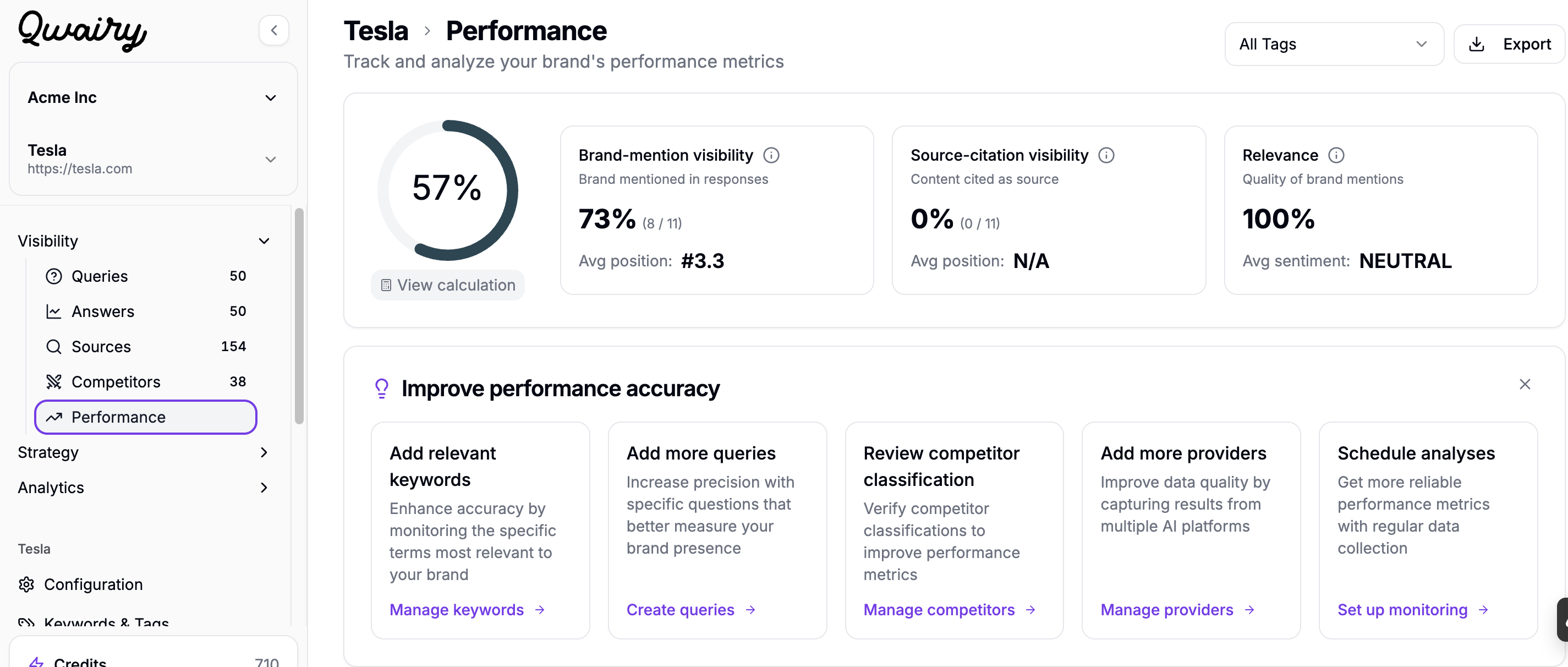
Qwairy provides a "visibility matrix" that can be filtered by LLM, prompt category, or type of mention. This gives you a clear map of where you stand and where to act.
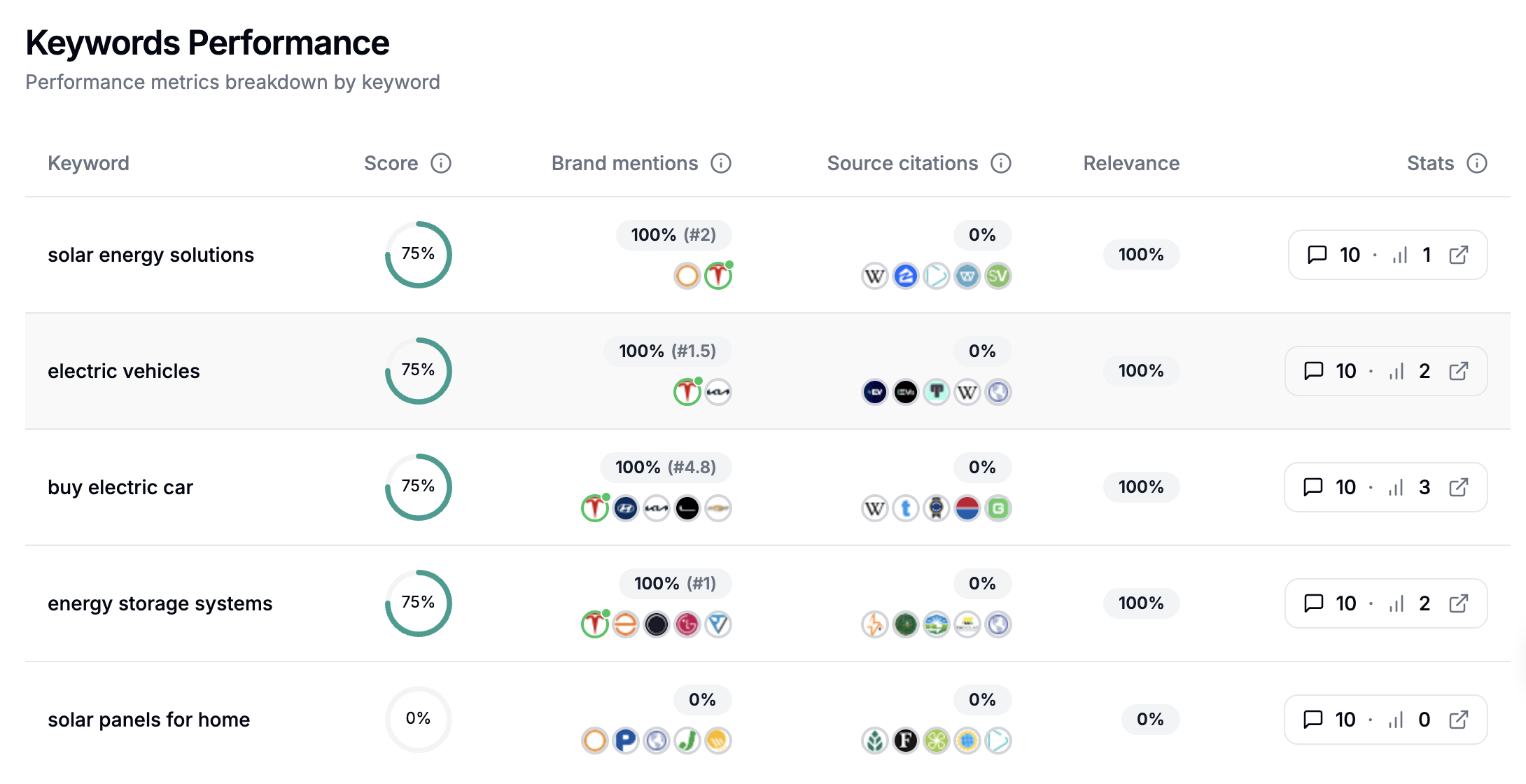
If you don't have access to such a tool, it's still possible to do it manually - though time-consuming. You can prompt LLMs with queries you've gathered (from Step 1), and then manually record where your brand appears and in what form. Tools like ChatGPT Pro, Perplexity, and even Bing Chat (Copilot) allow you to simulate these queries across platforms.
You're not just checking if your brand shows up - you're looking at:
Positioning: Are you mentioned first? As an expert? As an afterthought?
Consistency: Do you appear across multiple LLMs for the same topic?
Depth: Are you cited once or across multiple prompts?
Competitor coverage: Are your direct competitors consistently more visible?
Mapping your competitive landscape is key. Sometimes, the most visible brands in LLMs aren't the ones dominating traditional SEO. US-based or Wikipedia-cited brands often show up more frequently due to their presence in training data.
After this audit, build a dashboard or spreadsheet that tracks for each prompt:
Prompt text
Whether your brand appears (Y/N)
Type of mention (Brand/Source)
LLMs tested (GPT, Claude, Gemini…)
Competitor mentions
Suggested action (Create new content, Improve citation, Boost authority…)
This becomes your tactical roadmap for content and authority optimization.
Don't assume that if you rank #1 on Google, you're visible in ChatGPT or Gemini. LLMs pull from a mix of structured training data, trusted domains, and co-occurrence - not from SERPs. Also, don't rely solely on brand name searches. LLMs won't mention you unless your brand is relevant and authoritative on the topic.
Now that you know which prompts matter and where your brand is (or isn't) mentioned, it's time to act. This step is about crafting or refining content so that LLMs identify it as relevant, trustworthy, and worthy of inclusion in their answers.
LLMs don't evaluate your content like a Google algorithm. They look for semantically rich, clearly structured, and contextually relevant passages, not just pages. What matters is not just "having content" on a topic, but providing clear, answer-oriented segments that LLMs can reuse. Let's take a prompt like "What is the best CRM for freelancers?" Ask yourself: Do I have a page or article that clearly and directly answers this question? Is the passage structured in a way that LLMs can easily extract? Does my content include comparative reasoning, expert quotes, or statistics? 💡 If you want to understand how LLMs talk, you can read our study where we analyzed 32, 961 queries made on ChatGPT, Perplexity and Gemini
Start from scratch with a GEO-first mindset. That means:
Write a dedicated section or article focused entirely on answering the question
Use simple, declarative sentences (LLMs prefer clear over clever)
Structure your response like a featured snippet: definition, comparison, recommendation
Add expert quotes or insights to increase perceived authority
Use FAQ schema to explicitly structure questions/answers for parsing
You need to re-optimize for extraction. That means:
Add a dedicated H2 or H3 block directly answering the prompt
Shorten and clarify long paragraphs
Add semantic enrichment using tools like YourTextGuru, ThotSEO or Surfer
Compare your content to the current sources cited by LLMs and do better (more examples, more up-to-date info, more objectivity)
LLMs may favor pages that answer multiple related prompts. Think cluster topics. A page on "Best CRM for freelancers" might also answer:
"Best free CRM for freelancers"
"CRM vs spreadsheet for solo business owners"
"Affordable CRM tools in 2025"
See the web searches captured behind answers from supported models, and the content gaps they reveal.
SEO tells you to create evergreen, high-intent landing pages. GEO tells you to write extractable insights. SEO cares about headers, keywords, backlinks. GEO cares about clarity, citations, structure. In SEO, users find your page. In GEO, LLMs decide if your answer deserves to be summarized.
Once your content is live, test it. Paste the prompt into ChatGPT or Perplexity. Does it now mention your brand or cite your page? If not, tweak your copy and submit feedback to the LLM when possible (ChatGPT and Perplexity allow this). Over time, these reinforcements help the model associate your content with the prompt.
To rank in LLMs, your brand must be perceived as trustworthy. Unlike SEO where backlinks are the ultimate currency, GEO gives more weight to brand mentions, source citations, and presence in training data. You can see all the sources used by an LLM on Qwairy:
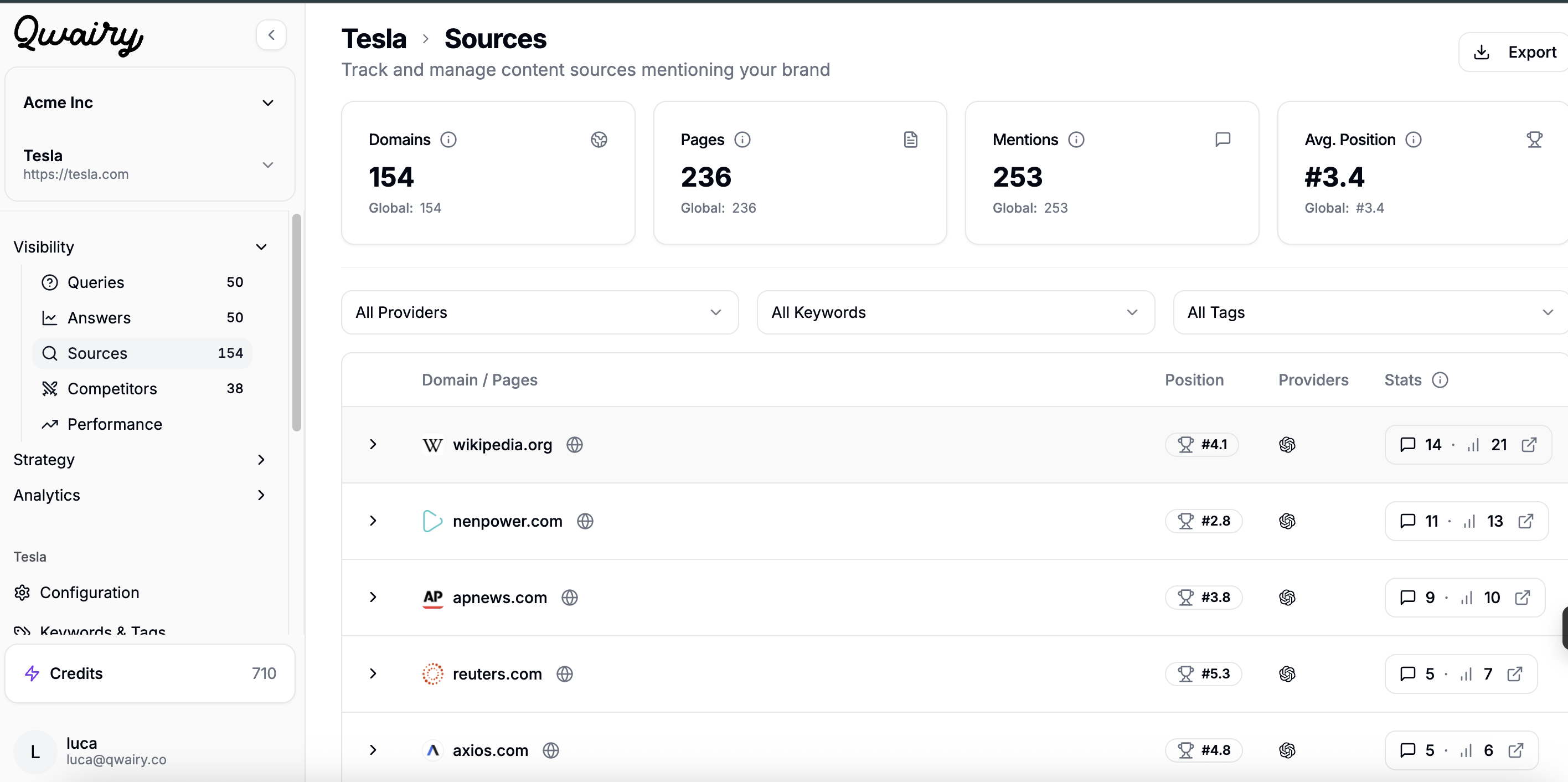
LLMs don't just pick random content - they generate answers based on a mix of:
So the real question is: When a user asks a question in your industry, is your brand part of the model's known and trusted ecosystem?
Models favor information from domains like:
Wikipedia
The Guardian, Forbes, Wired, Le Monde…
Reddit (heavily used in OpenAI training)
Open-access blogs with strong topical authority
You don't need links - just named mentions. 💡 Ex: "According to the French startup Qwairy, GEO is the new SEO for AI." That sentence, even without a backlink, feeds entity recognition.
Wikipedia is core training material for most LLMs. If you can:
Create a page about your brand (requires notability)
Or get mentioned in existing pages
This dramatically increases your entity presence in LLM memory.
LLMs are trained on Reddit, Quora, Stack Overflow, and even niche forums. Strategically placing content here increases:
Entity co-occurrence (your brand associated with key concepts)
Real-user credibility
Use a pseudo if needed, but create threads that answer key prompts from Step 1.
Even though backlinks matter less directly, cited sources do influence how hybrid AI searches (like Perplexity) form answers. You should:
Analyze what URLs are cited by LLMs for your topics (Qwairy or manual)
Pitch better content to the same publications
Syndicate your thought leadership to industry newsletters and trusted domains
Tools like HARO, Featured.com, and Qwoted are helpful to place expert quotes in articles.
Make sure your site is crawlable by:
GPTBot (OpenAI)
ClaudeBot (Anthropic)
Common Crawl bots
Check your robots.txt and server logs. Don't block these bots unless you have a legal reason.
User-agent: GPTBot
Allow: /

User-agent: ClaudeBot
Allow: /
This ensures your content is ingested in future model training.
Don't chase only high-DR backlinks; focus on semantic authority and source trust
Don't block AI bots in your robots.txt
Don't forget non-English mentions if your market is global - Claude and ChatGPT both read multilingual sources
📚 Bonus Tip: Use Perplexity's citation panel to spy on what sources get chosen - and aim to replace or supplement them with your own content.
Metrics to follow:
LLM traffic referrals (e.g. from ChatGPT.com, Perplexity.ai)
Prompt visibility (via Qwairy)
Mentions as a brand vs. source
Citation tracking in AI-generated content
Set up filters in Google Analytics using Regex like:
^.*ai|.*chatgpt.*|.*gemini.*|.*perplexity.*|.*openai.*
Monitor and optimize weekly.
GEO is where SEO was in 2005 - a golden opportunity for early adopters. If your brand wants to remain visible in a world dominated by AI-generated answers, now is the time to act. Start by analyzing your current LLM visibility. Build authoritative, structured, conversational content. Earn brand mentions in credible places. And keep your finger on the pulse of evolving AI search platforms.
GEO isn't a trend. It's the next frontier of online visibility.
Track the questions that matter to your business, see which brands each answer mentions and which sources it cites, then work on the gaps.
Free plan with 120 initial credits • No credit card required
Other Articles
ChatGPT Ads Are Coming to France: What US Data Reveals Before Launch
ChatGPT ads appear in 69.25% of US-monitored commercial answers but near zero in France. What US data reveals before the French launch, and how to prepare.
ChatGPT Stopped Citing Reddit. Our Data Shows the Mechanism Behind the 95% Collapse
Reddit's share of ChatGPT Search citations collapsed 95% in one week in August 2026. Qwairy's citation data reveals the mechanism: a query fan-out change on August 8 that switched ChatGPT to direct site: interrogation, redistributing citations from discussion platforms to official sources.