
Loading page
A practical three-way breakdown of SEO, answer engine optimization, and generative engine optimization: what each one means, where they overlap, and how to run them as a single AI visibility program.

Three letters used to be enough. You did SEO, you ranked on Google, you earned the click. In 2026, the same job - getting found - is spread across a ranked list of links, extracted answer boxes, and generative engines like ChatGPT, Claude, Perplexity, and Google's AI Overviews. Each surface picked up its own acronym: SEO, AEO, and GEO. The acronyms create more confusion than they resolve. Vendors use them interchangeably one day and treat them as rival disciplines the next. Meanwhile you still have one budget, one content team, and one question: what actually changes about your work? This guide is the three-way disambiguation. You'll get clean definitions of SEO, AEO, and GEO, an honest map of where they overlap and where they genuinely diverge, a side-by-side comparison table, and a straight answer to whether these are truly separate disciplines or one converging practice. Most importantly, you'll leave with a way to run all three as a single program instead of three competing roadmaps.
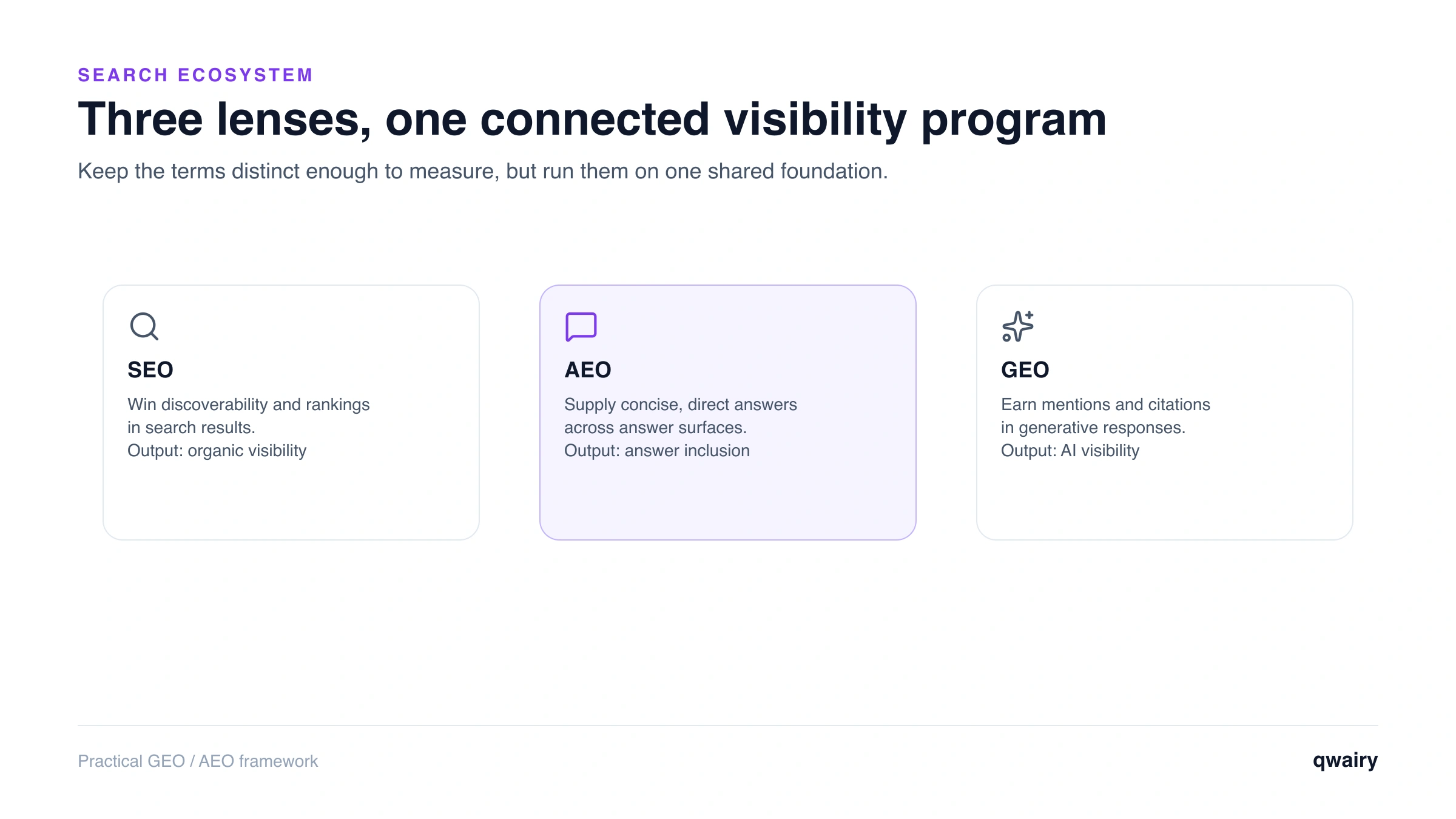
All three optimizations chase the same outcome - being the source a searcher trusts - but they target different surfaces. What changed is not the goal; it's where the answer gets rendered and who renders it.
SEO optimizes for the traditional ranked list of results on Google and Bing.
AEO (Answer Engine Optimization) optimizes to be the answer - the featured snippet, the People Also Ask block, the voice response, the answer box.
GEO (Generative Engine Optimization) optimizes to be cited and recommended inside answers written by large language models.
Hold onto that framing. Nearly every real difference between the three flows from one variable: the surface where your content shows up, and what that surface rewards.
SEO is the discipline of earning visibility in the organic results of a search engine - the ten blue links. The mechanics are well understood: a crawler discovers your page, the engine indexes it, and an algorithm ranks it against competing pages for a query. Your job is to rank high enough to earn the click. The signals are mature and documented across two decades of practice: crawlability and site health, relevance and topical depth, internal linking, page experience, and earned authority (backlinks and the signals bundled under E-E-A-T). Success is measured in rankings, impressions, organic clicks, and click-through rate. SEO is not going anywhere. Even inside AI products, the retrieval layer that decides what to summarize still leans heavily on the same web index and ranking signals SEO has always served. A study covered by Search Engine Land found that a meaningful share of ChatGPT clicks actually flow to Google - the classic search engine remains part of the pipeline, not a casualty of it.
AEO is the practice of structuring content so an engine extracts it as the direct answer, rather than as one option in a list. The term predates the current AI wave. It grew out of featured snippets, knowledge panels, voice assistants, and "position zero" - surfaces where a searcher gets a single answer and often never clicks through. Kevin Indig frames it as an upgrade of the old "crawl, index, rank" pipeline into "retrieved, cited, trusted" (Growth Memo ). AEO rewards a specific shape of content: a clear, self-contained answer placed near the top of the page, unambiguous entities, structured data (schema), and question-and-answer formatting that a machine can lift cleanly. The KPI shifts from "do I rank" to "do I own the answer" - snippet ownership, answer-box share, and coverage of zero-click queries. Because AI Overviews and conversational search engines assemble answers the same way answer boxes did, AEO has quietly become the bridge concept between classic SEO and generative search.
GEO is the practice of structuring your content and brand presence so generative AI systems cite and recommend you in the answers they write. The term was introduced in GEO: Generative Engine Optimization , first released on arXiv in 2023 and presented at KDD 2024 by Aggarwal et al., which ran controlled experiments on how content can be optimized for higher visibility in AI-generated responses. Wikipedia and Search Engine Land now both maintain running definitions of it. The distinguishing move is that a generative engine doesn't return a list - it composes a paragraph and decides which sources to weave in. So GEO optimizes for citability. The Princeton team found that content became more likely to be cited when it added credible statistics, quotations from named sources, and clear citations, reporting visibility gains of up to 40% from the best-performing of its nine tested methods, measured across a 10,000-query benchmark. Keyword stuffing, notably, did not help. GEO's KPIs are the newest and least standardized: your share of voice inside AI answers, how often you're mentioned or cited, the sentiment attached to those mentions, and the referral traffic that arrives from AI engines. Referral traffic from AI assistants grew sharply through 2025 by Semrush's clickstream analysis (Semrush ) - small in absolute terms, but the trajectory is the reason GEO exists as a category.
The overlap is larger than the marketing around these acronyms admits; the genuine differences are narrower but real. What all three share:
A dependence on being crawlable and indexed. If engines can't retrieve your content, none of the three works.
A reliance on authority and trust signals - links, brand mentions, and reputation across the web.
A reward for clear, well-structured, genuinely useful content. The old SEO advice about depth and clarity didn't get replaced; it got more important.
Where they genuinely differ:
The rendered surface. A ranked list (SEO) versus an extracted answer (AEO) versus a composed, cited paragraph (GEO). This is the root difference.
The unit of success. A ranking position, versus owning the answer, versus being one of several cited sources inside someone else's sentence.
The measurement. Clicks and rankings are directly observable. Answer-box ownership is observable. But visibility inside a ChatGPT or Claude answer is probabilistic and non-deterministic - the same prompt can yield different sources on different days, which is why AI visibility needs sampled, ongoing monitoring rather than a rank check.
Run a free audit: see if ChatGPT, Gemini and Copilot recommend you, in about a minute.
Dimension | SEO | AEO | GEO |
Primary goal | Rank in the list of results and earn the click | Be the extracted answer (snippet, answer box, AI Overview) | Be cited and recommended inside a generative answer |
Surface | Google / Bing organic SERPs | Featured snippets, People Also Ask, voice, AI Overviews | ChatGPT, Claude, Perplexity, Gemini, AI Overviews |
Primary signals | Links, relevance, crawlability, page experience, E-E-A-T | Structured data, concise Q&A formatting, entity clarity | Citations, statistics, quotations, authority, brand mentions across the web |
Core KPIs | Rankings, organic clicks, impressions, CTR | Snippet ownership, answer-box share, zero-click coverage | Share of voice in answers, citation / mention rate, sentiment, AI referral traffic |
Content implications | Depth, topical authority, internal linking, earned links | Clear direct answers up top, schema, FAQ blocks | Quotable, evidence-dense, well-sourced content LLMs can lift verbatim |
Here's the honest take: SEO is genuinely distinct in mechanism, while AEO and GEO are largely the same emerging discipline wearing two labels. AEO and GEO describe overlapping work with a difference of emphasis and vintage. AEO is the older term, rooted in answer boxes and voice; GEO is the term coined specifically for generative engines. In practice, the content moves that win an AI Overview citation are close to the moves that win a ChatGPT citation. Several practitioners - and Kevin Indig directly - argue the distinction is mostly semantic and that both sit on top of the same SEO foundation (Growth Memo ). SEO is the one that stays meaningfully separate, because ranking in a list and earning a click is a different mechanic from being woven into a written answer. But even that line is blurring: Google's AI Overviews sit on top of the same index SEO feeds (Google ), so the same page can rank, win a snippet, and get cited by an LLM at once. The useful way to hold this: treat AEO and GEO as facets of one "AI visibility" practice, and treat SEO as the foundation both stand on. The acronyms matter far less than recognizing you're now optimizing for multiple surfaces from a single body of content.
You need one strategy that covers all three surfaces - not three teams, three roadmaps, or three budgets. If you strip out the labels, the answer is simple. You still need the foundational work SEO has always done, because every AI surface retrieves from the indexed web. You need the answer-shaped clarity AEO demands, because both snippets and AI Overviews reward it. And you need the citability GEO measures, because that's where a fast-growing slice of discovery now happens. What you don't need is to fragment the work. The wrong move in 2026 is to spin up a separate "GEO initiative" disconnected from your existing content and SEO operation. The right move is to widen the same operation's targets and add the measurement layer that tells you whether AI engines are actually citing you.
Fold the three into a single loop: build a strong foundation, shape content to be answerable and quotable, then measure across every surface and feed what you learn back in. Here's a practical sequence.
Run that loop and the acronym you file the work under stops mattering. You're optimizing one library of content for every surface a searcher might use.
Put the terminology into practice: Use the complete AEO guide , share this AEO/GEO/SEO comparison with stakeholders, and scale the operating model with the enterprise AEO strategy .
See your mentions across ChatGPT, Claude and Perplexity in real time, the moment buyers ask.
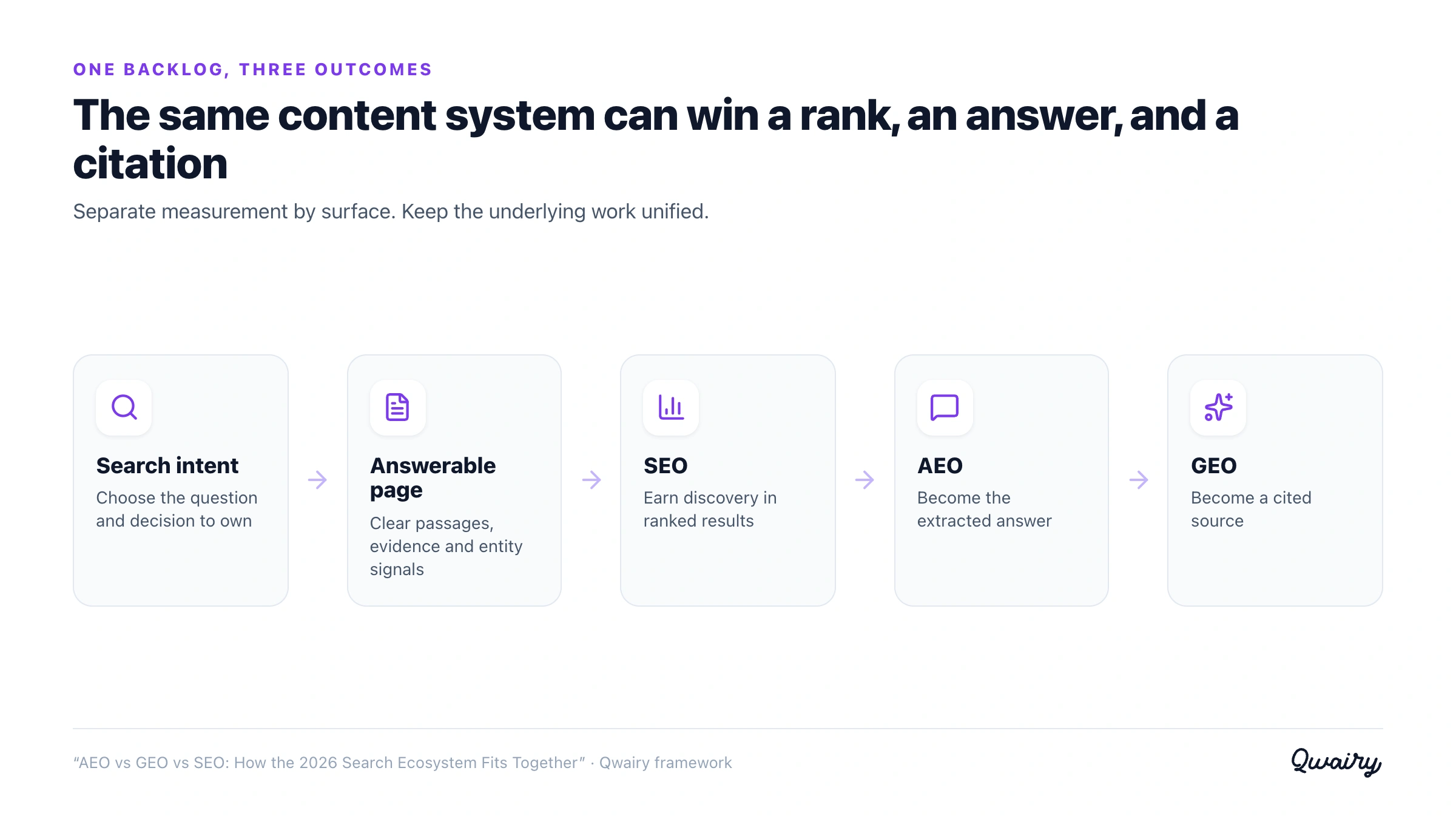
SEO, AEO, and GEO should not create three competing queues. Use one work item with four required fields:
Work item | Primary lens | Shared value |
Fix client-only product content | SEO | Makes the page crawlable for search and retrievable by AI systems. |
Rewrite a comparison answer-first | AEO | Improves featured answers, passage extraction, and generative citations. |
Correct brand facts across authoritative sources | GEO | Strengthens entity confidence, organic trust, and answer accuracy. |
Publish first-party research | Shared | Creates linkable evidence, quotable answers, and citation-worthy source material. |
The label helps route expertise; it should never duplicate the work. Review one backlog by business intent and evidence gap, then report surface-specific outcomes from the same underlying change.
SEO, AEO, and GEO are not three competing playbooks. They're three views of the same job - being the trusted source - refracted through three different surfaces: the ranked list, the extracted answer, and the generative citation. SEO remains the foundation. AEO and GEO are two labels for the fast-converging practice of AI visibility on top of it. Stop asking which acronym to invest in. Build one content operation strong enough to rank, clear enough to be extracted, and citable enough to be recommended - then measure all three so you know it's working. For a narrower head-to-head on the two AI-native disciplines, see the AEO vs GEO comparison on the Qwairy blog .
No, but it's built on SEO. GEO targets a different surface - citations inside generative answers rather than positions in a ranked list - and measures success differently. But it depends entirely on the crawlability, authority, and content quality that SEO has always produced. Think of GEO as a new layer on the same foundation, not a replacement.
Mostly emphasis and vintage. AEO is the older term, rooted in featured snippets, voice, and answer boxes; GEO was coined specifically for generative engines like ChatGPT and Perplexity. In practice the tactics overlap heavily, and many practitioners treat them as facets of one "AI visibility" discipline rather than two separate ones.
No. The most effective setup is one team running a single program that optimizes one body of content for multiple surfaces. Splitting the work into separate initiatives usually creates duplicated effort and conflicting roadmaps. Add measurement for the new surfaces rather than adding headcount silos.
Because generative answers are non-deterministic, you measure them by sampling over time rather than checking a single rank. AI visibility platforms run representative prompts repeatedly across engines and track how often you're mentioned or cited, with what sentiment, and how that compares to competitors - turning a probabilistic surface into a trend you can act on.
No. AI Overviews and chat assistants retrieve from the same indexed web SEO serves, and a notable share of AI-driven journeys still route through traditional search. SEO's role shifted from the finish line to the foundation, but strong SEO is a prerequisite for showing up in AI answers at all.
Start by making existing content answerable and quotable - clear answers up top, structured data, credible statistics and citations - since that serves snippets and generative citations at once. Then add AI visibility measurement so you can see whether engines are citing you, and let that data guide where you invest next.
Track your mentions across ChatGPT, Claude, Perplexity and all major AI platforms. Join 1,500+ brands monitoring their AI presence in real-time.
Free trial • No credit card required • Complete platform access
Other Articles
Answer Engine Optimization (AEO): The Complete 2026 Guide
A complete, practitioner-level guide to Answer Engine Optimization: what AEO is, how answer engines like ChatGPT, Perplexity and Google AI Overviews select and cite content, the core levers, a step-by-step workflow, and how to measure it.
How to Set Up AI Referral Tracking in GA4, Plausible and Matomo
Most analytics tools miss or misclassify AI referral traffic by default. This step-by-step guide shows you how to properly track visits from ChatGPT, Perplexity, Claude, Gemini, and other AI platforms in GA4, Plausible, and Matomo.