
Loading page
A complete, practitioner-level guide to Answer Engine Optimization: what AEO is, how answer engines like ChatGPT, Perplexity and Google AI Overviews select and cite content, the core levers, a step-by-step workflow, and how to measure it.

Search stopped being a list of links. Open ChatGPT, Perplexity, or a Google results page in 2026 and the first thing you see is an answer - synthesized, confident, and stitched together from a handful of sources the model decided to trust. Your prospects read that answer. Many of them never scroll to the blue links underneath. That shift has a name: Answer Engine Optimization (AEO) - the practice of getting your brand, product, and expertise selected, quoted, and cited inside AI-generated answers. The stakes are concrete. The Pew Research Center found that Google users clicked a traditional search result in just 8% of visits where an AI summary appeared, versus 15% of visits without one - and clicked a link inside the summary only 1% of the time (Pew Research Center, July 2025 ). When the answer is the destination, being the source of the answer becomes the new front page. This guide is the pillar of everything we publish on AEO. You'll get a precise definition, how answer engines actually pick and cite content, how AEO relates to SEO and GEO, the five levers that move the needle, a step-by-step workflow with a checklist, and how to measure whether any of it is working.
AEO is the discipline of making your content the thing an AI answer engine reaches for - and names - when it responds to a question. Traditional SEO optimizes for a ranking: a position in a list a human then chooses from. AEO optimizes for inclusion in the answer itself: being retrieved, being quoted, and ideally being cited by name. It emerged for a simple reason. A new layer sat down between your content and your audience. Instead of returning ten links, engines now read across many sources and compose a single response. The user's attention lands on that response, not on your page. If your content isn't in the model's answer, for that user you effectively don't exist - no impression, no click, no brand recall. AEO is not a rebrand of SEO with new vocabulary. The unit of success changed. In classic search you win a slot; in an answer engine you win a mention inside prose you don't control. That difference reshapes what you optimize: clarity over keyword density, extractable passages over long preambles, verifiable authority over link volume alone.
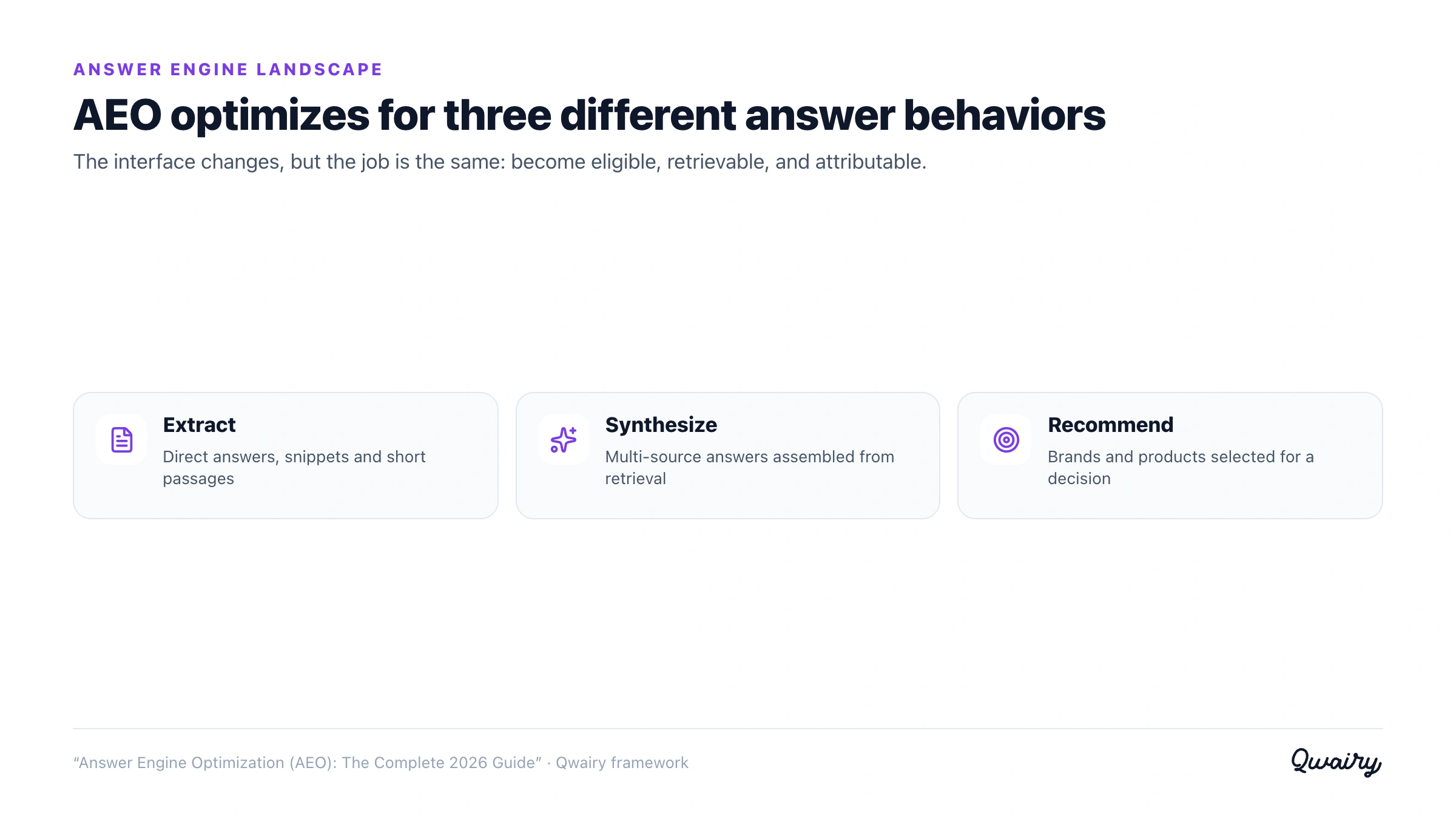
An answer engine is any system that responds to a natural-language question with a synthesized answer rather than a list of results. In 2026 the field is dominated by a handful of them, each with its own retrieval behavior and citation style.
Engine | Owned by | How it answers |
ChatGPT (with search) | OpenAI | Detects when a query needs fresh information, retrieves from the web, and returns an answer with linked source citations. Search shipped in October 2024 . |
Perplexity | Perplexity AI | An answer-first engine: retrieves live sources for nearly every query and attaches numbered inline citations to each claim. |
Google AI Overviews | Google | The AI summary at the top of Google Search, built on Gemini and drawing from Google's index. Launched in the US in May 2024. |
Google AI Mode / Gemini | Google | A fully conversational search experience and standalone assistant that answer questions end-to-end, with links surfaced alongside. |
Microsoft Copilot | Microsoft | Grounded in Bing's web index; answers with citations and is embedded across Windows and Microsoft 365. |
The differences matter because each engine draws from a different index and rewards slightly different signals - but the underlying mechanics are similar enough that one coherent AEO strategy serves all of them.
Under the hood, most answer engines run a retrieval-augmented pipeline, and every stage is a place you either get selected or filtered out. Simplified, it looks like this:
Two practical consequences follow. First, passages win, not pages. Engines extract self-contained chunks that answer a sub-question cleanly. A page that buries its answer under three paragraphs of throat-clearing is harder to quote than one that states the answer up front. Second, trust is a gate. Google formalizes this as E-E-A-T (Experience, Expertise, Authoritativeness, Trust) in its quality guidance, and answer engines lean heavily on similar signals - clear authorship, corroboration across the web, and a recognizable entity behind the content. No engine publishes the exact weighting it gives these signals, and the weighting shifts over time, so treat them as directional rather than as a formula.
Run a free audit: see if ChatGPT, Gemini and Copilot recommend you, in about a minute.
AEO, GEO, and SEO are overlapping layers, not competing religions. SEO is the foundation: crawlability, indexing, site health, and topical relevance. Without it, no answer engine can retrieve you in the first place. GEO - Generative Engine Optimization - is the closest cousin. The term was introduced in a paper first released on arXiv in 2023 and later presented at KDD 2024, "GEO: Generative Engine Optimization" , by researchers at Princeton and collaborators, which tested tactics for improving visibility in generative responses and reported that adding elements like citations, quotations, and statistics could lift a source's visibility in generated answers by up to 40% for certain content. In practice most teams use GEO and AEO interchangeably; where people distinguish them, GEO leans toward the generative-answer surfaces (ChatGPT, Perplexity, AI Overviews) and AEO is used more broadly for any "answer"-style result, including featured snippets and voice. We keep the deep, side-by-side breakdown in a dedicated comparison so this pillar stays readable - see AEO vs GEO vs SEO for the full analysis. For this guide, hold onto the mental model: SEO gets you retrievable, AEO/GEO get you selected and cited.
Five levers do most of the work. Pull them in order of leverage for your situation.
Write so a machine can lift a clean answer without editing you. Lead each section with the answer, then support it. Use descriptive H2/H3 questions that mirror how people ask. Keep the answer to a claim in a tight, self-contained paragraph - an engine can quote a crisp two-to-four-sentence block far more easily than a sprawling one. Definitions, comparison tables, numbered steps, and short lists are disproportionately quotable because they map directly onto how answers are formatted.
Answer engines trust entities they can recognize and corroborate. Make sure your brand, your authors, and your products exist as consistent, well-described entities across the web - a coherent About page, real author bios with credentials, and consistent naming everywhere you appear. First-hand experience (original data, tests, customer results) is hard to fabricate and stands out to systems tuned to reward it. Authority still compounds through citations and mentions from sources the engines already trust.
Schema markup makes your content legible to machines. Marking up articles, FAQs, products, organizations, and authors with schema.org structured data helps engines parse what a page is, who wrote it, and how its pieces relate. It's not a magic ranking lever, but it reduces ambiguity - and less ambiguity means cleaner retrieval and more reliable attribution.
Recency is a trust signal, especially for fast-moving topics. Answer engines favor content that reflects the current state of the world. Keep a visible last-updated date, refresh statistics and examples, and revisit pillar pages on a schedule. A 2026 guide that still cites 2023 realities gets quietly passed over.
A large share of AI citations point to places you don't own. Studies of AI citation behavior consistently find that user-generated and reference platforms punch far above their weight: Reddit, YouTube, and LinkedIn rank among the most-cited domains , and in one Semrush analysis Reddit accounted for the single largest share of LLM citations , ahead of Wikipedia and YouTube. The implication: your owned content is necessary but not enough. Earn genuine presence where the engines already look - authentic participation in relevant communities, accurate and well-sourced Wikipedia entries where you qualify, and a healthy footprint on review and comparison sites (G2, Capterra, and category-specific platforms) that AI engines pull from for recommendations.
Treat AEO as a repeatable loop, not a one-time project. Here's the workflow we run:
Every key page leads with the answer, then supports it
Section headings phrased as the questions users actually ask
Quotable passages: tight, self-contained, factual
Author bios with real, verifiable expertise
Original data, examples, or first-hand experience included
Structured data (Article, FAQ, Organization, Product) implemented
Visible last-updated date; stats and examples current
Consistent brand/product/author entities across the web
Presence on the review and community sites AI cites in your category
A monthly loop to re-check visibility and citation share
See your mentions across ChatGPT, Claude and Perplexity in real time, the moment buyers ask.
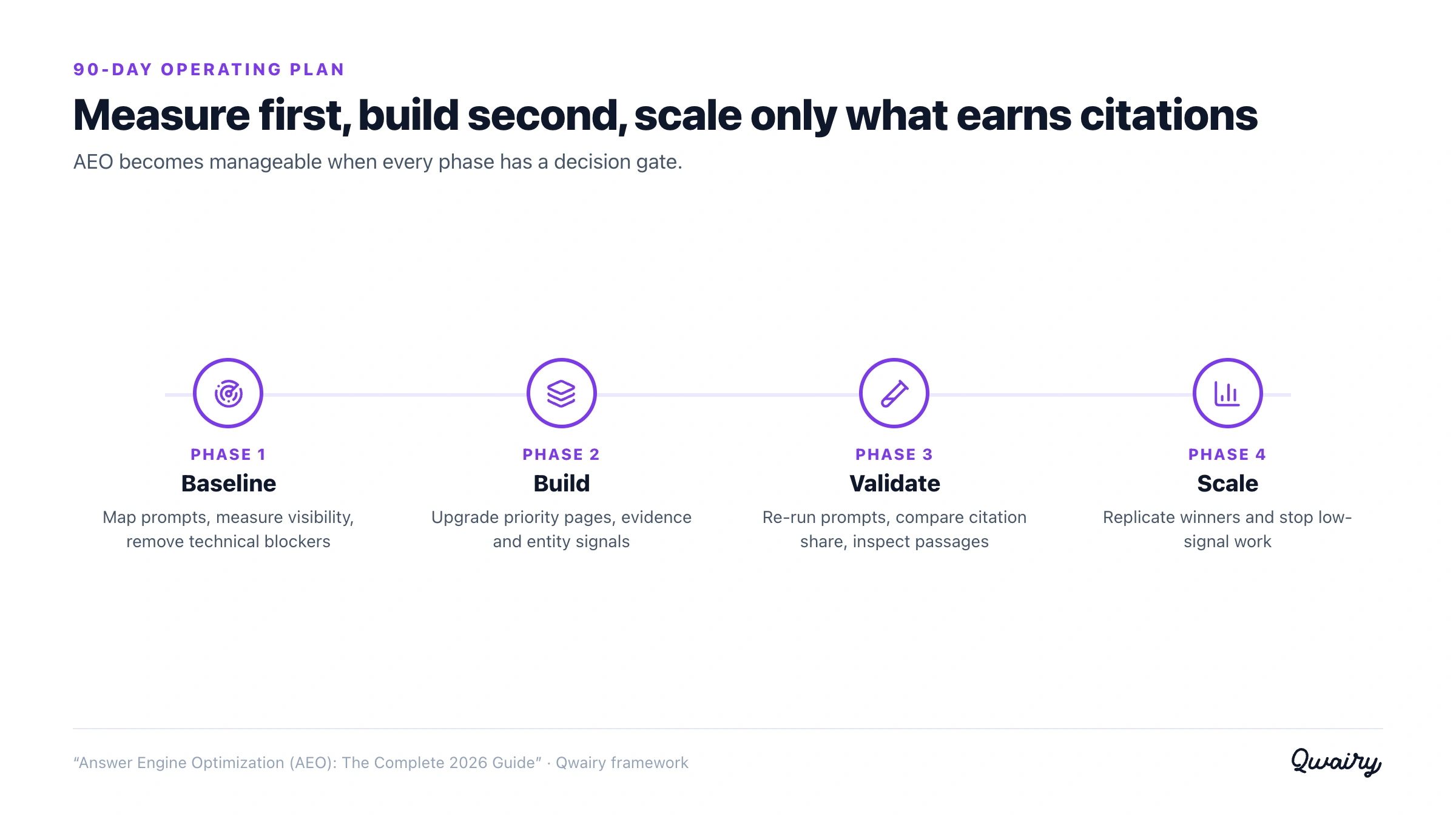
Turn the guide into a program with three decision gates.
Phase | Primary work | Required output | Decision gate |
Days 1 to 30: baseline | Define priority prompts, competitors, engines, current mentions, citations, cited URLs, technical access, and entity errors. | Prompt portfolio, visibility baseline, technical issues, ranked opportunities | Which topics have enough business value and visibility gap to fund? |
Days 31 to 60: build | Rewrite decisive passages, create missing decision assets, fix entity signals, strengthen internal links, and validate structured data. | Published page cohort with documented hypotheses and owners | Did the leading checks improve after crawl and retrieval? |
Days 61 to 90: corroborate and scale | Earn relevant third-party evidence, rerun the fixed prompt cohort, compare competitors, and retire tactics without observable impact. | Outcome review, reusable playbooks, next-quarter backlog | Which changes deserve scale, iteration, or cancellation? |
Assign one accountable program owner, then distribute execution: SEO owns crawl and site architecture, content owns answer assets, PR owns independent corroboration, product or analytics owns measurement, and legal reviews crawler and publisher controls. Shared ownership without one accountable owner produces activity but no learning cycle.
If you can't see whether an engine cites you, you're optimizing blind - and the classic SEO toolkit doesn't capture this. Answers are personalized, non-deterministic, and mostly invisible in your analytics, so AEO needs its own metrics:
Visibility / presence rate. Across a defined set of prompts, how often does your brand appear in the answer at all?
Citation share. When you do appear, how often are you cited by name or linked - and which of your pages get pulled?
Share of voice. Your presence versus named competitors on the same prompts. This is where AEO becomes competitive intelligence: you can see exactly who is winning the answers you want.
AI referral traffic. The (usually small but high-intent) sessions arriving from ChatGPT, Perplexity, Copilot, and others - worth isolating in analytics because these visitors already trust an AI's recommendation.
Sentiment and framing. How the engines describe you, not just whether they mention you - the adjectives and comparisons that shape buyer perception.
This is the layer Qwairy was built for: tracking your visibility and citations across ChatGPT, Claude, Perplexity, Gemini, and Google AI Overviews; showing which sources the engines pull from; monitoring competitors and sentiment; and connecting it back to AI-driven revenue. For teams building on top of it, an agent-native MCP makes the same data queryable programmatically - so measurement and action live in one place instead of a spreadsheet you update by hand.
You don't need to boil the ocean. Pick the ten prompts that matter most to your pipeline, measure where you stand today, fix the two or three pages that should obviously be cited and aren't, and earn presence on the one off-site source your category's answers keep referencing. Then re-measure. AEO rewards the teams who treat it as a habit - because the answers, and the models behind them, keep changing.
Use this pillar as a map: Start with this AEO foundation, align teams on AEO vs GEO vs SEO , prioritize with the AEO ranking factors , and rewrite priority pages with the GEO content optimization guide .
AEO is the practice of optimizing your content so AI answer engines - ChatGPT, Perplexity, Google AI Overviews, Gemini, and Copilot - select, quote, and cite it when they answer a question. Unlike SEO, which competes for a ranking in a list of links, AEO competes for inclusion in the synthesized answer itself.
No, but they depend on each other. SEO makes your content crawlable, indexed, and relevant, which is the precondition for any engine to retrieve you. AEO adds the layer on top: structuring content into extractable passages, strengthening authority and entity signals, and earning the off-site citations that answer engines trust so you're the source they actually quote.
Most run a retrieval-augmented pipeline: interpret the query, retrieve candidate passages from an index, re-rank them for relevance and trust, then ground the written answer in the survivors and cite them. Content that is clearly written, self-contained at the passage level, authoritative, and corroborated across the web is far more likely to be selected and credited.
In practice they overlap heavily and many teams use the terms interchangeably. GEO (Generative Engine Optimization), introduced in a Princeton-led paper first released on arXiv in 2023 and presented at KDD 2024 , leans toward generative-answer surfaces, while AEO is often used more broadly for any answer-style result. The tactics - extractable structure, authority, structured data, freshness, off-site citations - are the same.
Track AEO-specific metrics rather than rankings: visibility (how often you appear across a set of prompts), citation share (how often you're cited when you appear), share of voice versus competitors, AI referral traffic, and the sentiment with which engines describe you. Because answers are personalized and non-deterministic, you measure movement across many prompts over time, not a single position.
Yes. A large and consistent share of AI citations point to user-generated and reference platforms rather than brand-owned pages. Authentic participation in relevant communities, an accurate Wikipedia presence where you qualify, and a healthy footprint on review and comparison sites materially improve how often - and how favorably - answer engines cite you.
Track your mentions across ChatGPT, Claude, Perplexity and all major AI platforms. Join 1,500+ brands monitoring their AI presence in real-time.
Free trial • No credit card required • Complete platform access
Other Articles
How to Set Up AI Referral Tracking in GA4, Plausible and Matomo
Most analytics tools miss or misclassify AI referral traffic by default. This step-by-step guide shows you how to properly track visits from ChatGPT, Perplexity, Claude, Gemini, and other AI platforms in GA4, Plausible, and Matomo.
AEO vs GEO vs SEO: How the 2026 Search Ecosystem Fits Together
A practical three-way breakdown of SEO, answer engine optimization, and generative engine optimization: what each one means, where they overlap, and how to run them as a single AI visibility program.