
Loading page
How large organizations win AI search at scale - who owns AEO, how to prioritize thousands of pages across brands and markets, monitor brand-safety risk, and report AI visibility to leadership.

The discovery layer moved. AI answer engines - ChatGPT, Google AI Overviews, Perplexity, Claude, Gemini - increasingly sit between your buyers and your website. Google's AI Overviews now appear in more than 200 countries and territories and over 40 languages , and Pew Research found that people click a traditional link roughly half as often when an AI summary is present, following a source citation in about 1% of visits. For a small brand, answer engine optimization (AEO) - closely related to generative engine optimization (GEO) - is a focused project: a few dozen pages, one market, one owner. At enterprise scale the problem inverts. You have thousands of URLs, several brands, dozens of markets, a legal team, and a board that wants a single number. The tactics barely change; the hard part becomes governance, prioritization, and risk. This guide is for the people running AEO across a large surface: heads of SEO and content, brand and communications leaders, and the operators stitching them together. You'll get a working model for what changes at scale, how to assign ownership, how to prioritize when you can't optimize everything, how to handle multiple markets and languages, how to monitor brand-safety risk, and how to report AI visibility to leadership in a language they'll act on.
The fundamentals of AEO are the same for everyone - the enterprise difference is surface area, coordination, and exposure. The foundational GEO research (Aggarwal et al., first released on arXiv in 2023 and presented at KDD 2024) showed that content can be deliberately optimized to appear more often in AI-generated answers, with the best-performing methods lifting visibility by up to 40% across a 10,000-query benchmark. That holds whether you manage ten pages or ten thousand. What breaks at scale is your ability to do it consistently everywhere. Three things change once you cross into enterprise territory.
Surface area explodes. A small site can hand-tune every page for citability. You can't. With thousands of URLs across product, support, blog, docs, and legal, you're managing a distribution of quality, not a checklist. Some pages are already well-structured and frequently cited; most are invisible to answer engines and always will be. The job shifts from "optimize the page" to "decide which pages are worth optimizing and enforce a baseline on the rest."
Coordination becomes the bottleneck. AEO touches SEO, content, PR, product marketing, brand, legal, and localization - teams that rarely share a roadmap. A single strong AI answer about your category might depend on a schema change, a rewritten comparison page, a third-party review you don't control, and a press mention. No one team owns that outcome, which is exactly why it stalls.
Exposure becomes a board-level risk. When an AI engine describes your brand, it can get facts wrong, surface outdated policies, or recommend a competitor on a branded query. At small scale that's an annoyance. Across regulated markets and multiple languages, it's a legal, brand, and revenue risk that leadership needs visibility into.
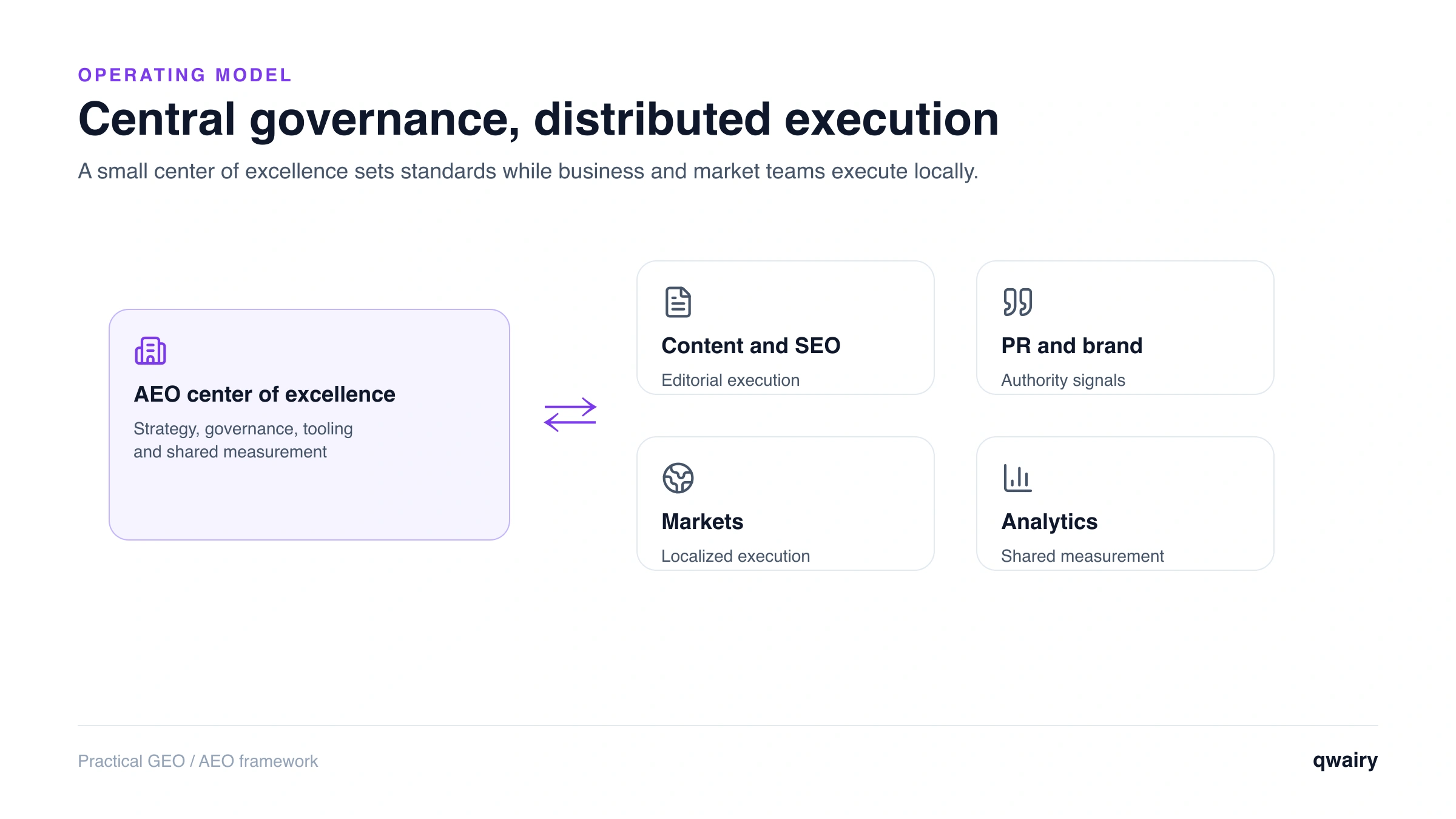
AEO fails at scale when it has no owner, and it fails just as hard when a single team is told to "own it" without authority over the inputs. The realistic model is a small accountable core that drives a cross-functional operating rhythm. A workable ownership pattern:
Function | Role in AEO |
AEO lead (often within SEO/organic) | Accountable for AI visibility as a metric; owns measurement, prioritization, and the operating cadence |
Content | Produces and updates citable answers, comparison pages, and FAQs to a shared standard |
Technical SEO / engineering | Structured data, crawlability for AI bots, page performance, canonicalization across markets |
PR & communications | Earns third-party mentions and authoritative citations - often the biggest lever for AI trust |
Brand & legal | Approves claims, sets brand-safety thresholds, owns escalation when AI misrepresents the brand |
Localization | Adapts priority answers per market and language, not just translates them |
Put AEO where organic search already lives, then give it a mandate that reaches across teams. In most enterprises the AEO lead sits inside SEO or organic growth, because the skill set overlaps and the measurement tooling is adjacent. What's new is the mandate: a monthly or biweekly forum where content, PR, technical, and brand review the same AI-visibility data and agree on the next set of moves. As Kevin Indig argues in his Growth Memo , AI search is becoming an organic-growth discipline in its own right - treat it as a program, not a side quest for one channel. The most underused lever here is PR. AI engines lean heavily on third-party, authoritative sources when deciding what to say about a category. Your owned pages matter, but a well-placed independent review or industry article can move how an engine describes you more than another landing page ever will.
Run a free audit: see if ChatGPT, Gemini and Copilot recommend you, in about a minute.
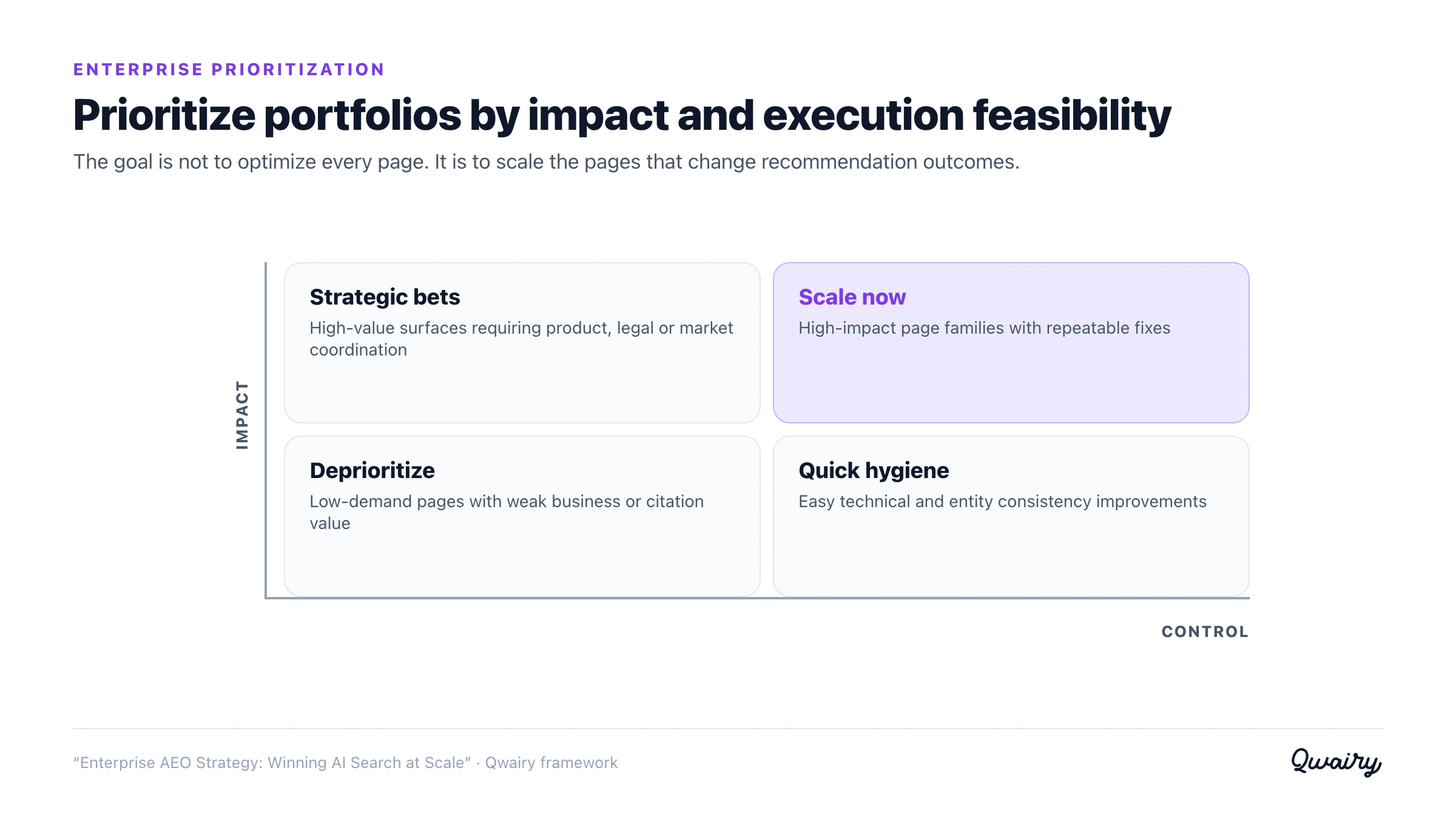
At enterprise scale, prioritization is the strategy. You will never optimize every page for every prompt in every market, so the goal is to spend effort where it changes an answer a real buyer will see. Use a simple two-axis model: business value of the query versus your current AI visibility on it.
Weight prompts by revenue proximity, not search volume. A low-volume, high-intent comparison prompt is worth more than a high-volume informational one your buyer never converts on. The Semrush clickstream analysis of ChatGPT usage shows AI queries often look nothing like classic search keywords - longer, more conversational, more task-shaped - so prioritizing on legacy keyword volume alone points you at the wrong pages.
AI visibility does not transfer across markets, and translation is not localization. Because AI Overviews and AI Mode now span 200+ countries and 40+ languages , a brand that dominates AI answers at home can be invisible or misdescribed abroad. Engines pull from different regional sources, and the competitive set, the trusted publications, and even the phrasing of buyer questions differ per market. Practical implications for a multi-market program:
Measure per market and per language, separately. A global average hides the markets where you're losing. Track priority prompts in-language, in-region.
Localize the answer, not just the words. Regional proof points, local reviews, local units and regulations, and market-specific comparison sets matter more to an engine than a clean translation.
Invest in local authority. Being cited by trusted in-market publications and directories is often the fastest route into that market's AI answers.
Watch for cross-market contradictions. Conflicting claims, pricing, or policies across regional sites confuse engines and can surface the wrong regional answer to the wrong user.
Prioritize markets the way you prioritize prompts: concentrate on the regions that drive revenue and where you can realistically move an answer, then enforce a baseline standard across the rest.
Answer engines will speak on your behalf whether or not what they say is true - and at enterprise scale that becomes a governed risk, not a curiosity. There are three failure modes worth watching.
Hallucinations and outdated facts. An engine states a wrong price, an expired policy, a discontinued feature, or a support process that no longer exists. This isn't hypothetical: a Canadian tribunal held Air Canada liable for its own chatbot's inaccurate statement about bereavement fares, rejecting the argument that the AI was a separate entity. The precedent that a company is responsible for what an AI says about it should focus any legal team's attention.
Misinformation and negative framing. Engines can amplify an old controversy, a misleading third-party claim, or an inaccurate summary of your security or compliance posture - sometimes citing a source you'd never endorse.
Competitor recommendations on your own turf. Ask "is [your brand] good for enterprise?" and an engine may pivot to recommending a rival. Branded prompts that hand the answer to a competitor are among the most commercially damaging and easiest to miss without monitoring.
Treat brand safety in AI answers like uptime monitoring: continuous, thresholded, and escalated. You cannot catch these by spot-checking ChatGPT once a month.
See your mentions across ChatGPT, Claude and Perplexity in real time, the moment buyers ask.
Leadership does not want a list of prompts; they want to know whether the brand is winning or losing the AI channel, and whether it's a risk. Translate AEO into a small set of durable metrics reported on a consistent cadence. A leadership-ready AI visibility report usually covers:
Share of AI visibility: how often you appear in answers to priority prompts, versus named competitors - the closest thing to "AI market share."
Citation quality: whether engines cite your owned properties and authoritative third parties, or weaker sources.
Sentiment and accuracy: how the brand is described, and any factual or brand-safety issues flagged this period.
Trend over time, per market: direction matters more than a single snapshot; segment by priority region.
Business linkage: referral traffic and conversions from AI engines where measurable. Semrush reports that outbound referral traffic from ChatGPT grew sharply through 2025 - worth tracking even while it's still a small share of total traffic.
Report the same metrics the same way every period. The value to a board is the trend line and the risk flags, not a new methodology each quarter.
A manual approach collapses the moment you have more than one brand or market - the measurement layer has to be automated and consistent. This is the gap Qwairy is built for: tracking how your brands appear across ChatGPT, Claude, Perplexity, Gemini, and Google AI Overviews, with visibility, citations, source intelligence, sentiment, competitor positioning, and AI-driven revenue measured on a common basis. For an enterprise program that means one place to compare AI visibility across brands and markets, spot the brand-safety issues worth escalating, see which sources engines actually cite so PR and content know where to invest, and report a consistent trend to leadership. An agent-native MCP integration also lets your own tools and AI agents query the same data, so AI visibility flows into the dashboards and workflows you already run. If you're standing up AEO across a large surface, measure the current state honestly first, then prioritize - more on measuring AI search on the Qwairy blog .
Operationalize the enterprise program: Anchor teams on the complete AEO guide , fund the roadmap with the AI search ROI framework , and align terminology with AEO vs GEO vs SEO .
Enterprise AEO is not a bigger version of small-brand AEO - it's a governance problem wearing an SEO costume. The tactics that make a single page citable are well understood. What determines whether a large organization wins AI search is whether it can assign clear ownership, prioritize against revenue, adapt per market, monitor brand safety continuously, and report a trend leadership will fund. Get the operating model right, measure honestly across every brand and market, and the page-level work finally compounds instead of scattering.
AEO (answer engine optimization) and GEO (generative engine optimization) both aim to make your brand appear accurately and favorably in AI-generated answers, and most teams use the terms interchangeably. At enterprise scale the distinction matters less than the operating model: doing the work consistently across thousands of pages, multiple brands, and many markets, with governance and measurement to match.
Usually a lead within SEO or organic growth is accountable for AI visibility as a metric, but they need a cross-functional mandate. Content, technical SEO, PR, brand, legal, and localization all control inputs, so AEO works best as a program with a regular forum where those teams act on shared data rather than as one team's isolated task.
Score priority buyer prompts by business value (proximity to revenue and intent) times opportunity (how far you are from a strong AI position), and fix the highest-leverage inputs first. Weight by revenue proximity, not search volume, and enforce a baseline standard - clear structure, direct answers, structured data, current information - across the long tail you won't hand-tune.
Treat it like uptime monitoring: maintain a watchlist of high-risk branded and comparison prompts, check them across engines and markets on a regular cadence, and set thresholds that escalate factual errors or competitor recommendations to brand and legal. The Air Canada tribunal case is a reminder that organizations can be held responsible for inaccurate AI statements about them.
No. Answer engines draw on different regional sources, competitive sets, and trusted publications, so a brand that leads AI answers in one market can be invisible or misdescribed in another. Measure per market and language separately, localize priority answers rather than translating them, and invest in local authority and citations.
Report a small, durable set of metrics on a consistent cadence: share of AI visibility versus competitors, citation quality, sentiment and accuracy including brand-safety flags, the trend over time per market, and any measurable AI-referred traffic. Leadership wants to know whether you're winning or losing the AI channel and whether it's a risk - keep the methodology stable so the trend line is trustworthy.
Track your mentions across ChatGPT, Claude, Perplexity and all major AI platforms. Join 1,500+ brands monitoring their AI presence in real-time.
Free trial • No credit card required • Complete platform access
Other Articles
Answer Engine Optimization (AEO): The Complete 2026 Guide
A complete, practitioner-level guide to Answer Engine Optimization: what AEO is, how answer engines like ChatGPT, Perplexity and Google AI Overviews select and cite content, the core levers, a step-by-step workflow, and how to measure it.
How to Set Up AI Referral Tracking in GA4, Plausible and Matomo
Most analytics tools miss or misclassify AI referral traffic by default. This step-by-step guide shows you how to properly track visits from ChatGPT, Perplexity, Claude, Gemini, and other AI platforms in GA4, Plausible, and Matomo.