
Loading page
Google AI Mode makes Search conversational and multi-turn, using query fan-out to break one question into many. Here's how to structure and measure your content so it gets surfaced.

Google Search stopped being a list of ten blue links a while ago. With AI Mode, it stops being a single query, too. AI Mode is Google's conversational, multi-turn search experience: you ask a question, get a synthesized answer with links, then keep going - refining, comparing, and drilling down without starting over. Under the hood, one thing you type can quietly become a dozen searches Google runs on your behalf. That mechanic, called query fan-out, is the single most important shift for anyone who cares about being found. The stakes are simple. If your content only answers the exact phrase someone typed, you're optimizing for a surface that no longer exists in isolation. AI Mode evaluates whether your page answers the cluster of sub-questions behind the intent - and whether it's the best, most extractable source among them. This guide covers what AI Mode is and how it differs from AI Overviews, how query fan-out actually works, what it means for the way you structure content, a step-by-step optimization workflow, and how to measure whether any of it is working.
AI Mode is a dedicated conversational search experience, not a widget bolted onto the results page. Google introduced AI Mode and expanded AI Overviews at Google I/O 2025 , powered by a custom version of its Gemini model. Instead of scanning a page of results, you get a generated answer, and you can immediately ask follow-up questions in the same thread - the way you'd talk to a chatbot, but grounded in live web retrieval and Google's index. The important word is conversational. AI Mode holds context across turns. You can start with "best noise-cancelling headphones for open offices," follow up with "which of those work with Teams," and then "cheaper alternatives under a certain budget" - and Google keeps the thread. Each turn is a new opportunity to be cited, or a new opportunity to be left out.
They share the same DNA but play very different roles in the user journey. AI Overviews are the AI-generated summaries that appear at the top of an otherwise normal results page - passive, automatic, and quick. AI Mode is a separate surface the user actively enters for deeper, exploratory research. Here's the practical breakdown:
AI Overviews | AI Mode | |
Where it lives | Top of the standard results page | A distinct, chat-like surface you enter |
Trigger | Automatic, for eligible queries | User actively chooses it |
Interaction | One-shot summary | Multi-turn, follow-ups with memory |
Intent | Quick answer, then browse | Deep research, comparison, reasoning |
Retrieval depth | Broad but shallower | Deep, via aggressive query fan-out |
The line between the two is blurring - Google has signaled it wants a more unified AI search experience, and features migrate between the surfaces over time. For optimization purposes, though, the underlying retrieval mechanic is what matters, and it's largely shared: query fan-out.
Run a free audit: see if ChatGPT, Gemini and Copilot recommend you, in about a minute.
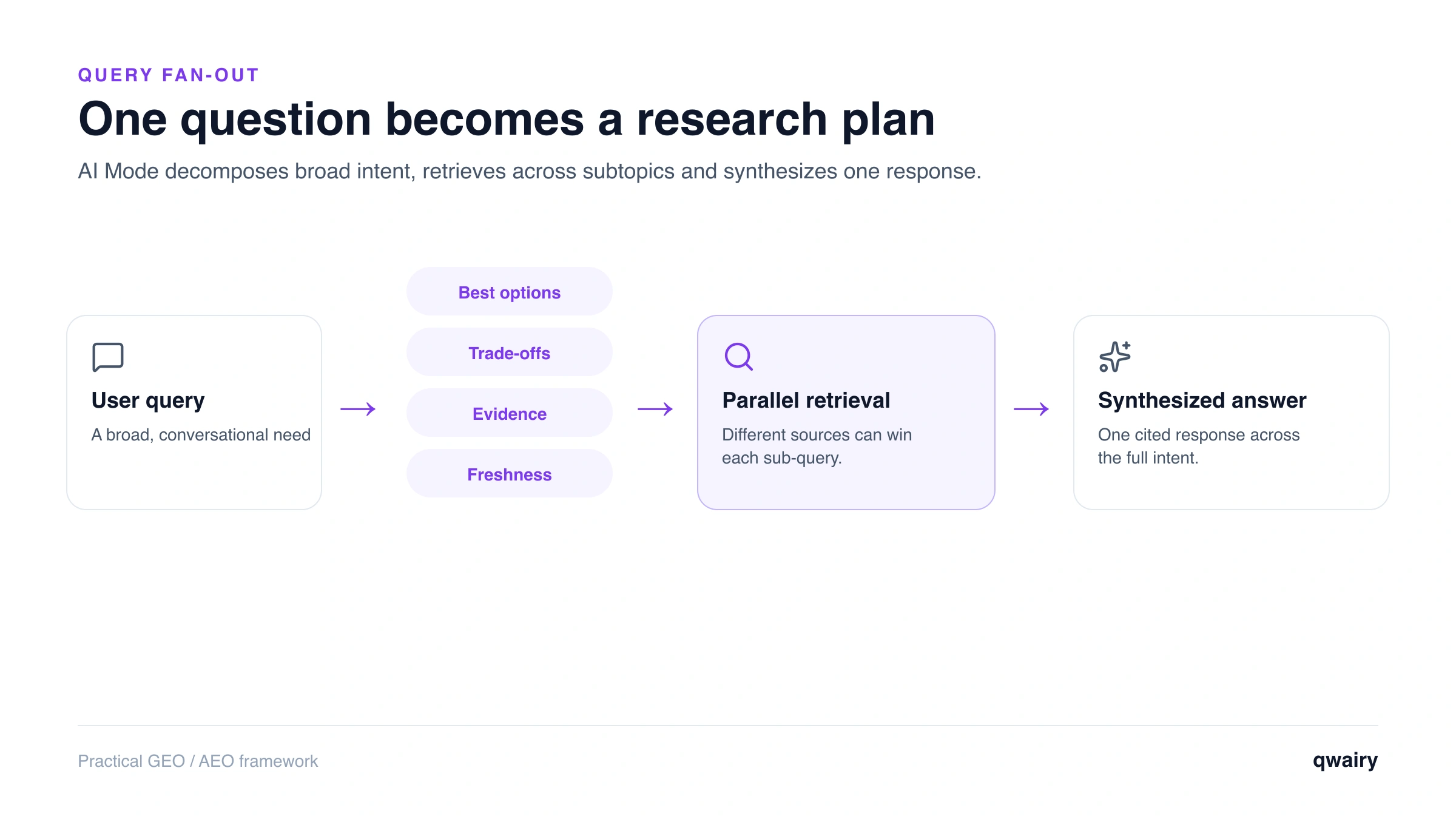
Query fan-out means Google breaks your question into subtopics and runs many related searches simultaneously, then synthesizes the results into one answer with links. In Google's own description of AI Mode, the system "breaks down your question into subtopics and issues a multitude of queries simultaneously on your behalf" to dive deeper into the web than a single traditional search would. Search Engine Land's explainer walks through the same idea: decompose the query, retrieve in parallel across angles, then consolidate. Analyses of Google's patents and public statements suggest a standard question can fan out into roughly a dozen parallel sub-queries, while Google's "Deep Search" feature can issue far more for complex research tasks. The exact count matters less than the consequence: you are no longer competing for one keyword - you are competing to be the best source across a whole tree of sub-questions, many of which the user never typed. Say someone asks AI Mode about "switching from spreadsheets to a CRM." The fan-out might quietly search for migration steps, data-import risks, pricing tiers, team-size fit, security considerations, and common objections. If your page nails the pricing angle but says nothing about data-import risk, you might be cited on one branch and invisible on five others. The pages that win are the ones that answer the whole cluster credibly.
Follow-up questions create branches, and each branch is a fresh retrieval you can win or lose. Because AI Mode remembers the thread, a single session can wander from "what is X" to "how does X compare to Y" to "how do I implement X." Content that's built to answer one narrow query performs poorly here; content organized as a connected set of answers gives Google something to pull from at every turn. Think less "rank a page" and more "be a reliable, cited presence across the conversation."
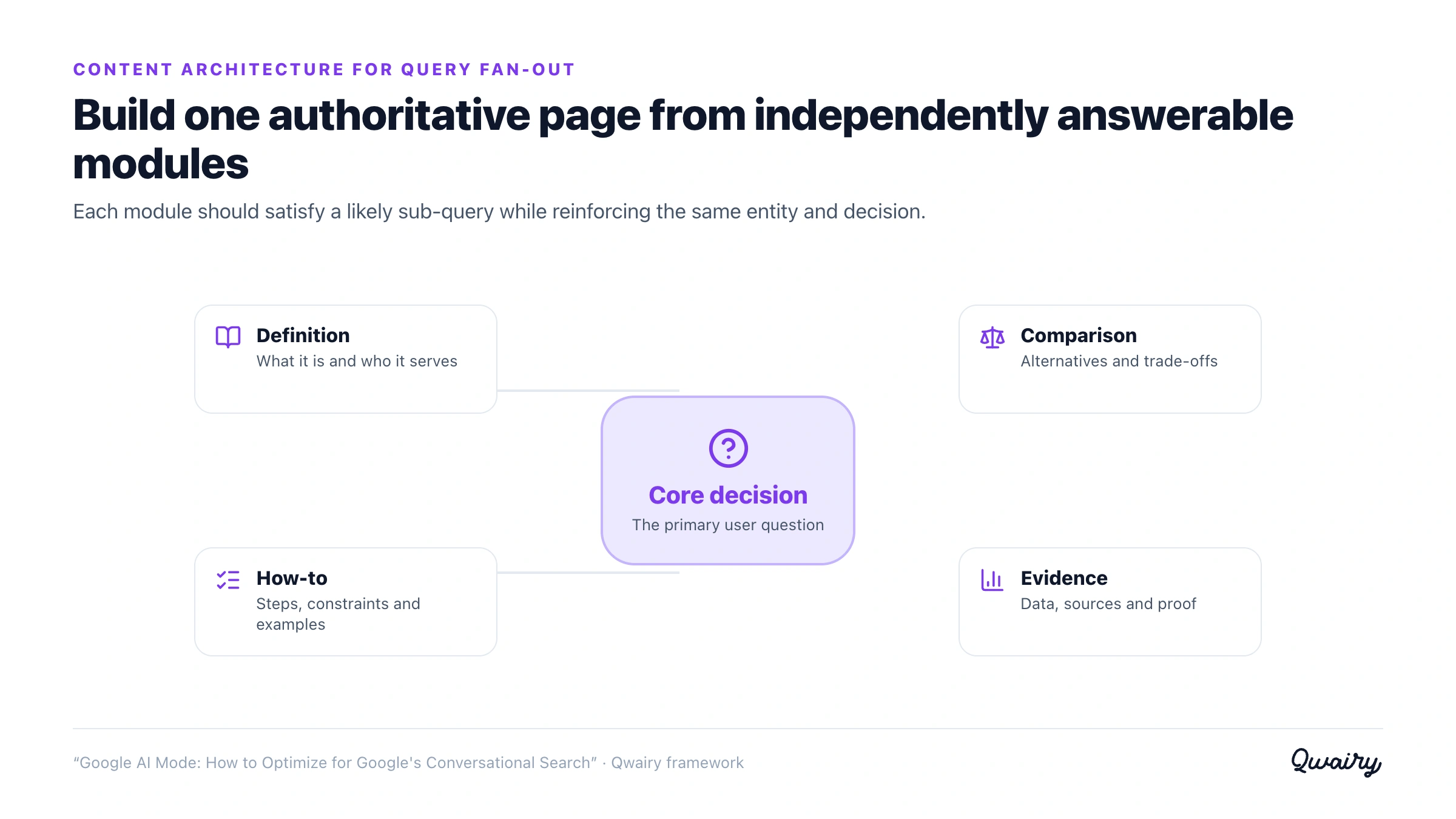
Breadth and extractability now beat exact-match keywords. In an AI Mode world, three shifts drive whether you get surfaced:
Topical completeness over keyword targeting. Cover every reasonable sub-question around a topic - specifications, comparisons, costs, alternatives, how-to steps, edge cases, and objections. Fan-out rewards pages (and clusters) that leave few gaps.
Semantic relevance over string matching. Google's models look for intent-aligned, complete answers, not exact phrases. Write for the meaning, not the keyword permutation.
Passage-level self-containment. Each section should stand on its own and answer a clear question, so a retrieval system can lift it cleanly without needing the rest of the page for context.
None of this replaces classic SEO - it extends it. Google itself has been blunt that its generative features don't require special tricks: Google's guidance states that "AEO" and "GEO" are still SEO , and that things like llms.txt, content chunking, or AI-specific schema aren't needed for its AI features. The foundation is the same; the emphasis shifts toward comprehensiveness and clarity.
See your mentions across ChatGPT, Claude and Perplexity in real time, the moment buyers ask.
Treat the fan-out as your content brief. Here's a workflow you can run on any priority topic.
Quick checklist before you publish:
Does the page answer at least 5-8 distinct sub-questions on the topic?
Can each section be lifted and understood on its own?
Are headings phrased the way people actually ask?
Is there a clear pillar-and-spokes structure with internal links?
Are entity signals (naming, author, organization) consistent and clean?
Is the content current, and is it readable without executing JavaScript?
The hard part isn't optimizing - it's knowing whether you're being surfaced at all. Traditional analytics were built for blue-link clicks, and AI Mode sessions don't map neatly to that model: a user can get everything they need inside the conversation, and clicks that do happen are often lumped into general Search reporting. Google Search Console won't tell you which sub-questions in a fan-out you appeared on, or which competitor got cited instead. That's the gap AI visibility tracking fills. Qwairy monitors how your brand shows up across the major AI engines - including Google's AI experiences, ChatGPT, Perplexity, Claude, and Gemini - measuring where you're cited, which sources are winning, sentiment, and how you stack up against competitors. For AI Mode specifically, the useful lens is coverage: run the sub-questions your fan-out map produced, and check how often you appear versus how often you're missing. You can go deeper on the mechanics and measurement approach on the Qwairy blog . The workflow closes the loop: map the fan-out, publish comprehensive content against it, then track which branches you own and which you've ceded - and feed that back into your next round of content.
Build the full Google AI Search cluster: Compare the AI Overview ranking factors , design site architecture for query fan-out , and account for the France and Europe rollout .
AI Mode turns a single search into a branching conversation, and query fan-out turns a single question into many. The brands that win won't be the ones chasing one keyword - they'll be the ones that answer the whole cluster of intent clearly, keep their content fresh and extractable, and actually measure where they show up. Start by mapping the fan-out for your top topics, fill the gaps, and make measurement a habit rather than a guess.
No. AI Overviews are automatic AI summaries at the top of a normal results page, meant for a quick answer. AI Mode is a separate, conversational surface users enter for deeper, multi-turn research. They share retrieval mechanics like query fan-out, but they serve different intents.
When you ask a question, Google breaks it into subtopics and runs many related searches at once, then combines the results into one answer with links. In practice, that means your content isn't judged against a single query but against a whole set of related sub-questions the system generates on your behalf.
Google hasn't published a fixed number, and it varies by complexity. Analyses of its patents and statements suggest a standard question can fan out into roughly a dozen parallel searches, with the Deep Search feature issuing many more for complex tasks. Treat the exact count as less important than the need for broad, complete coverage.
No. Google has stated that its generative AI features don't require llms.txt, content chunking, or AI-specific schema, and that optimizing for AI search is still fundamentally SEO. Focus on crawlable, well-structured, comprehensive content rather than exotic markup.
Yes - it's the foundation. Crawlability, rendered HTML, topical authority, strong entities, and quality content all still drive whether you get retrieved and cited. AI Mode changes the emphasis toward completeness and extractability, not the fundamentals.
Not through standard search analytics alone, which weren't built for conversational, multi-turn answers. Dedicated AI visibility tools track citations and presence across AI engines, letting you see which sub-questions you appear on and which competitors are being cited instead.
Track your mentions across ChatGPT, Claude, Perplexity and all major AI platforms. Join 1,500+ brands monitoring their AI presence in real-time.
Free trial • No credit card required • Complete platform access
Other Articles
Answer Engine Optimization (AEO): The Complete 2026 Guide
A complete, practitioner-level guide to Answer Engine Optimization: what AEO is, how answer engines like ChatGPT, Perplexity and Google AI Overviews select and cite content, the core levers, a step-by-step workflow, and how to measure it.
How to Set Up AI Referral Tracking in GA4, Plausible and Matomo
Most analytics tools miss or misclassify AI referral traffic by default. This step-by-step guide shows you how to properly track visits from ChatGPT, Perplexity, Claude, Gemini, and other AI platforms in GA4, Plausible, and Matomo.