
Loading page
A finance-minded framework for proving AEO and GEO ROI, with a metric stack, a copyable model in euros, attribution methods, and a leadership-ready business case.
Your buyers increasingly start their research inside an answer engine. They ask ChatGPT which tools to shortlist, they ask Perplexity to compare two vendors, and they read a Google AI Overview instead of clicking ten blue links. When the answer is good enough, they never visit your site at all. That shift breaks the measurement model most marketing teams still run on. SEO ROI was always a chain of clicks: impression, click, session, conversion. Answer engines snap that chain. The influence happens inside a response you can't fully see, and the conversion often shows up later through a channel that looks "direct" or "branded." So the hard question isn't whether to invest in Answer Engine Optimization (AEO) or Generative Engine Optimization (GEO). These labels describe overlapping parts of the same AI-search program. The hard question is how to prove that program pays back when the most important touchpoint is invisible by design. This guide is the finance-minded version of that answer: why AEO ROI is hard to measure, the metric stack that matters, a simple ROI model you can copy (in €), the attribution methods that connect AEO to pipeline, and how to pitch the budget to leadership without hand-waving.
The core problem is that answer engines are designed to end the journey on their own surface, not to send you a click. Three structural issues follow from that.
Zero-click answers remove the metric SEO was built on. When an AI engine answers directly, there is no session to count, no landing page, no bounce rate. Pew Research Center found that when a Google search returned an AI summary, users clicked a traditional search result in just 8% of those searches, versus 15% when no summary appeared, and clicked a link inside the summary itself only 1% of the time . The visibility can be real and the click can still never happen.
Conversions become assisted and "dark." Someone reads about you inside ChatGPT on Monday, searches your brand name on Thursday, and signs up the following week. Your analytics credit "branded search" or "direct," and the AEO touch that started everything is nowhere in the report — the same dark-social problem marketers have wrestled with for years, now amplified because the influencing surface is a private conversation with a model.
Last-click bias hides the assist. Most default reporting rewards the final click. AEO is almost always an early, upper-funnel touch, so a last-click model will systematically undervalue it, sometimes to zero. Judge AEO by last-click conversions and you'll conclude it doesn't work — while measuring the wrong thing. The takeaway: you can't measure AEO with a pure clicks-and-last-click model. You need a metric stack that captures presence and influence, plus an attribution approach honest enough to admit some value is modeled, not observed.
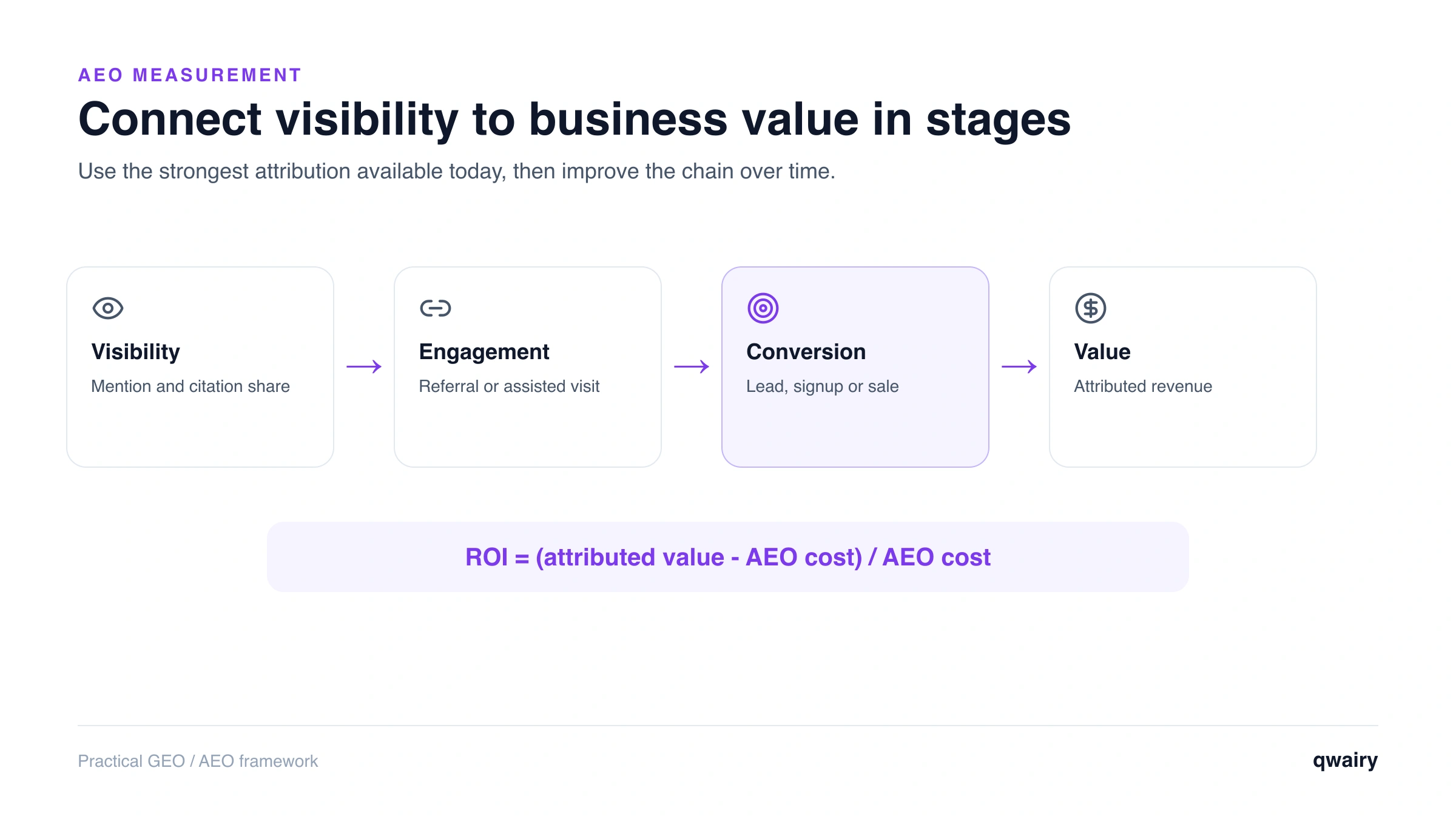
AEO ROI is a stack, not a single number, because value accrues at several stages before revenue appears. Read it top to bottom: the upper metrics are leading indicators you can move in weeks; the lower ones are lagging indicators finance cares about.
Metric | What it tells you | How to source it | Funnel stage |
AI visibility / presence rate | How often you appear in answers to the questions your buyers actually ask | Track a fixed set of priority prompts across engines over time | Awareness |
Citation share | How often you're cited as a linked source, not just mentioned in passing | Parse sources/citations in AI answers | Consideration |
Share of voice | Your slice of brand mentions vs. competitors across tracked prompts | Compare your mentions to rivals on the same prompts | Consideration |
Sentiment / perception | How the model describes you (leader, cheap, risky, niche) | Classify the language used around your brand | Consideration |
AI referral traffic | Sessions arriving from AI engines that do link out | GA4 / server logs, filtered by AI referrers | Intent |
Assisted pipeline / revenue | Deals where an AI touch appears in the journey or is self-reported | Referral tracking + self-reported attribution + CRM | Revenue |
Two notes that save you from bad conclusions. First, treat AI referral traffic as a floor, not the total — because so many AI-influenced buyers arrive later as branded or direct visits, referral counts undercount real influence. Semrush's tracking shows AI referral traffic is still a small share of most sites' visits but growing quickly ; the trend matters more than today's absolute. Second, don't skip the leading indicators just because they aren't revenue — visibility and citation share are the earliest proof your program is working, months before the pipeline line moves.
Run a free audit: see if ChatGPT, Gemini and Copilot recommend you, in about a minute.
You can build a defensible ROI number with one honest formula and one deliberately conservative assumption. The formula:
AI-influenced revenue = AI-attributed conversions × average deal value × influence weight
AEO ROI = (AI-influenced gross profit − program cost) ÷ program cost The "influence weight" is the honesty knob. Because most AEO touches are assisted rather than last-click, you don't credit 100% of a deal to AEO — you pick a fraction (say 0.3–0.7) and disclose it. A modeled number with a visible assumption is far more credible to a CFO than a precise-looking number with a hidden one.
The seven steps:
A worked example (illustrative — these are example inputs, not benchmarks; plug in your own):
Input | Example value |
Priority buyer prompts tracked | 60 |
AI-attributed leads / month (referral + self-reported, de-duped) | 45 |
Lead → customer rate | 7% |
New customers / month influenced by AI | 3.15 |
Average first-year contract value | €6,000 |
Gross margin | 80% |
Influence weight (assisted) | 0.5 |
Monthly AEO program cost (content, tooling, time) | €4,000 |
Running the numbers: 45 leads × 7% = 3.15 customers × €6,000 = €18,900 of influenced new annual contract value per month. Apply the 0.5 influence weight → €9,450 credited. Apply 80% gross margin → €7,560 credited gross profit. Subtract the €4,000 program cost → €3,560 net per month, an ROI of 89% at this run-rate. Because a single point estimate invites the reply "prove it," run three scenarios and hand finance the range:
Scenario | AI leads / mo | Influence weight | Credited gross profit / mo | Cost / mo | Net / mo | ROI |
Conservative | 25 | 0.3 | ~€2,520 | €4,000 | −€1,480 | ~−37% |
Base | 45 | 0.5 | ~€7,560 | €4,000 | €3,560 | ~+89% |
Optimistic | 70 | 0.7 | ~€16,464 | €4,000 | €12,464 | ~+312% |
The conservative row is a feature, not a bug. Showing a scenario where AEO loses money at low volume and low influence tells leadership you're modeling, not selling — which is what makes the base and optimistic cases believable.
See your mentions across ChatGPT, Claude and Perplexity in real time, the moment buyers ask.
No single method captures AI influence, so use three that overlap and reconcile them.
1. GA4 and referral tracking. Build a custom channel group that isolates AI referrers — hosts like chatgpt.com, perplexity.ai, gemini.google.com, and copilot.microsoft.com. This captures the visitors AI engines send with a link: your most reliable AEO signal, and also the one that undercounts most, since many AI-influenced buyers return later as branded or direct traffic referral tracking never labels. Read it as a conservative floor.
2. Self-reported attribution. Add a "How did you hear about us?" field to your signup or demo request, with an explicit "AI assistant (ChatGPT, Perplexity, Gemini…)" option. This is how you catch the dark conversions that never carried a referrer. Self-reported attribution has become a standard way practitioners recover credit for hard-to-track channels; see this walkthrough of measuring AI search impact for the pattern. It's noisy at the individual level but directionally strong in aggregate.
3. Brand-lift and correlation. Watch branded search volume, direct traffic, and your AI visibility trend together over time. When rising presence and citation share are followed by rising branded demand and pipeline, you have a correlation story — not proof of causation, but a reasonable case, especially if you can point to periods where citations moved and demand tracked them. One honesty note on conversion quality. Several analyses report that AI referral visitors convert at a higher rate than ordinary organic — Kevin Indig's Growth Memo and Semrush both describe AI traffic as small in volume but unusually engaged. Other studies find the opposite, that LLM referrals can convert worse than Google search . Treat the specific multiples you'll see quoted as directional, not settled, and measure your own conversion rate by source instead of importing someone else's number.
Pitch AEO as defending future demand, not as adding a channel — and bring the model, not adjectives. A structure that works:
This reframes the ask from "trust me, AI is important" to "here's a bounded bet with a downside case and a kill criterion" — a conversation a CFO can say yes to.
The model above only works if the top of the metric stack is instrumented, and that's the part manual tracking can't sustain. Checking a handful of prompts by hand across ChatGPT, Claude, Perplexity, Gemini, and Google AI Overviews doesn't scale, and it can't give you a trend line. Qwairy is built to measure exactly this layer: AI visibility and presence across the major engines, citation and source intelligence (who gets cited, from which domains), share of voice against competitors, and sentiment. It also connects that visibility to AI-driven revenue, so the leading and lagging indicators live in one place — and, because it exposes an agent-native interface (MCP), your own analyst or AI agent can query the data directly rather than wait on a dashboard. That's the difference between asserting AEO works and showing the line that proves it. For the broader playbook, the complete AEO guide goes deeper on visibility, citations, and measurement.
Continue from business case to attribution: Use the AI revenue attribution handbook , scale governance with the enterprise AEO strategy , and align terminology with AEO vs GEO vs SEO .
AEO ROI is hard because the highest-value touch is a zero-click answer inside a private conversation. You don't solve that by pretending clicks still tell the whole story — you solve it by measuring presence and influence at the top of the funnel, instrumenting referral plus self-reported attribution at the bottom, and being transparent about the modeled part in between. Do that, put a conservative scenario in front of finance, and AEO stops being an act of faith and becomes a bounded, defensible bet.
SEO ROI is measured on clicks and rankings; you can trace a session from search to conversion. AEO (answer engine optimization) and GEO (generative engine optimization) are effectively the same discipline under two names, and their ROI is measured on presence and influence inside AI answers, where the click is often missing. The metrics shift from rankings and sessions toward visibility, citation share, and assisted revenue.
You can calculate it, as long as you're honest that part of the number is modeled. Use AI-attributed conversions × deal value × an influence weight for credited revenue, subtract program cost, and divide. The influence weight (a conservative fraction like 0.3–0.7) is what keeps it from being guesswork — it makes your assumption explicit and auditable instead of hidden.
Combine three signals. Referral tracking in GA4 catches the visits that do arrive with a link; a self-reported "How did you hear about us?" field catches the dark conversions that don't; and a brand-lift view correlates your AI visibility trend with branded search and direct traffic. No single method is complete, but together they triangulate a defensible estimate.
Ask for a time-boxed test rather than a permanent line item — enough to cover content, tooling, and time for one to two quarters, with pre-agreed success metrics. The point of the test is to move leading indicators (visibility, citation share) quickly and gather enough attribution data to run the ROI model on real numbers before you commit to a larger budget.
Start with AI visibility and citation share on your priority prompts. They're the earliest proof the program is working, they move within weeks, and they're a leading indicator of the revenue that follows. Report them as your quarter-one success metric while you build out the attribution and revenue view underneath.
Some analyses say yes — AI referral traffic tends to be low in volume but highly engaged — while others find it converts worse than Google search. The findings are genuinely mixed, so don't rely on a borrowed multiple. Measure conversion rate by source in your own analytics and let your data settle the question for your business.
Track your mentions across ChatGPT, Claude, Perplexity and all major AI platforms. Join 1,500+ brands monitoring their AI presence in real-time.
Free trial • No credit card required • Complete platform access
Other Articles
Answer Engine Optimization (AEO): The Complete 2026 Guide
A complete, practitioner-level guide to Answer Engine Optimization: what AEO is, how answer engines like ChatGPT, Perplexity and Google AI Overviews select and cite content, the core levers, a step-by-step workflow, and how to measure it.
How to Set Up AI Referral Tracking in GA4, Plausible and Matomo
Most analytics tools miss or misclassify AI referral traffic by default. This step-by-step guide shows you how to properly track visits from ChatGPT, Perplexity, Claude, Gemini, and other AI platforms in GA4, Plausible, and Matomo.