Loading page

A Qwairy research study on how AI answer engines frame the 2026 World Cup winner, where they agree, where answers become volatile, and what marketers can learn from AI perception mapping.
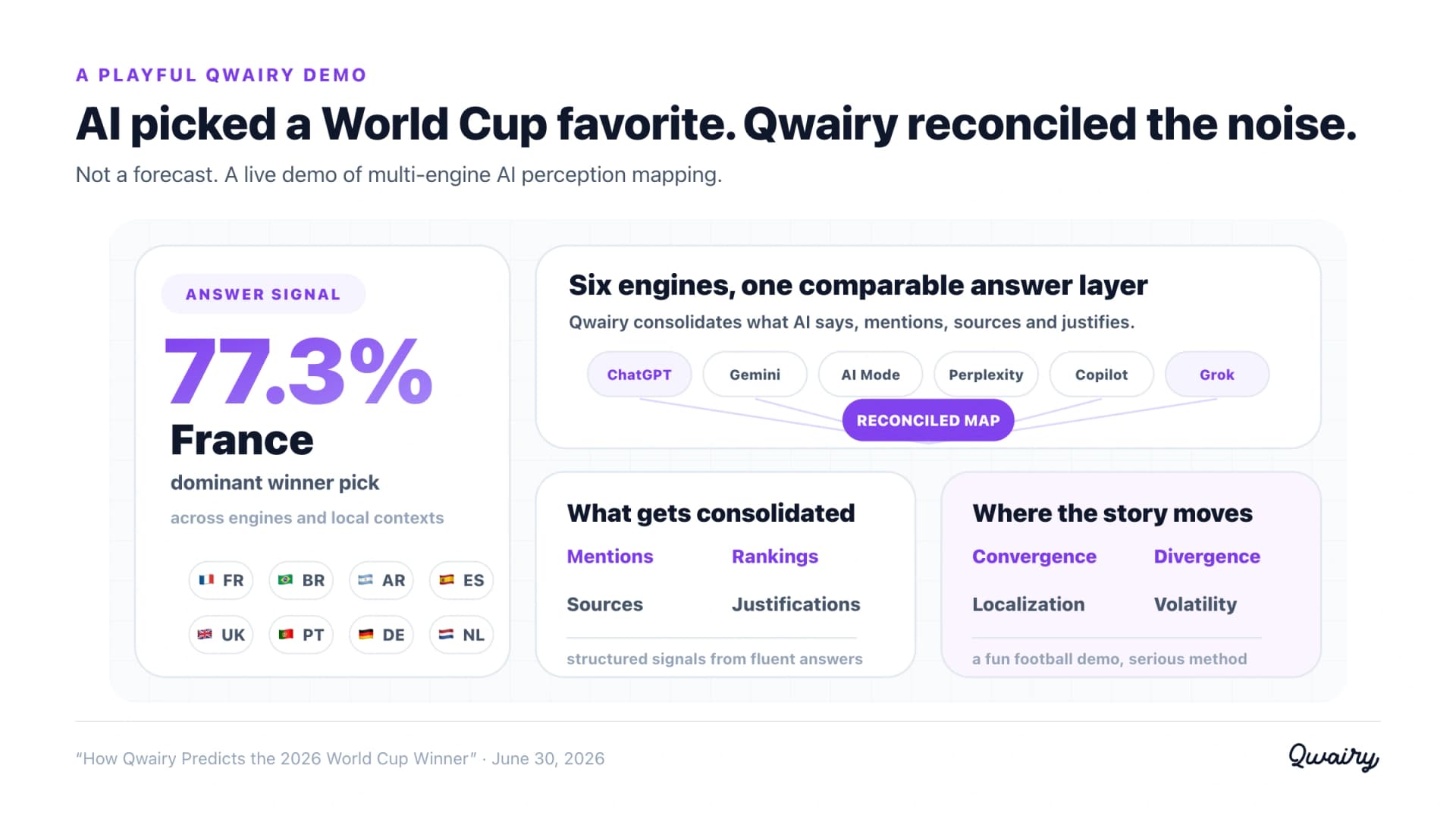
AI picked France to win the 2026 World Cup. Almost everywhere. Before anyone starts betting: don't. The interesting part is not the prediction. It is how consistently AI engines converged on the same answer. We asked six AI answer engines a ridiculous question with a serious method:
Who is most likely to win the 2026 FIFA World Cup? Then we ran it the way a brand would measure AI visibility: across engines, localizations, prompt families, repeated answers, sources, facts, clusters and volatility.
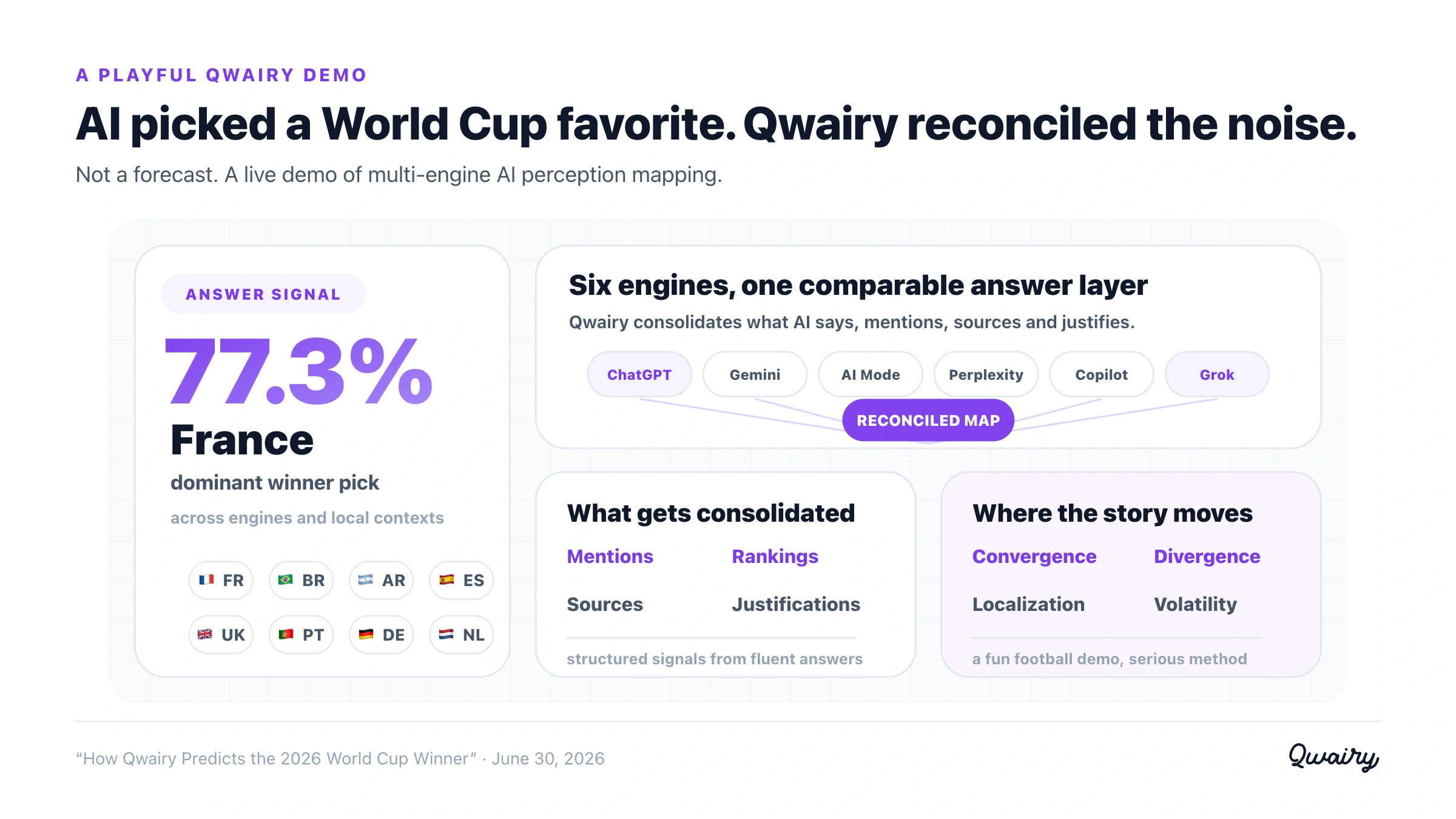
Qwairy collected a validated four-figure answer panel on June 30, 2026 across six answer engines: ChatGPT, Gemini, Google AI Mode, Perplexity, Copilot and Grok. The same English prompt families were tested across eight country localizations: France, Brazil, Argentina, Spain, United Kingdom/England, Portugal, Germany and Netherlands. We extracted and reconciled winner picks, team mentions, ranks, sources, recurring facts, narrative clusters and volatility. No prompt instructed the engines to pick France, and no prompt framed France as the expected winner.
Across the consolidated dataset, France dominated the answer layer with 77.3% of extracted winner picks.
Rank | Team | Share of extracted winner picks | Answer-layer role |
1 | France | 77.3% | Dominant favorite |
2 | Spain | 7.0% | Main challenger |
3 | Argentina | 3.8% | Legacy contender |
4 | Brazil | 3.7% | High-ceiling contender |
5 | Morocco | 1.8% | Dark-horse signal |
6 | Netherlands | 1.6% | Narrative variant |
7 | Norway | 1.1% | Star-led outsider |
8 | Germany | 0.9% | Residual contender |
9 | Portugal | 0.8% | Elite-squad mention |
10 | England | 0.6% | Low-conversion contender |
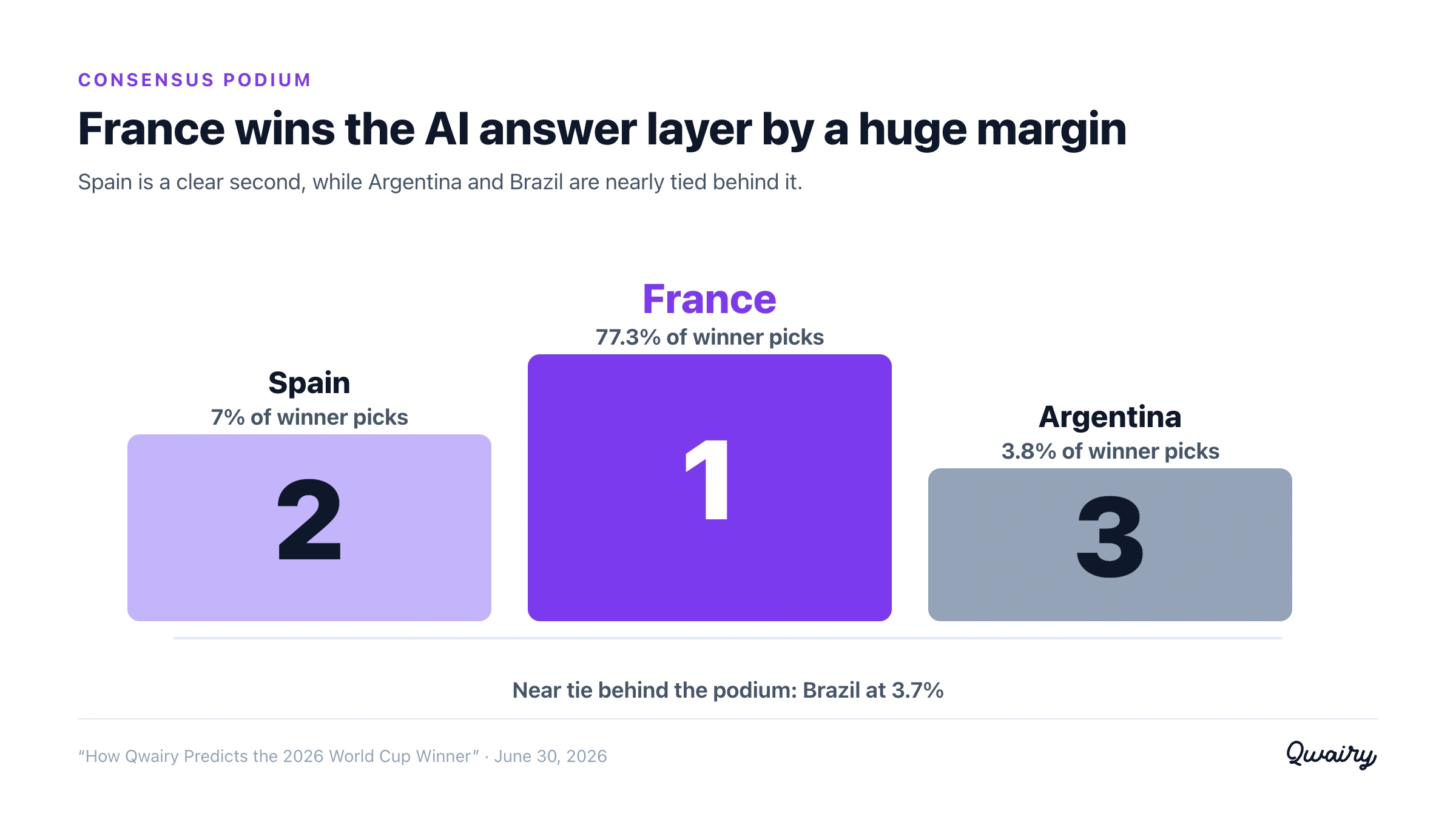
The interesting part is not only that France leads. It is that the lead remains resilient across engines, countries and prompt families.
France finished first in every engine, but the intensity changed.
Engine | Share of winner picks naming France first |
Grok | 90.7% |
Gemini | 84.3% |
Copilot | 83.3% |
Google AI Mode | 71.6% |
ChatGPT | 71.3% |
Perplexity | 62.4% |
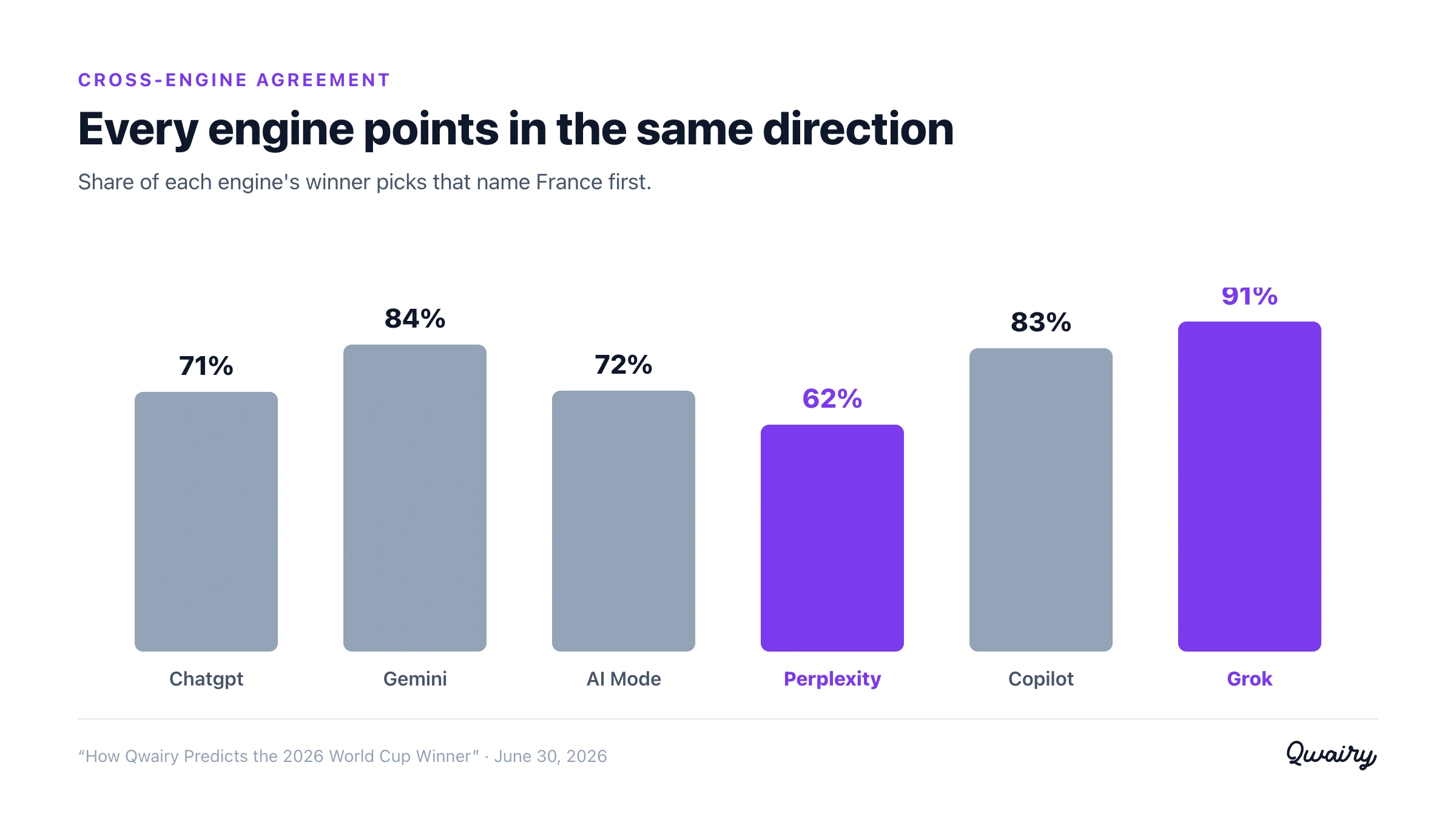
Grok was the most concentrated around France. Perplexity was the most open surface, giving more room to Spain, Brazil, Morocco and other alternatives. ChatGPT and Google AI Mode sat in the middle: clear France lead, more visible challengers.
When Qwairy reconciled winner picks by localization and engine, every model-country cell resolved to France. That matters because this was not one model repeating one answer. It was a multi-engine, multi-localization pattern.
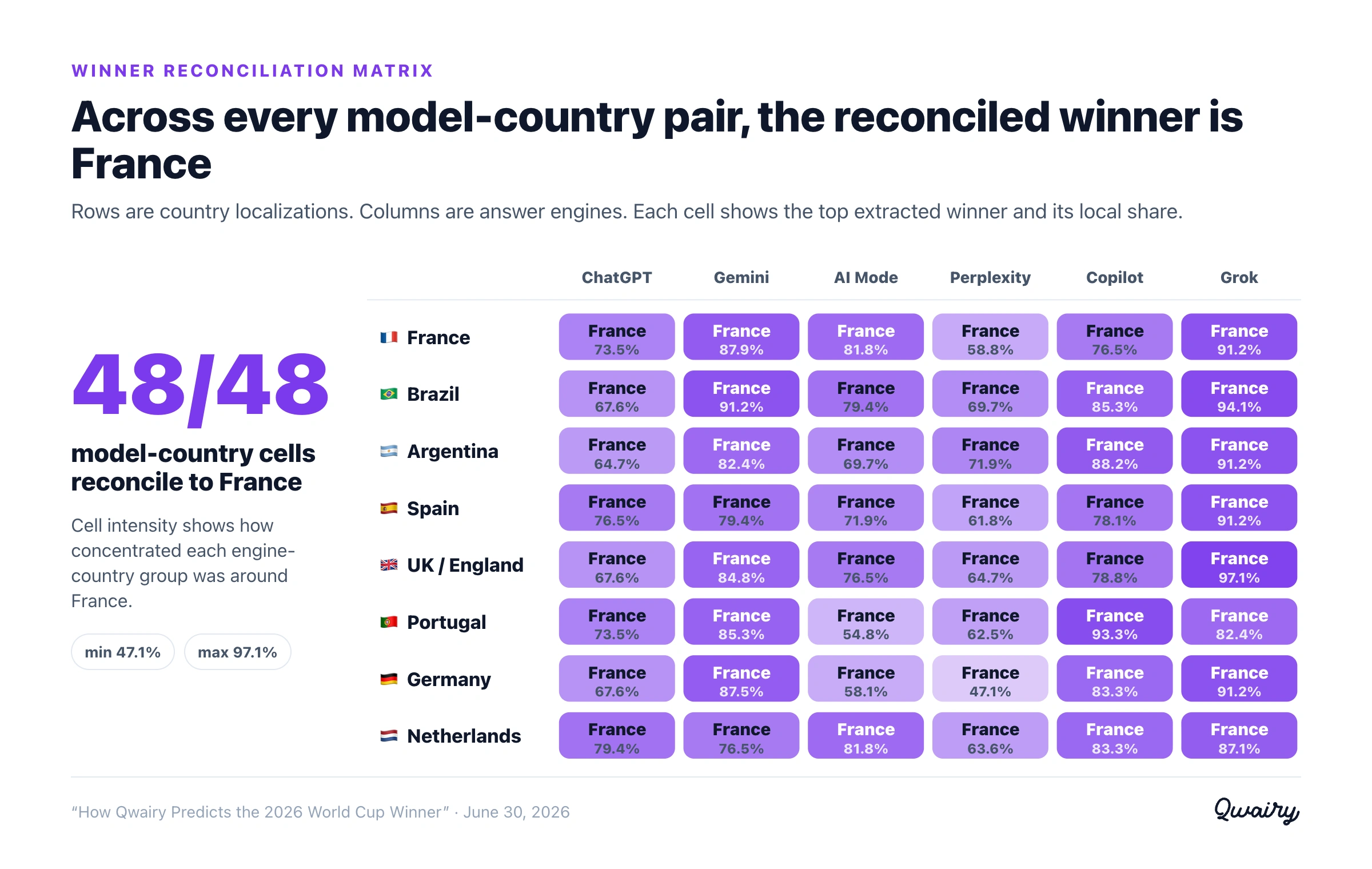
Localization | ChatGPT | Gemini | AI Mode | Perplexity | Copilot | Grok |
🇫🇷 France | 1. 🇫🇷 73.5% 2. 🇪🇸 11.8% 3. 🇦🇷 5.9% | 1. 🇫🇷 87.9% 2. 🇧🇷 6.1% 3. 🇳🇱 3.0% | 1. 🇫🇷 81.8% 2. 🇲🇦 4.5% 3. 🇳🇱 4.5% | 1. 🇫🇷 58.8% 2. 🇧🇷 11.8% 3. 🇪🇸 11.8% | 1. 🇫🇷 76.5% 2. 🇦🇷 5.9% 3. 🇵🇹 5.9% | 1. 🇫🇷 91.2% 2. 🇪🇸 5.9% 3. 🇯🇵 2.9% |
🇧🇷 Brazil | 1. 🇫🇷 67.6% 2. 🇪🇸 14.7% 3. 🇧🇷 8.8% | 1. 🇫🇷 91.2% 2. 🇦🇷 5.9% 3. 🇪🇸 2.9% | 1. 🇫🇷 79.4% 2. 🇪🇸 5.9% 3. 🇦🇷 2.9% | 1. 🇫🇷 69.7% 2. 🇪🇸 12.1% 3. 🇯🇵 6.1% | 1. 🇫🇷 85.3% 2. 🇦🇷 2.9% 3. 🇧🇷 2.9% | 1. 🇫🇷 94.1% 2. 🇳🇴 5.9% |
🇦🇷 Argentina | 1. 🇫🇷 64.7% 2. 🇪🇸 20.6% 3. 🇲🇦 8.8% | 1. 🇫🇷 82.4% 2. 🇦🇷 5.9% 3. 🇧🇷 2.9% | 1. 🇫🇷 69.7% 2. 🇦🇷 12.1% 3. 🇪🇸 9.1% | 1. 🇫🇷 71.9% 2. 🇪🇸 12.5% 3. 🇲🇦 6.3% | 1. 🇫🇷 88.2% 2. 🇦🇷 2.9% 3. 🇲🇦 2.9% | 1. 🇫🇷 91.2% 2. 🇳🇴 5.9% 3. 🇦🇷 2.9% |
🇪🇸 Spain | 1. 🇫🇷 76.5% 2. 🇧🇷 8.8% 3. 🇪🇸 5.9% | 1. 🇫🇷 79.4% 2. 🇦🇷 5.9% 3. 🇧🇷 5.9% | 1. 🇫🇷 71.9% 2. 🇦🇷 9.4% 3. 🇪🇸 9.4% | 1. 🇫🇷 61.8% 2. 🇧🇷 11.8% 3. 🇪🇸 11.8% | 1. 🇫🇷 78.1% 2. 🇪🇸 15.6% 3. 🇦🇷 3.1% | 1. 🇫🇷 91.2% 2. 🇯🇵 2.9% 3. 🇳🇴 2.9% |
🇬🇧 UK / England | 1. 🇫🇷 67.6% 2. 🇪🇸 14.7% 3. 🇧🇷 8.8% | 1. 🇫🇷 84.8% 2. 🇧🇷 9.1% 3. 🇦🇷 6.1% | 1. 🇫🇷 76.5% 2. 🇪🇸 8.8% 3. 🇧🇷 5.9% | 1. 🇫🇷 64.7% 2. 🇪🇸 14.7% 3. 🇧🇷 5.9% | 1. 🇫🇷 78.8% 2. 🇪🇸 9.1% 3. 🇲🇽 6.1% | 1. 🇫🇷 97.1% 2. 🇳🇴 2.9% |
🇵🇹 Portugal | 1. 🇫🇷 73.5% 2. 🇪🇸 8.8% 3. 🇦🇷 2.9% | 1. 🇫🇷 85.3% 2. 🇩🇪 8.8% 3. 🇦🇷 2.9% | 1. 🇫🇷 54.8% 2. 🇦🇷 25.8% 3. 🇪🇸 6.5% | 1. 🇫🇷 62.5% 2. 🇧🇷 9.4% 3. 🇪🇸 9.4% | 1. 🇫🇷 93.3% 2. 🇦🇷 3.3% 3. 🇧🇷 3.3% | 1. 🇫🇷 82.4% 2. 🇵🇹 8.8% 3. 🇳🇴 5.9% |
🇩🇪 Germany | 1. 🇫🇷 67.6% 2. 🇪🇸 11.8% 3. 🇧🇷 5.9% | 1. 🇫🇷 87.5% 2. 🇧🇷 9.4% 3. 🇦🇷 3.1% | 1. 🇫🇷 58.1% 2. 🇦🇷 22.6% 3. 🇪🇸 6.5% | 1. 🇫🇷 47.1% 2. 🇪🇸 20.6% 3. 🇧🇷 8.8% | 1. 🇫🇷 83.3% 2. 🇪🇸 10.0% 3. 🇦🇷 3.3% | 1. 🇫🇷 91.2% 2. 🇧🇷 2.9% 3. 🇨🇴 2.9% |
🇳🇱 Netherlands | 1. 🇫🇷 79.4% 2. 🇪🇸 8.8% 3. 🇦🇷 5.9% | 1. 🇫🇷 76.5% 2. 🇧🇷 8.8% 3. 🇦🇷 5.9% | 1. 🇫🇷 81.8% 2. 🇵🇹 9.1% 3. 🇪🇸 6.1% | 1. 🇫🇷 63.6% 2. 🇪🇸 18.2% 3. 🇧🇷 6.1% | 1. 🇫🇷 83.3% 2. 🇪🇸 10.0% 3. 🇧🇷 3.3% | 1. 🇫🇷 87.1% 2. 🇳🇴 9.7% 3. 🇨🇦 3.2% |
This does not mean every answer picked France. It means the top reconciled winner inside every country-engine group was France. The challenger layer appears in the second and third positions.
Run a free audit: in a few minutes, ChatGPT, Gemini and Perplexity answer 8 buying questions about your market live, and you see who they recommend.
The local market mattered, but not in the obvious way. Local teams were discussed more often in their own country context, yet the final winner pick rarely changed.
Localization | #1 | #2 | #3 |
🇫🇷 France | France 78.0% | Spain 6.8% | Brazil 3.7% |
🇧🇷 Brazil | France 81.3% | Spain 6.4% | Brazil 3.0% |
🇦🇷 Argentina | France 78.1% | Spain 7.5% | Argentina 4.5% |
🇪🇸 Spain | France 76.5% | Spain 7.5% | Brazil 4.5% |
🇬🇧 UK / England | France 78.2% | Spain 7.9% | Brazil 5.4% |
🇵🇹 Portugal | France 75.4% | Argentina 6.2% | Spain 4.6% |
🇩🇪 Germany | France 72.3% | Spain 8.2% | Argentina 5.6% |
🇳🇱 Netherlands | France 78.5% | Spain 7.2% | Brazil 3.6% |
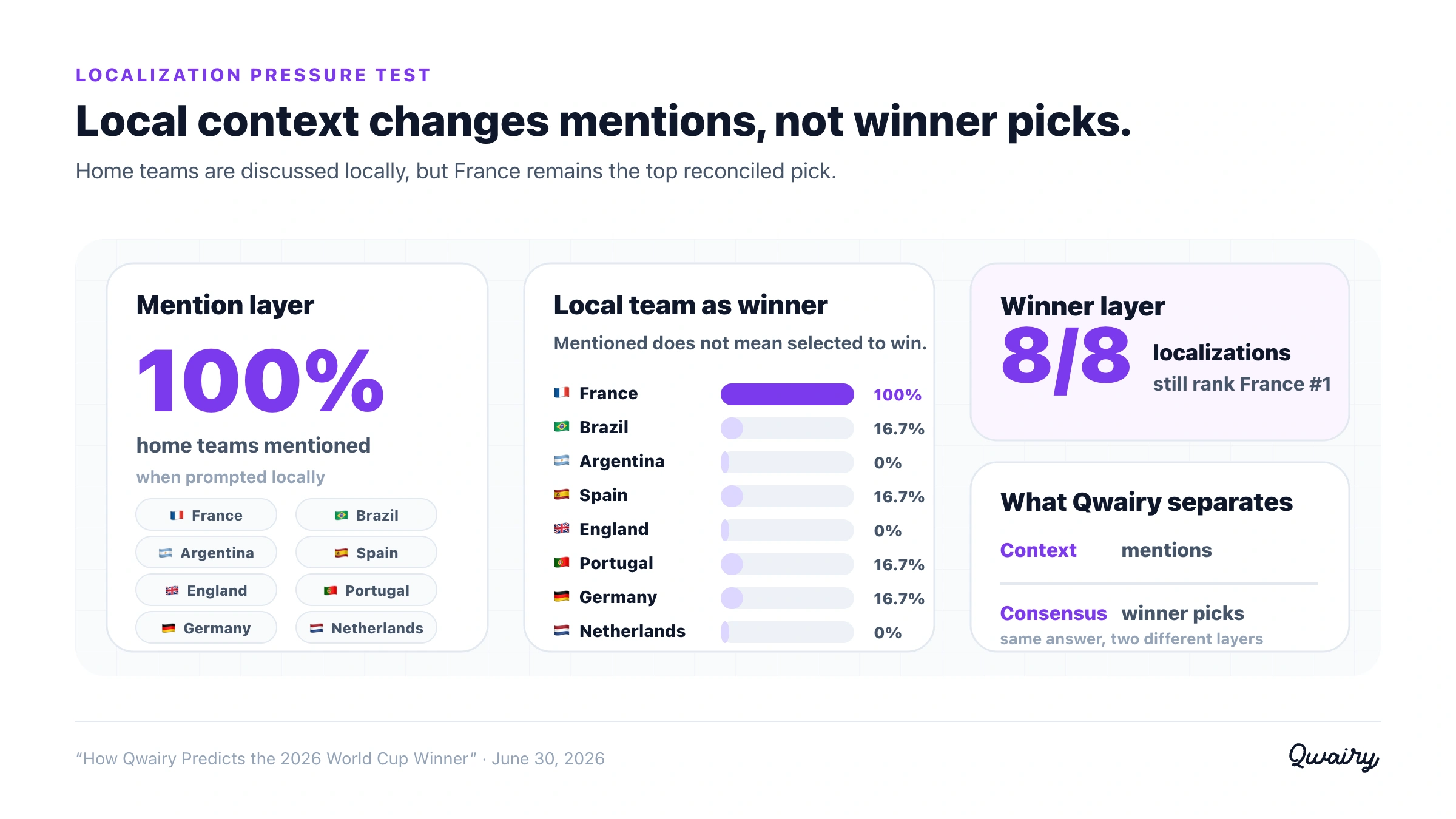
France is the exception because the global consensus and local context point in the same direction. For the others, the local team appears in the answer, but the engine often returns to France.
The overall volatility rate across repeated prompt groups was 37.9%: more than one in three repeated engine-country-prompt groups produced more than one winner pick.
Prompt family | Volatile repeated groups |
Dark horses | 89.4% |
Final four | 50.0% |
Source-backed ranking | 43.8% |
Winner likelihood | 39.6% |
Facts driving prediction | 31.3% |
Contradictions | 18.8% |
Home-country bias | 18.8% |
Cluster labels | 12.5% |
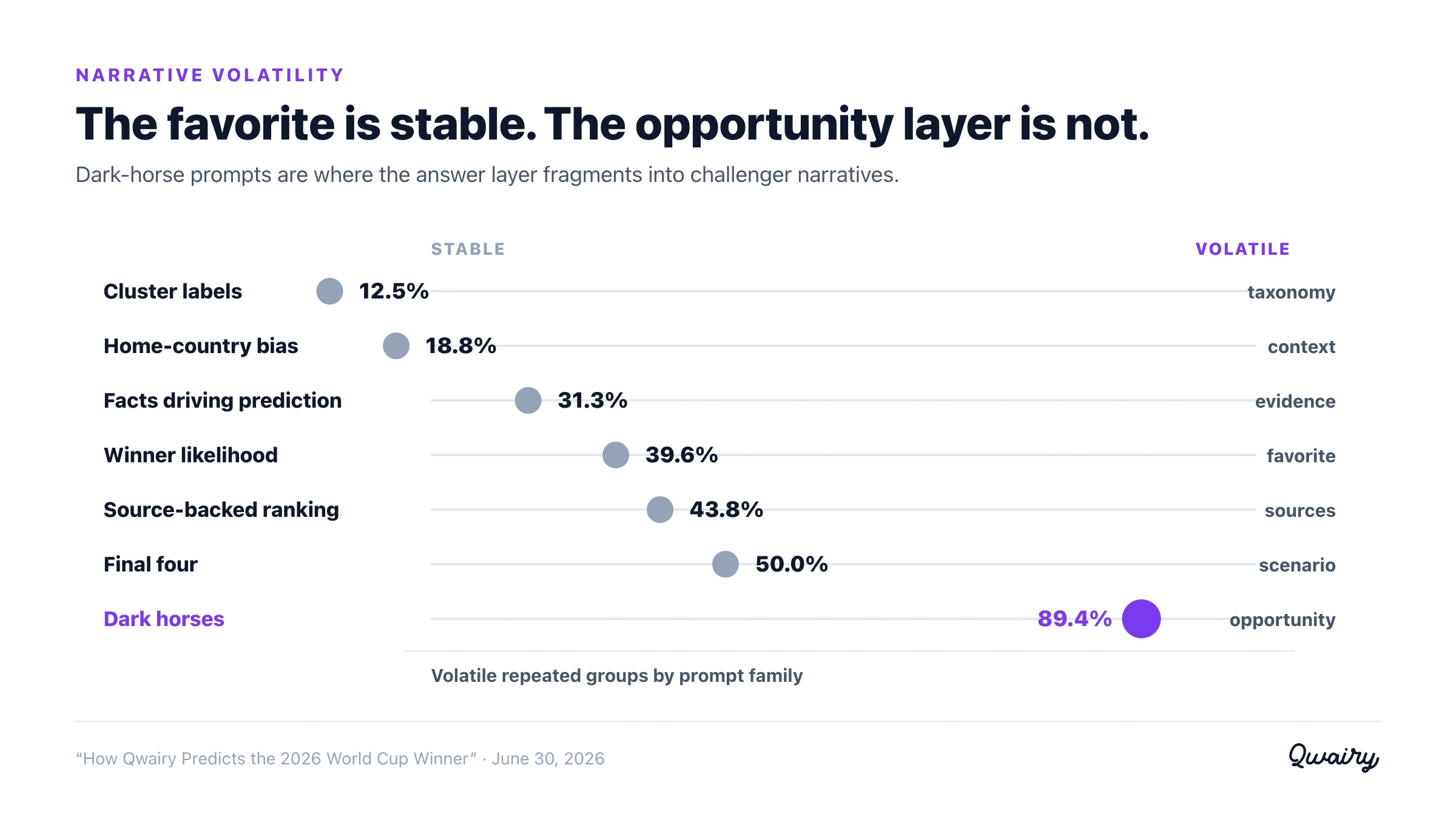
That split is the story:
The consensus layer hardened around France.
The interpretation layer diverged around final-four logic, facts and source-backed rankings.
The opportunity layer fragmented around dark horses.
AI volatility is not just noise. It tells you where the answer layer is still negotiable.
The most repeated narrative clusters were practical: knockout path, current form, tactical control, tournament experience, odds/models and squad depth.
Narrative cluster | Share of answer panel |
Knockout path | 98.0% |
Current form | 96.6% |
Tactical control | 88.6% |
Tournament experience | 86.6% |
Odds and models | 86.5% |
Squad depth | 86.3% |
Dark horse logic | 77.8% |
Stars and icons | 74.4% |
Injury or fragility | 46.0% |
Home advantage | 32.3% |
The source layer was just as important. AI answers pulled from a mix of sports media, social/video platforms, official tournament pages, odds/model pages and general web sources.
Source category proxy | Share among top surfaced domains |
Sports media | 40.3% |
Social and video | 27.9% |
Other web | 22.8% |
Official | 6.9% |
Odds and models | 2.2% |
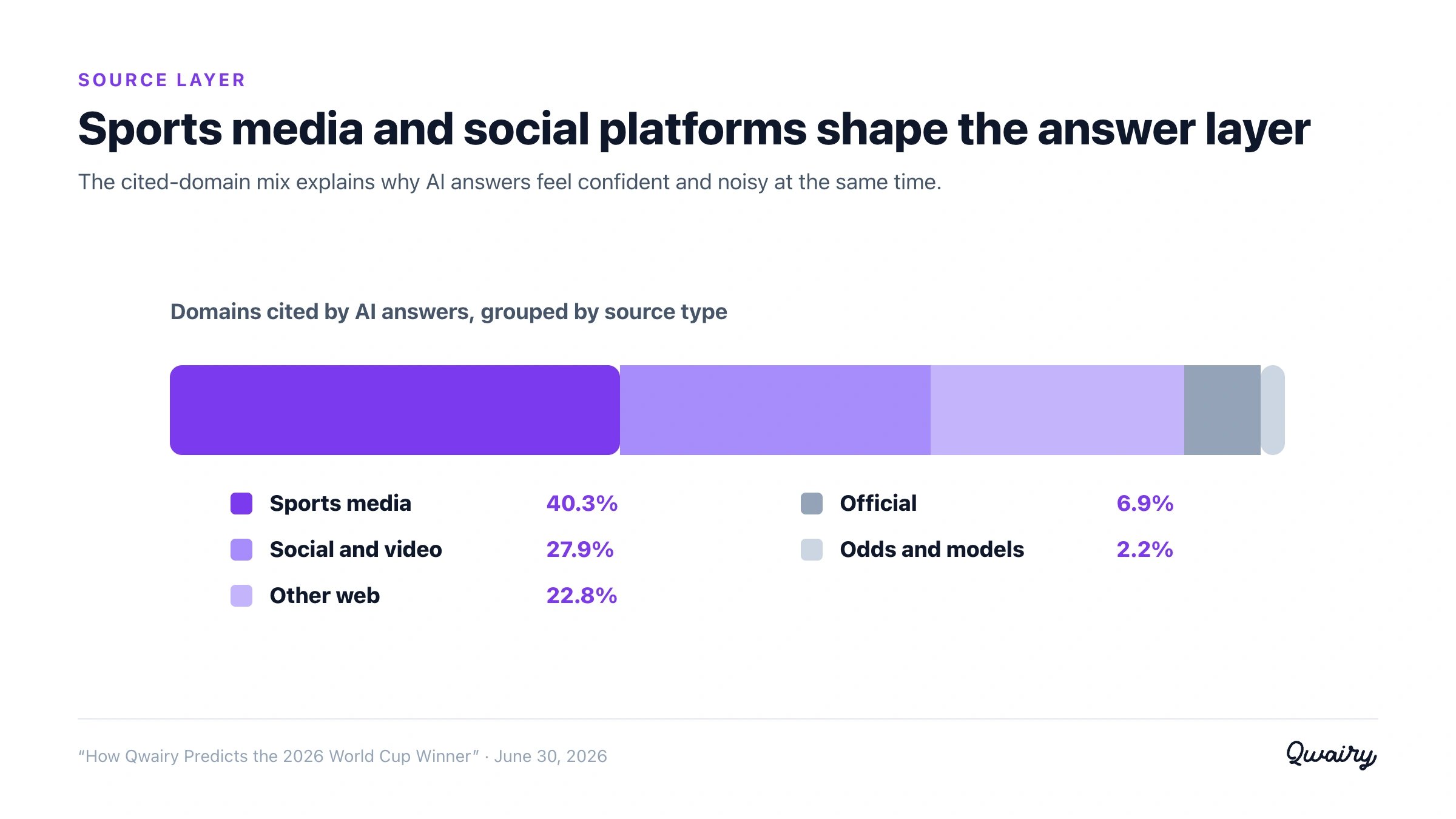
Top surfaced domains included ESPN, YouTube, FOX Sports, FIFA, X, Yahoo Sports, The Analyst, Facebook, Instagram, Wikipedia, Sports Illustrated and Goal.
Break your visibility down model by model to see where each AI mentions you and where it doesn't.
This is where we ruin the fun slightly: Qwairy does not know who will win the 2026 World Cup. This is not betting advice, not a forecast model, and not a claim that France will win. The study measures how AI answer engines framed the winner question at a specific moment in time. Sports context changes quickly. Source pages change quickly. Models can lag behind live events or update without notice. The correct interpretation is: as of June 30, 2026, AI answer engines consistently framed France as the dominant winner pick, while the surrounding narratives remained much more volatile. We will rerun the exact same panel as the tournament progresses. If the eventual champion is not France, that gap becomes the real finding. It shows how far the AI answer layer can sit from the outcome on the pitch, and how quickly it rewrites itself once results land. Either way, the method is what we are testing, not the trophy.
The football angle is fun. The useful lesson is bigger. Qwairy can use a noisy public event to demonstrate the same workflow that matters for brand perception:
collect comparable answers across engines;
run the same prompts across local contexts;
extract winners, mentions, ranks, facts, sources and clusters;
measure volatility instead of pretending every answer is stable;
reconcile conflicting answers into a readable market narrative.
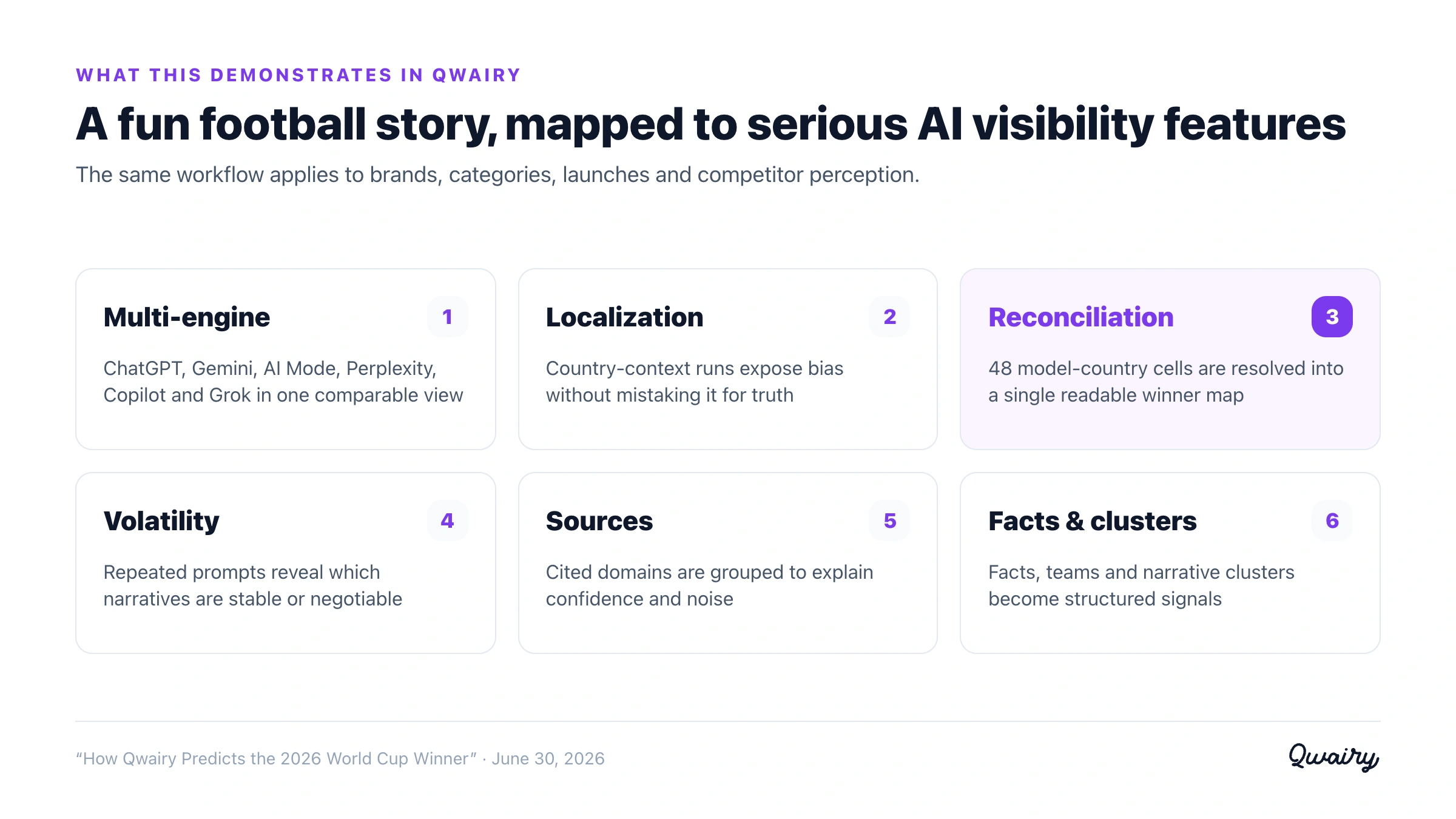
What the study shows | Qwairy capability demonstrated |
Six answer engines disagree in intensity while pointing in the same direction | Multi-engine AI visibility monitoring |
Country context changes the supporting narrative more than the winner | Localization tracking |
48 model-country cells become one readable winner map | Answer reconciliation |
Dark-horse prompts fragment while the favorite stays stable | Prompt volatility monitoring |
Sports media, social, official and odds/model pages shape the answer layer | Source intelligence |
Facts and narrative clusters can be extracted from fluent answers | Fact extraction and cluster analysis |
For the World Cup, the fun finding is simple: AI has a favorite, and it is France. For marketers, the more important finding is this: AI answers are now a measurable perception layer. May the best team win. For everything else, the useful question is whether you can see how AI engines mention, justify, source and recommend you. That is what Qwairy is built to track, reconcile and turn into actionable recommendations. If you want this same map for your own brand instead of a national team, see how Qwairy tracks it .
The study was run on June 30, 2026 across six answer engines (ChatGPT, Gemini, Google AI Mode, Perplexity, Copilot and Grok), eight country localizations, and 18 prompts (10 base prompts and 8 booster prompts), with prompts repeated to measure volatility. After deduplication, the consolidated four-figure answer panel reached a 97.9% usable rate, with no missing rows remaining. Errors were excluded from the analysis. All prompts were run in English. Country localization was controlled separately, and local-team prompts inserted the relevant team name.
All prompts were written in English. Each one included the same framing: this is sports analysis, not betting advice.
Base prompts
# | Prompt |
1 | As of June 30, 2026, who is most likely to win the 2026 FIFA World Cup? Rank the top 10 teams with short reasons. |
2 | As of June 30, 2026, predict the final four of the 2026 FIFA World Cup: winner, runner-up, third place and fourth place. Explain the logic briefly. |
3 | As of June 30, 2026, which teams are the safest semi-final picks in the 2026 FIFA World Cup, and why? |
4 | As of June 30, 2026, which team is the biggest dark horse to win the 2026 FIFA World Cup? Give one bold pick and one safer pick. |
5 | As of June 30, 2026, how likely is the local team to win the 2026 FIFA World Cup compared with the other favorites? Give a clear ranking context. |
6 | As of June 30, 2026, if the 2026 FIFA World Cup knockout stage was played from today, who would win the tournament and why? |
7 | As of June 30, 2026, name the top 5 contenders in the 2026 FIFA World Cup and list the evidence that matters most for each. |
8 | As of June 30, 2026, which 2026 FIFA World Cup contender is most likely to be overrated by AI predictions? Explain why. |
9 | As of June 30, 2026, which 2026 FIFA World Cup prediction is most fragile because of injuries, bracket path, form, or uncertainty? |
10 | As of June 30, 2026, give a confidence score from 0 to 100 for the top 8 teams to win the 2026 FIFA World Cup. |
Booster prompts
# | Prompt |
1 | As of June 30, 2026, who is most likely to win the 2026 FIFA World Cup? Give a ranked top 8 and explain the main evidence for the top 3. |
2 | As of June 30, 2026, predict the final four of the 2026 FIFA World Cup. Include winner, runner-up, third place and fourth place, and give one uncertainty for each. |
3 | As of June 30, 2026, what facts matter most when predicting the 2026 FIFA World Cup winner? List the facts, the teams they help, and the teams they hurt. |
4 | As of June 30, 2026, build a source-backed ranking of the top 8 contenders to win the 2026 FIFA World Cup. For each team, mention the type of source or evidence you rely on. |
5 | As of June 30, 2026, where do predictions about the 2026 FIFA World Cup winner disagree the most? Name the teams that create disagreement and explain why. |
6 | As of June 30, 2026, rank the top 5 dark horses in the 2026 FIFA World Cup and explain which one has the most realistic path to the final. |
7 | As of June 30, 2026, are predictions too optimistic or too pessimistic about the local team's chances to win the 2026 FIFA World Cup? Compare the local team to France, Argentina, Spain, Brazil, England and Portugal. |
8 | As of June 30, 2026, group the main 2026 FIFA World Cup winner predictions into 4 or 5 narrative clusters. Give each cluster a short label, the teams inside it, and the evidence behind it. |
External context pages consulted for tournament and market context:
Track the questions that matter to your business, see which brands each answer mentions and which sources it cites, then work on the gaps.
Free plan with 120 initial credits • No credit card required
Other Articles
ChatGPT Ads Are Coming to France: What US Data Reveals Before Launch
ChatGPT ads appear in 69.25% of US-monitored commercial answers but near zero in France. What US data reveals before the French launch, and how to prepare.
ChatGPT Stopped Citing Reddit. Our Data Shows the Mechanism Behind the 95% Collapse
Reddit's share of ChatGPT Search citations collapsed 95% in one week in August 2026. Qwairy's citation data reveals the mechanism: a query fan-out change on August 8 that switched ChatGPT to direct site: interrogation, redistributing citations from discussion platforms to official sources.