Loading page

Google launched AI Overviews and AI Mode in France on July 22, 2026. Learn why the rollout took two years, what it changes for brands, and how to measure both surfaces in Qwairy.
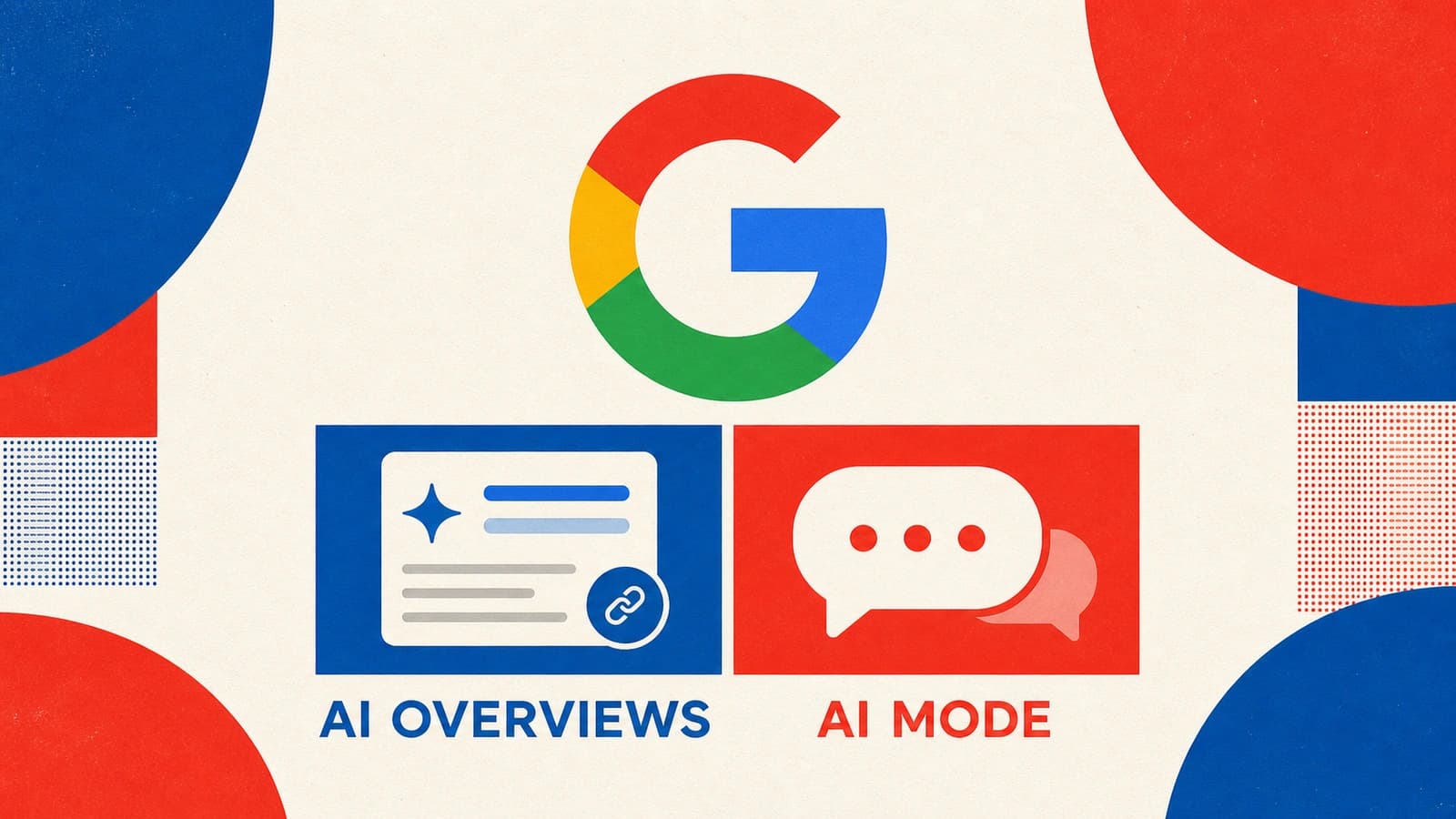
On July 22, 2026, Google launched AI Overviews and AI Mode in France, closing one of the largest remaining gaps in its AI Search rollout. For brands, Google Search now has two additional surfaces where they can be mentioned, cited, compared, recommended, or omitted. Qwairy is among the first platforms to offer monitoring of both Google AI Overviews and AI Mode in France, available from launch day.
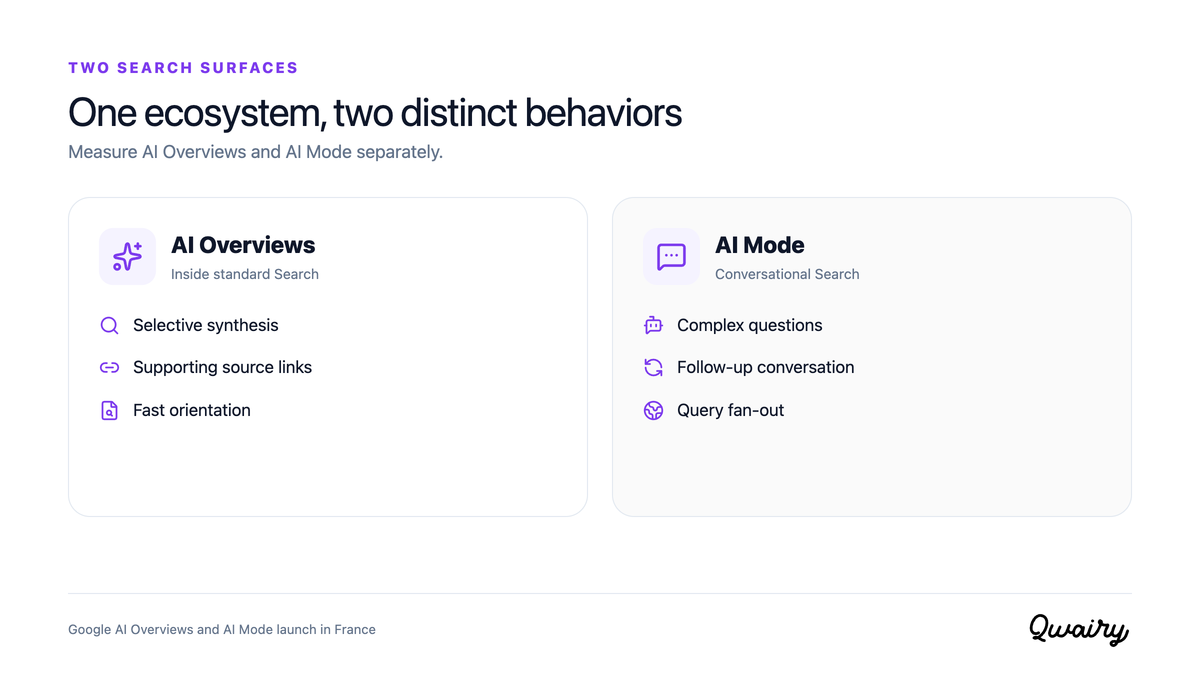
AI Overviews | AI Mode | |
Experience | A synthesis inside the standard results page | A dedicated conversational search interface |
Best for | Quick orientation | Research, comparison, and follow-up questions |
Brand signal | Mention or citation in a concise answer | Recommendation, comparison, evidence, and deeper source use |
Google says AI Overviews appear only when its systems determine that a generated answer adds value. AI Mode goes further: users can ask detailed questions by text, voice, or image and continue with follow-ups. AI Mode also uses query fan-out. It breaks a question into subtopics, runs several searches, and assembles an answer with supporting links. According to Google's French launch announcement, AI Mode queries are three times longer on average than traditional searches. That matters for content strategy. A page can enter the final answer because it resolves one specific sub-question, even when it does not rank for the broad prompt entered by the user.
Run a free audit: in a few minutes, ChatGPT, Gemini and Perplexity answer 8 buying questions about your market live, and you see who they recommend.
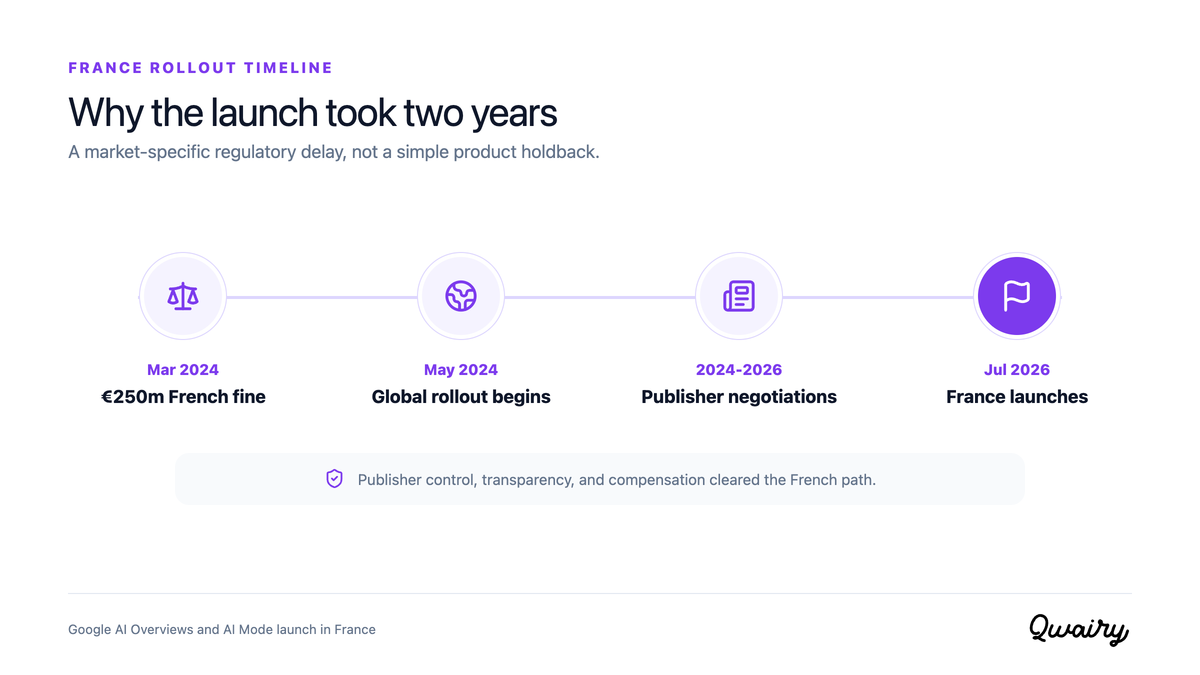
Google began rolling out AI Overviews globally in May 2024. France remained excluded while Google, French regulators, and press publishers worked through a country-specific issue: how press content could be used in generative Search while respecting neighboring-rights commitments. In March 2024, the French Competition Authority fined Google €250 million for failing to comply with several commitments involving press publishers and agencies. The Authority found that Bard, later renamed Gemini, had used publisher content for training, grounding, and answer display without sufficient disclosure. It also criticized the lack of a technical way for publishers to refuse this AI use without affecting their visibility in Search, Discover, or Google News. This separation was central. Publishers needed to be able to opt out of generative answers without disappearing from Google's traditional surfaces. At launch, Google introduced a Search Console control in France that lets site owners decide whether their content may appear in and help ground generative Search features. Google says this choice is not used as a ranking signal outside those features. Product maturity developed in parallel, including answer quality, source presentation, and safeguards. But the main France-specific reason for the delay was regulatory: control, transparency, and the economic treatment of press content had to be addressed before generative answers could be embedded directly in Search.
Traditional SEO visibility is usually measured through rankings, impressions, clicks, and URLs. AI-generated answers introduce four additional questions:
A brand can rank well and still be absent from the generated synthesis. It can also be mentioned without receiving a link, or cited without being explicitly named. SEO therefore remains essential, but it is no longer a complete measurement system. Google Search Central says no special AI file or markup is required. Pages still need to be indexable, useful, accessible, and eligible to appear with a snippet. GEO adds the missing feedback loop: observe the answer, understand its sources, and compare the outcome with competitors.
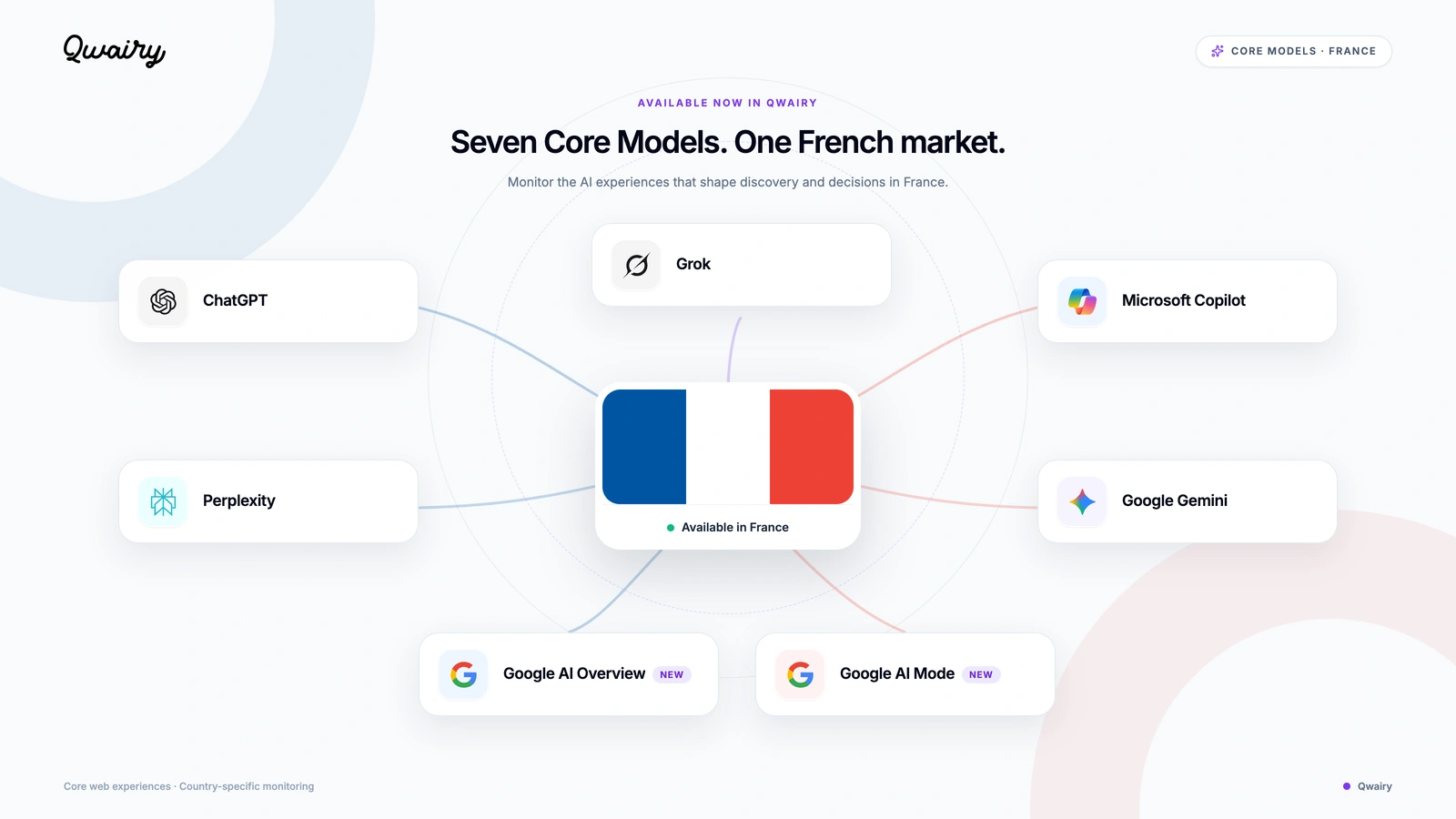
France is new to these Google surfaces, but not to Qwairy's measurement model. We have tracked a consistent query set across AI Overviews and AI Mode for months in an earlier-launch market, and observed material shifts in which brands are mentioned, which sources are cited, and how comparison questions are answered. The French rollout is therefore not a day-one experiment for us: the monitoring framework is ready now. Every week without a baseline is a week of change that cannot be reconstructed reliably later. Brands configured for France can now add both surfaces as Core Models. Each costs 1 credit per prompt, per model, per run:
Country integrity is strict. A France collection remains a France collection: Qwairy does not silently substitute an answer from another country when a French collection cannot be completed. Teams can monitor brand mentions, cited URLs and domains, competitors, share of voice, sentiment, answer context, and changes over time across both Google surfaces.
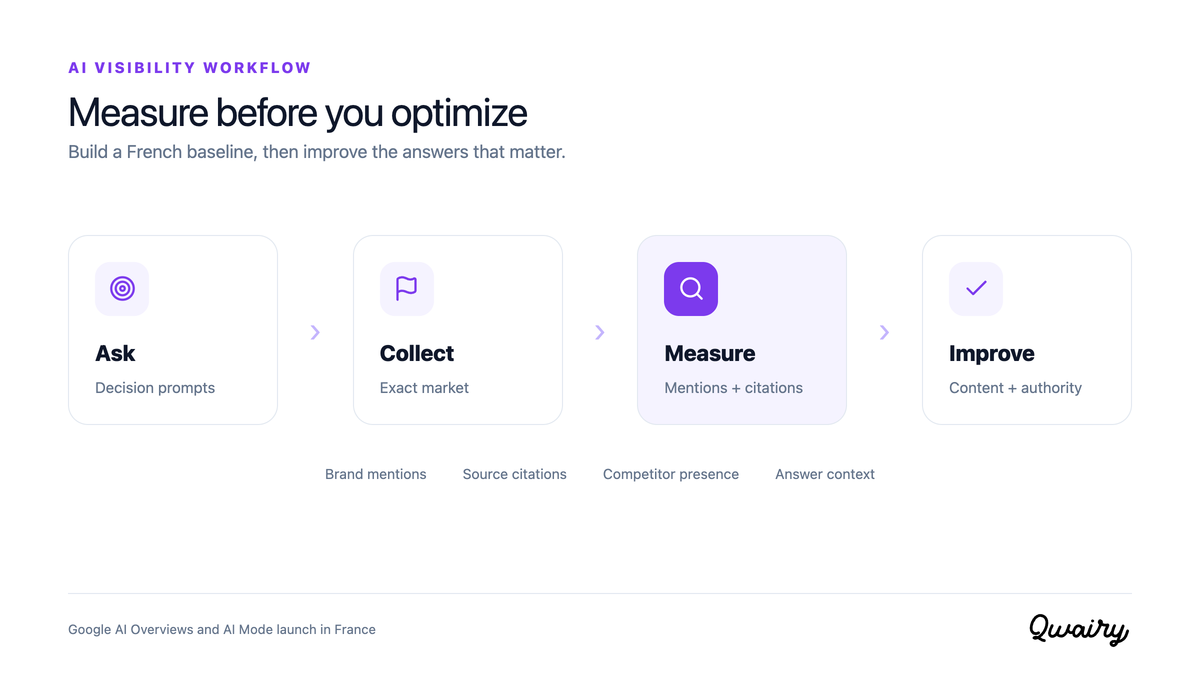
See the web searches captured behind answers from supported models, and the content gaps they reveal.
French search now includes a new decision layer. The strategic question is no longer whether Google will become an answer engine. It is what that answer engine already says about your category, which brands it recommends, and which sources shape the response.
Ready to establish your Google AI Search baseline in France? Start for free | Book a demo
Track the questions that matter to your business, see which brands each answer mentions and which sources it cites, then work on the gaps.
Free plan with 120 initial credits • No credit card required
Other Articles
Source Authority: Find the Sources That Shape AI Answers
Source Authority reveals which domains consistently shape monitored AI answers, turning citation reach, consensus, momentum, breadth, and context into a practical source strategy.
Agencies: Turn AI Visibility Audits into New Business
A practical playbook for turning unlimited AI visibility audits without automatic expiration into an agency growth engine, from lead magnet to monitoring.