Loading page

Source Authority reveals which domains consistently shape monitored AI answers, turning citation reach, consensus, momentum, breadth, and context into a practical source strategy.

Two domains can earn the same number of AI citations and have radically different strategic value. One may be cited six times by the same provider, from the same page, during one short-lived spike. The other may be selected across several providers, prompts, and pages, week after week. A citation count calls them equal. The underlying behavior says otherwise. That gap is why we built Qwairy Source Authority: a proprietary score from 0 to 100 that measures the observed influence of a domain inside the AI answers monitored for a brand.
Authority is not a label a domain permanently owns. In AI search, it is a pattern systems reveal through repeated source selection.
TL;DR: Source Authority goes beyond citation volume. It evaluates whether a domain is cited broadly, prominently, recently, and repeatedly across the providers, models, prompts, and pages in a brand workspace. The result is a contextual source map for content, PR, and outreach decisions, not a universal trust score for the web.
Citation count answers a useful but narrow question: How often did this domain appear? It does not tell you whether those citations came from one model or many, one page or a body of work, one prompt or an entire topic, one burst or a durable pattern. Those distinctions change the decision. A source cited repeatedly from one URL by one provider may represent a tactical opportunity. A source selected across several models, buyer questions, and pages is more likely to be part of the information environment shaping your market. Volume tells you that a source is present. Authority describes the structure of that presence. This matters because source strategy has a cost. Every outreach campaign, expert contribution, research partnership, content brief, and digital PR initiative competes for time. Prioritizing by raw citation count alone can send teams toward the loudest source rather than the most consequential one.
Source Authority summarizes a rolling 90-day snapshot for a single brand workspace. It uses Qwairy's observed answer and citation data only. It does not import backlinks, Domain Authority, AI Readiness, traffic, or unrelated customer data. The score combines five dimensions.
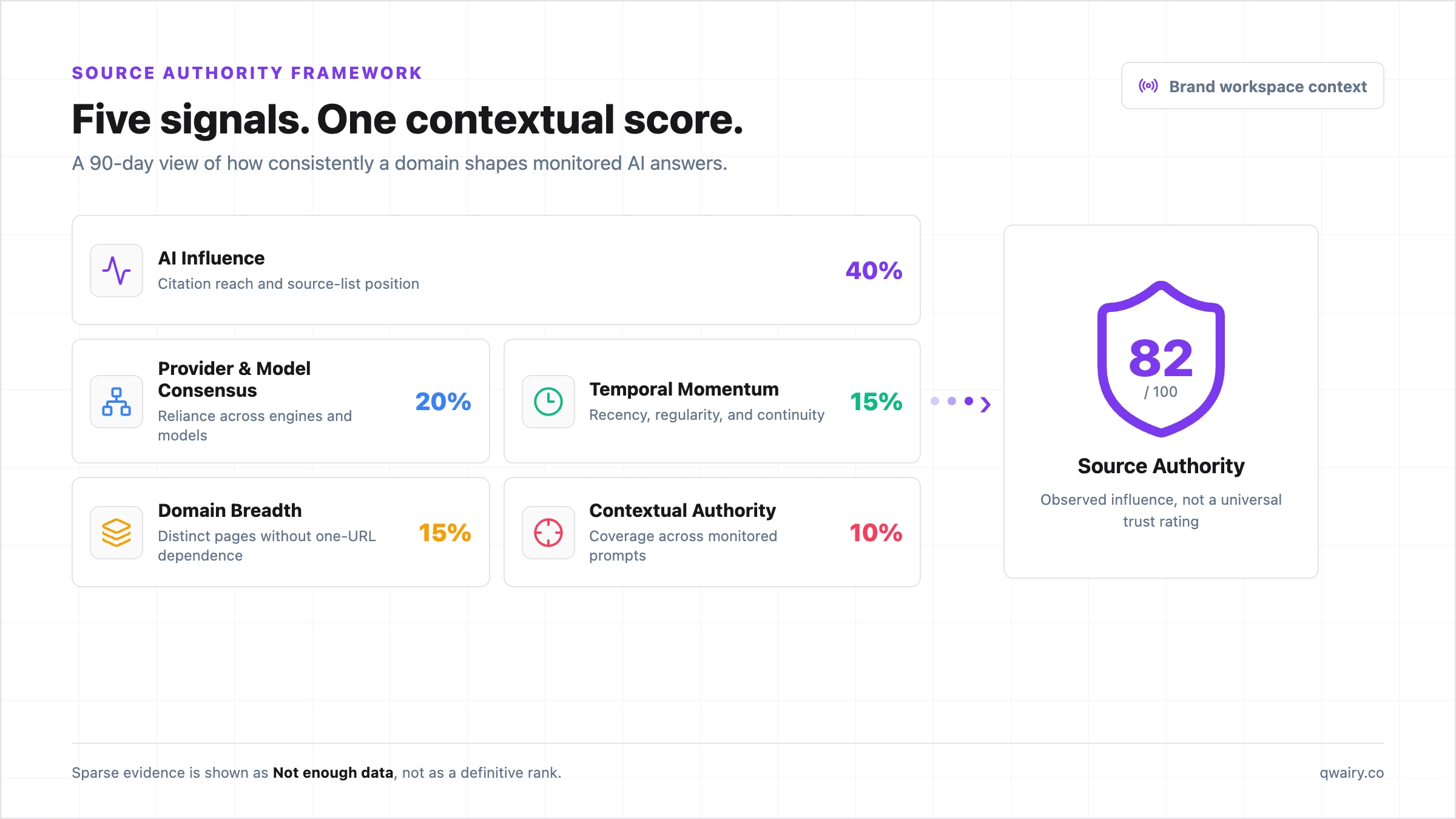
Source Authority combines influence, consensus, momentum, breadth, and context inside one brand workspace.
The largest component measures both citation reach and source-list position. Reach asks how many distinct monitored answers cite the domain relative to the available answer set. Position asks how prominently the domain tends to appear among cited sources. A domain that appears in many answers and regularly earns an early citation position carries more observed influence than one that is mentioned occasionally at the bottom of long source lists.
A source can dominate one engine and remain invisible everywhere else. Consensus measures whether reliance extends across different AI providers and models. Broader agreement makes the signal more robust and reduces the risk of mistaking one provider's sourcing preference for category-wide influence. The score rewards breadth, but it does not assume every provider should behave identically. Divergence is still valuable evidence: it can reveal where a source has model-specific leverage.
Authority can be durable, emerging, or decaying. Temporal Momentum looks at how regularly the domain is cited across the period, whether recent activity is sustained, and how long it has been since the last observed citation. This prevents a single launch, news event, or temporary citation spike from looking like permanent authority. It also helps surface sources whose influence is becoming more consistent before raw totals make the change obvious.
One successful URL is not the same as a repeatable source footprint. Domain Breadth measures how many distinct pages earn citations and how concentrated the domain's influence is on its strongest URL. A domain supported by several useful pages has a more resilient footprint than a domain whose entire score depends on one article. For content teams, this dimension often exposes the difference between an isolated win and a format worth replicating.
A domain may be cited frequently because several variations of the same prompt lead to the same source. Contextual Authority measures how many distinct monitored prompts cite the domain relative to the workspace's prompt set. It captures whether the source shapes one narrow question or participates across a broader part of the buyer journey. When the citation footprint is too sparse to support a responsible interpretation, Qwairy displays Not enough data instead of presenting a fragile estimate as a definitive rank.
The same domain can have different Source Authority scores for two brands. That is not a flaw. It is the point. A specialist publication can be central to the prompts monitored by a cybersecurity company and almost absent from the answers surrounding a travel brand. A major newspaper can be globally reputable yet have little observed influence on a specific B2B software category. Source Authority therefore belongs to the context that produced it:
the brand workspace;
the monitored prompt portfolio;
the available providers and models;
the citations observed during the rolling 90-day window.
Qwairy does not combine every customer's data into one global ranking. The score describes the source environment around the brand and market being monitored. This makes it useful for prioritization, but unsuitable as a general verdict on a publisher's credibility, editorial quality, or truthfulness.
Run a free audit: in a few minutes, ChatGPT, Gemini and Perplexity answer 8 buying questions about your market live, and you see who they recommend.
What you see | What it means | What it does not mean |
High Source Authority | The domain is repeatedly and broadly selected in the monitored AI answers. | The website is universally trustworthy or influential in every market. |
Low Source Authority | Qwairy observes limited or concentrated influence in this workspace. | The content is low quality or the organization lacks credibility. |
Not enough data | The observed citation footprint is too sparse for a responsible score. | The domain is unimportant or should be ignored. |
Consider a simple illustrative case.
Source A is cited 12 times by one provider, from one URL, across two closely related prompts, mostly during one week.
Source B is also cited 12 times, but across three providers, six prompts, five URLs, and throughout the 90-day window. Raw usage treats them as equal. Source Authority should not. Source A may still be useful, but its leverage is concentrated. Source B shows broader and more durable observed influence. The next move also changes: inspect the winning page behind Source A; study the repeatable editorial pattern behind Source B, then decide whether to protect, influence, learn from, or watch it. Do not compare scores from unrelated brand workspaces as if they shared one global benchmark. Within a workspace, read Source Authority alongside Source Usage, Average Position, Providers, On-Page Presence, and the URLs earning citations. The score tells you where influence is concentrated. The surrounding evidence explains why and shows whether there is a realistic action to take.
When an influential source already supports your brand, treat it as an asset. Track the cited pages, keep the underlying proof points current, and watch for changes in provider coverage or competitor framing. The objective is not to manipulate the source. It is to preserve the quality and relevance that made the citation useful.
When a high-authority source shapes relevant answers but omits your brand, it becomes a stronger outreach candidate. Inspect the prompts and cited pages first. Then decide whether the credible path is expert commentary, original data, product evidence, inclusion in an existing comparison, or a better resource the publisher would genuinely want to reference. Source Authority improves prioritization. It does not replace editorial fit.
A domain with strong authority and broad URL coverage often reveals a repeatable information pattern. Study the cited pages for structure, specificity, freshness, evidence, authorship, and answer-ready formatting. The useful question is not “How do we copy this page?” It is “What makes this source repeatedly usable across different answers?”
A source with recent, recurring citations across multiple models can matter before it reaches the top of a volume ranking. Monitoring emerging sources helps teams react while the source landscape is still changing, rather than after a competitor has already become the default reference. Qwairy also uses Source Authority to strengthen prioritization in the Action Center, so source and outreach opportunities are ordered by expected influence rather than generated as an unranked list.
Follow the sentiment AI attaches to your brand across the answers you monitor.
Traditional SEO authority metrics and Source Authority answer different questions.
Source Authority | Traditional SEO authority metrics | |
Primary evidence | Observed citations in monitored AI answers | Backlinks and link-graph signals |
Scope | One brand workspace and prompt portfolio | A domain's broader web presence |
Time frame | Rolling 90-day behavior | Usually a longer historical profile |
Main question | Does this source shape the AI answers that matter here? | How strong is this domain's backlink profile? |
Best use | Prioritize source, content, PR, and outreach work | Compare SEO link strength and prospecting opportunities |
The metrics can complement each other. They should not be substituted for one another. A strong backlink profile does not guarantee that AI systems select a domain in your category. A specialist source can shape important AI answers without owning the largest link graph.
Open Monitor > Citation Sources and use this sequence:
The goal is not to collect more domains. It is to understand which sources have enough observed leverage to change the answer environment around your brand. SEO made link authority measurable. AI search creates a different analytical problem: identifying which sources systems actually select while answering the questions your audience asks. Source Authority does not certify truth. It maps observed dependence. That distinction changes the strategic question from “Which websites look authoritative?” to “Which sources are already shaping the answer, and what would it take to earn a credible place in that source set?”
Track the questions that matter to your business, see which brands each answer mentions and which sources it cites, then work on the gaps.
Free plan with 120 initial credits • No credit card required
Other Articles
Agencies: Turn AI Visibility Audits into New Business
A practical playbook for turning unlimited AI visibility audits without automatic expiration into an agency growth engine, from lead magnet to monitoring.
Google AI Overviews and AI Mode Launch in France - Track Both from Day One with Qwairy
Google launched AI Overviews and AI Mode in France on July 22, 2026. Learn why the rollout took two years, what it changes for brands, and how to measure both surfaces in Qwairy.