
Loading page
Microsoft Copilot grounds its answers in Bing. This guide explains how it sources answers and the concrete steps to earn brand mentions and citations.

Microsoft Copilot is no longer a novelty tucked inside Bing. It sits in the Windows taskbar, inside Edge, across Bing search, and - crucially for anyone selling to businesses - inside Microsoft 365, where it drafts documents and answers questions with live web results. For a large slice of professional users, Copilot is becoming a default way to ask the internet a question. That changes the math for visibility. When a buyer asks Copilot "what's the best tool for X" or "how do I solve Y," being one of the sources it pulls from and cites puts your brand in front of that decision at the exact moment it's being made. Being absent means a competitor gets that moment instead. The good news: Copilot is one of the more predictable AI assistants to optimize for, because its answers are grounded in a search engine you can already influence - Bing. If you understand how Copilot assembles an answer, the levers are concrete and mostly familiar. This guide breaks down how Copilot sources its answers, why Bing SEO and structured content are the core levers, a step-by-step workflow to earn mentions, and how to actually measure whether it's working.
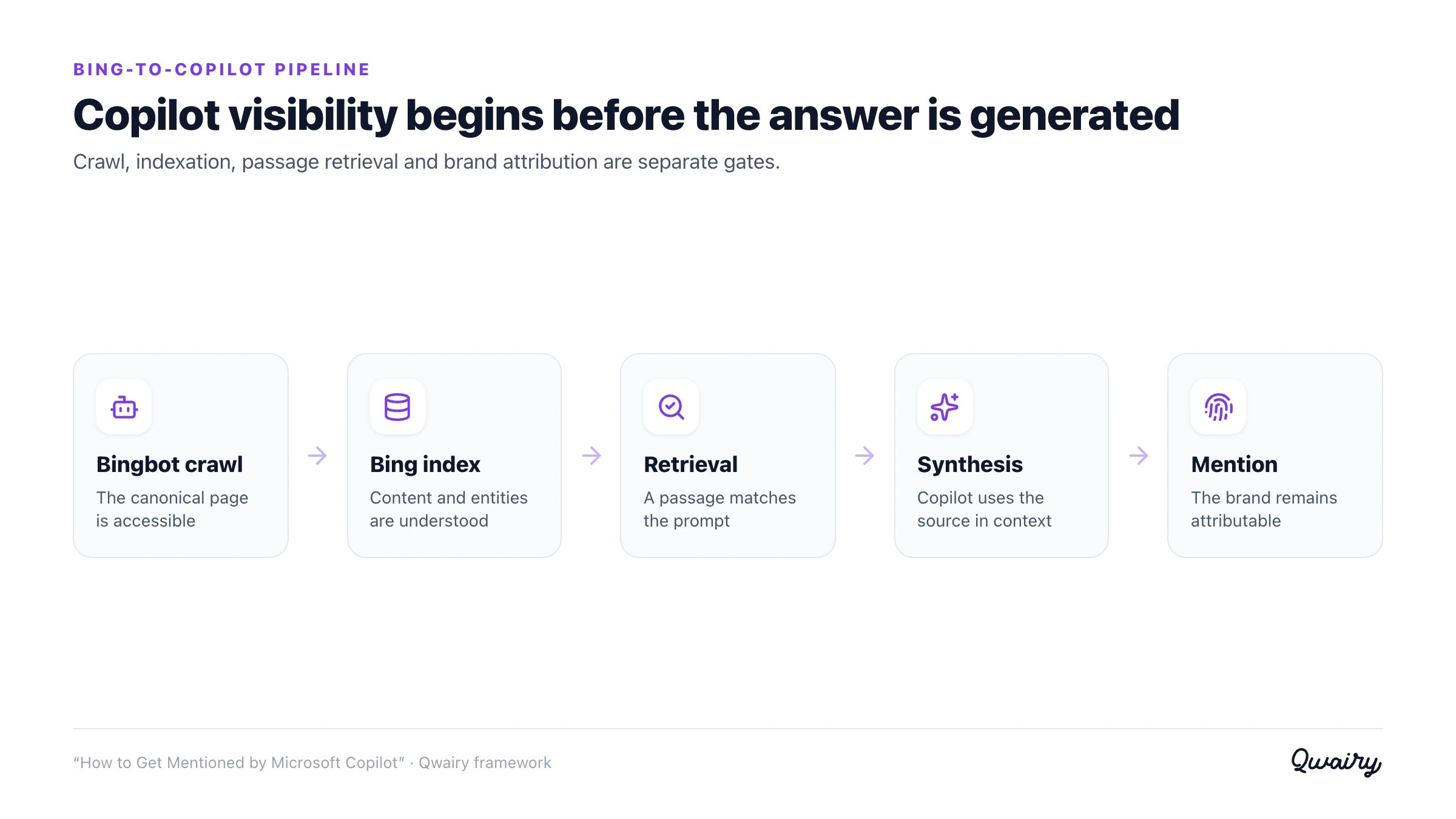
Copilot is two systems working together: a large language model and a live search layer. The language model - built on OpenAI's GPT family through Microsoft's partnership with OpenAI - handles reasoning and phrasing. But for anything current, specific, or factual, Copilot doesn't rely on the model's memory. It runs a search, retrieves web pages, and grounds its answer in what it finds, then shows numbered citations linking back to those pages. That grounding step is the whole opportunity. The search layer behind Copilot is Bing. Copilot queries Bing's web index, pulls a set of candidate results, and synthesizes an answer from them - much the way a person would skim the top results and write a summary. If a page isn't in Bing's index, or ranks poorly for the query Copilot runs, it can't be part of that summary. So the mental model is simple:
Every one of those steps is downstream of your Bing presence. That's why "getting mentioned by Copilot" is, in practice, mostly "being the kind of page Bing ranks and Copilot finds easy to quote."
Optimizing for Copilot is optimizing for Bing - with a bonus. Bing has often been treated as an afterthought behind Google, but Copilot has made its index strategically important again. And the payoff can compound: ChatGPT search has historically leaned on Bing's index for part of its web grounding, so work that improves your Bing visibility can pay off across more than one assistant. The practical implication is that you don't need a mysterious new "Copilot SEO" discipline. You need solid Bing fundamentals plus content that's easy for a model to extract and quote.
Bing is a separate search engine with its own index, crawler, and ranking signals - you can't assume your Google performance carries over. Many teams have never once checked how they rank in Bing. If that's you, you may be invisible to Copilot without realizing it. A few things to keep in mind about Bing specifically:
Bing runs its own crawler, bingbot. If bingbot can't reach or render your pages, you won't be indexed - full stop.
Bing's ranking emphasis differs from Google's. Bing has historically leaned more on exact-match relevance, clear on-page signals, and established domain authority. Clean, well-structured pages tend to do well.
Bing has its own webmaster ecosystem. Bing Webmaster Tools is the equivalent of Google Search Console, and it's where you'll submit sitemaps, inspect indexing, and read performance data.
Structure matters just as much as ranking. Copilot has to lift an answer out of your page. Content written as one long, undifferentiated wall is hard to extract. Content organized as clear questions and direct answers, short paragraphs, lists, and tables is easy to quote - which makes it more likely to be the passage Copilot pulls.
Run a free audit: see if ChatGPT, Gemini and Copilot recommend you, in about a minute.
Here's the concrete workflow, from "not indexed" to "cited and tracked." Work through it in order; the early steps are prerequisites for the later ones.
robots.txt isn't blocking bingbot, and make sure important content isn't hidden behind heavy client-side rendering that crawlers may not execute. If a bot can't see the content, it can't be grounded on it.##/### headings phrased the way people ask questions, keep paragraphs tight, and use bulleted lists and comparison tables. This is the single highest-leverage thing you can do to make a passage quotable.Organization and sameAs for entity clarity, plus Article, FAQPage, HowTo, Product, and Breadcrumb where relevant. Structured data helps engines understand what your page is about and which entity it belongs to.nocache and noarchive. Most brands want to be included, so the default of doing nothing is usually correct - but it's worth knowing the controls exist.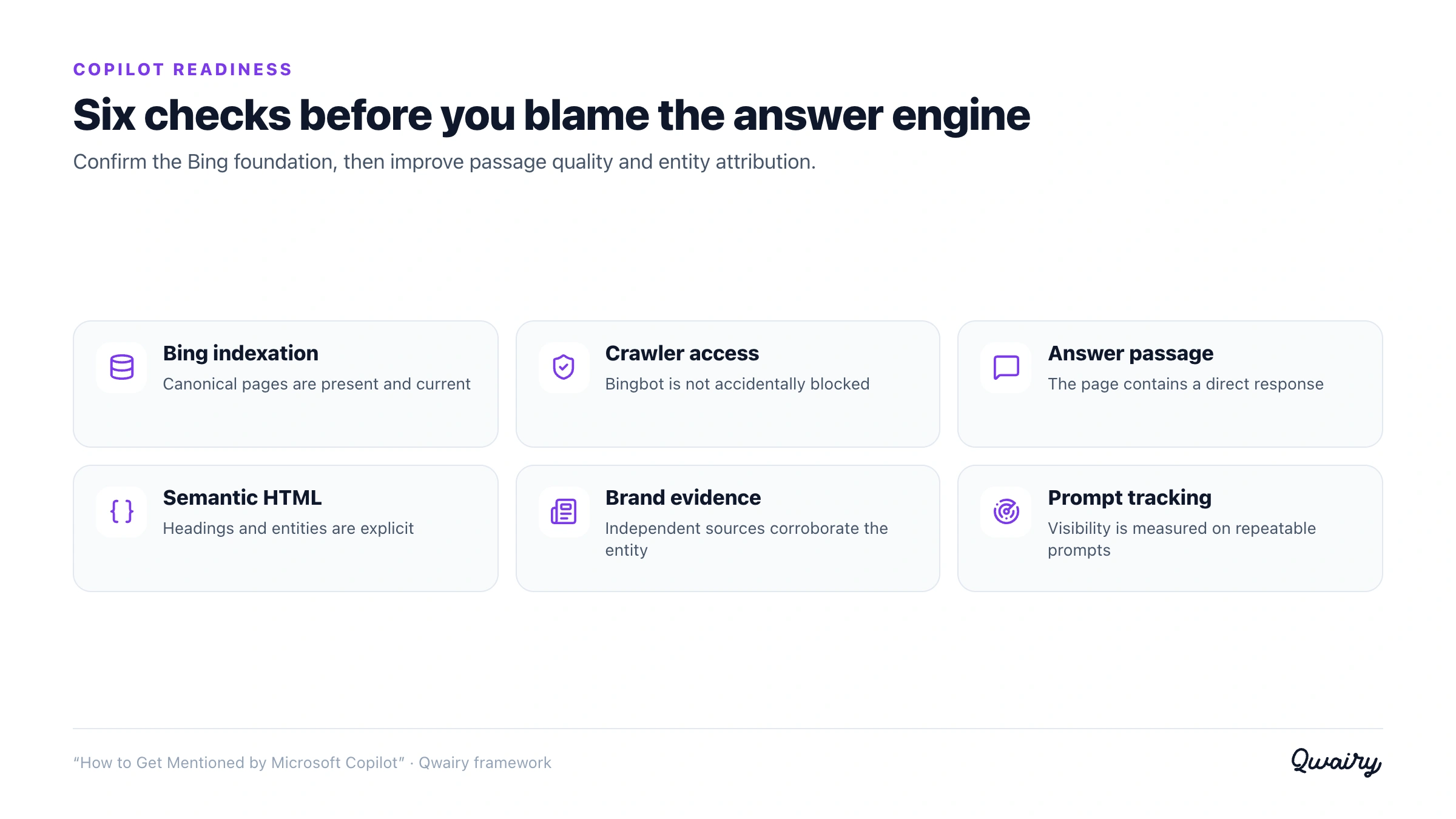
Run this quick audit before you publish anything you want Copilot to cite.
Site verified in Bing Webmaster Tools, sitemap submitted
Key pages confirmed indexed in Bing
IndexNow enabled for instant updates
bingbot not blocked; content visible without JS execution
Page ranks (or is realistically ranking) for its target question in Bing
Answer-first structure: question-style headings, concise answers, lists/tables
Relevant schema.org markup in place and validated
Consistent brand/entity details and credible off-site mentions
A visible freshness date, and content that is genuinely current
See your mentions across ChatGPT, Claude and Perplexity in real time, the moment buyers ask.
You can't improve what you don't measure - and eyeballing Copilot manually doesn't scale. Typing a few prompts into Copilot and screenshotting the result tells you almost nothing reliable: answers are non-deterministic, they vary by user, region, and session, and they shift as the index updates. One good answer today isn't a trend. Start with the fundamentals you can see directly. Bing Webmaster Tools shows your Bing impressions, clicks, and average position - a leading indicator, because pages that don't rank in Bing rarely get grounded by Copilot. Track those numbers the way you'd track Search Console. But Bing rankings are a proxy, not the real thing. What you ultimately care about is: for the questions my buyers ask, does Copilot mention or cite my brand - and how does that compare to competitors? Answering that at scale means running a consistent set of prompts across engines on a schedule and measuring your mention rate, citation share, and which of your pages get pulled. That's exactly what an AI visibility platform is for. Qwairy tracks brand presence and citations across the major AI engines, shows which sources they pull from, and lets you compare your share of voice against competitors over time - so Copilot visibility becomes a metric you manage rather than a thing you occasionally check. For more on how citations work across different assistants, see the Qwairy blog .
Extend the Copilot playbook: Apply the cross-engine citation framework , audit crawlability with the technical GEO checklist , and improve retrieval paths through site architecture for AI .
Getting mentioned by Microsoft Copilot isn't a dark art. Copilot grounds its answers in Bing, so the levers are the ones you can already pull: be indexed and discoverable in Bing, rank for the questions your audience asks, structure content so a model can lift a clean answer out of it, and back it all with consistent authority and entity signals. Do that, keep the content fresh, and measure your presence systematically instead of guessing. The brands that treat Bing and Copilot as first-class - not a Google afterthought - are the ones that show up when a buyer asks Copilot what to choose.
Yes. Copilot pairs an OpenAI language model with a live search layer, and that search layer is Bing. When you ask Copilot something current or factual, it runs Bing searches, retrieves top results, and grounds its answer in them, citing the pages it used. That is why your Bing presence is the primary lever for being mentioned.
It builds on the same foundation. You still need to be crawlable, indexed, and ranking - just in Bing, which many teams neglect. The Copilot-specific layer is making content easy to extract: answer-first structure, question-style headings, concise passages, lists, tables, and clean structured data so a model can quote you accurately.
Verify your site in Bing Webmaster Tools and submit a sitemap; if you use Google Search Console, you can import directly. Then enable IndexNow, the Microsoft-backed protocol that pings search engines the moment you publish or update a page, so new content gets discovered without waiting for the next crawl.
Microsoft has published guidance on influencing how your content is used in Bing's generative experiences through meta directives, and standard robots.txt rules govern crawling. In practice most brands want to be included, so the usual goal is the opposite - making sure nothing accidentally blocks Copilot from seeing and citing you.
Not necessarily. Copilot grounds in Bing, and Bing has its own index, crawler, and ranking signals. Strong Google performance often correlates with the underlying quality Bing also rewards, but you should verify your Bing rankings and indexing separately rather than assume they carry over.
Manual checks are unreliable because answers vary by user, region, and session. Use Bing Webmaster Tools for ranking signals, then use an AI visibility platform to run a consistent prompt set across engines on a schedule - measuring your mention rate, citation share, and which pages get pulled, all compared against competitors.
Track your mentions across ChatGPT, Claude, Perplexity and all major AI platforms. Join 1,500+ brands monitoring their AI presence in real-time.
Free trial • No credit card required • Complete platform access
Other Articles
Answer Engine Optimization (AEO): The Complete 2026 Guide
A complete, practitioner-level guide to Answer Engine Optimization: what AEO is, how answer engines like ChatGPT, Perplexity and Google AI Overviews select and cite content, the core levers, a step-by-step workflow, and how to measure it.
How to Set Up AI Referral Tracking in GA4, Plausible and Matomo
Most analytics tools miss or misclassify AI referral traffic by default. This step-by-step guide shows you how to properly track visits from ChatGPT, Perplexity, Claude, Gemini, and other AI platforms in GA4, Plausible, and Matomo.