
Loading page
A practical, cross-engine playbook for earning citations from AI engines like ChatGPT, Perplexity, Gemini and Google AI Overviews. Learn how citations are chosen, the tactics that work across engines, and how to measure your citation share.

Search is no longer the only place buyers find you. A growing share of research now happens inside AI engines - ChatGPT, Perplexity, Google Gemini, Google's AI Overviews, and Microsoft Copilot - where the answer arrives pre-assembled and a handful of sources get the credit. When your brand is one of those cited sources, you win attention, trust, and referral traffic. When it isn't, you're invisible, even if you rank on page one. This is a different game from classic SEO. Ranking gets you into a list of blue links; getting cited gets you into the answer itself. The mechanics overlap with SEO, but the winning move is narrower: you have to be the passage an engine chooses to quote, paraphrase, or link when it composes a response. The good news is that the levers are learnable, and most of them transfer across engines. Retrieval and citation are converging on a few shared principles: be the clearest answer, be easy to extract, be a recognizable authority, and be referenced elsewhere. This playbook is the hub for that work. It covers how engines choose citations, the cross-engine tactics that move the needle, a checklist you can run this week, and how to measure your citation share so you know whether any of it is working. For engine-specific detail, we link out to dedicated guides at the end.
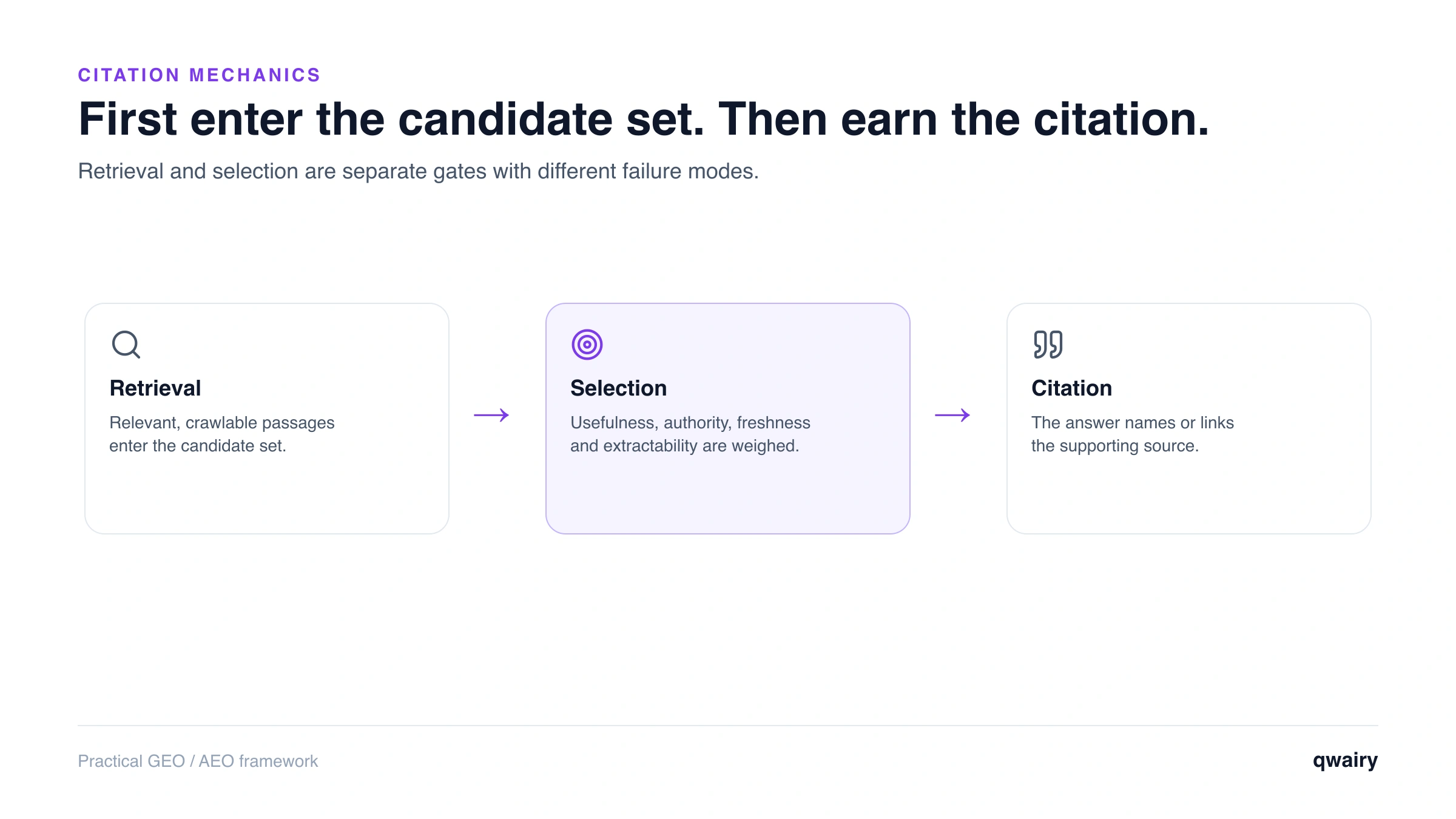
Citation is a two-stage process, and most content fails at the first stage. Whether an engine grounds its answer in live web results or in its training data, getting cited means clearing two hurdles: first being retrieved into the candidate set, then being selected into the final answer. Optimizing for one without the other wastes effort.
Retrieval is the filter that decides whether your page is even in the running. Most consumer AI engines that cite sources do so by running a search - sometimes their own index, sometimes a partner's - fanning a user's question out into multiple sub-queries and pulling back a set of candidate documents. This is often called "query fan-out," and it means a single user question can touch many more pages than a traditional search would.
To be retrievable you need the basics right: the page must be crawlable by the relevant AI user-agents, render its content in the initial HTML (most AI crawlers do not execute JavaScript the way Googlebot does), and be topically relevant to the sub-questions the engine generates. If you're blocked in robots.txt, hidden behind client-side rendering, or simply not indexed, you never enter the candidate set.
Once you're a candidate, the model decides which sources to actually quote or link. Selection favors content that directly and cleanly answers the specific sub-question, that reads as trustworthy, and that is easy to lift a self-contained passage from. Research on generative engines points in this direction: the academic paper that introduced the term "Generative Engine Optimization" (GEO, Aggarwal et al., arXiv ) found that adding clear citations, quotations, and relevant statistics to a source can meaningfully increase how often a generative engine surfaces it - while naive keyword stuffing did little. In practice, selection rewards the same things a good editor would: a crisp answer near the top, evidence, and authority signals the model can trust. That's why the tactics below cluster around clarity, structure, and credibility rather than tricks.
These five levers work across ChatGPT, Perplexity, Gemini, AI Overviews, and Copilot because they map to the retrieval-then-selection pipeline every citing engine shares. Prioritize them in order; the first two are within your control today.
Engines cite the source that answers the question most completely and directly. Start from the questions your buyers actually ask, in their words, and make sure a single page answers each one thoroughly. Thin, generic pages that skim ten subtopics lose to a focused page that fully resolves one.
Map the real questions (support tickets, sales calls, "People Also Ask," Reddit and community threads).
Give each meaningful question its own answerable page or clearly-headed section.
Answer first, elaborate second - lead with the direct answer, then add nuance.
Make it trivial for a model to lift a correct, self-contained passage. AI engines synthesize from snippets, so content that packages its answers into clean, quotable units gets pulled more often.
Use descriptive headings that match the question (## How much does X cost?).
Put a concise answer in the first sentence or two under each heading.
Use lists, tables, and step-by-step formats for comparisons and processes.
Add structured data (FAQPage, HowTo, Article, Organization) so the meaning is machine-readable.
Keep each passage self-contained - avoid answers that only make sense with the paragraph above.
Models lean on sources they can recognize and trust. Beyond the page, you're building an entity - a brand the engine understands as a distinct, credible thing. That comes from consistency and corroboration: consistent naming and descriptions across the web, an established author/expert behind the content, and presence in the knowledge sources engines rely on (Wikipedia, Wikidata, and authoritative citations - the degree of reliance varies by engine).
Demonstrate first-hand experience and expertise (the "E-E-A-T" idea, documented in Google's Search guidance ).
Keep your name, category, and description consistent everywhere you appear.
Claim and maintain your entity footprint (Wikidata, knowledge panel, authoritative profiles).
Run a free audit: see if ChatGPT, Gemini and Copilot recommend you, in about a minute.
What others say about you often matters more than what you say about yourself. Engines cross-reference the wider web, so being mentioned, reviewed, and linked by credible third parties raises your odds of being surfaced - sometimes those third-party pages get cited instead of you, which is still a win if they carry your brand.
Earn coverage in respected industry publications and get included in "best of" roundups.
Build a genuine presence where communities discuss your space (Reddit, forums, Q&A sites) - these are frequently retrieved, especially by Perplexity.
Pursue reviews, comparisons, and expert citations rather than low-quality link volume.
Freshness is a retrieval and trust signal, especially for engines that browse live. Answers to "best," "top," "2026," and "latest" queries change, and engines favor recently updated sources. Revisit cornerstone pages on a schedule, update dates and facts honestly, and prune content that has gone stale rather than letting it drag your credibility down.
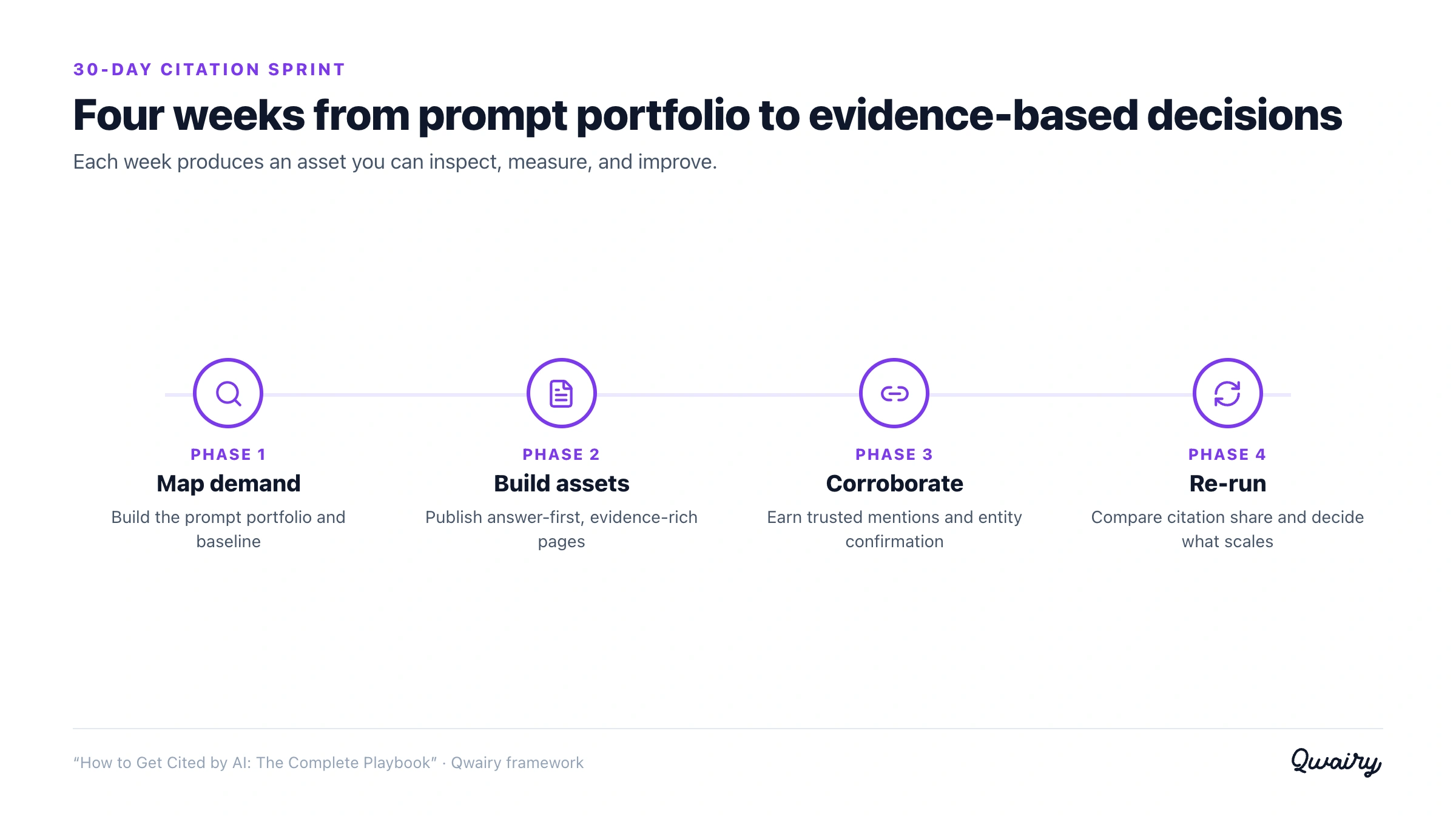
Use one month to produce a defensible baseline and one complete learning cycle.
Select priority prompts across category discovery, problems, comparisons, alternatives, and branded verification.
Record which engines mention the brand, cite the domain, cite competitors, or use third-party sources.
Map each prompt to one business intent and one target page.
A definition asset that resolves an important concept clearly.
A decision asset that compares options with explicit criteria and caveats.
An evidence asset that contributes original methodology, data, examples, or expert analysis.
Each asset must pass crawlability, answer extraction, source quality, entity attribution, and freshness checks before publication.
Strengthen internal links from the relevant topic hub.
Correct inconsistent brand facts across official profiles.
Earn legitimate third-party mentions where buyers and engines already look for evidence.
Verify retrieval-bot access without changing training policy by accident.
Measure mention rate, citation rate, cited URLs, source diversity, competitor share, and answer accuracy on the same prompt portfolio. Keep changes that improve the intended signal. Rewrite or stop tactics that produce no observable movement. The sprint's deliverable is not “more GEO activity.” It is a ranked backlog tied to specific prompts, pages, engines, and measured failure modes.
Run this checklist on any page you want cited. It sequences the levers above into a concrete audit you can complete in an afternoon.
robots.txt, unless you deliberately want them out.H1/H2 that mirror it.See your mentions across ChatGPT, Claude and Perplexity in real time, the moment buyers ask.
The playbook is shared, but each engine weights the levers differently. Use this table as a map, then go deep with the per-engine guides.
Engine | How it grounds answers | What that means for you |
ChatGPT | Training data plus live search (ChatGPT search) for current queries (OpenAI ) | Be both a recognizable entity and a fresh, retrievable source |
Perplexity | Retrieval-heavy, citation-dense by design | Freshness, structure, authority, and community presence matter most |
Google Gemini / AI Overviews | Tied to Google's index and ranking systems (Google ) | A strong classic-SEO base carries over directly |
Microsoft Copilot | Grounded largely in Bing's index | Bing SEO and structured content drive inclusion |
Claude | Parametric knowledge plus browsing/tools where enabled (including MCP) | Clear, authoritative, well-structured content travels well |
For engine-specific tactics and measurement, use the dedicated guides for ChatGPT , Perplexity , Google Gemini , Claude , and Microsoft Copilot .
If you can't measure citations, you can't improve them - and neither Search Console nor your analytics report them natively. The metric that matters is your citation share: how often each engine cites you (versus competitors) for the prompts your buyers actually ask. Measuring it means tracking a representative set of prompts across engines over time, recording which sources each answer cites, and attributing mentions to brands and domains. This is exactly what Qwairy is built for: it monitors your visibility and citations across ChatGPT, Claude, Perplexity, Gemini, and Google AI Overviews, breaks down which sources and domains the engines pull from, tracks competitors and sentiment, and connects it to AI-driven revenue - with an agent-native interface for querying it all. Start by defining your prompt set, baseline your current citation share, ship the checklist above, and watch whether the share moves. For more on the underlying concepts, see the Qwairy blog .
Apply the playbook engine by engine: Follow the dedicated guides for ChatGPT , Claude , Gemini , and Microsoft Copilot .
Getting cited by AI isn't a mystery, and it isn't a hack. It's the disciplined application of a few durable principles: answer real questions better than anyone, structure those answers so a model can lift them cleanly, build an authority and entity that engines recognize, earn corroboration from the wider web, and keep it all fresh. Do that, measure your citation share honestly, and iterate. The engines will keep changing; being the best, clearest, most credible answer will not go out of style.
It means an AI engine references your page or brand when it composes an answer - by quoting it, paraphrasing it, or linking it as a source. Unlike a classic search ranking, a citation puts you inside the answer the user reads, which drives trust and referral traffic even when the user never scrolls a list of links.
It overlaps but isn't identical. A solid SEO foundation - crawlability, relevance, authority - makes you retrievable, which is a prerequisite. But citation adds a selection step that rewards answer-first writing, extractable structure, and clear entity signals. Engines tied to Google's index (Gemini, AI Overviews) reward classic SEO most directly; retrieval-heavy engines like Perplexity weight freshness and structure heavily.
It varies by engine and topic. Engines that browse live (Perplexity, ChatGPT search, Copilot) can pick up a well-structured, authoritative page relatively quickly once it's indexed, while entity-level authority and knowledge-graph presence build over months. Treat it as an ongoing program, not a one-time fix, and measure the trend rather than any single answer.
No, and you shouldn't try to game it. There's no submission form and no guaranteed placement. What you can control is being the clearest, most credible, most extractable answer to the questions your audience asks - and being referenced by trustworthy third parties. Manipulative tactics tend to be short-lived and risk your credibility with both engines and readers.
Start where your audience actually is and where you can measure impact. For most B2B and consumer brands that means the engines with the largest reach and clearest measurement - typically ChatGPT, Perplexity, and Google's AI Overviews. Baseline your citation share across all of them first, then invest where you're weakest relative to competitors.
Track a fixed set of buyer-relevant prompts across engines on a recurring basis, record which sources each answer cites, and attribute those citations to brands and domains so you can compute your citation share over time. Because native tools like Search Console don't report AI citations, a dedicated AI-visibility platform such as Qwairy is the practical way to baseline and trend this.
Track your mentions across ChatGPT, Claude, Perplexity and all major AI platforms. Join 1,500+ brands monitoring their AI presence in real-time.
Free trial • No credit card required • Complete platform access
Other Articles
Answer Engine Optimization (AEO): The Complete 2026 Guide
A complete, practitioner-level guide to Answer Engine Optimization: what AEO is, how answer engines like ChatGPT, Perplexity and Google AI Overviews select and cite content, the core levers, a step-by-step workflow, and how to measure it.
How to Set Up AI Referral Tracking in GA4, Plausible and Matomo
Most analytics tools miss or misclassify AI referral traffic by default. This step-by-step guide shows you how to properly track visits from ChatGPT, Perplexity, Claude, Gemini, and other AI platforms in GA4, Plausible, and Matomo.