
Loading page
A practical guide to structuring your site so AI answer engines can find, extract, and attribute every page. Covers topic clusters, internal linking, URL and heading hierarchy, self-contained pages, and entity consistency.

For twenty years, SEO rewarded the whole domain: you built authority, climbed the rankings, and earned the click. AI answer engines work differently. ChatGPT, Claude, Perplexity, Gemini, and Google's AI Overviews don't rank your pages against ten blue links - they retrieve fragments of the web, weigh them, and synthesize a single answer. Your site is no longer a stack of pages competing for position. It's a database these systems query. That changes what "good architecture" means. A page can be genuinely excellent and still be invisible if a model can't reach it, can't isolate the passage that answers the question, or can't be sure the passage belongs to your brand. Structure - how pages connect, how URLs and headings are shaped, how self-contained each page is - decides all three. The goal of this article is to make every page on your site answerable: able to stand on its own as a complete, attributable answer to a specific question, reachable through clean links, and consistent with the rest of your site as a single entity. Below you'll get a working mental model of how AI reads a site, then the concrete levers - topic clusters, internal linking, URL and heading hierarchy, self-contained pages, and entity consistency - plus a checklist and a way to measure whether any of it is working.
AI answer engines don't browse your site the way a person does - they retrieve and recombine fragments of it. Most AI answers are produced by some form of retrieval: the engine pulls candidate passages from an index (its own, a partner's, or a live search), splits them into chunks, ranks those chunks for relevance, and feeds the best few into the model that writes the answer. Getting cited means clearing two separate gates.
The first gate is retrieval: can the engine find, fetch, and parse your content at all? That still depends on old-fashioned crawlability. Google's own guidance is blunt that it can only follow a link if it's a standard <a href> anchor element (Google Search Central ), and most AI crawlers are less capable than Googlebot, not more. If a page is orphaned, buried, or only assembled by client-side JavaScript, it may never enter the candidate pool.
The second gate is selection: given that your passage was retrieved, does the model choose to quote and attribute it? This is where structure and evidence matter. The Princeton-led "GEO: Generative Engine Optimization" study found that content-level optimizations - clearer structure, plus adding citations, quotations, and statistics - improved a source's visibility in generative-engine answers by up to roughly 40% for the best-performing methods (arXiv ). Architecture is what makes those well-structured, evidence-rich passages easy to isolate in the first place.
Optimize for the passage a model can lift out and quote, not just the page a human lands on. When an engine chunks your content, it doesn't reason about your beautiful full-page narrative - it grabs a few hundred words around the relevant heading. If that chunk only makes sense after reading the three sections above it, it's a weak candidate. If it answers the question completely on its own, it's a strong one. Practically, that means:
One clear idea per section. Each ## or ### block should resolve a single question so a chunk drawn from it is coherent in isolation.
Answer-first, then elaborate. Lead with the direct answer in the first sentence or two, then add nuance, caveats, and examples. Models (and skimming humans) reward the front-loaded answer.
Descriptive headings that name the question. "How AI crawlers handle JavaScript" beats "A closer look." The heading is often the strongest signal a retriever has about what a chunk is about.
Think of your page as a set of self-contained answer blocks stitched together, not one long essay that only works read top to bottom.
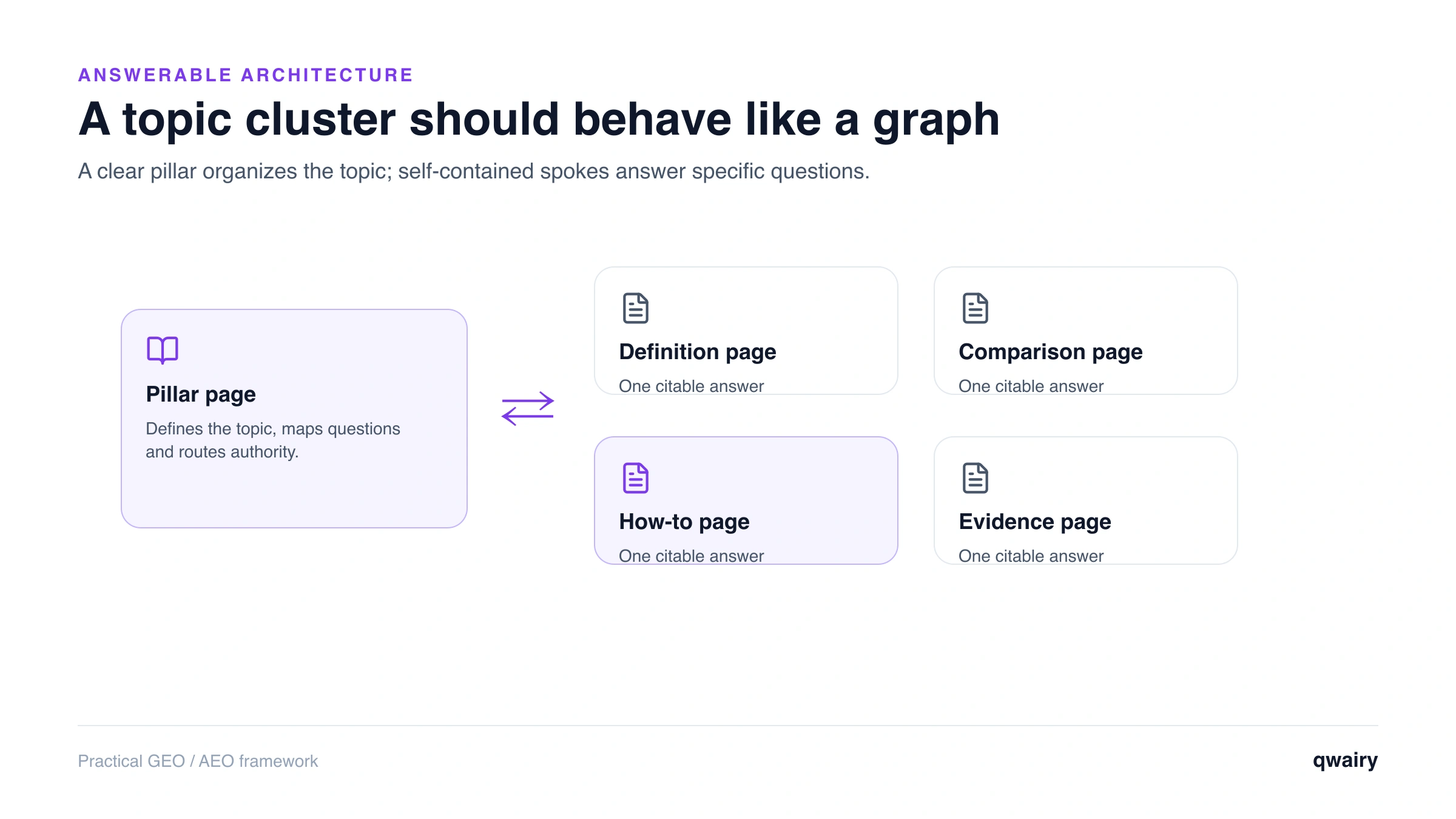
Group everything you publish into topic clusters so a model sees a coherent, authoritative body of work rather than scattered posts. The hub-and-spoke (or pillar-and-cluster) model organizes content around a central overview page linked to many focused subpages, which link back to the hub and to each other. It's the most durable way to signal topical depth to both search and AI systems (Ahrefs on topic clusters ).
The pillar is a broad, comprehensive overview of a topic you want to own - the page that defines terms, frames the problem, and points to everything more specific. It should read as the definitive starting point and link out to each spoke (Ahrefs on content pillars ). Pillars are natural citation targets when a model needs a general, authoritative source.
Spokes each answer one narrow question in depth - the long-tail, high-intent queries where AI answers are increasingly decisive. A cluster on "technical GEO" might have spokes on crawlers, rendering, structured data, and this very topic. Each spoke is a self-contained answer, and collectively they prove you cover the topic exhaustively.
Connect clusters as a web, not as sealed-off silos. Older "siloing" advice discouraged linking between sections; modern practice favors clusters that link to the pillar and laterally to related spokes, because that cross-linking passes context and authority where a strict silo would wall it off (Ahrefs on internal links ). A retriever that pulls one spoke can then follow contextual links to adjacent answers, which is exactly how multi-turn AI search (query fan-out) explores a topic.
Run a free audit: see if ChatGPT, Gemini and Copilot recommend you, in about a minute.
Internal links are how both crawlers and models discover related pages and understand how your ideas connect. They're the cheapest, most controllable architecture lever you have. A few rules that matter more for AI retrieval than for classic SEO:
Use real, crawlable anchors. Standard <a href> links only - not buttons, not JavaScript-only navigation an AI crawler won't execute.
Write descriptive anchor text. "Learn how AI crawlers render JavaScript" tells the machine what's on the other side; "click here" tells it nothing. Anchor text is a labeled edge in your site graph.
Link contextually, in the body. In-content links carry more meaning than footer or mega-menu links because they sit next to the concept they describe (Yoast ).
Eliminate orphan pages. A page with no internal links pointing to it may never be discovered. Every page should be reachable from at least one relevant hub.
Keep important pages shallow. If a key answer is five clicks from the homepage, treat that as a red flag. Flatter, well-linked structures are easier to crawl and retrieve.
Predictable URLs and a clean heading outline give machines a map of your site and of each page. Both are cheap to get right and expensive to fix later.
Google recommends a simple, logical URL structure that is readable to humans, warning that overly complex, parameter-heavy URLs create crawling problems (Google Search Central ). For AI-friendliness:
Make URLs readable and descriptive - /geo/site-architecture beats /p?id=8842.
Reflect the cluster hierarchy in the path (/topic/subtopic) so structure is legible from the URL alone.
Keep URLs stable; when you must change one, redirect the old path so accumulated authority and any existing citations survive.
Maintain an XML sitemap and keep lastmod accurate so engines can find new and updated pages efficiently (Google Search Central ).
Use exactly one <h1> per page that states the page's core question, then nest ## and ### in true outline order - don't skip levels for styling. A correct heading tree is a machine-readable table of contents; it's how a retriever decides which chunk of your page maps to which sub-question. Phrase headings the way people ask, so a heading can double as the query it answers.
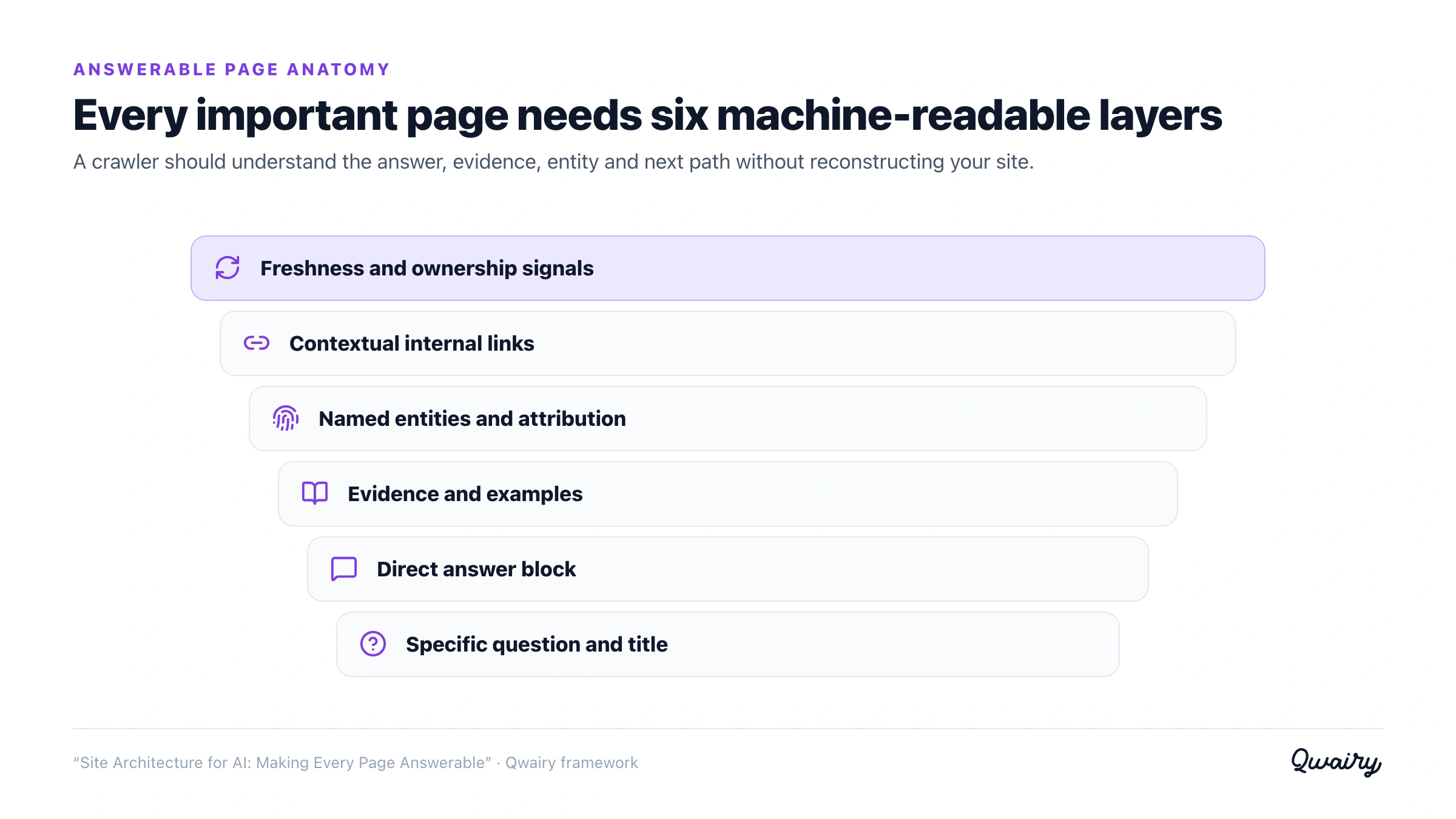
Assume a model will encounter one page - or one section - with zero context from the rest of your site. This is the single biggest mindset shift. In a ranked list, a page could rely on the surrounding site to make sense. As a retrieved passage, it can't. To make a page answerable in isolation:
Define your terms and name the entity on the page. Don't assume the reader (or model) already knows what your product is or which company you are.
Avoid context-dependent phrasing like "as we saw above" or "in the previous post" inside a section meant to stand alone.
State the who and what once, clearly. A passage that says "the platform tracks brand visibility across AI engines" is attributable; one that just says "it does this automatically" is not.
Back claims with evidence. Concrete statistics, quotations, and cited sources make a passage both more useful and more likely to be selected - the GEO study is direct evidence that this lifts citation rates (arXiv ). Flag anything you can't verify rather than inventing a number.
A self-contained page is, by definition, an answerable one.
A model has to be confident that "you" on page A are the same entity as "you" on page B before it will attribute an answer to your brand. Fragmented naming and identity are a quiet reason brands get under-cited or misattributed.
Use one canonical brand name and spelling everywhere - no drift between "Qwairy", "Qwairy.co", and "the Qwairy app."
**Add Organization structured data with **sameAs linking your official profiles (LinkedIn, Crunchbase, Wikidata, etc.), which is Google's documented way to give machines explicit clues about an entity (Google Search Central ).
Keep author and company identity consistent across bylines, about pages, and schema so your expertise consolidates on one entity rather than scattering.
Point every cluster back to a canonical "who we are" page so there's a single authoritative node describing the entity the rest of the site orbits.
Entity consistency turns a pile of pages into one recognizable source - the prerequisite for being cited by name.
See your mentions across ChatGPT, Claude and Perplexity in real time, the moment buyers ask.
Run this checklist against any site you want AI engines to read, extract, and attribute.
<a href> links, present in an XML sitemap, and not blocked in robots.txt for the AI crawlers you want.sameAs structured data tying the site to one recognizable entity.lastmod and visible dates so engines know it's current.Architecture changes are invisible unless you track whether AI engines start finding, quoting, and attributing your pages. Rankings won't tell you; you need visibility into AI answers directly. That's the layer Qwairy is built for: it tracks how your brand appears across ChatGPT, Claude, Perplexity, Gemini, and Google AI Overviews, which of your URLs get cited as sources, how AI crawlers are actually hitting your site, and how you compare to competitors - with an agent-native MCP so your own tools can query the same data. When you restructure a cluster or fix an orphan, that's how you see whether retrieval and citations respond. For more on the underlying tactics, the Qwairy blog goes deeper on each lever.
Complete the architecture layer: Audit the full stack with the technical GEO checklist , verify JavaScript rendering for AI crawlers , and make every passage answerable with the GEO content optimization guide .
AI search rewards sites that are easy to disassemble: reachable pages, self-contained passages, clean URLs and headings, a coherent cluster graph, and one consistent entity behind all of it. None of this is exotic - it's disciplined information architecture pointed at a new consumer. Make every page able to answer one question on its own, wire the pages together so machines can navigate the relationships, and be unmistakably one brand throughout. Do that, and you stop hoping to rank and start being the answer.
Both, and they're inseparable. Great content that a model can't crawl, can't isolate into a clean passage, or can't confidently attribute to your brand won't get cited. Architecture is what lets your content quality actually reach the answer. Think of content as the substance and architecture as the delivery mechanism.
A self-contained page answers a specific question completely on its own, without depending on other pages or earlier sections for context. It defines its terms, names the entity involved, leads with the direct answer, and backs claims with evidence. Because AI engines retrieve and quote passages rather than whole sites, this isolation is what makes a page quotable.
Use topic clusters, not rigid silos. Both organize content around themes, but strict silos forbid linking between sections, which cuts off useful context and authority. Clusters link a pillar page to focused spokes and let related spokes link to each other, giving AI systems a connected map of your expertise to traverse.
They rely on links to discover pages, but most are less capable than Googlebot - many don't execute JavaScript and won't follow links that aren't standard <a href> anchors. That makes crawlable HTML links, descriptive anchor text, and the absence of orphan pages more important for AI than for traditional SEO, not less.
There's no magic number - link wherever it genuinely helps a reader or a machine understand a related concept, using descriptive anchor text. The failure modes are the extremes: an orphan page with no inbound links may never be discovered, while a page stuffed with dozens of low-relevance links dilutes the signal each one carries. Prioritize relevance over volume.
Track AI-specific signals rather than classic rankings: whether your pages appear and get cited in ChatGPT, Perplexity, Gemini, and Google AI Overviews, which URLs are used as sources, and how AI crawlers are accessing your site. Platforms like Qwairy monitor this across engines so you can tie an architecture change to a measurable shift in retrieval and citations.
Track your mentions across ChatGPT, Claude, Perplexity and all major AI platforms. Join 1,500+ brands monitoring their AI presence in real-time.
Free trial • No credit card required • Complete platform access
Other Articles
Answer Engine Optimization (AEO): The Complete 2026 Guide
A complete, practitioner-level guide to Answer Engine Optimization: what AEO is, how answer engines like ChatGPT, Perplexity and Google AI Overviews select and cite content, the core levers, a step-by-step workflow, and how to measure it.
How to Set Up AI Referral Tracking in GA4, Plausible and Matomo
Most analytics tools miss or misclassify AI referral traffic by default. This step-by-step guide shows you how to properly track visits from ChatGPT, Perplexity, Claude, Gemini, and other AI platforms in GA4, Plausible, and Matomo.