Loading page

A practical, evidence-based guide to JSON-LD for AEO: what schema can and cannot do, the types that matter, implementation examples, validation, and measurement.
Search is splitting in two. On one side, the classic list of blue links. On the other, answer engines — ChatGPT, Claude, Perplexity, Gemini, Google's AI Overviews — that read the web, synthesize an answer, and cite a handful of sources. Answer Engine Optimization (AEO) is the discipline of being one of those cited sources. Every AEO checklist eventually lands on the same line item: "add schema markup." And every honest practitioner has the same reaction — does it actually work, or is it SEO theater? This guide gives you a straight answer. We'll separate what structured data provably does from what vendors wish it did, walk through the schema types that carry real weight for machine understanding, show short JSON-LD you can adapt, and cover how to validate it. Then we'll connect the work to the only thing that matters: whether your citations across AI engines actually go up. No hype. Schema is a cheap, high-clarity investment — as long as you know what you're buying.
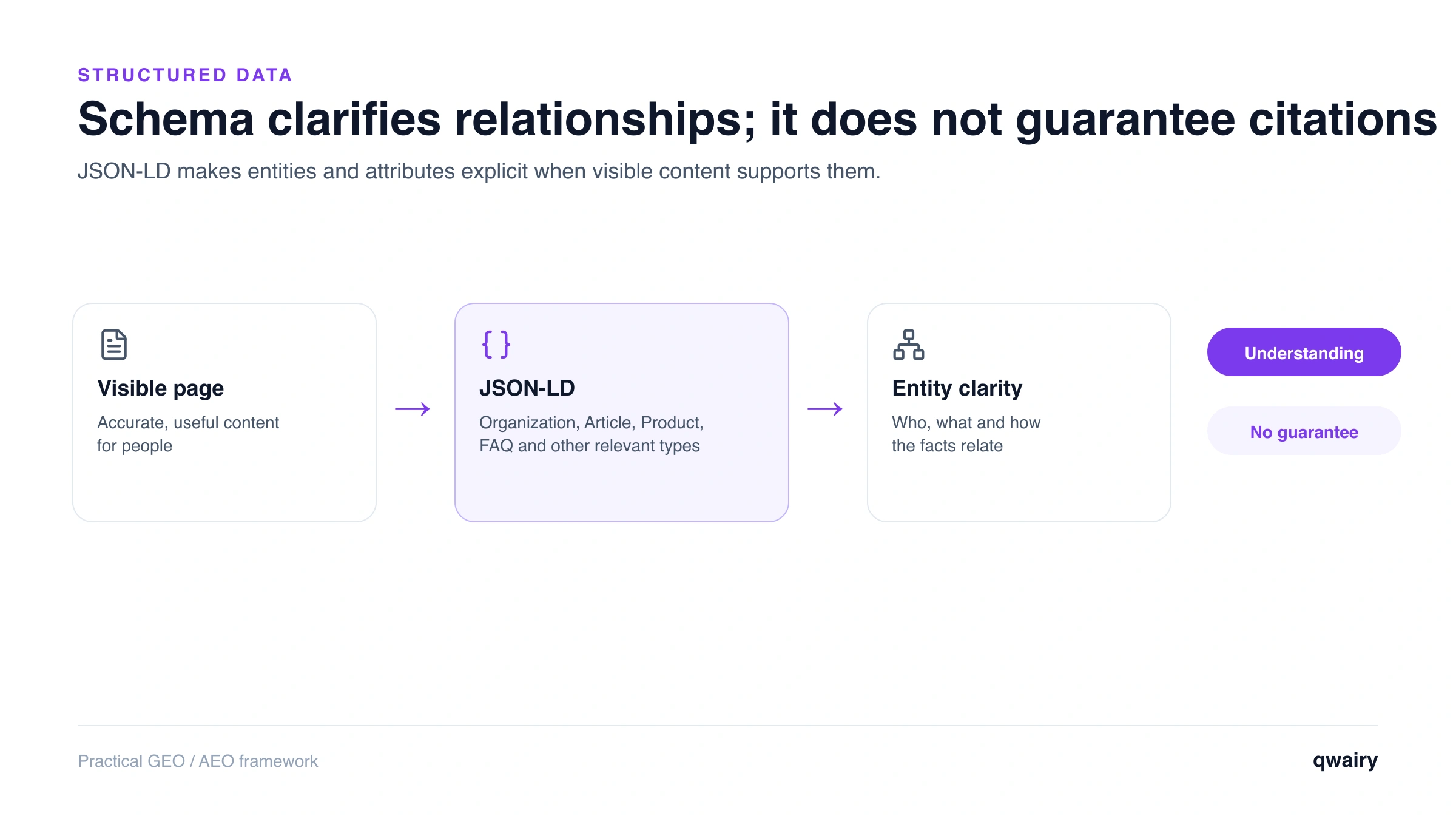
Start with the fact Google has stated plainly: structured data is not a ranking factor. Google's John Mueller has repeatedly said structured data won't make a page rank better; it makes a page eligible for search features and helps Google understand the content (Search Engine Journal ). The common analogy: structured data is the directions to the party, not the invitation. It gets you in the door for rich results — it doesn't earn the spot. That distinction matters even more for AEO, because AI answer engines don't work like the rich-results pipeline at all. Large language models mostly consume rendered text. When an engine like Perplexity or an AI Overview picks sources, it's weighing relevance, authority, and how cleanly it can extract a supported claim — not counting your JSON-LD blocks. So does schema help AI citations? The honest answer is: indirectly, and modestly. Structured data does three things that align with how answer engines choose sources:
Entity clarity. Organization, Person, and Product markup state unambiguously who and what a page is about, and link entities to known identifiers (via sameAs). That reduces the disambiguation an engine has to guess at.
Relationship structure. Markup encodes author, publisher, date, price, and hierarchy as explicit key-value pairs instead of leaving a model to infer them from layout.
Knowledge-graph feeding. Clean entity data has long fed Google's Knowledge Graph, which in turn informs AI Overviews. The exact weight of structured data in AI Overview source selection is not publicly documented.
Here's the part most posts skip: you will find blog posts claiming schema gives you "3.2x more citations" or "40% more AI Overview appearances." Treat those numbers as marketing, not evidence. They rarely come from controlled studies, and no major engine has published a direct schema-to-citation multiplier. Both Google and Microsoft describe structured data as one signal among many for search and AI features — which is very different from a guaranteed lever. The pragmatic takeaway: schema markup is a low-cost way to remove ambiguity for machines. It won't rescue thin content, and it isn't a citation cheat code. But when two comparable pages compete to be the cited source, the one that hands machines a clean, structured description of itself is easier to trust and quote. That's reason enough to do it well.
You don't need forty schema types — you need six done correctly. Prioritize the ones that establish identity, attribution, and structure.
This is the foundation. Organization markup (ideally on your homepage or a global template) tells engines your brand's canonical name, logo, and official profiles. The sameAs array is the key field: it links your brand to authoritative external references, which is exactly the kind of entity disambiguation answer engines rely on.
{
  "@context": "https://schema.org",
  "@type": "Organization",
  "@id": "https://www.example.com/#organization",
  "name": "Example Co",
  "url": "https://www.example.com",
  "logo": "https://www.example.com/logo.png",
  "sameAs": [
    "https://www.linkedin.com/company/example-co",
    "https://en.wikipedia.org/wiki/Example_Co"
  ]
}
Attribution is a trust signal. Article or BlogPosting markup states who wrote a piece, who published it, and when — the provenance an answer engine wants before quoting a claim. Keep dateModified honest and current; freshness is one of the more credible differentiators in AI source selection.
{
  "@context": "https://schema.org",
  "@type": "BlogPosting",
  "headline": "Schema Markup for AEO: A Practical JSON-LD Guide",
  "author": { "@type": "Person", "name": "Luca Fancello" },
  "publisher": {
    "@type": "Organization",
    "name": "Example Co",
    "logo": { "@type": "ImageObject", "url": "https://www.example.com/logo.png" }
  },
  "datePublished": "2026-01-12",
  "dateModified": "2026-08-02",
  "mainEntityOfPage": "https://www.example.com/blog/json-ld-schema-guide-for-ai-citations"
}
Run a free audit: in a few minutes, ChatGPT, Gemini and Perplexity answer 8 buying questions about your market live, and you see who they recommend.
Read this before you rip out your FAQ schema. In August 2023 Google limited FAQ rich results to authoritative government and health sites and deprecated HowTo rich results (Google Search Central ), and Google has since wound the FAQ feature down further (Search Engine Journal ). But "no rich result" is not "no value." FAQPage markup still encodes clean question-and-answer pairs — precisely the shape answer engines extract when responding to a query. Valid schema.org markup stays machine-readable whether or not Google paints a visual widget. Use it where you genuinely have Q&A content; don't stuff it to game a feature that no longer exists.
{
  "@context": "https://schema.org",
  "@type": "FAQPage",
  "mainEntity": [
    {
      "@type": "Question",
      "name": "Does schema markup improve AI citations?",
      "acceptedAnswer": {
        "@type": "Answer",
        "text": "It clarifies entities and relationships for machines, but it is not a guaranteed citation lever."
      }
    }
  ]
}
Same story as FAQ. HowTo rich results were deprecated, so don't expect the stepped visual treatment in Google. The structured representation of an ordered process still communicates step semantics to any parser that reads it. If you publish genuine step-by-step content, the markup is cheap to keep — just don't count on a SERP feature.
For commerce, Product markup is non-negotiable. It exposes price, currency, availability, and brand as explicit fields — the attributes shopping-oriented AI experiences read. Always set priceCurrency correctly (here, EUR) and keep availability in sync with reality.
{
  "@context": "https://schema.org",
  "@type": "Product",
  "name": "Example Widget",
  "description": "A durable stainless-steel widget.",
  "brand": { "@type": "Brand", "name": "Example Co" },
  "offers": {
    "@type": "Offer",
    "price": "49.00",
    "priceCurrency": "EUR",
    "availability": "https://schema.org/InStock",
    "url": "https://www.example.com/products/example-widget"
  }
}
Breadcrumbs are underrated. BreadcrumbList markup tells engines where a page sits in your hierarchy, which helps them understand topical context and the relationships between pages. It's small, stable, and worth templating site-wide.
{
  "@context": "https://schema.org",
  "@type": "BreadcrumbList",
  "itemListElement": [
    { "@type": "ListItem", "position": 1, "name": "Blog", "item": "https://www.example.com/blog" },
    { "@type": "ListItem", "position": 2, "name": "Schema Markup for AEO", "item": "https://www.example.com/blog/json-ld-schema-guide-for-ai-citations" }
  ]
}
Most schema problems aren't exotic — they're the same handful of errors, repeated. Watch for:
Markup that contradicts the page. The number-one rule from Google: structured data must match visible content. A price or rating in JSON-LD that doesn't appear on the page is a spam signal, not a shortcut.
Using JSON that never renders. If your schema is injected by a script an AI crawler doesn't execute, it may never be seen. Prefer server-rendered JSON-LD in the page source, since crawler JavaScript execution varies by engine and most AI crawlers do not execute it at all.
Orphan entities. An Organization here, an Article there, none referencing each other. Use @id and properties like publisher and author to connect nodes into one coherent graph.
Marking up features that no longer exist. Adding elaborate FAQ/HowTo schema expecting rich results you won't get. Keep it only for real semantic value.
Stale data. dateModified, price, and availability that drift from reality erode the trust the markup is supposed to build.
Required-field gaps. Missing recommended properties (logo, image, author) that make the entity harder to resolve.
Check your robots.txt rules, llms.txt and sitemap signals for AI crawlers before rewriting a single page.
Never ship schema you haven't validated — two free tools cover it. Run both, because they answer different questions.
A checklist before publishing:
Valid JSON-LD syntax (no trailing commas, correct nesting).
Every claim in the markup appears in visible content.
Entities reference each other into a connected graph.
Currency in EUR, with prices and availability current.
datePublished / dateModified accurate.
Validation is necessary but not sufficient. Ship schema only when all eight checks pass:
@id values rather than disconnected duplicates.url, mainEntityOfPage, breadcrumbs, images, and offers resolve to the intended canonical resources.datePublished preserves history and dateModified changes only after a substantive update.Roll out material schema changes to a small page cohort first. Save the validation output, crawl state, rich-result eligibility, and AI citation baseline. Expand only after the data remains accurate and the deployment creates no duplicate entities, broken canonicals, or contradictory offers. This gate is deliberately stricter than “zero syntax errors.” A valid graph that describes the wrong thing is worse than no graph because it creates machine-readable misinformation.
Schema is an input. Citations are the output — and you should measure the output, not assume the input worked. The whole reason to be skeptical of "schema boosts citations by X%" claims is that almost nobody instruments the result. You can. Ship your structured data, then track whether your brand's presence and citations across ChatGPT, Claude, Perplexity, Gemini, and Google AI Overviews actually move — and which sources those engines quote when they mention you. That's what Qwairy is built for: AI visibility tracking across the major engines, citation and source intelligence, competitor monitoring, and sentiment — so you can tell whether a schema rollout, a content change, or a PR push is what shifted your citations. For teams that want to pull this into their own workflows, an agent-native MCP is available. More playbooks live on the complete AEO guide . Treat schema as a hypothesis: "cleaner entity data should make us easier to cite." Then let the data confirm or kill it.
Connect schema to the wider program: Use the complete AEO guide , strengthen brand identity with entity SEO for AI , and validate crawlability with the technical GEO checklist .
Schema markup for AEO is worth doing — just for the right reasons. It isn't a ranking factor and it isn't a citation cheat code. It's a low-cost way to hand machines an unambiguous description of who you are, what you published, and how your pages relate. In a world where answer engines synthesize and cite, that clarity is a quiet advantage. Implement the six types that matter, validate them, keep them honest and current — and then measure whether your AI citations actually move. Let the numbers, not the hype, tell you what worked.
No. Google has stated structured data is not a direct ranking factor for classic search, and no major AI engine has confirmed it as a direct citation lever. It aids machine understanding and eligibility for features, which can indirectly support visibility, but it won't lift weak content on its own.
Organization markup, sitewide. It establishes your brand's canonical identity and links to authoritative profiles via sameAs, which is the entity clarity answer engines lean on. Add Article/BlogPosting next for content attribution.
Often, yes — for the semantics, not the widget. Google limited and later wound down FAQ rich results, but the markup still encodes clean question-answer pairs that machines can read. Use it where you have genuine Q&A content; don't add it just to chase a feature that's gone.
JSON-LD. Google recommends it, it's the easiest to maintain (a single script block, separate from your HTML), and it's the most widely supported. Keep it in the server-rendered source so crawlers reliably see it.
Validate syntax with Google's Rich Results Test and the Schema.org validator, confirm parsing in Search Console — then measure the outcome. Track your citations and visibility across AI engines (for example with Qwairy) before and after the change to see real impact.
Yes, if it's inaccurate. Markup that contradicts visible content or describes things not on the page can be treated as spam. Mark up what's genuinely there, keep it current, and don't invent structure to game deprecated features.
Track the questions that matter to your business, see which brands each answer mentions and which sources it cites, then work on the gaps.
Free plan with 120 initial credits • No credit card required
Other Articles
Answer Engine Optimization (AEO): The Complete 2026 Guide
A complete, practitioner-level guide to Answer Engine Optimization: what AEO is, how answer engines like ChatGPT, Perplexity and Google AI Overviews select and cite content, the core levers, a step-by-step workflow, and how to measure it.
How to Set Up AI Referral Tracking in GA4, Plausible and Matomo
Most analytics tools miss or misclassify AI referral traffic by default. This step-by-step guide shows you how to properly track visits from ChatGPT, Perplexity, Claude, Gemini, and other AI platforms in GA4, Plausible, and Matomo.