
Loading page
Qwairy maps when ChatGPT Shopping appears across 100,000+ monitored runs. A matched test found appearance rates ranging from 21.7% to 96.7%.

ChatGPT Shopping does not begin with a product ranking. It begins with a decision: should Shopping appear at all? Qwairy combined a monitoring panel of more than 100,000 completed ChatGPT runs with a balanced matched test. The panel spans tens of thousands of distinct prompt texts, hundreds of brands, 15 configured language locales and 33 countries. In the matched test, Shopping cards appeared in 21.7% of informational scenarios, compared with 95% of recommendation scenarios and 96.7% of “where to buy” scenarios. The category and use case stayed matched; the requested task changed. From there, we traced the observable sequence: query reformulation, sources, product-specific lookups, product ranking and merchant ranking.
11.2% at scale: Shopping appeared in 11.2% of 100,000+ monitored runs; the panel was not balanced by intent, language or geography.
21.7% to 96.7%: commercial framing materially changed how often Shopping appeared in the matched test.
69.8% added “best”: captured queries introduced “best” or equivalent product-selection language absent from the original prompt.
9 domains either way: matched-test responses had the same median source breadth with and without Shopping.
4 product lookups: once Shopping appeared, the median observable response contained four queries for named products.
42.7% mixed outcomes: the same prompt produced both Shopping and non-Shopping results across repeated runs.
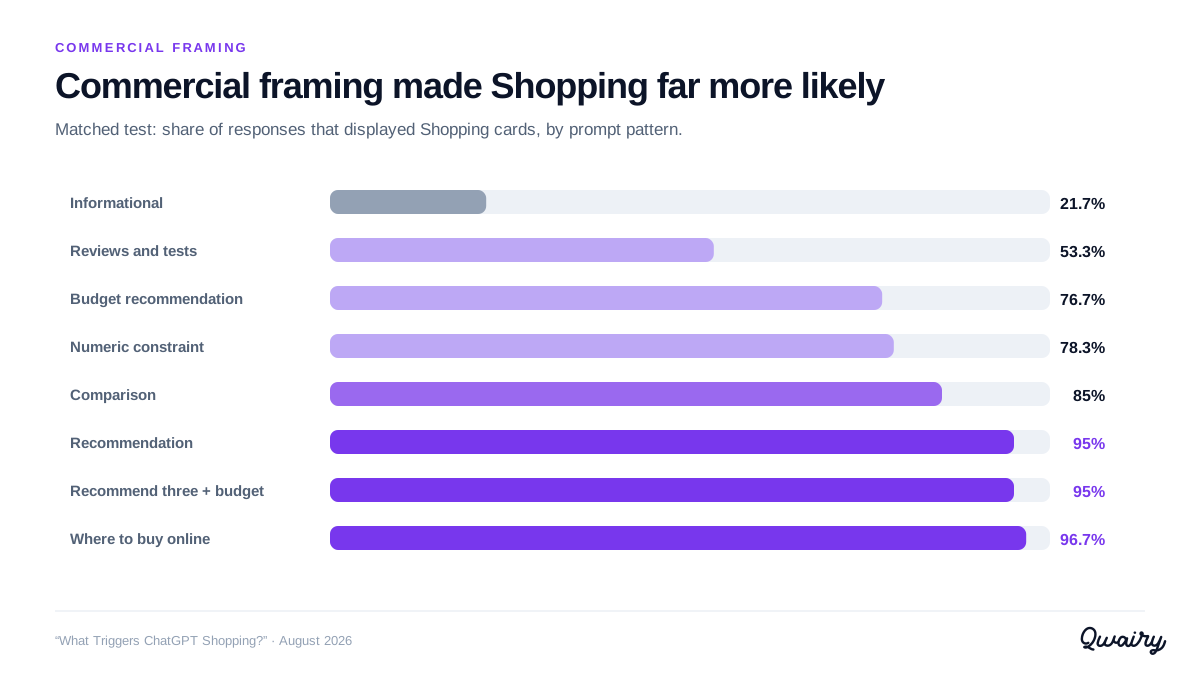
Matched test; the broader monitoring panel is analyzed separately.
Here, commercial framing means asking ChatGPT to recommend or locate a purchasable product, compare options, or evaluate prices. Mentioning a product category alone does not guarantee that Shopping will appear. The matched test makes the distinction concrete:
Informational: “Which features matter when choosing running shoes for training three times a week?”
Recommendation: “Which running shoes are best for training three times a week?”
Transactional: “Where can I buy good running shoes online for training three times a week?”
“Where can I buy...” triggered Shopping in 96.7% of controlled observations. Direct recommendations reached 95%. Comparisons reached 85%. Prompts framed as general guidance produced cards only 21.7% of the time. Requests for tests and reviews reached 53.3%. Budget and numeric constraints produced intermediate appearance rates of 76.7% and 78.3%, respectively. Across matched product categories, the “where to buy” pattern increased Shopping appearance by 75 percentage points versus the informational baseline. Recommendation language increased it by 73.3 points. In the broader July panel, Shopping appeared in 11.2% of completed runs, but its mix was not balanced by intent, language or geography. The matched test provides the cleaner comparison of commercial framing because category and use case stayed fixed.
Run a free audit: see if ChatGPT, Gemini and Copilot recommend you, in about a minute.
In the matched test, the captured query layer reformulated requests before product-specific lookups appeared. It introduced additional criteria around specificity, recency and product discovery. Captured queries frequently added terms absent from the original prompt:
69.8% of captured queries added “best” or equivalent product-selection language.
62.3% added a year signal.
8.5% added commercial terms such as price, euros, shops or offers.
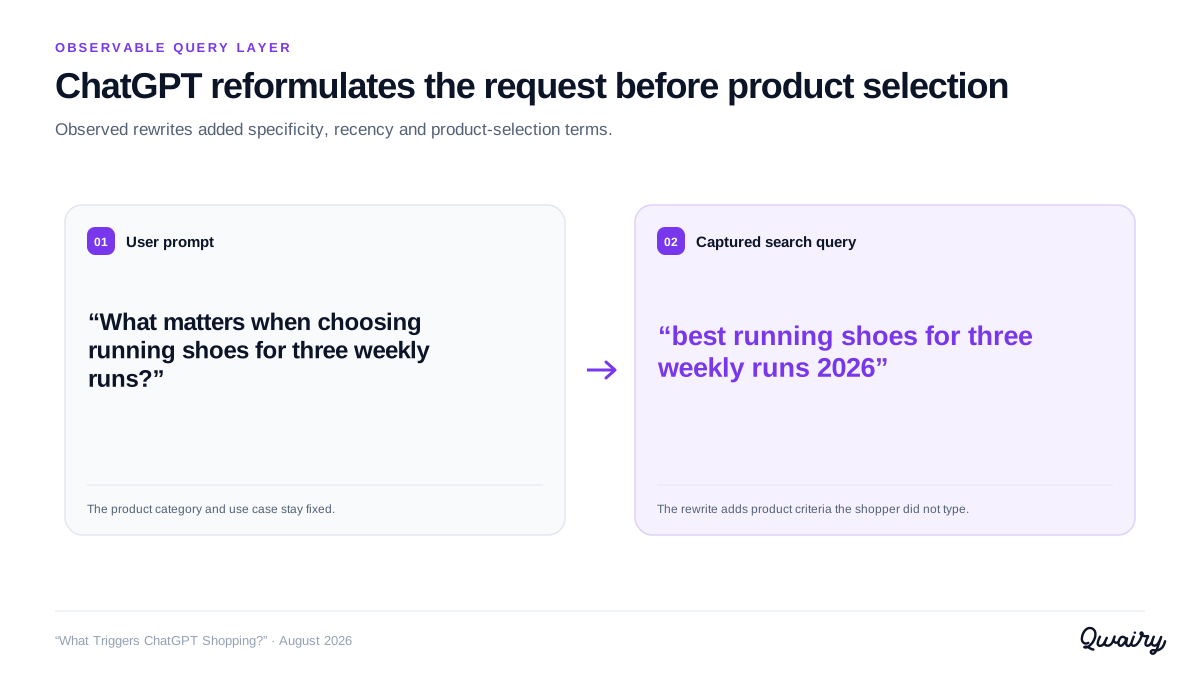
English rendering of one observed prompt-to-query pair; formatting normalized for readability. This changes the optimization problem. E-commerce teams are not competing only for the words a shopper typed. They are also competing for criteria introduced or reformulated in the captured queries, including recency, “best” language, commercial terms and local relevance.
In the matched test, both outcomes had the same median source footprint: 13 captured source references from 9 distinct domains. Shopping-positive responses did not show a broader median source footprint than non-Shopping responses. Editorial, review and community sources dominated the observed search layer.
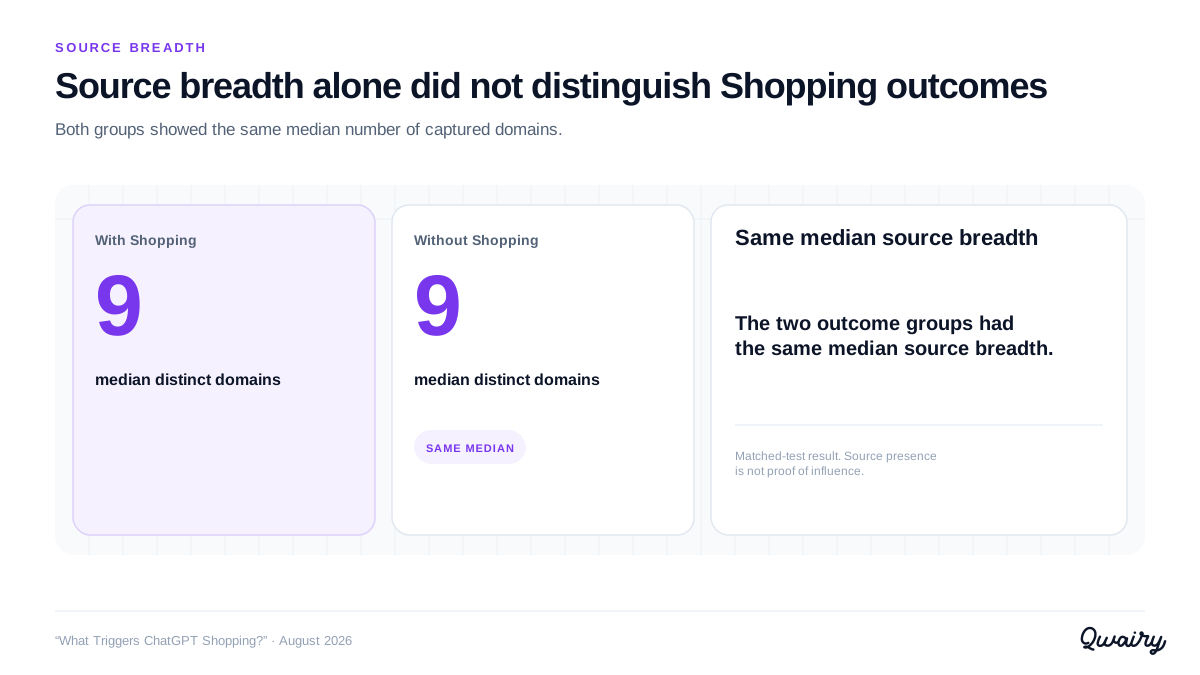
The two outcome groups had the same median source breadth; the chart does not estimate source influence. Amazon was nearly absent from the search-source lists captured by this matched test, even when Shopping appeared. This does not rule out Amazon or other sources in upstream layers the collector cannot observe. Marketplace and reseller visibility becomes a separate issue later, when merchants are ranked. Captured source presence is not proof of influence. The data cannot assign a causal weight to an individual domain or map one source to one selected product.
The observed search layer usually contained one reformulated query; multiple distinct category-level queries were rare. In the captured response structures, the largest branching appeared at the product-lookup stage. In Shopping-positive responses with observable raw data, 98.8% contained product-specific lookup queries. The median fan-out was four named products, with an observed range from one to ten. These lookups typically named specific headphone, mattress or stroller models.
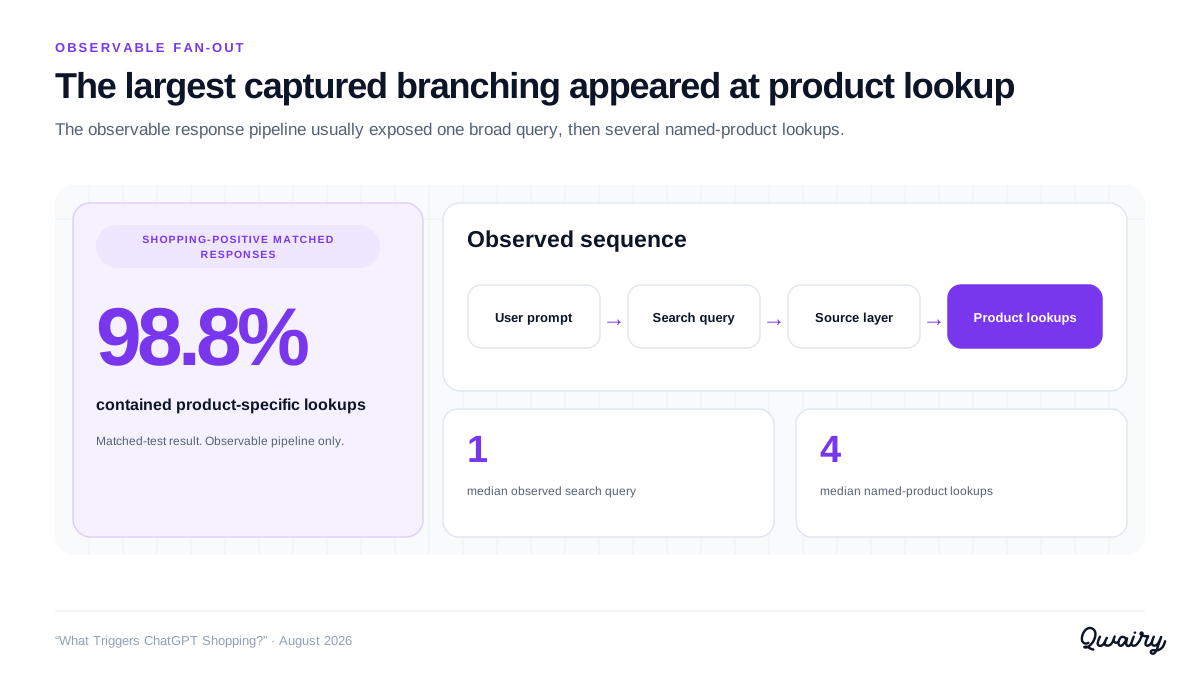
This is the observable response pipeline, not a complete map of OpenAI's private internal system. This complements Profound's network-level breakdown . Profound analyzed network logs at scale to infer product-query fan-out and product-card-to-offer relationships. Qwairy addresses a different question with a matched design: which prompt patterns make Shopping appear, and how often the same prompt switches outcomes. The studies observe different layers. Qwairy's captured destination URLs show where shopping links point; they do not identify whether product-card metadata came from a web crawl or a direct product feed.
The same prompt did not always produce the same result. Shopping switched on and off in 42.7% of matched scenarios across repeated observations.
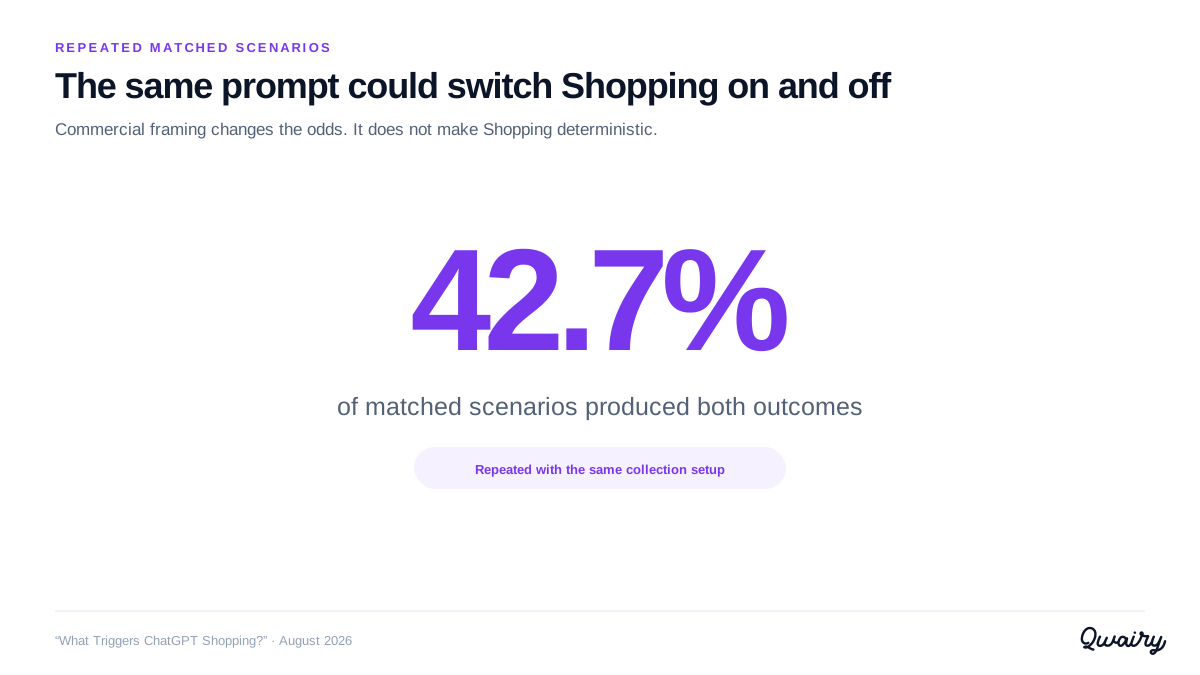
Five repeated observations per prompt-category scenario using the same collection setup. Commercial framing changed the odds, but did not make the result deterministic. Possible contributors include model variation, changing candidate availability and product eligibility, but this study cannot isolate their respective effects. This is why a screenshot is not a measurement. Trigger rate must be monitored over repeated observations.
OpenAI documents product selection and merchant selection as separate stages. Qwairy's July monitoring panel shows that the collected product set was unstable too. Across consecutive Shopping-positive observations for the same configuration, the first validated item in the collected product array changed 77.7% of the time. In 45.4% of pairs, the returned product sets shared nothing. This is a collector-order measure, not direct evidence of how every user saw the cards arranged. The merchant layer may then surface resellers instead of the brand's own store. In Qwairy's preceding destination study, only 6.4% of identifiable shopping destinations matched the recorded product-brand domain. For 51.8% of eligible product-brand domains, the recorded brand domain never appeared as an identifiable destination. Read the full study: ChatGPT Recommends the Product. Where Does the Shopping Link Go? .
ChatGPT recommends the Nike Pegasus 41 in this interface example. The visible merchant panel lists Intersport, Sport 2000 and SportsShoes.com , not Nike's own store.
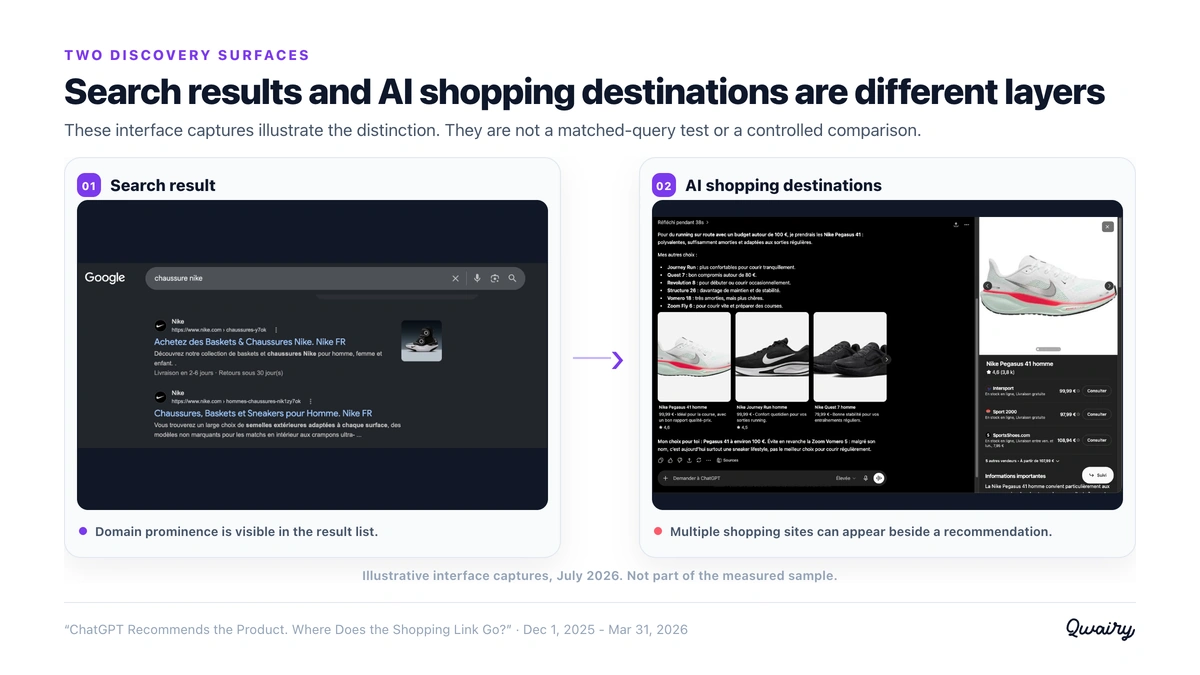
Visual reproduced from Qwairy's merchant-destination study. French-language interface capture, July 2026; not part of any measured cohort in this article. Nike can win the product recommendation while resellers occupy the visible merchant slots.
See your mentions across ChatGPT, Claude and Perplexity in real time, the moment buyers ask.
Build a stable prompt set across informational, comparison, recommendation, budget and purchase intents. Track Shopping appearance as a rate, not a yes-or-no screenshot. Qwairy can segment those prompt families and repeat them over time to identify where Shopping activates, disappears or changes.
Track the queries and domains ChatGPT surfaces around each intent. Look for the criteria it adds, then make sure product pages, editorial content and third-party coverage answer them clearly. Do not treat a citation as proof that it caused a product result.
Allow OAI-SearchBot if you want eligible pages to appear in ChatGPT Search. Keep identifiers, titles, descriptions, variants, images, prices, stock, shipping and seller information accurate. OpenAI's product feed specification exposes these fields directly. A feed can improve freshness and completeness. It does not guarantee Shopping, product selection or merchant position.
For every returned product, classify the displayed sellers as the brand's own store, a marketplace, a reseller or another merchant. Monitor product presence and merchant destination as two different KPIs. If click attribution is available, connect owned-domain traffic to first-party sessions and checkout data without treating that as proof of incrementality.
ChatGPT Shopping is a sequence of decisions and rankings. The final merchant destination can diverge from the recommended brand even after Shopping appears.
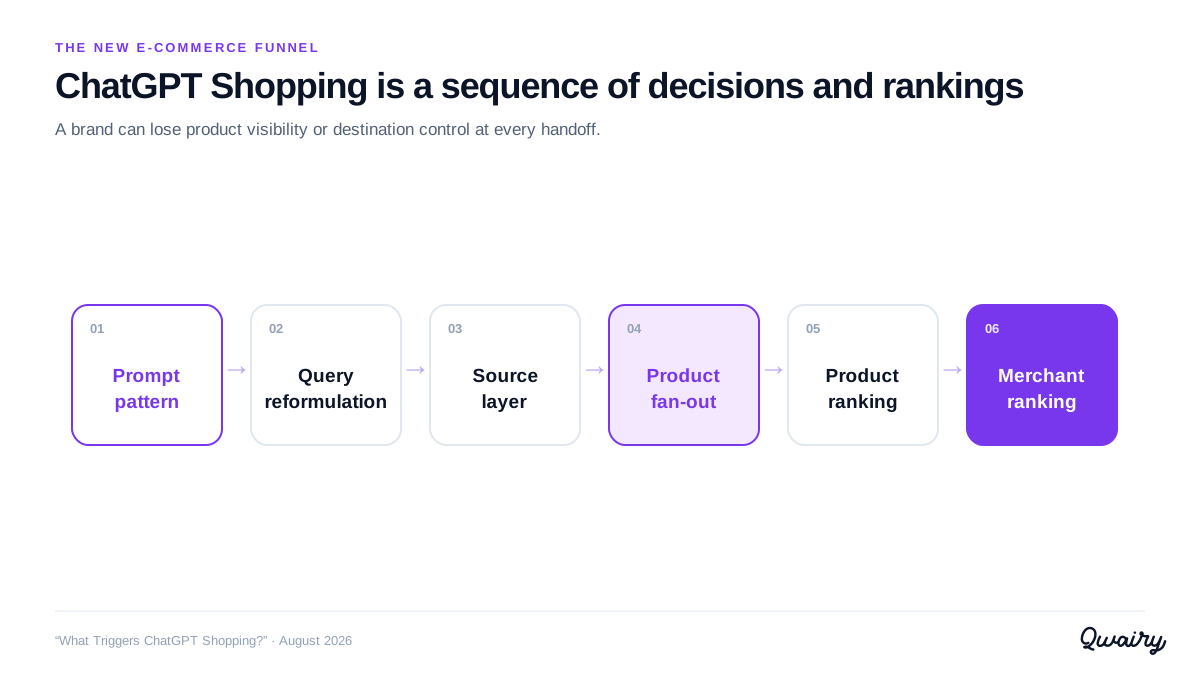
Qwairy measures a sequence of observable and documented layers. OpenAI's private internal pipeline may contain additional steps. Winning a product recommendation is only one step. E-commerce teams must also measure whether Shopping appears, which products remain visible and which merchant domains are shown beside them. Audit your product and merchant visibility in ChatGPT Shopping with Qwairy .
The July 2026 multilingual monitoring panel was frozen for analysis on August 1, 2026. That snapshot contained 133,609 completed ChatGPT runs, 45,647 distinct prompt texts and 696 brands across 15 configured language locales and 33 countries. Shopping appeared in 11.2% of completed runs. The mix was not balanced by intent, language or geography. The matched test was collected on August 1, 2026 across 12 product categories and eight prompt patterns. Each prompt-category scenario was repeated five times using the same collection setup, for 480 responses. Language and market were held constant. The headline appearance rates come from this matched test and should not be assumed to transfer unchanged across locales. Observable response structures were used to compare normalized queries, source references and product-specific lookups. Terms were counted as added only when absent from the normalized original prompt; fixed lexicons grouped “best” language, year signals and commercial terms. Merchant figures come from a separate four-month Qwairy study and were not pooled with either dataset.
Captured queries, product URLs and merchant URLs expose only the observable response layer, not OpenAI's complete internal fan-out, retrieval sources or ranking weights. The collected array order was not independently matched to the order displayed in the ChatGPT interface. The studies identify visible destinations, not user behavior. They do not observe impressions, clicks, purchases, orders, revenue or incrementality.
Track your mentions across ChatGPT, Claude, Perplexity and all major AI platforms. Join 1,500+ brands monitoring their AI presence in real-time.
Free trial • No credit card required • Complete platform access
Other Articles
ChatGPT Ads Are Coming to France: What US Data Reveals Before Launch
ChatGPT ads appear in 69.25% of US-monitored commercial answers but near zero in France. What US data reveals before the French launch, and how to prepare.
ChatGPT Stopped Citing Reddit. Our Data Shows the Mechanism Behind the 95% Collapse
Reddit's share of ChatGPT Search citations collapsed 95% in one week in August 2026. Qwairy's citation data reveals the mechanism: a query fan-out change on August 8 that switched ChatGPT to direct site: interrogation, redistributing citations from discussion platforms to official sources.