
Loading page
A practical guide to building your brand's knowledge graph so AI engines recognize you as a coherent, well-sourced entity. Covers the sources that feed entity data, a step-by-step build, and how to measure whether it's working.

For a decade, the game was ranking a page. Now the game is being understood. When someone asks ChatGPT, Perplexity, or Google's AI Overviews about your category, the model doesn't hand back ten links - it composes an answer, and it decides which brands are real, credible entities worth naming. That decision is grounded in structured knowledge about things, not strings of keywords. That structured knowledge is a knowledge graph. Google popularized the idea in 2012 with the launch of its Knowledge Graph - a map of entities (people, companies, products, places) and the relationships between them. Today that same entity layer, plus open sources like Wikidata and Wikipedia, quietly shapes what generative engines say about you. If your brand isn't a well-defined entity, AI has two options: skip you, or guess. Neither is good. Guessing is how you end up conflated with a similarly named company, described with an outdated tagline, or credited to the wrong founder. This guide focuses on implementation: how to turn canonical brand facts into a maintained first-party graph, publish those relationships consistently, reconcile external identifiers, and monitor drift. For the broader discipline of earning entity recognition across the web, use the entity SEO for AI guide .
A knowledge graph is a database of entities and their verified attributes, connected by relationships - the difference between "a string of letters that spells your brand" and "a known company with a founder, a category, a headquarters, and a website." Google's own framing was "things, not strings." An entity has a stable identity that persists across mentions, languages, and spellings. For AI systems this matters more than it ever did for classic search. A ranked list of blue links tolerates ambiguity - the user disambiguates by clicking. A generated answer does not. The model has to commit to a single interpretation of "who this brand is" before it writes a sentence. Clear entity data lowers the risk of that commitment; sparse or contradictory data raises it.
These two terms get used interchangeably, but they're not the same thing. The Knowledge Graph is the underlying entity database. The knowledge panel is the box that appears on the right of Google results (or at the top on mobile) when Google is confident it understands an entity - showing your logo, description, founding date, social profiles, and more. A knowledge panel is essentially a visible receipt that Google has modeled you as a distinct entity. You don't have to have a panel to exist in the graph, but earning one is strong evidence that your entity data is coherent and well-sourced.
Generative engines are grounded in entity data whether they say so or not. Google's AI Overviews and Gemini draw on the same core search and Knowledge Graph infrastructure that powers traditional results. Google describes AI Overviews as built on its core ranking systems, though the precise weighting of the Knowledge Graph is not publicly detailed. Engines like ChatGPT and Perplexity lean heavily on the open web's canonical entity references - above all Wikipedia and Wikidata - because those are dense, structured, and widely trusted sources of "who is who." The practical takeaway: the more consistently your brand is described across the sources these systems trust, the more confidently they'll name you, describe you accurately, and cite you.
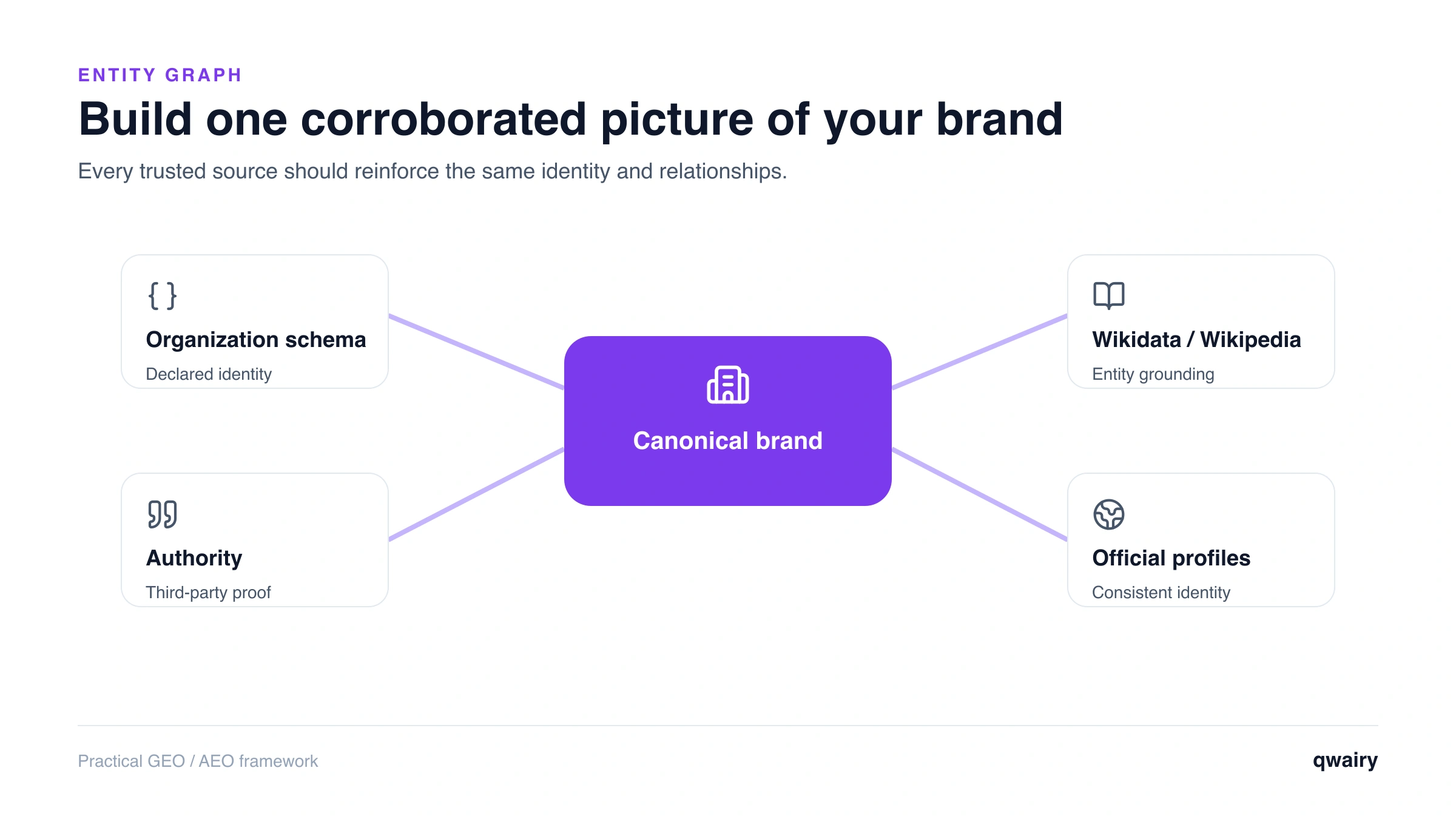
No single action creates an entity. A knowledge graph is assembled from corroborating signals across independent, authoritative sources. These are the ones that carry the most weight.
Wikidata - the free, collaborative, machine-readable knowledge base at wikidata.org . It's the connective tissue between many knowledge graphs and a source both Google and open-web AI systems can consume directly. A well-formed Wikidata item with a stable identifier and linked references is one of the highest-leverage entity assets you can hold.
Wikipedia - a strong corroborating signal if your brand genuinely meets the encyclopedia's notability standards . Wikipedia punches above its weight in AI answers because it's heavily cited and rigorously sourced. Do not force it - an article that fails notability will be deleted, and paid or promotional editing violates policy.
Authoritative third-party citations - coverage in reputable press, industry publications, directories, and databases (Crunchbase, review platforms, trade bodies). These are the references that make Wikidata and Wikipedia entries stick, and they independently reinforce your entity even where those two don't exist.
Structured data on your own site - Organization schema with a sameAs array pointing to your official profiles. This is you telling the graph, in machine-readable terms, exactly which entity you are.
Verified official profiles - Google Business Profile, LinkedIn, X, Crunchbase, and your primary social accounts. Consistency across these - same name, same logo, same description - is a signal in itself.
Treat this as an entity-building program, not a one-off task. Each step corroborates the others; the compounding is the point. Work through them in order.
sameAs. On your homepage, publish Organization structured data including your legal name, logo, and a sameAs array linking every official profile (Wikipedia, Wikidata, LinkedIn, Crunchbase, social accounts). Validate it with Google's Rich Results Test. This is the cheapest, fastest signal you fully control.Run a free audit: see if ChatGPT, Gemini and Copilot recommend you, in about a minute.
Before you consider the foundation done, confirm every item below returns the same answer:
Is your official brand name spelled identically on your site, Wikidata, LinkedIn, Crunchbase, and social profiles?
Does your homepage carry Organization schema with a complete sameAs array?
Does a Wikidata item exist, with referenced statements and links back to your profiles?
Is your one-line description consistent everywhere it appears?
Are your logo and founding details identical across profiles?
Do independent, authoritative sources describe your brand the way you do?
The unique asset is not another public profile. It is a governed system of record that every public surface can reuse. Build the minimum viable graph around stable identifiers and explicit relationships.
organization → owns → product, person → founded → organization, and organization → locatedIn → place. Add effective dates so a former executive or discontinued product does not remain current forever.sameAs target resolves to the right entity, and test high-risk prompts for stale facts or conflation.This operating model is what separates a maintained brand knowledge graph from a one-time entity SEO checklist.
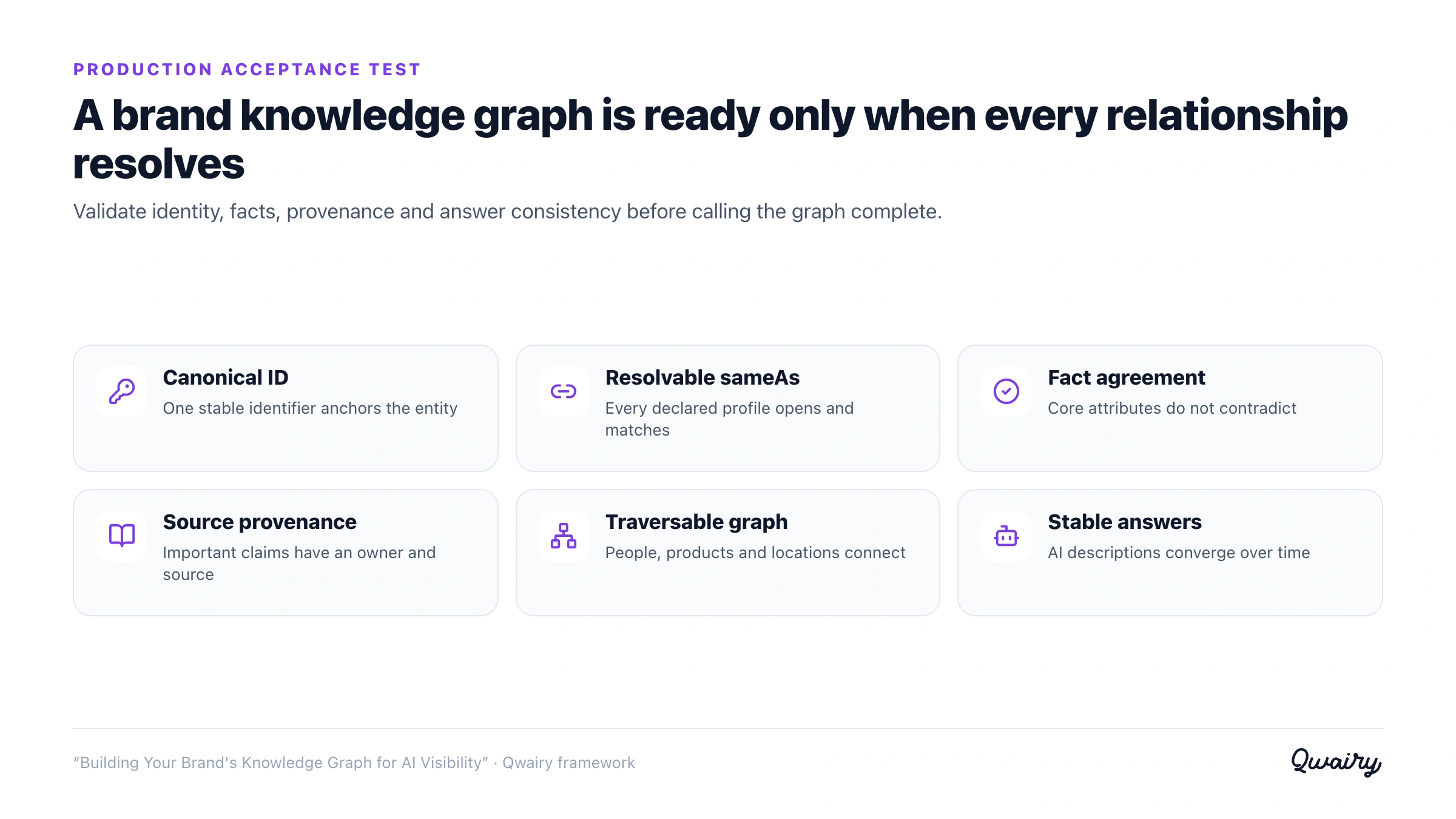
Do not call the graph finished because Organization schema validates. A production-ready brand graph passes all eight gates below:
A failed gate blocks release for the affected entity. This is stricter than a schema validator by design: syntax can be perfect while the graph is semantically wrong. The acceptance test protects against the expensive failures that matter in AI answers, including conflation, stale executives, incorrect ownership, and attribution to the wrong brand.
See your mentions across ChatGPT, Claude and Perplexity in real time, the moment buyers ask.
Building entity signals is only half the job - you need to know whether AI engines have actually absorbed them, and how they describe you as a result. Traditional rank tracking won't tell you this. The questions that matter now are: does ChatGPT name you in your category? Does Perplexity cite your site? Does Google's AI Overview describe you accurately, or with a stale or wrong fact? Track a few things over time:
Presence - how often each major engine mentions your brand for the prompts your buyers actually ask.
Accuracy - whether the facts AI states about you (category, founders, positioning) match your canonical entity.
Citations - which of your pages and profiles the engines pull from and link to.
Confusion - any signs a model is conflating you with another brand or attributing the wrong attributes.
This is exactly the layer Qwairy is built to monitor - tracking how your brand shows up across ChatGPT, Claude, Perplexity, Gemini, and Google AI Overviews, which sources get cited, and how accurately you're described - so you can tell whether your entity work is landing and where it's breaking. For the broader strategy around establishing your brand as a recognized entity, see the related guides on the Qwairy blog .
Most knowledge-graph efforts fail for predictable, avoidable reasons. Watch for these:
Inconsistent naming. Three spellings of your brand across five profiles teaches the graph that you might be three different things.
Forcing Wikipedia. A non-notable article gets deleted, and promotional editing can damage credibility. Earn it or skip it.
Wikidata without references. Unsourced statements are weak and get challenged. Reference every claim.
Set-and-forget. Entities go stale. A rebrand you didn't propagate becomes an AI engine describing last year's company.
Skipping structured data. Organization schema with sameAs is the one signal you fully control; leaving it off is leaving leverage on the table.
Connect the graph to the wider entity program: Use entity SEO for AI for the full signal map, the entity disambiguation playbook for lookalike conflicts, and the Wikipedia and Wikidata guide for policy-compliant public knowledge sources.
The shift from links to answers rewards clarity of identity. AI engines can only describe - and cite - brands they understand as coherent entities. Building your brand's knowledge graph is the work of making that understanding unavoidable: a canonical definition of who you are, structured data that states it, and independent, authoritative sources that corroborate it across the web. Start with the parts you control - consistent naming, Organization schema, clean official profiles, a well-referenced Wikidata item - then earn the citations that make it durable. Then measure, because in AI search you can't manage what you can't see the model say.
The knowledge graph is the underlying database of entities and their attributes and relationships. The knowledge panel is the visible box on Google's results page that appears once Google is confident it understands an entity. The panel is a symptom of strong graph data, not the data itself - you can be a well-modeled entity without a panel, but earning a panel is good evidence your entity data is coherent.
No. Wikipedia is a strong corroborating signal, but it's neither necessary nor sufficient. Many brands are well-represented in Google's Knowledge Graph and cited by AI engines without a Wikipedia article, built on Wikidata, structured data, and authoritative third-party coverage. Only pursue Wikipedia if you genuinely meet its notability standards.
Generative engines need to commit to a single interpretation of your brand before they can write about it. Clear, consistent, well-sourced entity data lowers the risk of that commitment, so engines are more likely to name you, describe you accurately, and cite your content. Sparse or contradictory data leads engines to skip you or guess - which is how misattribution and outdated facts creep in. The exact mechanisms differ by engine and are not fully disclosed.
Once a panel appears for your brand, use Google's official entity verification process to claim it. Verification lets you suggest corrections to inaccurate facts. You cannot create a panel on demand - it only appears when Google's systems recognize your entity - but you can steward and correct one that exists.
The signals you control - Organization schema, consistent profiles, a Wikidata item - can be in place within days to weeks. The signals you earn - authoritative citations, a knowledge panel, a Wikipedia article - accrue over months and depend on genuine coverage and notability. Treat it as an ongoing program, not a launch.
You have to observe what the engines actually say. Track your brand's presence, the accuracy of the facts AI states about you, which sources get cited, and any signs of confusion with other brands - across the major engines and over time. Platforms like Qwairy are built to monitor exactly this, so you can catch drift or misattribution and trace it back to the source that needs fixing.
Track your mentions across ChatGPT, Claude, Perplexity and all major AI platforms. Join 1,500+ brands monitoring their AI presence in real-time.
Free trial • No credit card required • Complete platform access
Other Articles
Answer Engine Optimization (AEO): The Complete 2026 Guide
A complete, practitioner-level guide to Answer Engine Optimization: what AEO is, how answer engines like ChatGPT, Perplexity and Google AI Overviews select and cite content, the core levers, a step-by-step workflow, and how to measure it.
How to Set Up AI Referral Tracking in GA4, Plausible and Matomo
Most analytics tools miss or misclassify AI referral traffic by default. This step-by-step guide shows you how to properly track visits from ChatGPT, Perplexity, Claude, Gemini, and other AI platforms in GA4, Plausible, and Matomo.