
Loading page
A hub guide to entity SEO in the AI era: what an entity is, why generative engines rely on entities, the signals that make your brand recognizable, a step-by-step roadmap, and how to measure entity presence.

Search stopped being about matching strings of text more than a decade ago. When Google introduced its Knowledge Graph in 2012, it reframed the whole problem as "things, not strings" - real-world people, places, products, and organizations connected by facts and relationships. AI answer engines inherited that worldview and made it the entire game. When ChatGPT, Perplexity, Gemini, or Google's AI Overviews answer a question about your market, they are not scanning a ranked list of ten blue links. They reason over entities they already "know," decide which are relevant and trustworthy, and choose which ones to name. If your brand isn't a clearly defined entity in that web of knowledge, you don't get considered - you get skipped. The stakes are higher than a lost ranking. When a model doesn't recognize you as a distinct entity, one of two bad things happens: you're absent from the answer entirely, or the model confuses you with a similarly named company and attaches the wrong facts, prices, or reputation to your name. This guide is the hub for entity SEO in the AI era. You'll learn what an entity actually is, why generative engines lean on entities so heavily, the concrete signals that make your brand recognizable, and a step-by-step roadmap to build entity authority - plus how to measure whether any of it is working.
An entity is a uniquely identifiable thing, not a keyword. A keyword is a string of characters. An entity is the concept behind it, with its own attributes and its own relationships to other entities. "Apple" the string is ambiguous; the fruit and the company are two distinct entities, each a separate node in a knowledge graph with different facts hanging off it. Entities have three properties that matter for AI:
Identity - they can be pinned down unambiguously, often by a stable identifier (a Wikidata Q-number, a Google Knowledge Graph ID, a company registration number).
Attributes - facts that describe them: founding date, category, founders, location, products.
Relationships - how they connect to other entities: "is a competitor of," "was founded by," "is headquartered in."
Here's the practical difference:
Old model (strings) | Entity model (things) |
Match query text to page text | Resolve the query to a concept |
Rank documents by relevance signals | Reason over facts and relationships |
"10 blue links" for the user to sort | A synthesized answer that names specific entities |
Keyword density, exact-match | Consistency, disambiguation, authority |
For a brand, becoming an "entity" means the systems that power AI answers hold a confident, correct, and distinct record of who you are - separate from every other similarly named thing in the world.
Generative engines use entities to stay grounded, to disambiguate, and to decide what's trustworthy enough to cite. Understanding the three mechanisms tells you exactly what to optimize.
Most AI answer engines don't rely on memory alone. They retrieve documents at query time (retrieval-augmented generation) and synthesize an answer from what they pull. Retrieval systems increasingly resolve a query to entities first, then fetch the most authoritative sources about those entities. If your brand is a well-formed entity with authoritative sources attached, you're far more likely to be retrieved - and retrieved content is what gets cited.
Some of what a model "knows" is baked into its weights from training. The more consistently your brand appears across the web with the same stable facts, the more reliably those facts get encoded - and the more confidently the model will surface you unprompted. Inconsistent or sparse mentions produce a fuzzy, low-confidence representation the model hesitates to use.
Entities are how a system resolves ambiguity. If "Acme" could mean four companies, the model leans on entity signals - structured identifiers, consistent naming, authoritative cross-references - to pick the right one. Weak entity signals are exactly why models sometimes hand your traffic (and your reputation) to a namesake. This failure mode is common enough that it gets its own guide: Entity Disambiguation for AI . Academic work on optimizing for these systems, notably the GEO: Generative Engine Optimization paper (first released on arXiv in 2023 and presented at KDD 2024), found that content visibility in generative engines responds to signals like citations, quotations, and authoritative framing rather than classic keyword tactics. That's an entity-and-authority story, not a keyword-density one. Treat the paper's per-tactic uplift figures as directional rather than guaranteed for your niche.
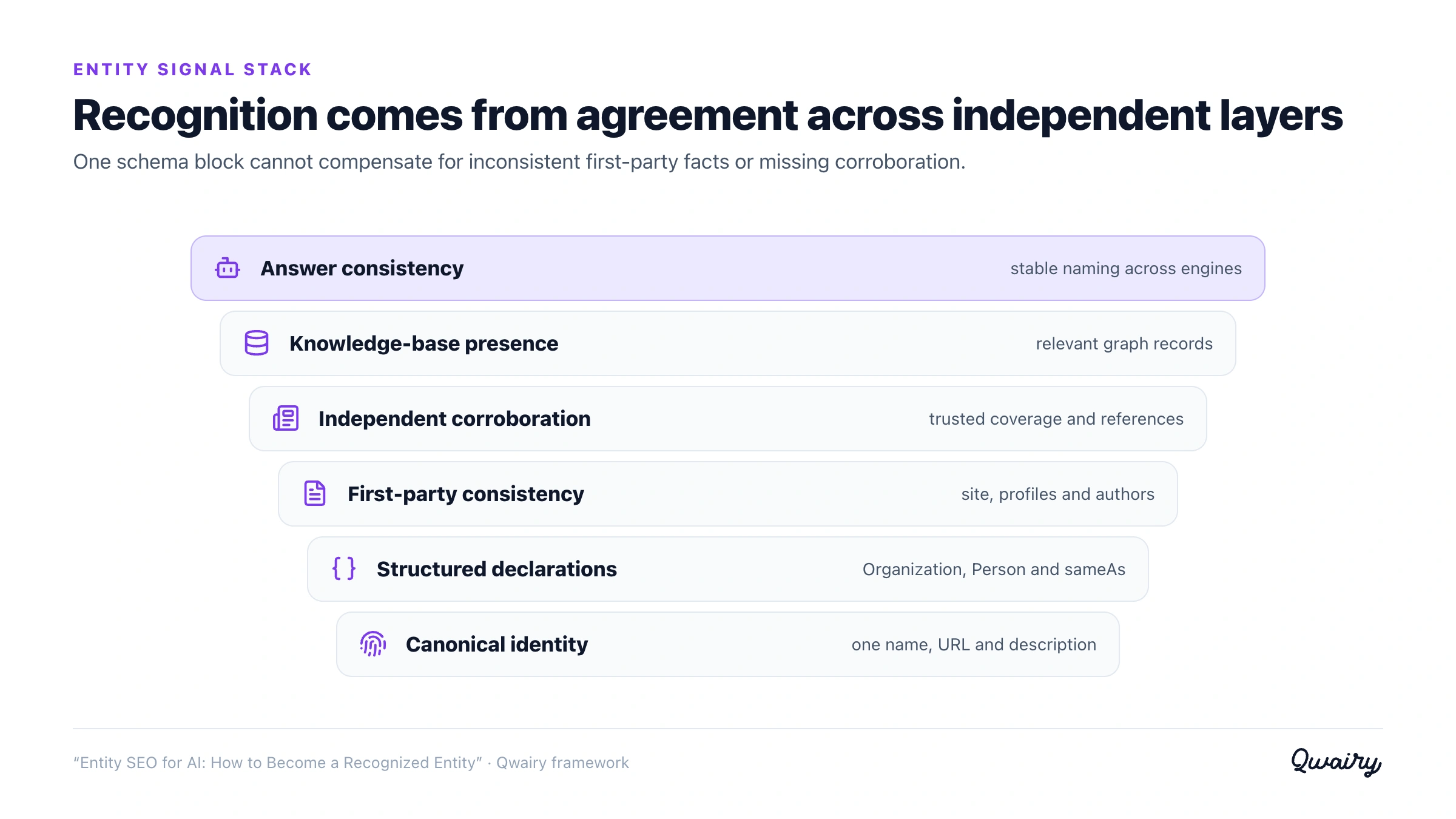
You establish an entity the same way a librarian catalogs a book: consistent identity, verifiable facts, and cross-references from trusted places. These are the levers you control.
Run a free audit: see if ChatGPT, Gemini and Copilot recommend you, in about a minute.
Pick one canonical brand name and use it identically everywhere: your site, social profiles, directories, press, and structured data. The classic local-SEO discipline of consistent NAP (Name, Address, Phone) generalizes here - every inconsistency (Acme vs. Acme Inc. vs. Acme.io) splits your entity into fuzzy fragments and weakens the model's confidence. Consistency is the single cheapest, highest-leverage entity signal.
Structured data is how you tell machines what you are instead of hoping they infer it. At minimum, implement Organization schema on your site, with:
name, legalName, url, and logo
sameAs - an array of URLs pointing to your authoritative profiles (LinkedIn, Crunchbase, your Wikidata item, official social accounts). The sameAs property definition describes how URLs can identify the same entity, making it one of the most direct disambiguation signals you can send.
Person schema for named founders/authors, and Article schema on editorial content.
Which schema types matter for AI citations is a deep topic on its own - the JSON-LD schema guide for AI citations separates useful machine-readable identity signals from unsupported citation promises. Here, the point is narrower: schema is how you assert your entity's identity, facts, and cross-references in a machine-readable way.
An entity is defined largely by what others say about it, not just what you say about yourself. Being mentioned - ideally cited - by sources the AI already trusts (established publications, industry databases, respected communities) does two things: it reinforces the facts about your entity, and it earns the off-site citations that retrieval systems favor. This is where entity SEO overlaps with digital PR and Google's E-E-A-T emphasis on demonstrated experience, expertise, authoritativeness, and trust.
Wikidata and Wikipedia punch far above their traffic weight because they are structured, openly licensed, heavily cross-referenced, and widely used as training and grounding data. A Wikidata item gives your entity a canonical identifier that ties your sameAs references together; a Wikipedia article (where genuinely warranted by notability) is a strong grounding source. Both must be earned honestly, on the platforms' own notability and sourcing rules - this is important enough that the guide Wikipedia & Wikidata for AI Visibility covers the policy-compliant path in full. The degree to which each engine relies on Wikipedia and Wikidata varies and changes over time.
Your own site is the primary source of truth about your entity. A clear "About" page stating who you are and what you do, consistent internal linking, an author/team page, and self-contained pages that each answer a question completely all help retrieval systems build a confident picture. Structuring your whole site around this is the subject of Building Your Brand's Knowledge Graph for AI Visibility .
Treat entity authority as a project with a sequence, not a one-off task. Work these steps in order - each one makes the next more effective.
sameAs with every authoritative profile you own. Validate with Google's Rich Results Test and Schema.org validator .sameAs points at.One canonical brand name, used identically everywhere
Organization schema live and valid, with a populated sameAs
Person/author schema for your named experts
Claimed, consistent profiles on LinkedIn, Crunchbase, and key directories
A Wikidata item (if you meet notability), correctly sourced
A clear "About" page and author/team pages
Authoritative third-party mentions actively being earned
Monitoring in place for how AI describes your brand
See your mentions across ChatGPT, Claude and Perplexity in real time, the moment buyers ask.
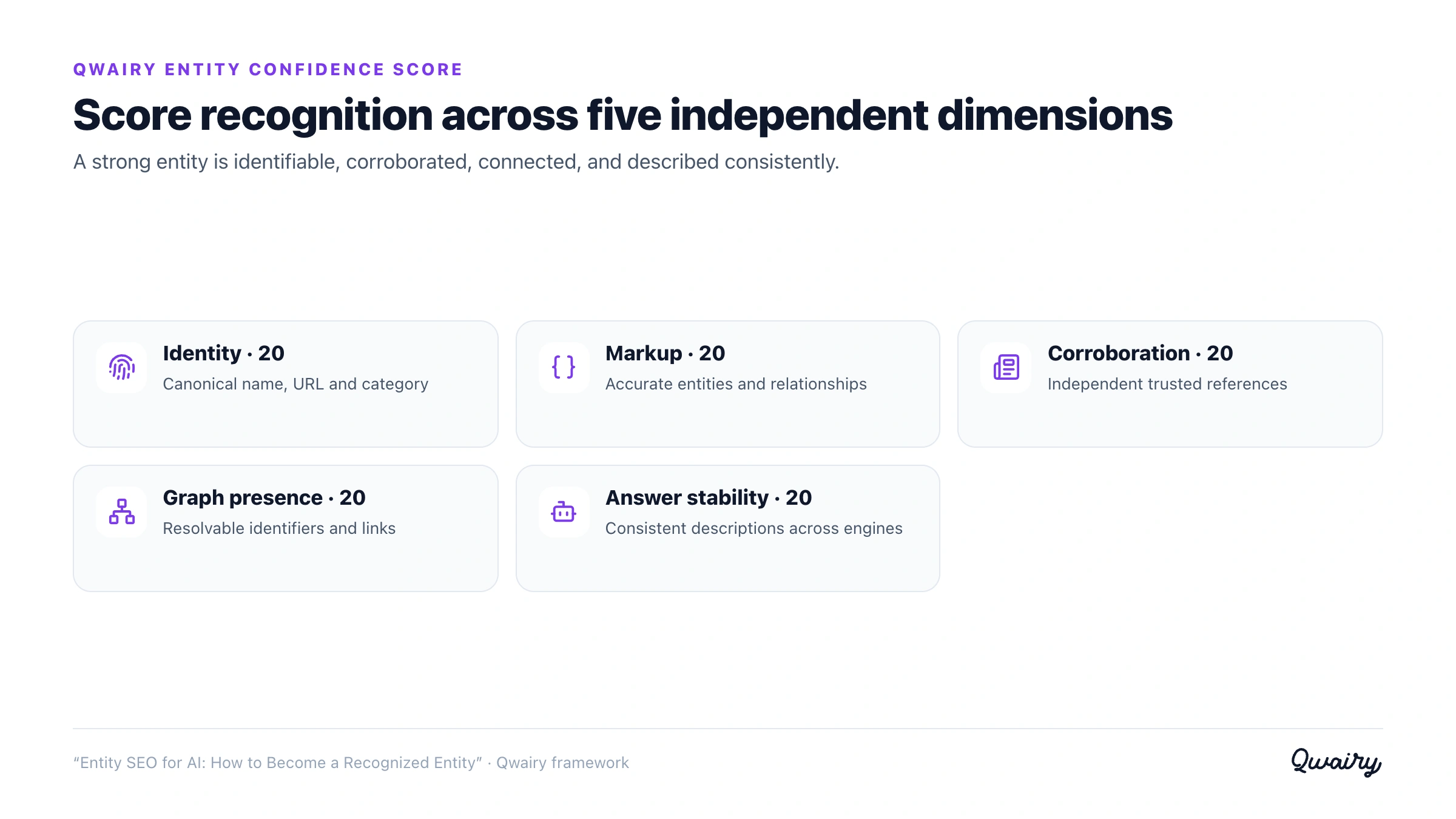
Entity SEO becomes actionable when confidence is measurable. Score the brand across five dimensions, each worth 20 points.
Dimension | 20-point standard |
Identity consistency | Canonical name, aliases, category, URL, logo, location, and core description agree across every official surface. |
First-party declaration | About, author, product, and location pages expose the entity in visible copy and valid JSON-LD with stable IDs. |
Independent corroboration | Relevant third-party sources confirm the important facts without copying the brand's own wording. |
Knowledge-source alignment | Eligible Wikidata, Wikipedia, registry, review, and industry records resolve to the correct entity and current facts. |
Answer consistency | Priority AI prompts identify the right brand, category, products, people, and relationships across engines. |
Use evidence for every point. 85 to 100 is a strong entity foundation. 70 to 84 means the entity is recognized but still vulnerable to omission or confusion. Below 70 means content optimization is premature: fix identity and corroboration first. The score also prevents cannibalization inside your own entity program. This article owns recognition and confidence; the disambiguation guide owns lookalike conflicts; the knowledge graph guide owns the maintained data model.
If you can't see how AI engines currently describe you, you're optimizing blind. Entity work has a long feedback loop, so measurement matters more than usual. Track a few things:
Recognition - do the major engines return a confident, correct description of your brand when asked directly, or a vague/wrong one?
Disambiguation - are you being confused with a namesake? Are the wrong facts, categories, or competitors attached to you?
Citation share - when the model answers questions in your category, how often does it name and cite you versus competitors, and which sources does it pull from?
Perception - is the sentiment and the set of attributes associated with your entity accurate and on-brand?
This is precisely what a platform like Qwairy is built to measure: it tracks how your brand appears across ChatGPT, Claude, Perplexity, Gemini, and Google AI Overviews - visibility and citation share, the sources feeding those answers, competitor comparisons, and the sentiment and attributes models associate with your entity. That turns "become a recognized entity" from an act of faith into something you can baseline, act on, and prove. You can dig deeper into the surrounding tactics on the Qwairy blog .
Turn entity strategy into implementation: Fix name collisions with the entity disambiguation playbook , build a maintained brand knowledge graph , and evaluate Wikipedia and Wikidata without shortcutting notability rules.
Entities are the language AI answer engines think in. Your goal isn't to chase a keyword up a ranking - it's to become a thing the models know: a distinct, correctly described, well-cross-referenced entity they can retrieve, trust, and name with confidence. Get your canonical identity, structured data, authoritative mentions, and knowledge-graph presence aligned, then measure how the engines actually describe you and close the gaps. Do that, and you stop being a string the models overlook and start being an entity they recommend.
Entity SEO is the practice of establishing your brand, people, and products as clearly defined, uniquely identifiable "entities" that search and AI systems recognize - rather than optimizing for keyword strings. It focuses on consistent identity, structured data, authoritative cross-references, and knowledge-graph presence so machines hold a confident, correct record of who you are.
Traditional SEO largely optimizes documents to rank for query strings. Entity SEO optimizes your brand's representation in the graph of things the web knows about - its facts, relationships, and identifiers. They're complementary: a strong SEO base still helps AI engines find and trust you, but entity signals are what let a model name you confidently in a synthesized answer.
No. Consistent naming, Organization and Person schema with a populated sameAs, claimed profiles, and authoritative third-party mentions can establish a solid entity without Wikipedia. Wikipedia and Wikidata help significantly, but only if you genuinely meet their notability and sourcing standards - see the dedicated guide to earning a Wikipedia and Wikidata presence .
Start with Organization schema (including logo and a well-populated sameAs), add Person schema for named founders and authors, and use Article schema on editorial content. sameAs is especially important because it explicitly tells machines which external profiles all refer to the same entity, which aids disambiguation.
Usually because your entity signals are weak or inconsistent, so the model can't reliably tell you apart from a similarly named thing. Fixes include a single canonical name used everywhere, sameAs cross-references, a Wikidata item, and authoritative content that pins down your facts. The entity disambiguation guide walks through the full remedy.
Ask the major AI engines to describe your brand and check for accuracy and confidence, watch for confusion with namesakes, and track how often models cite you (and which sources they use) when answering questions in your category. Tools like Qwairy monitor this across engines so you can baseline entity recognition, citation share, and sentiment, then measure movement over time.
Track your mentions across ChatGPT, Claude, Perplexity and all major AI platforms. Join 1,500+ brands monitoring their AI presence in real-time.
Free trial • No credit card required • Complete platform access
Other Articles
Answer Engine Optimization (AEO): The Complete 2026 Guide
A complete, practitioner-level guide to Answer Engine Optimization: what AEO is, how answer engines like ChatGPT, Perplexity and Google AI Overviews select and cite content, the core levers, a step-by-step workflow, and how to measure it.
How to Set Up AI Referral Tracking in GA4, Plausible and Matomo
Most analytics tools miss or misclassify AI referral traffic by default. This step-by-step guide shows you how to properly track visits from ChatGPT, Perplexity, Claude, Gemini, and other AI platforms in GA4, Plausible, and Matomo.