
Loading page
AI answer engines often merge or misattribute similarly named brands. Learn why it happens, how to diagnose it across ChatGPT, Perplexity, and Gemini, and the entity disambiguation fixes that make your brand unmistakable.

Ask ChatGPT or Perplexity about your company and you may not recognize the answer. The model describes a competitor's product, credits your founder to another startup, or blends two similarly named businesses into one confident, wrong profile. That is not a hallucination in the usual sense - it is an entity resolution failure. AI answer engines don't treat brand names as strings of text. They resolve names to entities: distinct "things" in a knowledge graph, each with its own attributes, relationships, and sources. When your brand's entity is weakly defined - or looks too much like another - the model binds the query to the wrong node, and everything downstream inherits the mistake. For buyers, this is worse than being invisible. A wrong answer inside an AI conversation reaches the prospect directly, carries the model's authority, and you rarely get a chance to correct it in the moment. This guide explains why models confuse similarly named brands and people, how to diagnose it across the major engines, and the concrete disambiguation fixes that make your entity unmistakable - plus how to monitor so a fix actually stays fixed.
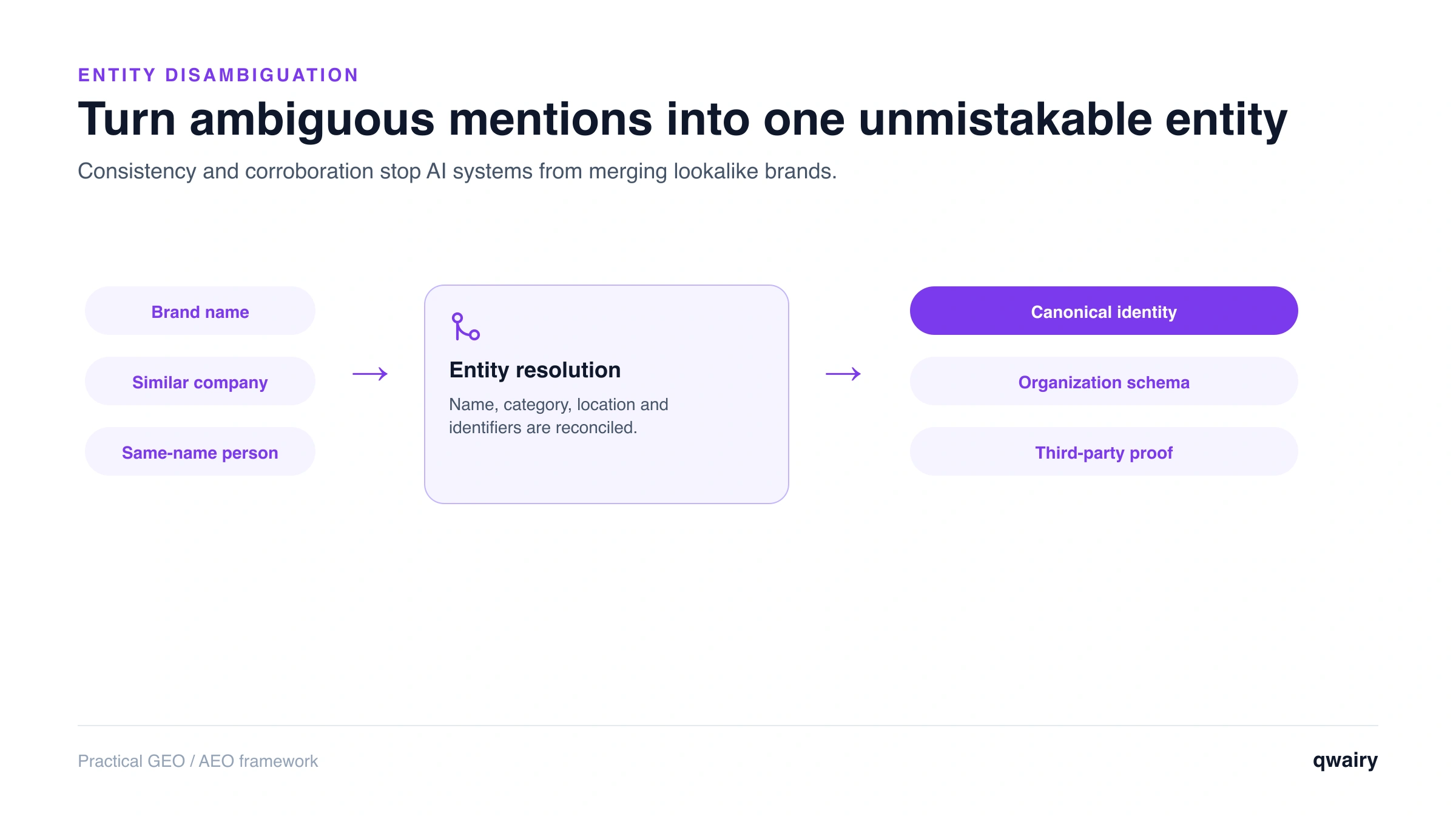
Modern search and AI systems index entities, not just keywords. Google made the shift explicit in 2012 with the Knowledge Graph - famously "things, not strings" . LLM-based answer engines inherit the same premise: a name is a pointer to an entity, and the model's job is to resolve which entity you mean. In academic terms this is named-entity disambiguation, or entity linking - mapping a mention in text to the correct entry in a knowledge base. Resolution goes wrong when the signals are sparse or contradictory. The usual triggers:
Shared or generic names. Dictionary-word brand names (Apex, Nova, Orbit) and common personal names collide with dozens of other entities.
Cross-industry homonyms. A fintech and a clothing label sharing a name; a SaaS tool named after a city or a common word.
Rebrands and acquisitions. The model still holds the old name, or fuses the acquired and acquiring companies into one entity.
Sub-brands and product lines. A product gets conflated with its parent company, or two products blur together.
Thin or inconsistent web presence. If authoritative sources describe you differently - or barely at all - the model fills the gaps with the nearest well-documented lookalike.
Confusion shows up in a handful of recognizable patterns:
The mechanism is the same each time: the model is confident, and confidence is not accuracy. The exact internal disambiguation logic differs per engine and isn't publicly documented in detail, but the levers that shape it are consistent - and they're in your control.
Before you fix anything, confirm what each engine actually believes about you. Treat it as an audit, not a spot check. Run this diagnostic:
Log each finding: engine, the wrong entity, which facts got swapped, and the sources cited. That log becomes both your fix list and your before/after baseline.
Disambiguation means giving machines unambiguous, corroborated signals of who you are - and who you are not. Work through these in order; the early ones do the heaviest lifting.
Pick a single canonical brand name and a consistent legal/entity name, and stop drifting. Align your name - and, where relevant, your address and contact details (NAP) - across your site, social profiles, directories, app stores, and your Google Business Profile . Inconsistent naming is the single most common reason a model can't cleanly bind your entity.
Decide between "Acme," "Acme Inc.," and "Acme.io," then use one form consistently in titles, your About page, and schema.
Add an explicit disambiguator in your own copy: "Acme, the [category] platform" - not just "Acme."
Structured data gives crawlers an explicit, machine-readable identity. On your homepage and About page, add Organization structured data (or LocalBusiness / Person for individuals), and use the sameAs property to link out to every authoritative profile that represents the same entity:
Wikipedia and Wikidata (where they exist)
LinkedIn, Crunchbase, X, GitHub, and your official social accounts
Any industry registry or official listing
sameAs is the web's explicit "these are all the same thing" statement. It's one of the cleanest disambiguation signals you can ship, and you fully control it. Validate it with Google's Rich Results Test and the Schema Markup Validator. Schema alone won't force an LLM to update, but it's a low-cost, high-clarity signal that reinforces everything else.
Run a free audit: see if ChatGPT, Gemini and Copilot recommend you, in about a minute.
Wikidata is a structured, openly licensed knowledge base that feeds Google's Knowledge Graph and is widely reused as grounding data across the web. A correct Wikidata item - with your official name, a precise description, instance of / industry statements, and external identifiers - directly disambiguates you.
Add "also known as" aliases so the model maps naming variants to you, not to a lookalike.
Populate the official website and identifiers (LinkedIn, Crunchbase, and similar) so cross-references corroborate one another.
Follow Wikidata's notability and sourcing rules - statements need verifiable references. How heavily each AI engine leans on Wikidata varies and isn't fully disclosed, but as clean, structured entity data it's a high-leverage, low-cost fix.
Give models one canonical page that states plainly who you are, what category you're in, who you are not, and the facts that define you (founding, location, leadership, products). An unambiguous About / entity page - written for extraction, in plain declarative sentences - is what retrieval engines quote when they want a clean self-description.
Lead with a one-sentence definition: "[Brand] is a [category] company that [does X]."
Where confusion is chronic, add a discreet clarifying line: "Not to be confused with [Lookalike], a [different category]." Even a small explicit contrast helps.
Keep founder, funding, and product facts consistent with your schema and Wikidata - contradictions between your own sources reintroduce ambiguity.
Models trust entities that independent, authoritative sources describe the same way. Every consistent mention - press, industry directories, reputable review sites, podcasts, conference bios - reinforces the correct binding.
Fix your details on Crunchbase, G2, and industry directories so they match your canonical facts.
Pursue coverage that names you precisely and links your official site.
Wikipedia , if you're genuinely notable, carries outsized weight - but pursue it the policy-compliant way, with independent secondary sources, never as an advertisement.
Generic entity-building helps; targeted contrast finishes the job. Once you know exactly which entity you're confused with, make the differences legible:
Ensure your category, location, and identifiers differ clearly across every structured signal.
Use distinct, consistent naming and visual cues (wordmark, logo styling) across profiles.
If a shared name is genuinely unavoidable, lean harder on category and geography as your disambiguators in both copy and schema.
What you're seeing | Likely cause | Primary fix |
Two brands merged into one answer | Weak entity separation, shared name | Wikidata aliases + `sameAs` • explicit contrast copy |
Features or founder credited to a competitor | Sparse authoritative sources | Third-party corroboration + entity home page |
Old name or positioning after a rebrand | Stale grounding data | Update schema, Wikidata, directories; publish a rebrand note |
Invented details | Under-described entity | Publish declarative facts; add Organization schema |
Competitor's site cited under your name | Retrieval grounding on the wrong source | Strengthen your own citable pages; earn on-topic mentions |
See your mentions across ChatGPT, Claude and Perplexity in real time, the moment buyers ask.
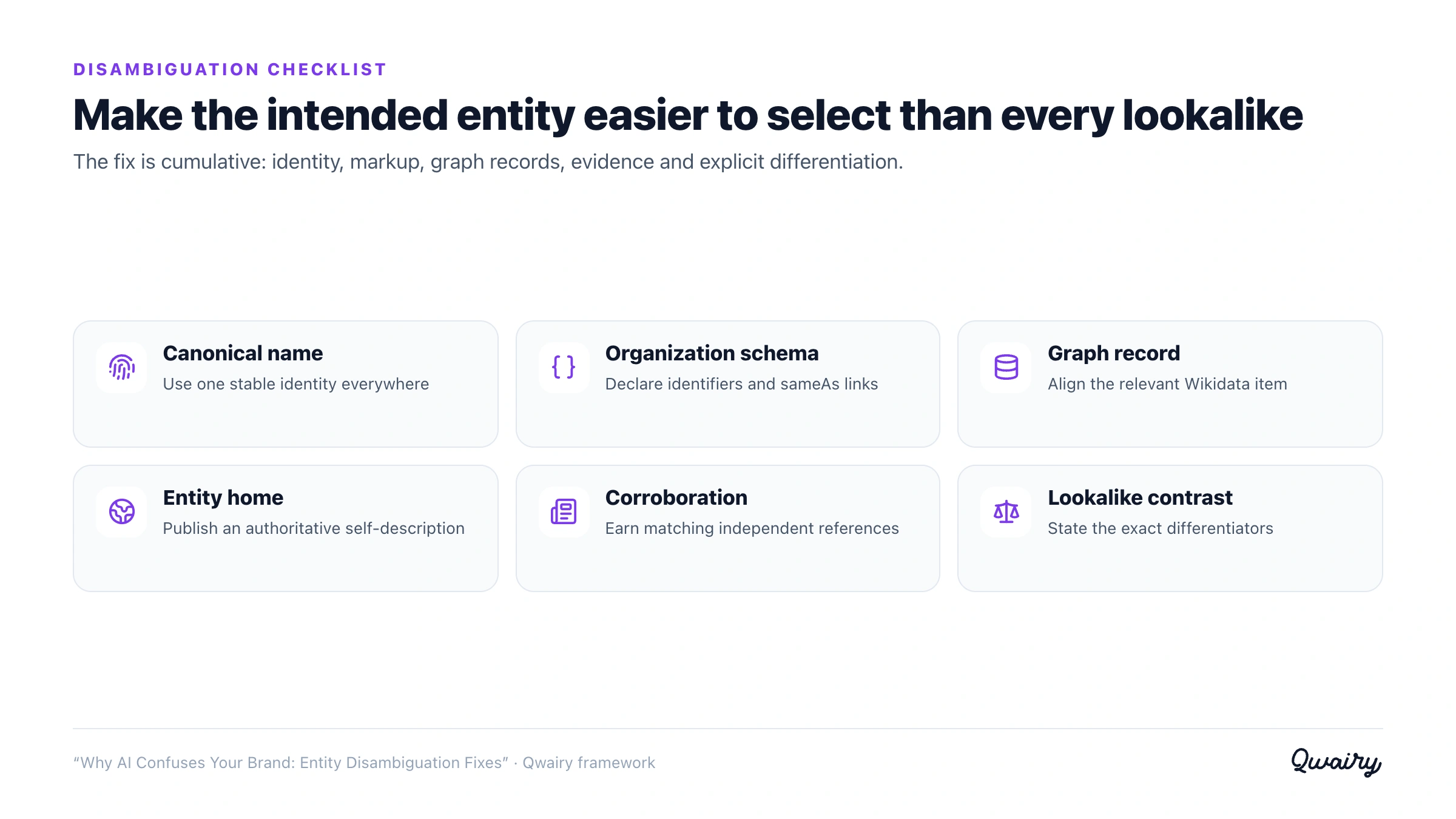
Use this as a working checklist:
One canonical brand name chosen and applied everywhere
NAP / core facts consistent across site, socials, directories, and Google Business Profile
Organization (or Person) schema live on homepage and About page
sameAs links to every authoritative profile
Wikidata item created or corrected, with aliases and identifiers
Plain-language entity home page ("[Brand] is a [category]…")
Explicit contrast line where a real lookalike exists
Third-party sources (Crunchbase, G2, press) aligned to canonical facts
Wikipedia pursued only if genuinely notable, and policy-compliant
Baseline captured across all engines before changes
Re-audit scheduled after sources re-crawl
Entity fixes decay. Sources change, competitors publish, models refresh their grounding, and a rebrand can quietly reintroduce confusion. Disambiguation is a monitoring problem as much as a one-time fix. You want continuous visibility into how every major engine describes you - not a quarterly manual spot check. That means tracking, per engine: whether the right entity is being returned, which facts are attributed to you, which sources are cited, and how perception reads once the confusion clears. This is the layer Qwairy is built for. It monitors how your brand appears across ChatGPT, Claude, Perplexity, Gemini, and Google AI Overviews, surfaces the sources feeding those answers, tracks competitor mentions and perception, and flags when a model attributes the wrong facts - so misattribution shows up in a dashboard instead of in a lost deal. For teams that want their own agents to query this data, an agent-native MCP is available. For more GEO tactics, browse the Qwairy blog .
Continue the entity work: Use entity SEO for AI as the broader roadmap, build a maintained brand knowledge graph , and pursue Wikipedia or Wikidata only when the eligibility and sourcing are legitimate.
AI confuses your brand when your entity is under-defined or too similar to a neighbor. The fix isn't clever prompting - it's making your identity unambiguous in the places machines read: consistent naming, Organization schema with sameAs, a correct Wikidata item, a declarative entity home, aligned third-party sources, and targeted contrast against the specific lookalike. Lay those signals down, verify each engine picks them up, and monitor so the fix holds. Do that, and the model stops guessing - because you've told it, in its own language, exactly who you are.
Answer engines resolve names to entities in a knowledge base, not to literal text. When your entity is weakly defined or shares a name with another well-documented one, the model binds to the wrong entity and inherits its facts. Strengthening and separating your entity signals fixes the root cause rather than the symptom.
Ask each engine "What is [Brand]?" and "What does [Brand], the [category] platform, do?", compare the answers, and inspect any cited sources. Divergence, swapped facts, or competitor URLs in the citations all indicate entity confusion. Run it across every engine, because they can disagree with one another.
Structured data - Organization schema plus sameAs - gives crawlers an explicit, machine-readable statement of your identity and its equivalent profiles. It won't single-handedly force an LLM to update, but it's a low-cost, high-clarity signal that supports every other fix and is fully under your control.
No. Wikipedia helps when you're genuinely notable, but a correct Wikidata item, consistent naming, sameAs links, and aligned third-party sources establish a clear entity without one. Pursue Wikipedia only the policy-compliant way, backed by independent secondary coverage.
It varies. Changes propagate only after engines re-crawl your site and their grounding sources update, which can take weeks. This is why you baseline before changing anything and re-audit afterward, rather than assuming an instant fix.
Invisibility means the model doesn't surface you at all; confusion means it surfaces the wrong facts under your name. Confusion is often more damaging, because a wrong answer reaches the buyer with the model's confidence behind it and looks authoritative.
Track your mentions across ChatGPT, Claude, Perplexity and all major AI platforms. Join 1,500+ brands monitoring their AI presence in real-time.
Free trial • No credit card required • Complete platform access
Other Articles
Answer Engine Optimization (AEO): The Complete 2026 Guide
A complete, practitioner-level guide to Answer Engine Optimization: what AEO is, how answer engines like ChatGPT, Perplexity and Google AI Overviews select and cite content, the core levers, a step-by-step workflow, and how to measure it.
How to Set Up AI Referral Tracking in GA4, Plausible and Matomo
Most analytics tools miss or misclassify AI referral traffic by default. This step-by-step guide shows you how to properly track visits from ChatGPT, Perplexity, Claude, Gemini, and other AI platforms in GA4, Plausible, and Matomo.