
Loading page
AI engines lean on Wikipedia and Wikidata to describe brands and entities. Here's how notability and sourcing rules really work, and the policy-compliant way to earn and keep a presence.

Ask ChatGPT, Perplexity, or Google's AI Overviews to describe a company, a founder, or a product category, and you'll notice something: the answer often reads like a Wikipedia summary. That's not a coincidence. Wikipedia and its structured sibling Wikidata are two of the most influential inputs into how AI systems understand the world - and how they describe you. They feed training data, ground entities, and populate the knowledge panels that AI engines lean on. But you can't buy your way in, and you can't spin your way in either. Both projects run on strict, community-enforced rules about who is notable enough to include and what counts as a reliable source. Break those rules and you don't just fail - you can get your page deleted and your account blocked. This guide covers why Wikipedia and Wikidata matter for AI visibility, the notability and sourcing rules you genuinely have to respect, the policy-compliant way to pursue a presence, a Wikidata primer, and the mistakes that get brands burned.
Wikipedia is overrepresented in AI systems because it's overrepresented in both their training data and their live retrieval. Large language models are trained on huge web corpora, and Wikipedia is a staple of nearly all of them - the GPT-3 paper, for example, lists Wikipedia among its named training datasets (arXiv ). It's clean, broad, well-structured, and openly licensed, which is exactly what model builders want. Retrieval-based engines lean on it too. When Perplexity, ChatGPT search, or Google's AI Overviews assemble a live answer, Wikipedia is frequently among the sources they cite - several independent analyses of AI-cited domains have repeatedly placed it near the top, alongside Reddit and YouTube. The exact share varies by engine, query type, and month, so treat any single figure with caution.
Wikidata's influence is quieter but arguably deeper. Wikidata is a structured, machine-readable knowledge base: every entity gets a stable identifier (a "QID") and a set of typed statements. It powers infoboxes across Wikipedia, and it has fed Google's Knowledge Graph since Google retired its own Freebase database and migrated that data into Wikidata. That Knowledge Graph is what generates the knowledge panels beside search results - the same canonical facts AI systems increasingly reuse.
The real prize isn't a footnote - it's being recognized as an entity. When a model can tie "your brand" to a stable identifier with a clear type ("SaaS company", "founded 2021", "headquartered in Paris"), it stops guessing. It knows which "Apollo" or "Luna" or "Notion" you are, and stops confusing you with the god, the moon, or the competitor two towns over. Wikipedia and Wikidata are two of the strongest, most trusted sources of that grounding. A citation gets you mentioned once; entity grounding shapes how you're described everywhere. Be honest with yourself, though: presence is a strong signal, not a guarantee. Reliance on Wikipedia and Wikidata varies across engines and questions, and neither is a magic switch that forces AI to recommend you.
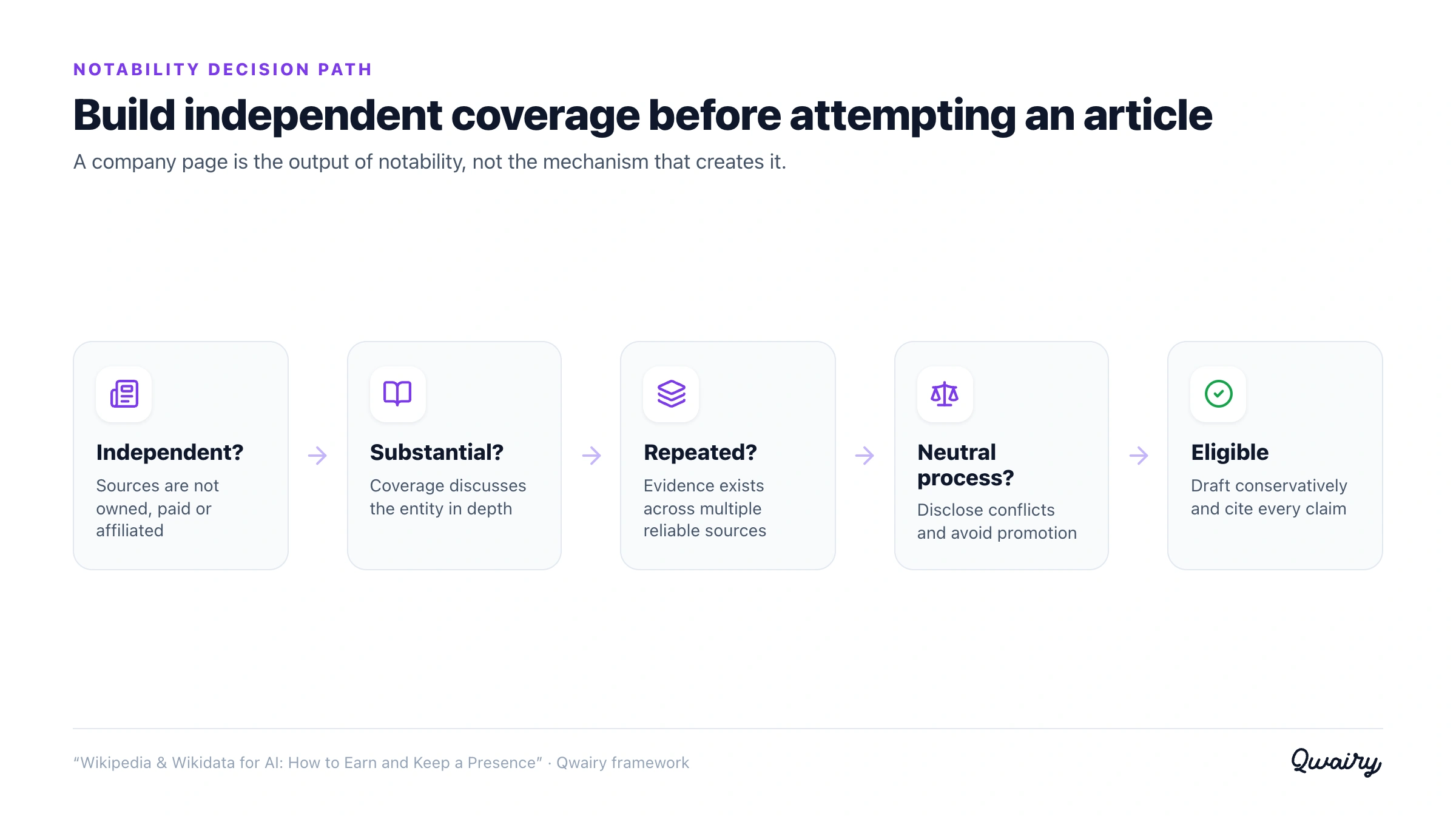
Wikipedia's gatekeeping is a feature, not a bug - and it applies to you whether you like it or not. The bar is called notability, and the sourcing standard behind it is what keeps most brands out.
Wikipedia's general notability guideline asks for "significant coverage in reliable sources that are independent of the subject" (Wikipedia:Notability ). Read that slowly, because every word is load-bearing:
Significant - more than a passing mention. A directory listing or a one-line quote doesn't count.
Reliable - established outlets with editorial standards, not anyone with a URL.
Independent - not you. Your press releases, your blog, your funding announcement written by your PR firm, interviews where you're just talking about yourself - none of these establish notability.
For companies and organizations the bar is higher, not lower. The dedicated guideline (WP:NCORP) explicitly discounts routine coverage like funding rounds, product launches, and PR-driven pieces, and demands genuinely independent, in-depth analysis (WP:NCORP ). Many well-funded startups simply are not notable by this standard yet - and that's a normal, correct outcome.
Run a free audit: see if ChatGPT, Gemini and Copilot recommend you, in about a minute.
Everything on Wikipedia must be verifiable against reliable, published sources (WP:V ). The reliable-sources guideline favors secondary sources with editorial oversight and a reputation for fact-checking (WP:RS ). In practice:
Counts | Doesn't count |
Independent reporting in established press | Press releases and PR wire posts |
Books, academic and industry analysis | Your own website, blog, or docs |
In-depth third-party profiles | Sponsored or paid placements |
Coverage with named editorial standards | Most social posts and forums |
If you can't point to several sources in the left column, you don't have a Wikipedia article yet. The fix is not clever writing - it's earning real coverage first.
Wikidata's inclusion bar is much lower than Wikipedia's, which is why it's often the better first target. Its notability policy accepts an item if it refers to a clearly identifiable entity that can be described with at least one serious, publicly available reference, or if it fills a structural need - for example, linking other items together (Wikidata:Notability ). You do not need a Wikipedia article to have a Wikidata item. That makes Wikidata a realistic, legitimate starting point for many brands that aren't yet Wikipedia-notable - provided the statements are accurate and sourced.
The fastest way to torch your reputation on Wikipedia is to edit your own article as if no one will notice. They will. Wikipedia strongly discourages editing about yourself, your employer, or your clients - that's a conflict of interest (WP:COI ). And if you're being paid to edit - including as an employee, agency, or freelancer - the Wikimedia Terms of Use require you to disclose it, and Wikipedia's paid-contribution disclosure policy spells out how. Undisclosed paid editing and promotional self-editing routinely end in:
Deletion of the article, sometimes with the topic protected against re-creation.
Blocks on the accounts involved.
Public embarrassment - COI edits are logged, visible, and occasionally reported on by journalists.
Do not create sockpuppet accounts, do not quietly pay someone to slip your page in, and do not treat the article as marketing copy. Wikipedia is not a brand asset you control; it's an encyclopedia that happens to describe you.
There is a legitimate path - it's just slower and more honest than most agencies admit. Follow it in order:
{{request edit}} template and let an uninvolved editor act on it.See your mentions across ChatGPT, Claude and Perplexity in real time, the moment buyers ask.
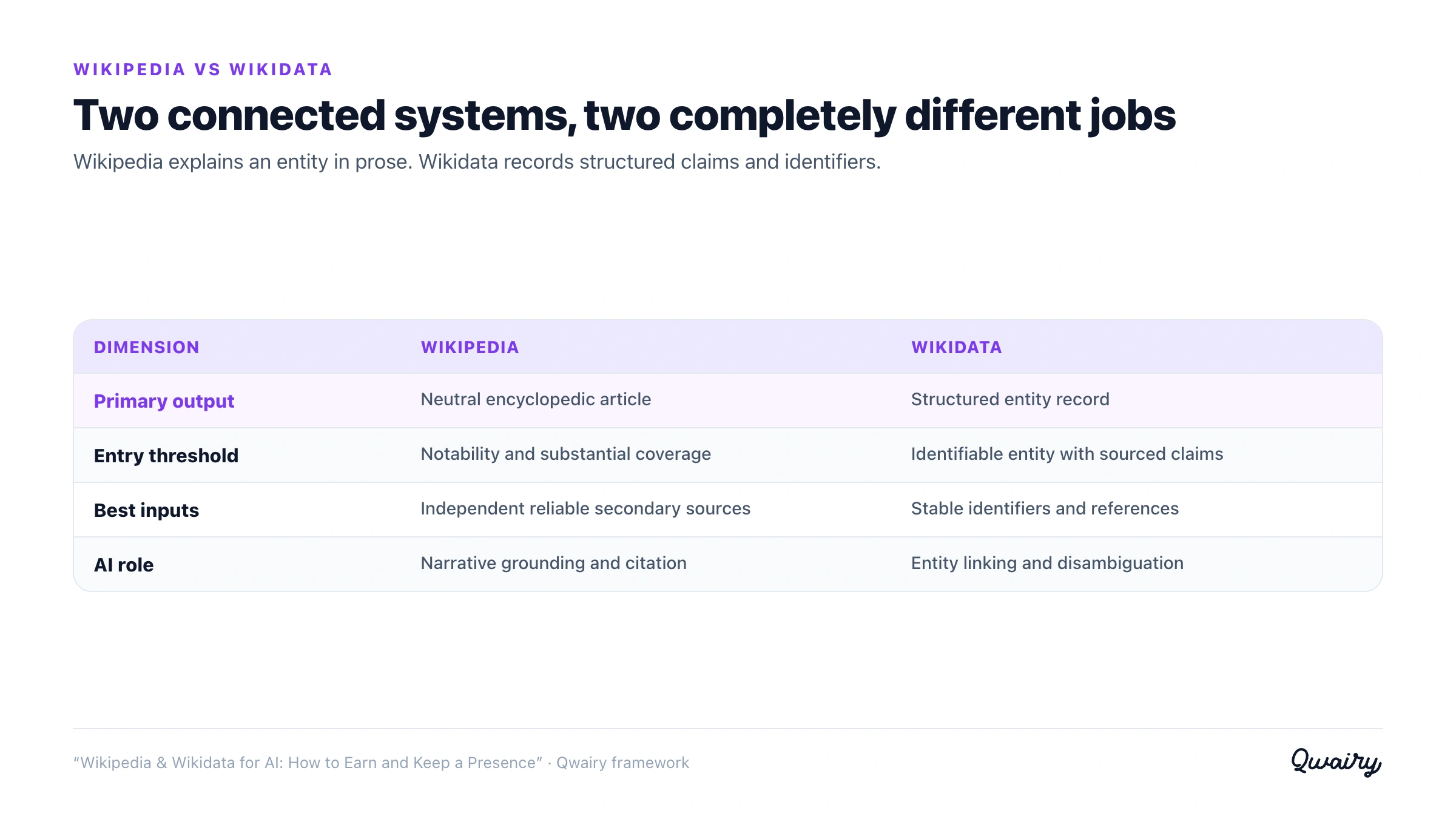
Wikidata is a database of items, and once you understand four concepts you can navigate it.
Items and QIDs. Every entity is an item with a permanent ID like Q42. That QID is the canonical anchor other systems - including AI - can resolve you to.
Properties and statements. Facts are expressed as property-value pairs: instance of (P31) → business; inception (P571) → a date; official website (P856) → your URL. Together these are "statements".
References. Good statements carry a reference to a reliable source. Unreferenced claims are weak and can be removed.
Identifiers and sameAs links. Wikidata connects your item to other authoritative databases and profiles. Those cross-links are exactly the entity-disambiguation signals AI systems value.
To pursue one legitimately: search Wikidata first to confirm no item already exists, create the item with a clear label and description, add well-referenced statements for the core facts, and link out to authoritative identifiers. Keep it factual - Wikidata is not a place for taglines. Start with the Wikidata introduction .
You can't manage what you can't see - and Wikipedia/Wikidata work is slow enough that you need feedback to justify it. The questions worth tracking: Are AI engines describing your brand accurately and consistently? Is Wikipedia showing up as a cited source in answers about your category? Did a corrected Wikidata statement change how models refer to you? This is where continuous AI-visibility monitoring earns its keep. Platforms like Qwairy track how your brand appears across ChatGPT, Claude, Perplexity, Gemini, and Google AI Overviews - which sources get cited, how you're described, and how that shifts over time - so you can connect entity work to real movement instead of guessing. Pair the honest, policy-compliant groundwork above with measurement, and you'll know whether your presence is actually paying off.
Build the foundation before the encyclopedia layer: Start with entity SEO for AI , create a consistent brand knowledge graph , and use the entity disambiguation playbook when names or facts are being conflated.
Wikipedia and Wikidata are among the highest-leverage entity signals in AI search - but they reward patience and punish shortcuts. Earn real coverage, respect notability and sourcing rules, disclose any conflict of interest, and let the community's process work. Start with Wikidata where you can, pursue Wikipedia only when the sources genuinely support it, and measure the downstream effect on how AI describes you. Do it the honest way and the presence sticks; try to game it and you'll spend more energy getting deleted than you ever saved.
No. A Wikipedia article helps, but it isn't required. A well-referenced Wikidata item, consistent structured data on your own site, and authoritative third-party coverage all contribute to entity recognition. Wikipedia is one strong signal among several - not a prerequisite.
Technically you can edit, but you shouldn't create an article about your own brand directly. That's a conflict of interest, and paid editing must be disclosed under the Wikimedia Terms of Use. The right approach is to disclose your COI and submit a draft through Articles for Creation so an independent reviewer decides.
Wikipedia is an encyclopedia of human-readable articles; Wikidata is a structured, machine-readable database of entities and facts. Wikidata has a much lower inclusion bar and can exist without a Wikipedia article, which often makes it the more realistic first target for a brand.
Strict. The organizations-and-companies guideline (WP:NCORP) explicitly discounts routine coverage like funding announcements and product launches, and requires significant, independent, in-depth sources. Many funded startups are simply not notable yet - and that's an expected outcome, not a failure of your PR.
No. Presence is a strong grounding signal, not a guarantee. How much any given engine relies on Wikipedia or Wikidata varies by model and query, and being described accurately is different from being recommended. Treat it as improving the odds - and the accuracy - of how you're represented.
Monitor how AI engines describe and cite your brand over time. Track whether Wikipedia appears as a cited source in answers about your category, whether your facts are represented correctly, and whether changes to your Wikidata item move the needle. Continuous AI-visibility tracking - for example with Qwairy - turns that from guesswork into something you can actually see.
Track your mentions across ChatGPT, Claude, Perplexity and all major AI platforms. Join 1,500+ brands monitoring their AI presence in real-time.
Free trial • No credit card required • Complete platform access
Other Articles
Answer Engine Optimization (AEO): The Complete 2026 Guide
A complete, practitioner-level guide to Answer Engine Optimization: what AEO is, how answer engines like ChatGPT, Perplexity and Google AI Overviews select and cite content, the core levers, a step-by-step workflow, and how to measure it.
How to Set Up AI Referral Tracking in GA4, Plausible and Matomo
Most analytics tools miss or misclassify AI referral traffic by default. This step-by-step guide shows you how to properly track visits from ChatGPT, Perplexity, Claude, Gemini, and other AI platforms in GA4, Plausible, and Matomo.