
Loading page
A practical guide to how Claude sources and cites information, the tactics that make your content citable, and how to measure whether Claude is naming your brand.
Claude has quietly become one of the most influential ways people research, decide, and buy. When someone asks Claude to compare tools, explain a category, or recommend a vendor, the brands it names - and the sources it links - shape the shortlist long before a human opens a search engine. Getting cited by Claude is not the same as ranking on Google. Claude assembles answers from a mix of what it learned in training, what it retrieves from the live web, and what you hand it through tools. Each of those paths has its own rules, and optimizing for one does little for the others. The good news is that the levers are concrete. Once you understand how Claude builds an answer and where its citations actually come from, you can make your content the thing it reaches for. This guide breaks down how Claude sources and cites information, what tends to get surfaced, the tactics that move the needle, and how to measure whether any of it is working.
Claude answers from three distinct places, and "getting cited" means something different in each.
Parametric knowledge - what Claude absorbed during training. Anthropic operates a crawler, ClaudeBot, that collects public web content that may contribute to model training datasets. Content in this layer shapes what Claude "knows" about your brand and category, but it typically surfaces without a live link.
Live web retrieval - what Claude fetches in real time. Anthropic added web search to Claude and the API in 2025 , and web-grounded responses include inline citations that link back to the original sources. For this, Anthropic runs separate agents: Claude-SearchBot for indexing content for search results, and Claude-User for user-initiated fetches when someone asks Claude a question (Search Engine Land ).
Tool-supplied context - what a system hands Claude at request time. Through the Model Context Protocol (MCP) , an open standard Anthropic released in late 2024, Claude can pull structured data from connected systems. Separately, the Citations feature on the Anthropic API lets developers ground Claude's answers in supplied documents with precise, passage-level references.
Being "cited by Claude" most often means appearing as a linked source in a web-grounded answer. But the strongest position is being present in all three layers at once: known in training, retrievable on the live web, and easy for tools to surface.
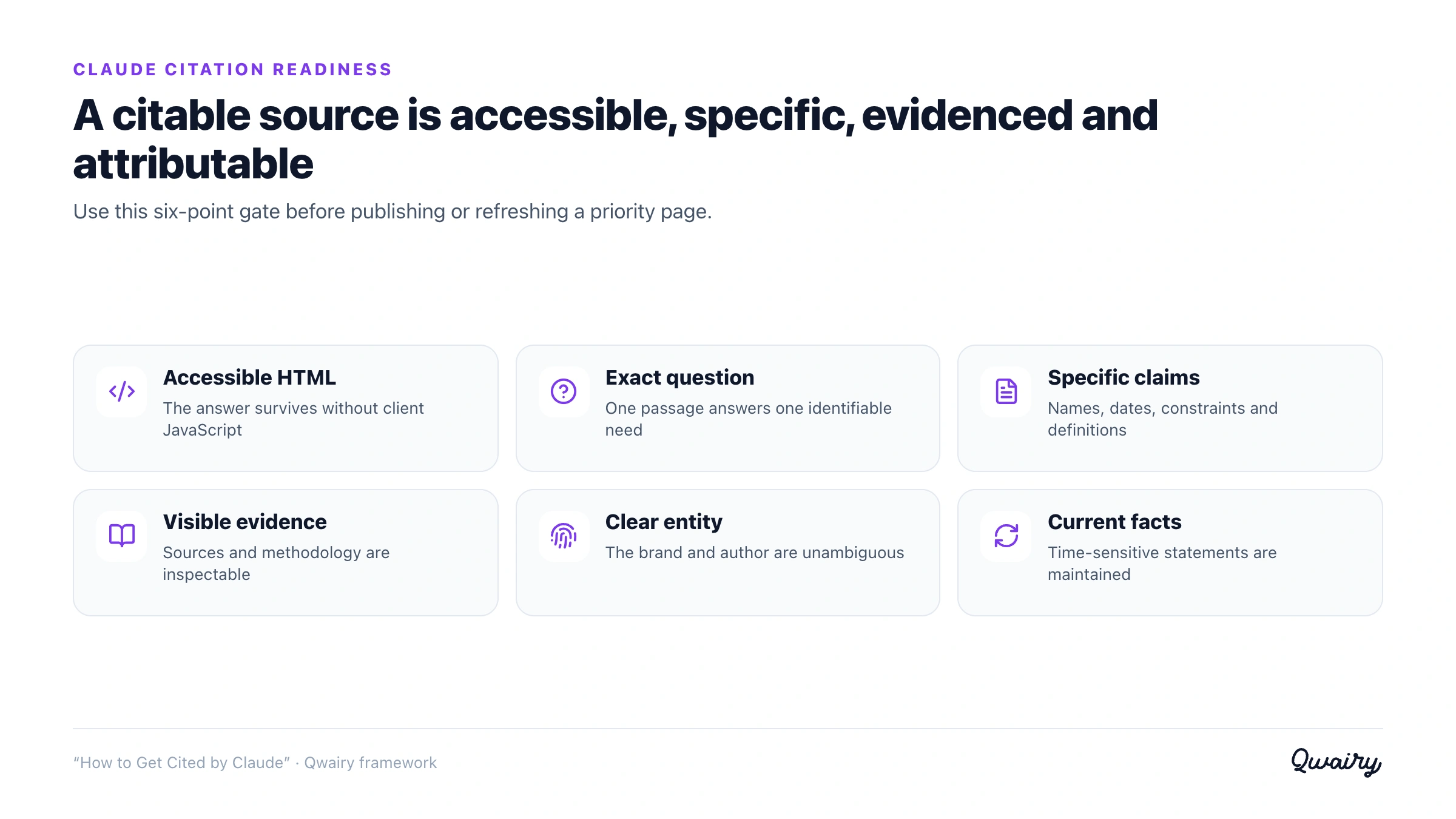
Claude favors sources that are clearly the best, most verifiable answer to the exact question asked - not just the highest-ranked page. AI answer engines retrieve many pages but cite only a handful, so visibility depends on being selected, not merely being found. The foundational research here - GEO: Generative Engine Optimization (Aggarwal et al., first released on arXiv in 2023 and presented at ACM SIGKDD 2024) - showed that adding citations, quotations, and statistics to a page measurably increased how often generative engines surfaced it, sometimes by large margins. The broad, repeatable pattern across studies is that topical relevance and being retrieved into the model's context are the biggest drivers of getting cited - pure domain authority matters less here than it does in classic SEO. In practice, Claude leans toward content that is:
Directly responsive - it answers the specific question, not a loosely related one.
Structured for extraction - clear headings, short self-contained passages, and a claim stated plainly enough to quote.
Verifiable - concrete facts, figures, and named sources, rather than vague marketing language.
Trustworthy at the entity level - the brand and author are recognizable, and the claims align with what other sources say.
Fresh, when the question is time-sensitive - for anything current, retrievable and recently updated pages win.
Optimizing for Claude is less about tricking a ranking algorithm and more about being genuinely, unambiguously the best answer - and making that answer easy to read, verify, and fetch.
Map the real questions your buyers ask Claude, then build a page that answers each one head-on. Lead with a direct, quotable answer in the first sentences of the relevant section, and back it with specifics. Claude rewards pages that resolve the question completely over pages that circle it.
Use descriptive ## and ### headings that mirror how people phrase questions.
Keep the load-bearing claim in a short, self-contained passage - a model should be able to lift one paragraph and have it stand alone.
Add tables, numbered steps, and bulleted comparisons where they clarify.
Include real data points and cite your own sources; quotable evidence gets absorbed into answers.
Run a free audit: see if ChatGPT, Gemini and Copilot recommend you, in about a minute.
Claude's training layer is where long-term brand memory lives. Establish your brand as a clear, consistent entity: a coherent name and description everywhere it appears, an authoritative "about" and product pages, author bylines with credentials, and structured data (Organization, Article, FAQPage) so machines can disambiguate you. Consistent presence across reputable third-party sources is what makes Claude associate your brand with your category.
What other credible sites say about you often matters more than what you say about yourself. Independent reviews, industry publications, well-moderated communities, and reference pages all feed both training data and live retrieval. Being referenced as a source elsewhere is one of the strongest signals that you're worth citing.
For any question where the answer changes over time, recency is a ranking factor in retrieval. Update your cornerstone pages, timestamp them honestly, and retire stale claims. A page that was accurate two years ago can be quietly passed over for a fresher competitor.
This is the technical foundation most brands overlook. Anthropic's official documentation defines three independently controllable bots:
Claude-SearchBot indexes content to improve Claude's search results. Blocking it may reduce your visibility and the accuracy of Claude's search answers.
Claude-User retrieves pages in response to a user's request. Blocking it can prevent Claude from fetching your content for user-directed web search.
ClaudeBot collects public-web content that may contribute to model development. Blocking it signals that future material should be excluded from Anthropic's training datasets.
Blocking ClaudeBot does not automatically block Claude-SearchBot or Claude-User. For brands that want citations without training access, allow the two retrieval agents and make a separate policy decision for the training bot. Anthropic states that its bots honor robots.txt and supports Crawl-delay for rate control.
Claude-SearchBot and Claude-User have access in robots.txt?ClaudeBot?See your mentions across ChatGPT, Claude and Perplexity in real time, the moment buyers ask.
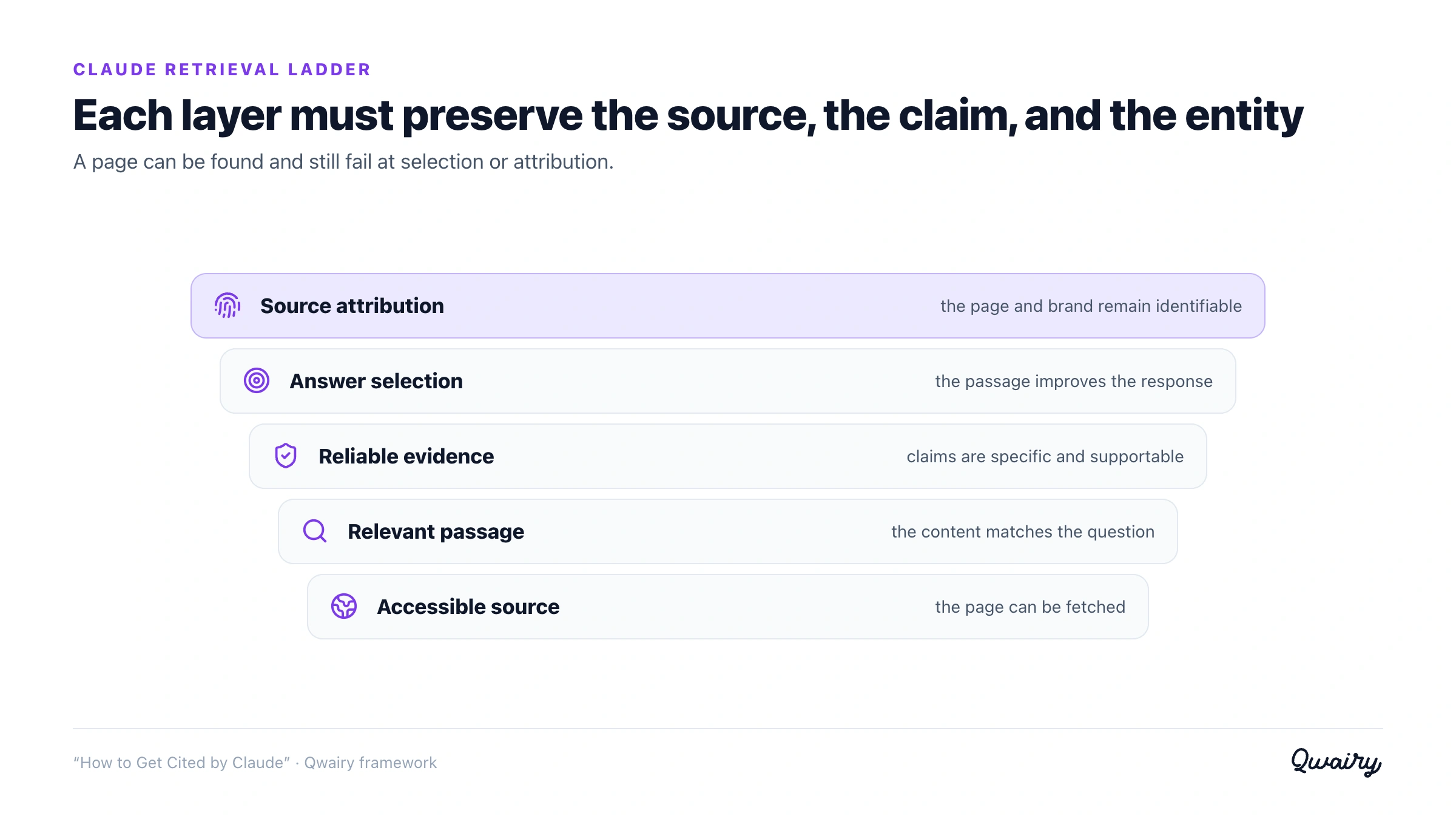
Claude visibility fails in layers. Diagnose the lowest broken layer first, because work higher in the ladder cannot compensate for a failure below it.
Level | Question | Pass condition |
1. Search discovery | Can Claude-SearchBot discover and index the page? | The bot is allowed, receives a successful response, and reaches the canonical content. |
2. User retrieval | Can Claude-User fetch the page when a user requests it? | The page is reachable without authentication, challenge loops, or client-only content. |
3. Passage extraction | Can one section answer the target question independently? | The copied passage preserves the answer, entities, evidence, and necessary caveat. |
4. Source confidence | Is the page safer to cite than competing sources? | Claims are sourced, authorship is clear, dates are honest, and uncertainty is explicit. |
5. Repeatable attribution | Does Claude cite the right URL and brand across repeated tests? | The citation recurs across the monitored prompt set without entity confusion. |
A page at Level 3 is readable but not necessarily trusted. A page at Level 4 is credible but not necessarily retrieved for the right prompts. Level 5 is the operating target: repeatable attribution, measured over time, with the same entity and canonical URL. Record the first failing level for every priority page. That single field makes the remediation obvious: crawler configuration, rendering, passage rewrite, evidence, or entity correction.
You can't optimize what you can't see - and Claude gives no dashboard of who it names. Because answers vary by phrasing, model, and moment, spot-checking a few prompts yourself is unreliable and unrepeatable. This is exactly the gap Qwairy closes. It tracks how your brand appears across the major AI engines - Claude included - measuring how often you're mentioned, which of your URLs get pulled as sources, how you compare with competitors on citation share, and the sentiment attached to your brand in AI answers. That turns "are we in Claude's answers?" into a metric you can trend over time and tie to editorial and PR work. For teams building on top of it, an agent-native MCP server makes the same data available directly to AI agents. If you want the wider playbook across every engine, the Qwairy blog covers the full GEO and AEO landscape. Measure, ship an improvement, and watch whether your citation share moves. That feedback loop - not guesswork - is what compounds.
Extend the Claude playbook: Apply the cross-engine citation framework , configure Anthropic access with the AI crawler guide , and strengthen recognition through entity SEO for AI .
Getting cited by Claude comes down to three things: being known (present and consistent in training data), being retrievable (crawlable, fresh, and structured for the live web), and being the best answer (directly responsive, verifiable, and quotable). Nail those, and Claude has every reason to reach for you. Then measure relentlessly, because in a space this new, the brands that treat AI visibility as a tracked, iterated discipline will pull steadily ahead of the ones still guessing.
Not directly. ClaudeBot governs training-data collection, while live citations in web-grounded answers come through Claude-SearchBot and Claude-User, which are controlled separately. Blocking ClaudeBot only removes your content from potential training datasets - you can still be retrieved and cited live, as long as the search and user-fetch bots have access.
The core principles - be relevant, structured, authoritative, and fresh - carry across all of them, but the retrieval behavior differs. Perplexity tends to cite many sources per answer, ChatGPT fewer, and Claude has its own crawlers and its own blend of trained knowledge and live search. The practical takeaway is to optimize the fundamentals once and then measure each engine separately, because citation share rarely looks the same across them.
Anthropic has not published the full details of Claude's retrieval backend, and it runs its own Claude-SearchBot for indexing, which points to a distinct retrieval layer rather than a straight dependency on Google. The safe assumption is that a strong SEO foundation helps but is not sufficient on its own - you also need to be crawlable and citable by Claude's specific bots.
For live web retrieval, changes can surface relatively quickly once Claude-SearchBot and Claude-User can reach updated pages. Influencing the training layer is much slower and tied to model update cycles, so brand-recognition gains accrue over months. Treat live-retrieval optimization as the fast lane and entity-building as the long game.
Yes - robots.txt lets you allow or disallow each Anthropic crawler independently, and per-path rules let you expose the pages you want cited while restricting others. Keep your highest-value, most answer-ready pages open to Claude-SearchBot and Claude-User. Just remember that blocking a bot removes the associated visibility, not just the crawl.
Structured data isn't a hard requirement, but it helps Claude parse and disambiguate your content and your brand entity, which supports selection. Organization, Article, and FAQPage markup are sensible starting points. Prioritize genuinely clear, extractable content first; treat schema as an amplifier, not a substitute.
Track your mentions across ChatGPT, Claude, Perplexity and all major AI platforms. Join 1,500+ brands monitoring their AI presence in real-time.
Free trial • No credit card required • Complete platform access
Other Articles
Answer Engine Optimization (AEO): The Complete 2026 Guide
A complete, practitioner-level guide to Answer Engine Optimization: what AEO is, how answer engines like ChatGPT, Perplexity and Google AI Overviews select and cite content, the core levers, a step-by-step workflow, and how to measure it.
How to Set Up AI Referral Tracking in GA4, Plausible and Matomo
Most analytics tools miss or misclassify AI referral traffic by default. This step-by-step guide shows you how to properly track visits from ChatGPT, Perplexity, Claude, Gemini, and other AI platforms in GA4, Plausible, and Matomo.