
Loading page
Google Gemini grounds its answers in Google Search, so getting cited comes down to a strong SEO foundation, answer-first structure, and a clear brand entity. Here's how to earn the citation and measure it across AI engines.

Google Gemini is no longer a standalone chatbot you visit once out of curiosity. It is the model layer running underneath a growing share of how people get answers from Google - the Gemini app, AI Overviews at the top of the results page, the new AI Mode tab, and AI features woven into Chrome, Android, and Workspace. That changes what "ranking" means. When Gemini answers a question, it often names its sources and links to them. Being one of those cited sources is the new visibility. Miss it, and you can rank on page one and still be invisible inside the answer the user actually reads. The good news: because Gemini leans heavily on Google's own Search index to ground its answers, the levers are more familiar than they look. Your SEO foundation is not obsolete here - it is the single biggest input. This guide explains how Gemini finds and picks sources, why your search foundation matters more than any "AI hack," the concrete steps to become citable, and how to measure whether it is working.
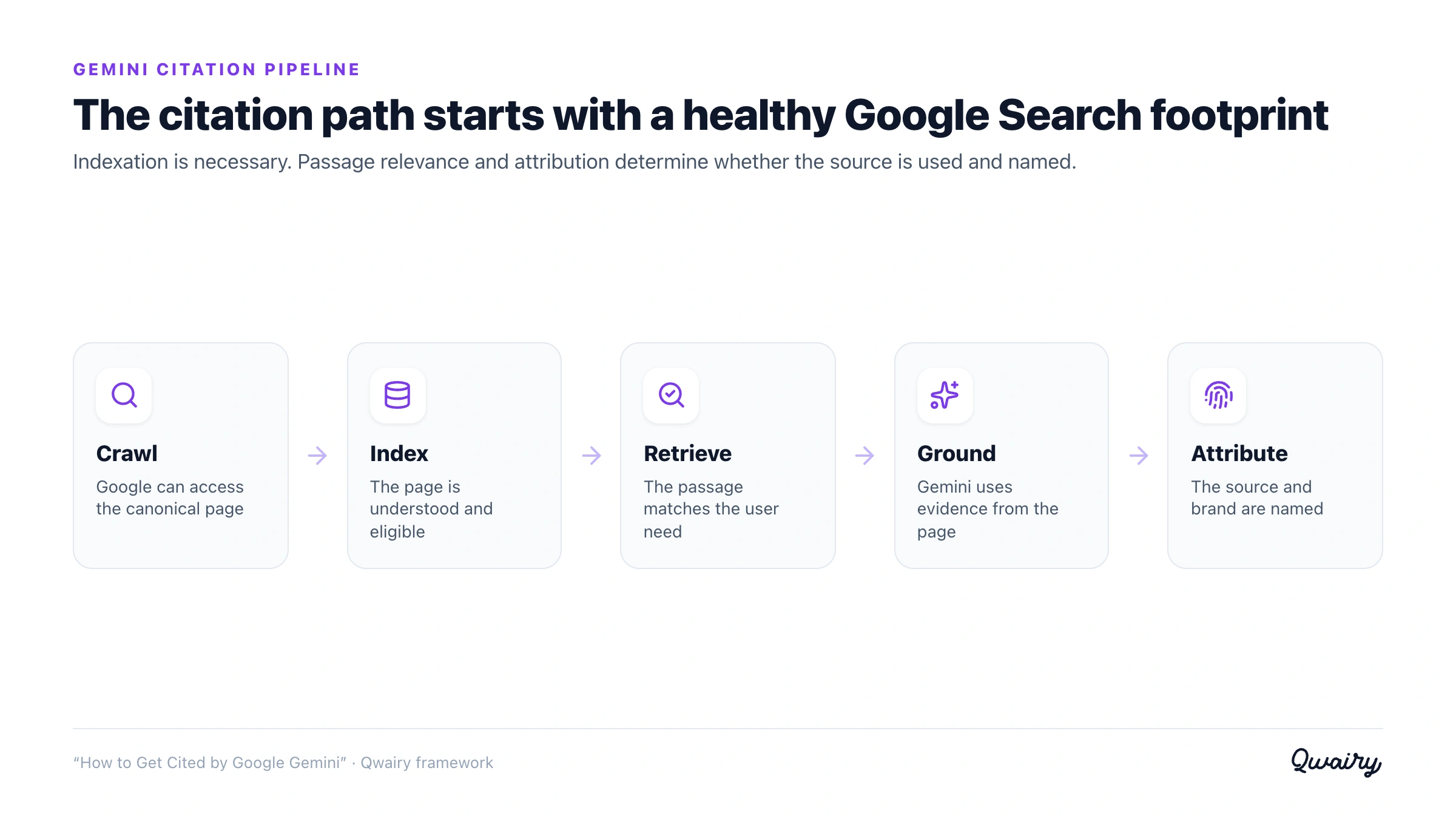
Gemini answers from two places: what it learned in training, and what it retrieves in real time. The first is its parametric knowledge - the model's internal weights. The second is retrieval, and for Gemini that retrieval channel is Google Search. Google calls this grounding with Google Search . When grounding is on, Gemini issues search queries, pulls in relevant web results, and generates its answer against that live evidence - then returns grounding metadata that includes the specific web sources and inline citations it used. The consumer Gemini app works on the same principle: for anything current, factual, or local, it grounds in Search rather than relying on memory alone, and surfaces links so users can verify.
Citations are separate from mentions. Gemini can talk about your brand without linking to you - that comes from what it absorbed in training - and it can cite a page without your brand being the subject. Getting cited, earning the clickable link, is what this article is about, because that is the part you can most directly influence through the same channel Google already ranks you in.
Gemini citations and Google's search infrastructure are tightly connected, but they are not one simple ranking pipe. The Gemini app can ground answers with Google Search, while AI Overviews and AI Mode are Search features built with Gemini models and Google's search systems.
Gemini with Google Search grounding can retrieve current web sources and show supporting links.
AI Overviews summarize selected queries inside Google Search.
AI Mode uses query fan-out to run related searches, then assembles a broader, multi-turn response.
For site owners, the practical foundation is Google crawlability, indexing, relevance, and trust. Google's guidance for AI features says the normal SEO fundamentals still apply and that no special schema or AI text file is required.
Do not confuse Googlebot with Google-Extended. Googlebot controls access to Google Search, including its AI features. Google-Extended is a separate robots.txt token for model training and grounding in Gemini Apps and Vertex AI; Google states that it does not affect inclusion or ranking in Google Search.
If Gemini grounds in Google Search, then being findable and trusted in Google Search is upstream of every citation. Three foundations matter most.
Crawlability and indexing. A page that is not crawled and indexed cannot be retrieved. Confirm your important pages are indexed, that you are not blocking Googlebot, and that content renders without requiring heavy client-side JavaScript that crawlers may not execute.
Relevance and ranking for the question - and its sub-questions. Because AI Mode fans a single question out into many, your content wins by covering not just the head query but the follow-ups around it: comparisons, "how," "why," edge cases, and definitions. Breadth of genuinely useful sub-topic coverage helps you show up across the fan-out.
Authority and E-E-A-T. Google has long emphasized experience, expertise, authoritativeness, and trust across its ranking and quality systems, and the same signals feed what gets surfaced in AI answers. First-hand experience, clear authorship, links to primary sources, and a strong external reputation all raise the odds that Gemini treats you as a safe source to cite.
Gemini quotes passages, not whole pages. A page that ranks but buries its answer in the tenth paragraph is harder to lift than one that answers cleanly and early.
Lead with the answer. State the direct answer in the first sentence or two under a heading, then expand. This "answer-first" pattern is easy for a model to extract verbatim.
Use descriptive headings that mirror real questions. ## How much does X cost? beats ## Pricing.
Break out lists, steps, and tables. Structured chunks map cleanly onto the format Gemini uses to compose answers.
Keep each section self-contained. Assume a passage may be read out of context; give it enough standing meaning to be quoted alone.
Add supporting structured data where it fits - Organization, Article and author, FAQ, and How-To markup help disambiguate your content and your entity, even though schema alone does not guarantee inclusion.
Run a free audit: see if ChatGPT, Gemini and Copilot recommend you, in about a minute.
AI systems reason about the world in entities - people, brands, products - not just keywords. If Google clearly understands who you are and what you are authoritative on, Gemini is likelier to cite you for the topics you own.
Keep your name, category, and key facts consistent across your site and the wider web.
Implement Organization and sameAs schema linking your official profiles.
Pursue durable, authoritative references - including, where you are genuinely notable, Wikipedia and Wikidata, which are heavily weighted entity sources.
Earn mentions and links from sites already trusted in your niche. Off-site citations are how authority gets built in the first place.
Work through this in order. Each step is a prerequisite for the next one paying off.
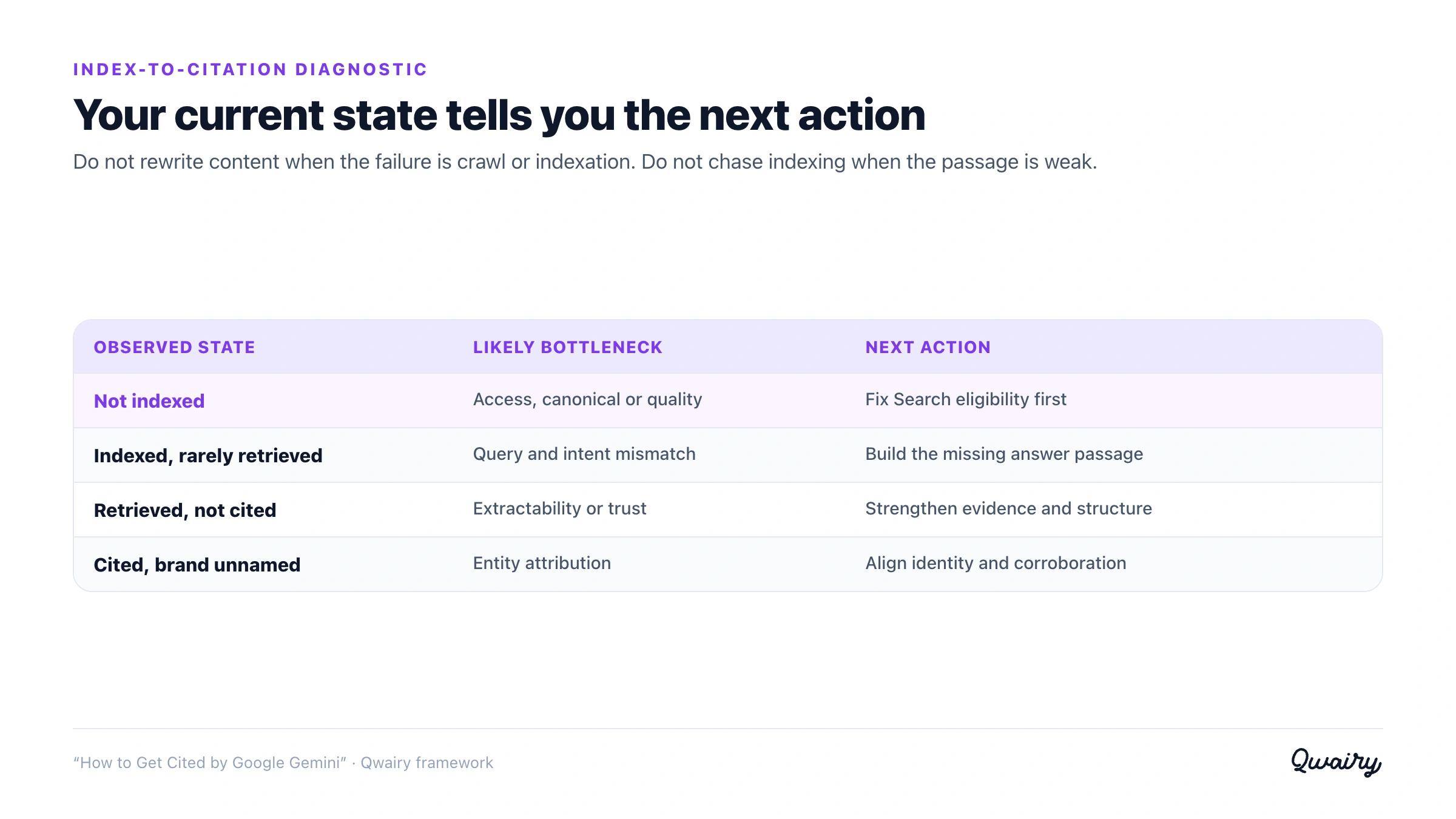
Use Search visibility and AI visibility together. The combination identifies the next action more accurately than either metric alone.
Search state | Gemini or AI citation state | Likely bottleneck | Next action |
Not indexed | Not cited | Discovery, crawl, rendering, canonical, or indexability | Fix the technical foundation before rewriting content. |
Indexed but not competitive | Not cited | Intent match, topical depth, authority, or freshness | Compare the page with the sources Google retrieves for the query and its fan-out. |
Competitive organic result | Not cited | Passage extractability or sub-question mismatch | Rewrite the decisive section answer-first and cover the missing follow-up. |
Cited | Wrong page or wrong brand | Canonical or entity ambiguity | Strengthen internal links, stable IDs, sameAs, and page-level attribution. |
Cited correctly | Unstable across tests | Weak consensus, freshness, or competing evidence | Improve corroboration and monitor a fixed prompt cohort over time. |
The matrix prevents wasted work. A crawl failure does not need more copy, and a top-ranking page ignored by Gemini does not need another generic SEO audit. Diagnose the state first, then change one layer.
See your mentions across ChatGPT, Claude and Perplexity in real time, the moment buyers ask.
This is where most teams go blind. A Gemini citation is not a normal search click, and standard analytics were not built to see it.
Referral traffic from the Gemini app can appear in your analytics (for example, referrals from gemini.google.com), but it captures only users who click through - and many read the answer without ever clicking.
AI Overviews and AI Mode citations mostly happen inside Google, so Search Console shows the impression and click for the query but does not separate "cited in the AI answer" from a classic blue link.
Manual spot-checks - asking Gemini your priority questions and noting who it cites - work for a handful of prompts but do not scale or trend over time.
To manage this properly you need to monitor, at the prompt level and across engines, whether Gemini - and ChatGPT, Perplexity, Claude, and Google AI Overviews - is surfacing and citing you, which sources it pulls from, and how your share of citations moves against competitors. This cross-engine visibility and citation tracking is exactly what Qwairy is built for, with an agent-native MCP so your own tools can query the data directly. If you optimize without measuring, you are guessing.
Extend the Gemini playbook: Apply the cross-engine citation framework , compare the AI Overview ranking factors , and strengthen machine understanding with entity SEO for AI .
Getting cited by Gemini is less exotic than it sounds. Because Gemini grounds in Google Search, the same foundations that win rankings - crawlable pages, genuine authority, answer-first structure, and a clear brand entity - are what make you citable. The shift is in what you optimize for: not just a position in a list of links, but a place inside the answer itself. Build the foundation, structure for extraction, strengthen your entity, and measure relentlessly across engines.
Not fundamentally. Gemini grounds its answers in Google Search, so classic SEO - crawlability, rankings, authority, and quality content - is the foundation. The main additions are structuring content so answers are easy to extract and making sure your brand reads as a clear, consistent entity.
No. There is no special tag or setting that forces inclusion. Google's guidance is that the same signals behind strong organic performance determine what appears in its AI features. You influence citations indirectly, by being an authoritative, well-structured, discoverable source.
Ranking strongly helps, because grounding pulls from Search, but AI Mode's query fan-out runs many related searches and can surface pages that rank for a specific sub-question rather than the head term. Covering the full question space, not just the main keyword, widens your chances.
No. Structured data helps machines understand your content and entity and can support eligibility, but it is not a guarantee of inclusion. Treat schema as one supporting signal alongside content quality, authority, and clear structure.
Gemini is tied tightly to Google's index, so your Google SEO foundation is the dominant lever. Perplexity is retrieval-heavy and often favors fresh, structured, and community sources, while ChatGPT blends its training with its own browsing. The core principles overlap, but the weighting of tactics differs by engine.
Manual checks catch a few prompts, and referral traffic from the Gemini app shows only the users who click. To trend it properly, use an AI-visibility tool that tracks, per prompt and across engines, whether you are surfaced and cited and how your share compares with competitors.
Track your mentions across ChatGPT, Claude, Perplexity and all major AI platforms. Join 1,500+ brands monitoring their AI presence in real-time.
Free trial • No credit card required • Complete platform access
Other Articles
Answer Engine Optimization (AEO): The Complete 2026 Guide
A complete, practitioner-level guide to Answer Engine Optimization: what AEO is, how answer engines like ChatGPT, Perplexity and Google AI Overviews select and cite content, the core levers, a step-by-step workflow, and how to measure it.
How to Set Up AI Referral Tracking in GA4, Plausible and Matomo
Most analytics tools miss or misclassify AI referral traffic by default. This step-by-step guide shows you how to properly track visits from ChatGPT, Perplexity, Claude, Gemini, and other AI platforms in GA4, Plausible, and Matomo.