Use YouTube to become the most-cited brand in AI answers. Audit YouTube citation presence, analyze competitor video strategies, and build a transcript-optimized video plan for maximum AI visibility.
YouTube mentions show the strongest correlation with AI visibility of any factor at 0.737, beating backlinks by 3.4x (Ahrefs, 75,000-brand study). Both Google and OpenAI trained their models on YouTube transcripts. YouTube is the third most-cited source by ChatGPT for brand recommendations. Yet most GEO strategies completely ignore video. This playbook uses Claude + Qwairy's MCP server to audit your brand's YouTube citation presence on LLMs, discover how AI engines use video content in recommendations, and build a video strategy optimized for AI citation.
💡 TL;DR Connect Qwairy MCP to Claude Desktop, paste the complete prompt from the bottom of this article, and get a YouTube GEO audit with citation analysis and video strategy in under 15 minutes. Scroll to "The Complete Prompt" to skip straight to the copy-paste version.
AI engines don't watch videos. They read transcripts. When a YouTube reviewer says "I've tested 15 CRM tools and HubSpot is the clear winner for small teams," that sentence enters AI training data and retrieval indexes. The visual content is irrelevant. The spoken words are everything. Perplexity and Google AI Overviews alone account for over 75% of all YouTube citations in AI search — making video transcripts a direct line into the two most citation-heavy AI platforms (Qwairy, 118K+ answers analyzed). This means YouTube GEO optimization is about transcript optimization, not video production quality. A well-structured review video with clear product mentions, feature comparisons, and use-case recommendations generates the text content AI engines cite. A cinematic brand video with no specific product claims generates nothing useful for AI citation.
By the end of the workflow:
A YouTube citation audit. How much of your AI visibility is powered by YouTube vs. other sources.
A competitor YouTube analysis. Which competitors benefit from YouTube citations and what types of videos drive them.
A video content strategy. Specific video formats, topics, and transcript optimization tactics designed for AI citation.
A measurement framework. How to track the connection between video publishing and AI visibility changes.
Qwairy account with active monitoring (Growth plan or above for MCP access).
Claude Desktop with Qwairy MCP connected.
Claude Pro or Max subscription for extended conversations.
What to ask Claude:
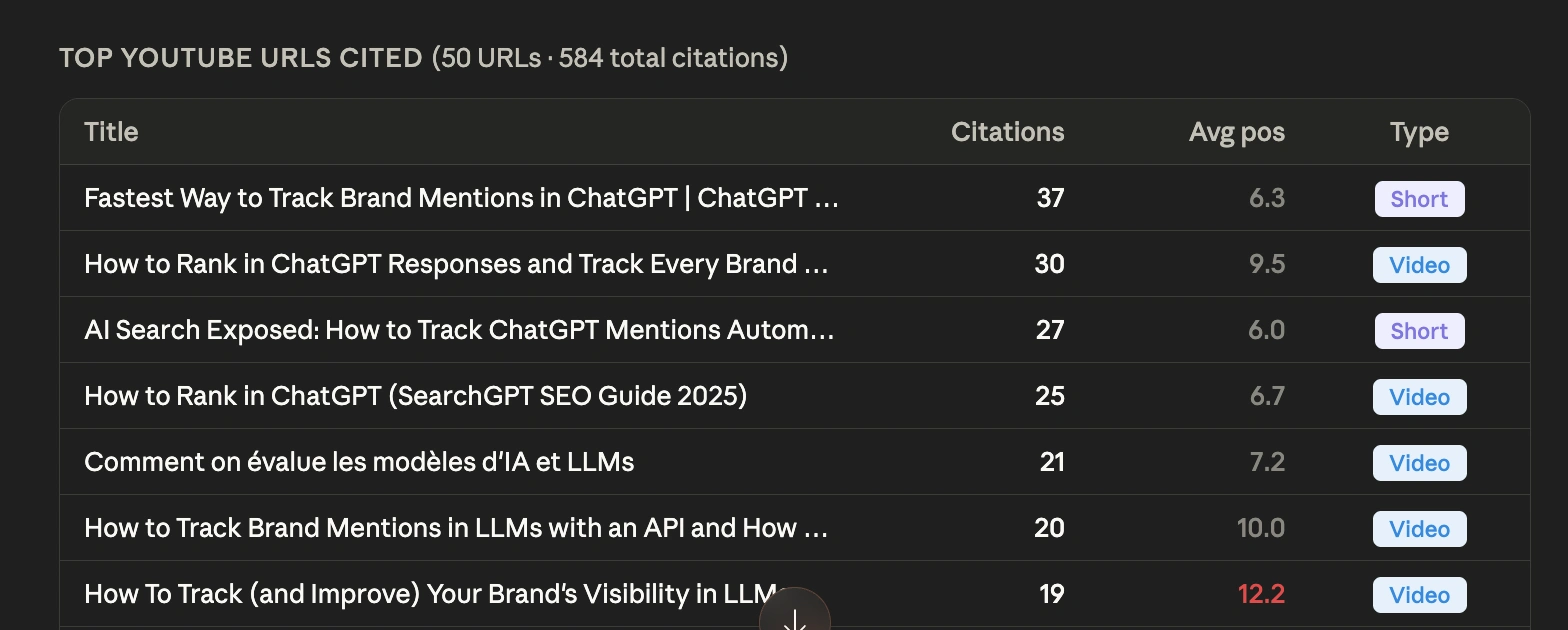
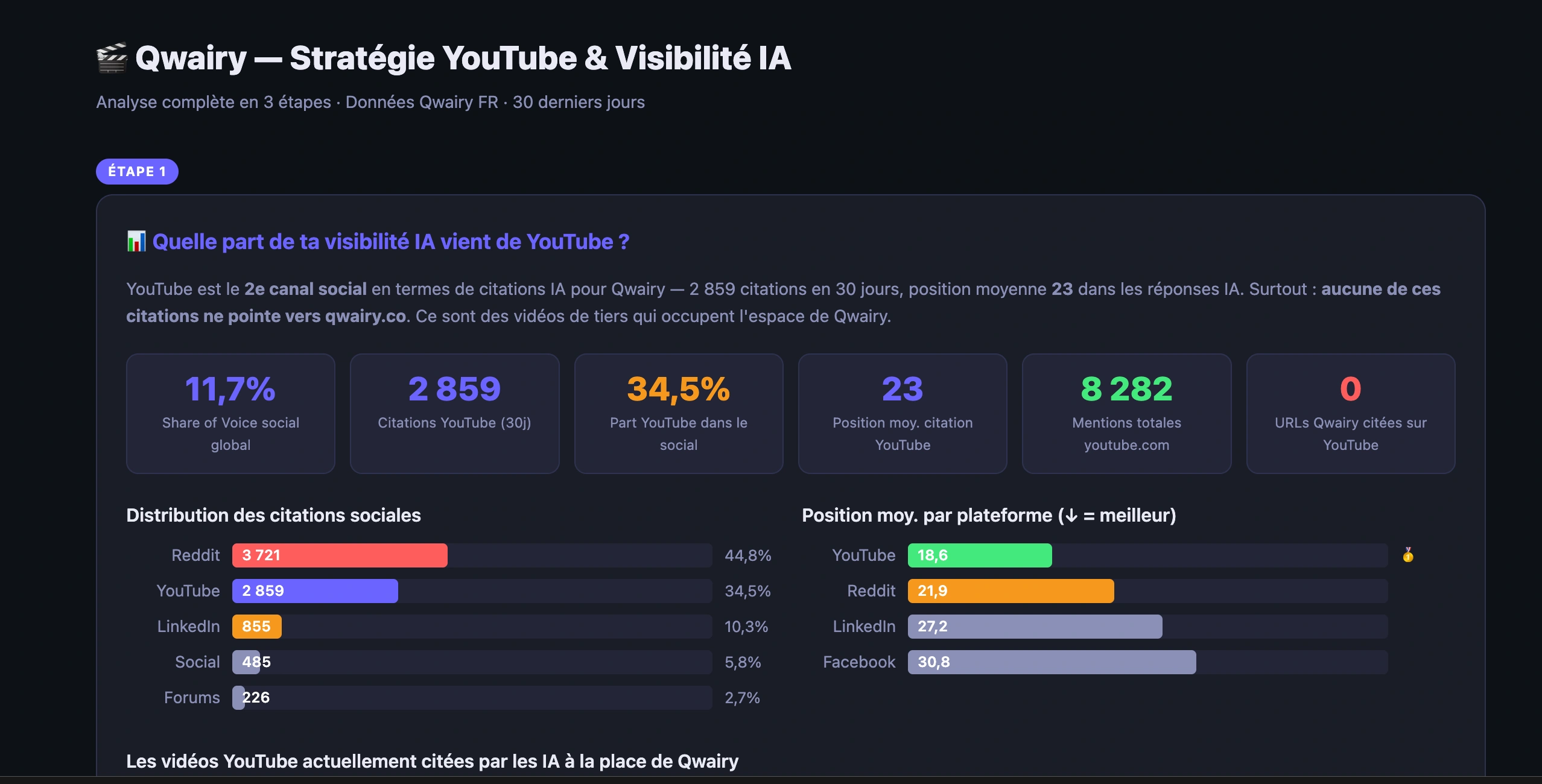
Pull my social insights for the last 30 days. Show me the platform distribution of social citations. What share comes from YouTube vs Reddit vs LinkedIn vs other platforms? Then pull source domains and filter to youtube.com. Show me the specific YouTube URLs being cited.
Tools Claude uses: get_social_insights then get_source_domains then get_source_urls
The reasoning behind this step: Before investing in video, assess your current YouTube citation baseline. Some brands already have YouTube citations (from user-generated reviews, tech channels, industry analysts) without knowing it. Others have zero, which represents the full opportunity.
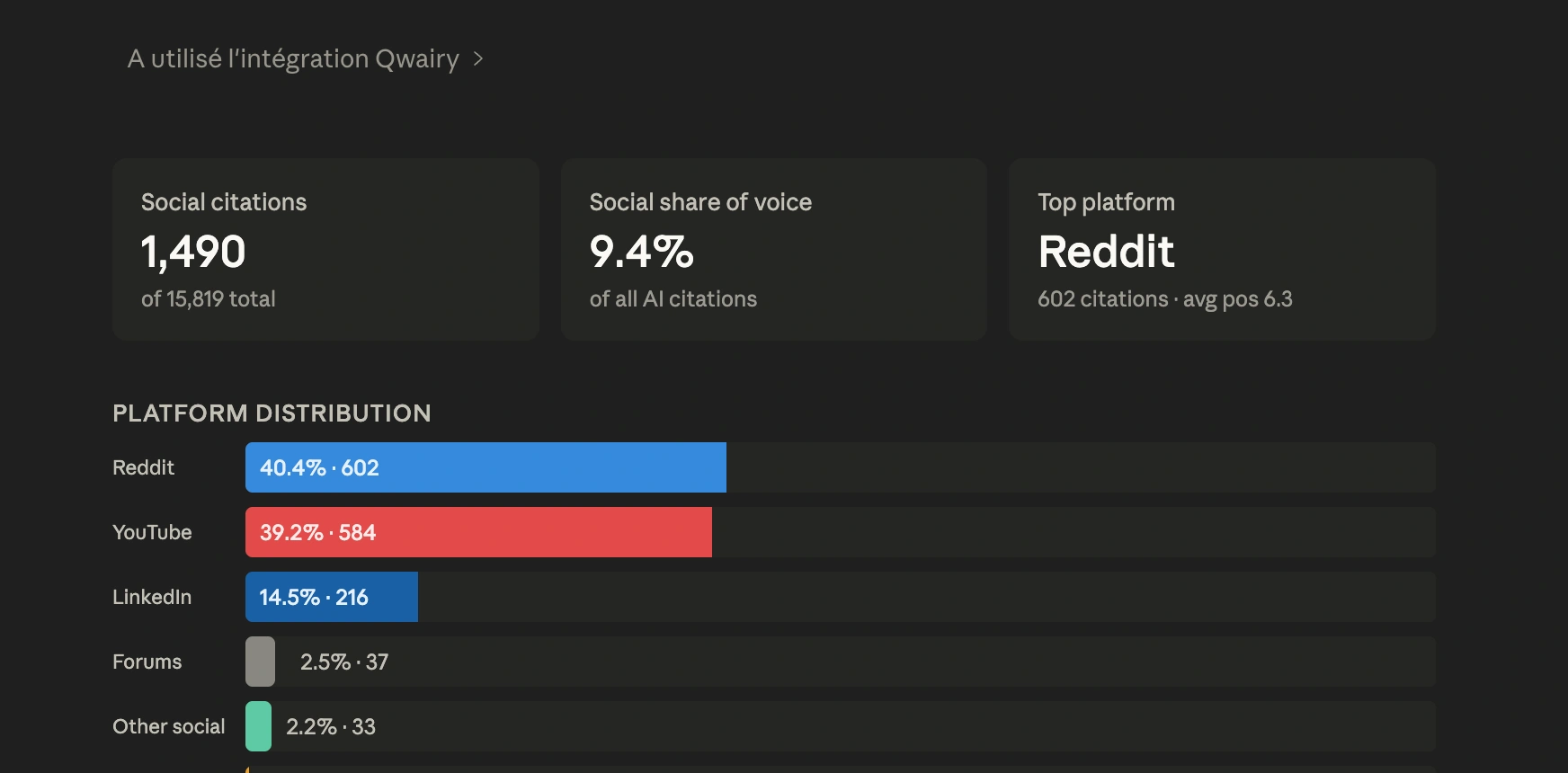
What to look for: If YouTube citations exist, analyze which videos drive them. Are they your own videos or third-party reviews? Third-party YouTube reviews that AI engines cite are extremely valuable and should be nurtured. If YouTube citations are zero, compare with competitors in the next step to validate the opportunity.
What to ask Claude:
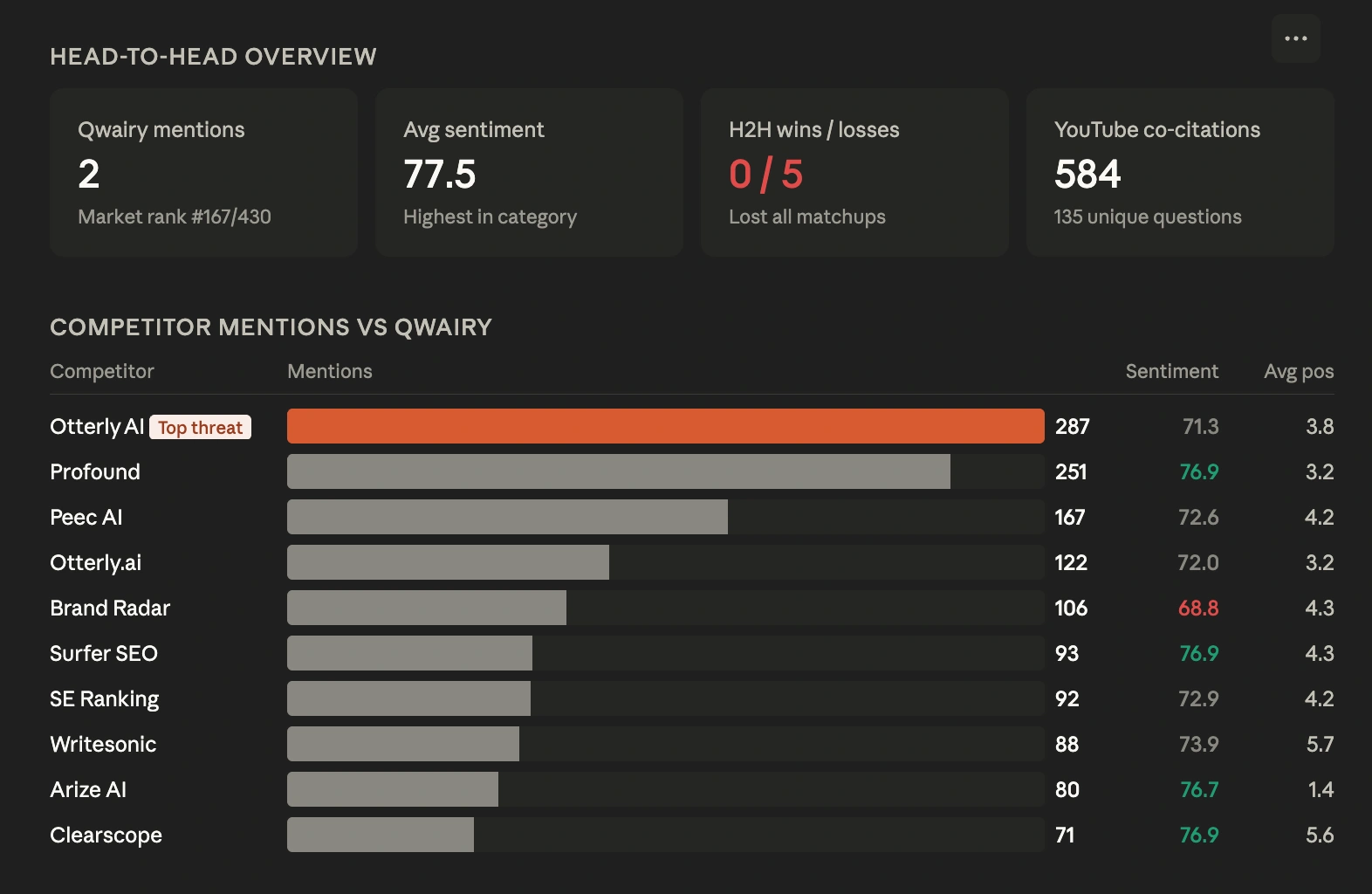
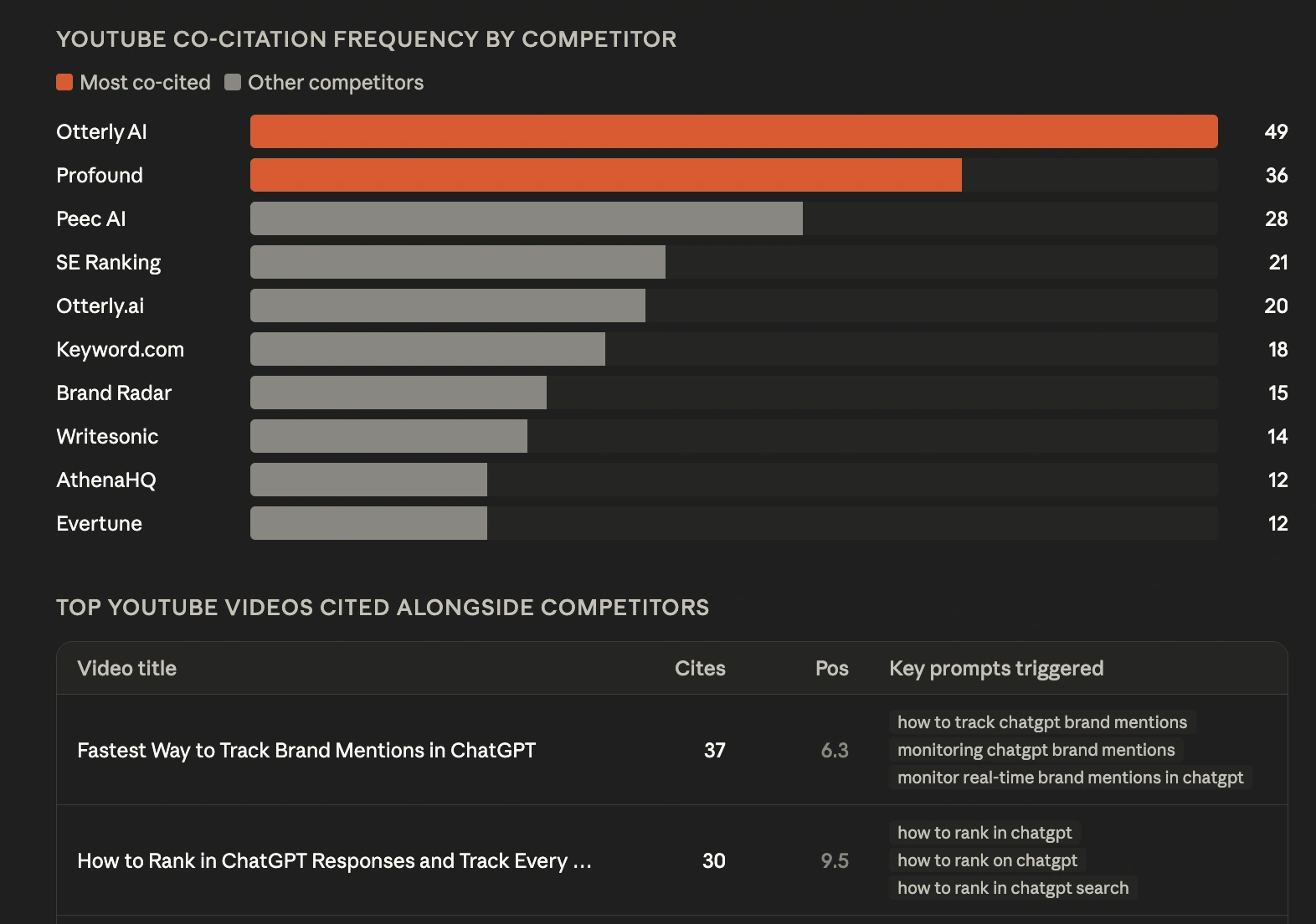
Run a competitor comparison. Then check which competitors have YouTube citations. For competitors with YouTube presence, profile youtube.com as a source to see which specific videos are cited and for which prompts.
Tools Claude uses: get_competitor_comparison then get_source_profile for youtube.com
The reasoning behind this step: If competitors have YouTube citations and you don't, the opportunity is validated. The specific video types that earn competitor citations reveal the template to replicate.
What to look for: Categorize competitor YouTube citations by video type. Comparison videos ("X vs Y"), review videos ("My honest review of X"), tutorial videos ("How to set up X"), and thought leadership videos ("The future of [category]"). Each type serves a different function in AI recommendations. Comparison and review videos tend to generate the most BOFU citations.
Run a free audit: see if ChatGPT, Gemini and Copilot recommend you, in about a minute.
What to ask Claude:
Based on the YouTube citation audit and competitor analysis, build me a video content strategy optimized for AI citation. Include: (1) video topics mapped to high-value prompts, (2) transcript optimization tactics for AI extraction, (3) a publishing cadence, and (4) a measurement plan connecting video publishing to AI visibility changes.
Tools Claude uses: Claude's reasoning layer synthesizes all previous data.
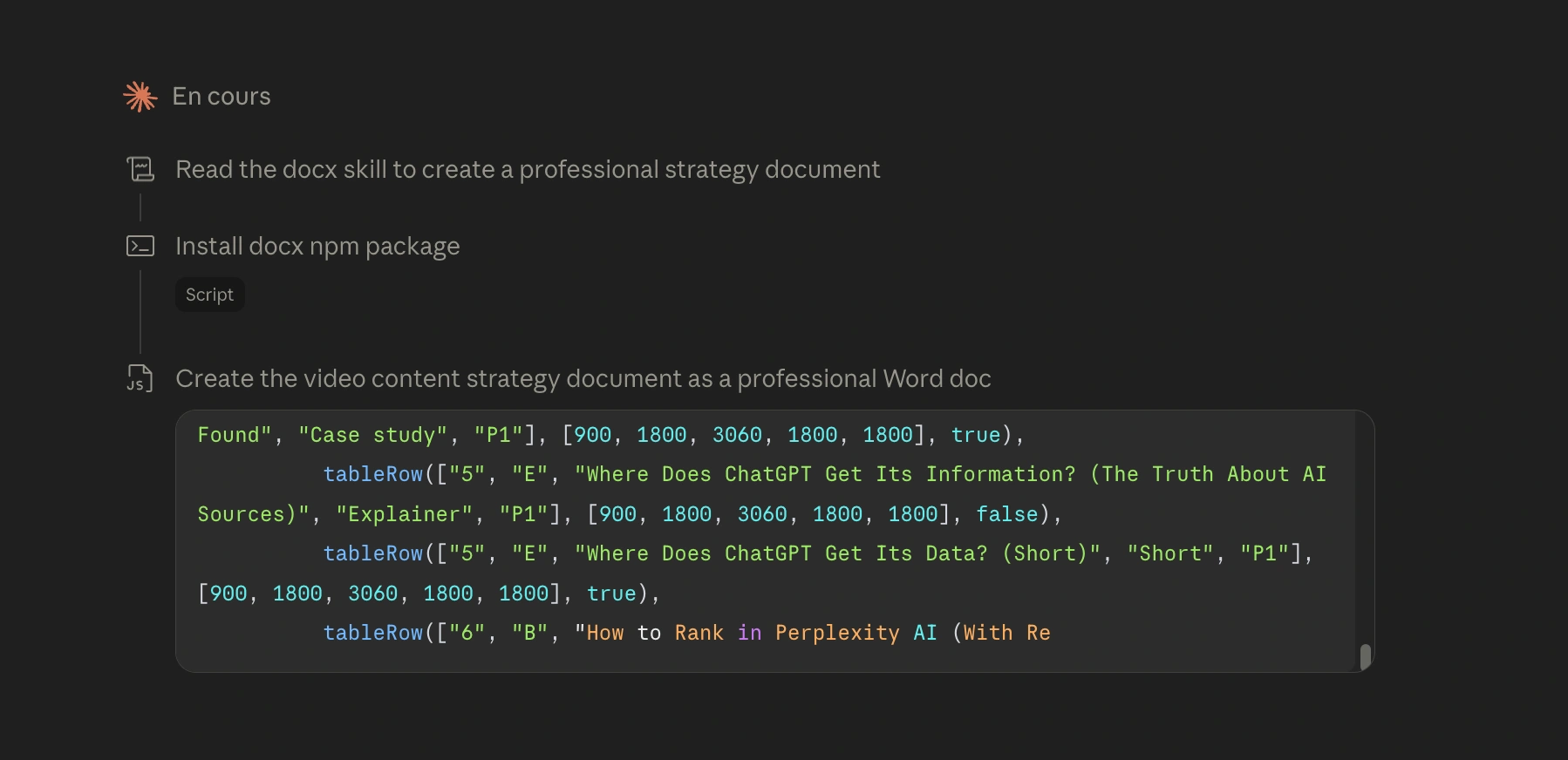
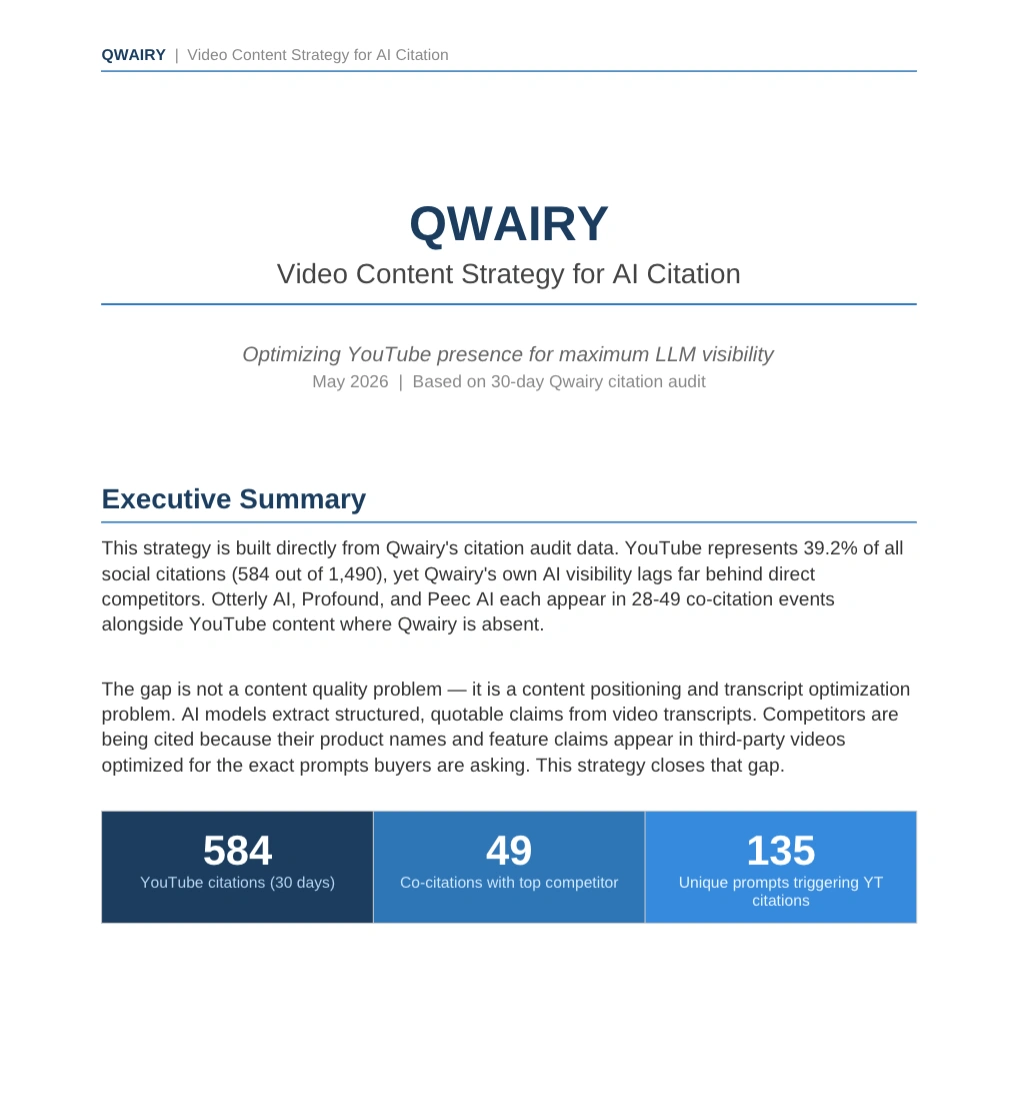
What Claude should produce:
Video topics. 5-10 video concepts mapped to high-value prompts where YouTube citations could improve visibility. Comparison videos ("[Your product] vs [Competitor] - honest comparison") and use-case walkthroughs ("How to [solve problem] with [product]") tend to generate the most AI citations.
Transcript optimization. Specific phrases to include in video scripts that match the language of monitored prompts. Clear product mentions by name. Specific feature callouts. Direct-answer statements ("For small teams, the best option is..."). These are the text patterns AI engines extract from transcripts.
Publishing cadence. One video per week or bi-weekly is sufficient. Consistency matters more than volume for building YouTube as a citation source.
Measurement plan. Track YouTube citation count in Qwairy monthly. Correlate video publishing dates with visibility trend changes. Allow 2-4 weeks for new videos to enter AI citation patterns.
See your mentions across ChatGPT, Claude and Perplexity in real time, the moment buyers ask.
Notion maintains a "Video Content Calendar" with topics, target prompts, publication dates, and citation tracking status.
Google Sheets tracks monthly YouTube citation counts alongside video publication dates to measure correlation.
Slack posts alerts when a YouTube video starts getting cited by AI engines.
See Complementary Tools for the full list of MCP integrations.
Audit Which Authority Sources Drive Your AI Citations. Full source ecosystem audit.
Build a Reddit GEO Strategy. Community source strategy.
60+ GEO Use Cases. Find the answer to any GEO question.
New playbooks documenting Claude + Qwairy MCP workflows for GEO operations are published regularly. Questions or feedback? Reach out on LinkedIn or at .
Track your mentions across ChatGPT, Claude, Perplexity and all major AI platforms. Join 1,500+ brands monitoring their AI presence in real-time.
Free trial • No credit card required • Complete platform access
Other Articles
How to optimize for AI Agents? (That Browse, Compare, and Buy) - With Qwairy’s MCP
Prepare your site for AI agents that browse, compare, and buy. Audit agent accessibility, analyze data extractability, and build a structured data roadmap for the next 12 months.
E-Commerce: How to audit if your Products Appear in AI Shopping Recommendations?
Audit your product visibility in AI shopping recommendations. Discover which products appear, which review sites drive recommendations, how competitors compare, and build an optimization plan for e-commerce AI visibility.
I want to use YouTube to improve my AI visibility. Walk me through this step by step:

1. Pull social insights and source data for YouTube. How much of my AI visibility comes from YouTube? Which specific YouTube URLs are cited?
2. Check competitor YouTube citations. Which competitors benefit? What types of videos drive their citations?
3. Build a video content strategy: topics mapped to high-value prompts, transcript optimization tactics, publishing cadence, and measurement plan.

Explain what each step reveals before moving to the next.
I want to analyze and improve my AI visibility on YouTube. Work through these steps sequentially, explaining what each step reveals before moving to the next.

**Step 1 — YouTube share of AI visibility**
Use Qwairy to pull social insights and source domain data for my brand.

- What % of my total AI citations come from YouTube vs other social platforms?

- What is the average citation position for YouTube vs Reddit, LinkedIn, etc.?

- Use get_source_profile on youtube.com to retrieve the top cited URLs.

- For every cited URL, fetch the real video title and channel name via the YouTube oEmbed API (https://www.youtube.com/oembed?url=VIDEO_URL&format=json). Never show raw URLs — always show title + channel.

**Step 2 — Competitor YouTube citation analysis**

- Use get_source_profile co-citation data to identify which competitors are cited alongside YouTube content in AI answers.

- For each top competitor, use get_competitor_position to get their Share of Voice, avg position, and coverage.

- For each competitor that has a YouTube channel, fetch their 5 most recent videos via their channel page (/videos), then resolve each video ID to a real title + channel name via oEmbed.

- Classify all videos (both cited and recent) by theme: GEO/AI explainer, tool comparison, tracking/mentions, ChatGPT ranking, product demo, or other.

**Step 3 — Content gap analysis**

- Run get_content_opportunities to identify prompts where competitors appear but the brand does not.

- Run get_prompt_signals to identify attack-zone prompts (high market openness, low SoV).

- Map each content gap directly to a video topic.

**Step 4 — Deliver an interactive HTML dashboard**
Build a single self-contained HTML file with a dark theme and the following sections:

A) **KPI strip** — YouTube citations, avg position, SoV, number of cited URLs, number of content gaps.

B) **Cited videos table** (interactive) — all YouTube URLs currently cited by AI, showing: thumbnail (from https://i.ytimg.com/vi/VIDEO_ID/hqdefault.jpg), real title, channel name, citation count, avg position, theme badge, language flag (🇫🇷/🇬🇧). Add filter buttons by theme and a live search input. Sort by citations by default.

C) **Competitor video dashboard** (card grid) — one card per video for each competitor channel. Each card shows: thumbnail, real title, channel, competitor name pill (color-coded per competitor), theme badge, and a "Citée par IA 🔴" or "Récente 🟢" status badge. Add citation count + avg position for cited videos. Filter by competitor name. Sort: cited first, then by mentions.

D) **Content strategy table** — video topics mapped to missed-opportunity prompts, target keyword cluster, recommended format (long-form / mid-form / Short), and priority badge.

E) **Transcript optimization checklist** — 6–8 actionable tactics as an interactive checklist (checkbox per item, progress bar).

F) **Publishing calendar** — 6-week grid showing which video to publish when.

G) **Measurement plan table** — metric, tool (Qwairy feature), baseline, and 90-day target.

All sections must be fully interactive (filters, search, sortable columns). No raw YouTube URLs anywhere — always show title + channel. Use a consistent dark color theme with color-coded competitor pills.