Loading page

On May 7, 2026, ChatGPT started embedding clickable links to brands' own sites inside its answers. A study of 140,000+ ChatGPT answers: the rate jumped roughly 14× overnight, every link carries a utm_source=chatgpt.com tag, and only ChatGPT moved.
For two years, AI assistants played by one rule: mention the brand, never link it. ChatGPT would recommend you by name, then leave the reader with nowhere to go. On May 7, 2026, ChatGPT broke that rule, overnight and alone. We measured the shift across more than 140,000 of its answers. Here is how it looks like:
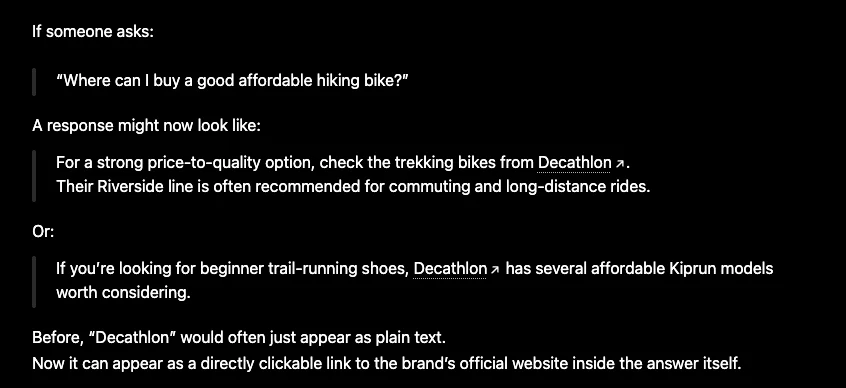
On May 7, ChatGPT started embedding clickable links to brands' own websites directly inside its answers. The share of answers carrying one jumped from roughly 0.4% to 6.2% (about 14x) on a single day.
It is a step, not a ramp. Flat for seven weeks, a wall on May 7, steady ever since.
Among answers that mention the brand, the linked share went from about 2% to 29%. The same brands are recommended, now with a destination.
Only ChatGPT moved. Perplexity, Gemini and Copilot are flat across the same window.
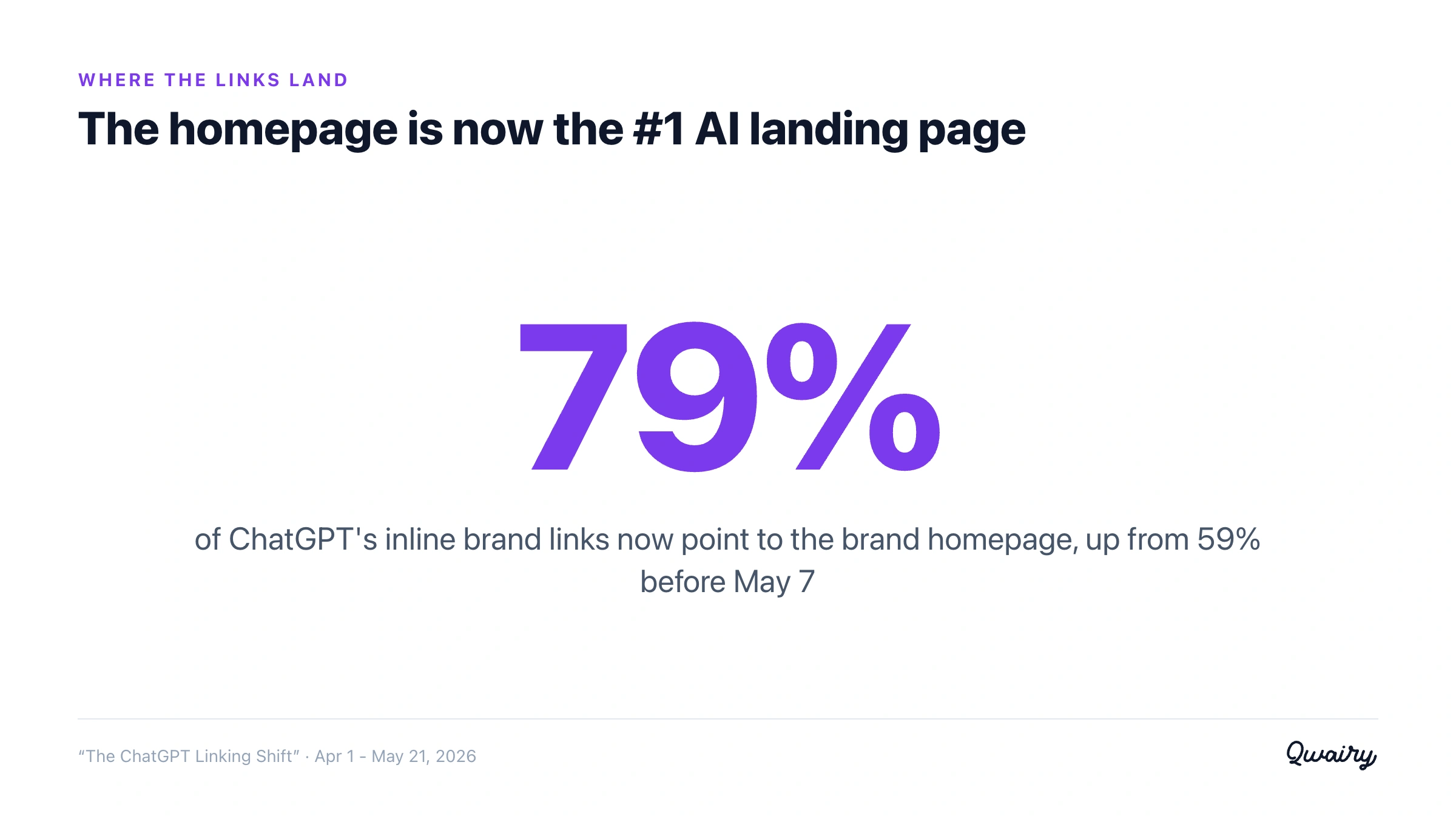
79% of the new links point to the brand's homepage, up from 59%.
We measure this from the answer text itself: an answer counts as linking the brand when it contains at least one hyperlink pointing to the brand's own website, and the rate is the share of answers where that is true. It is a per-answer yes-or-no on linking, not a count of mentions or citations, and not a measure of clicks or referral traffic, which this study does not track.
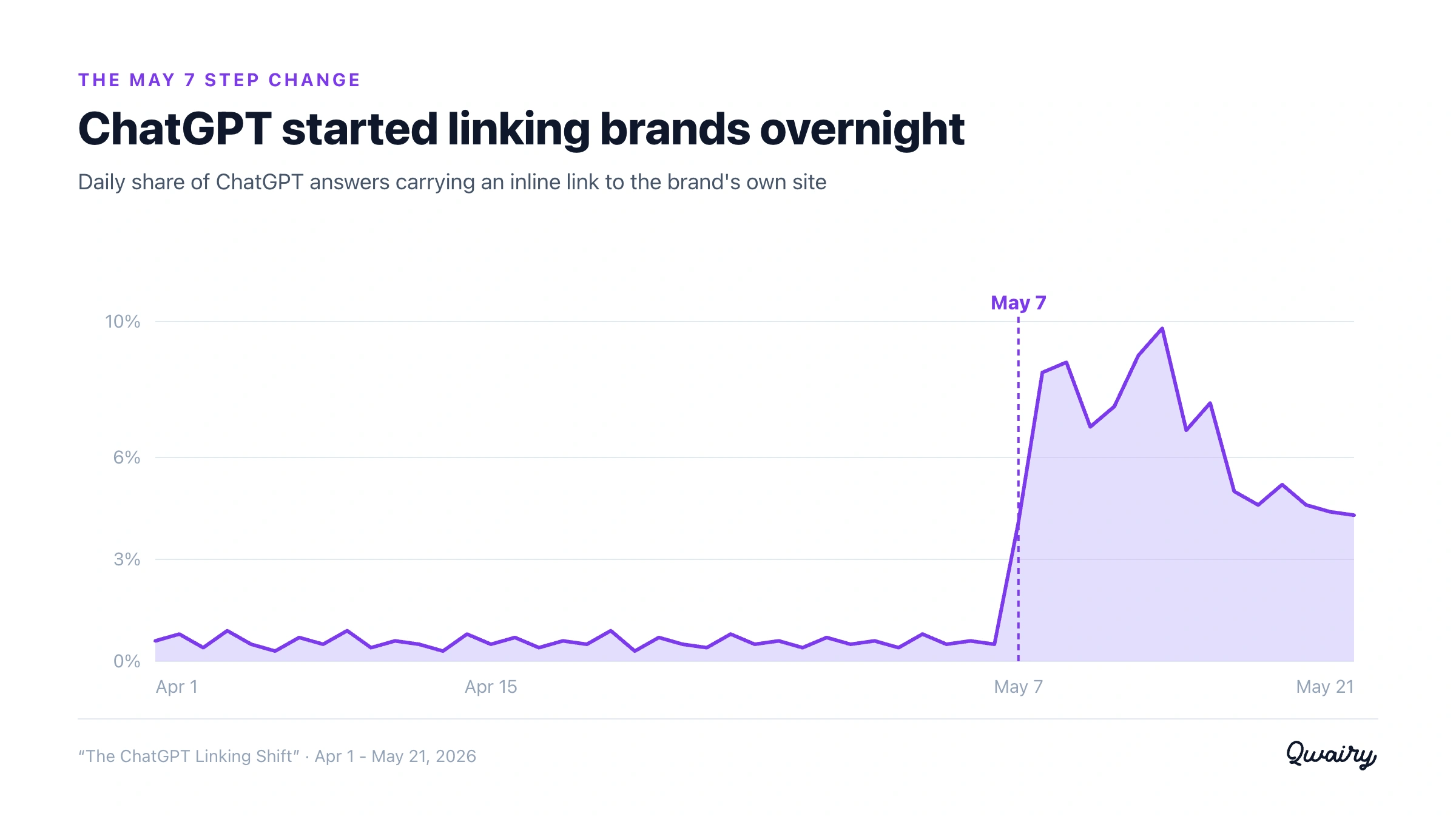
For seven weeks the rate sat in a flat 0.3-1.0% band. Then it broke. May 6 was an ordinary day at 0.5%; May 7 hit 4.1%; within 48 hours it was above 7%, and it has held there since. A gradual rollout produces a slope. This produced a wall. The clearest way to feel the change: among answers that mention the brand at all, the share that also link to it went from about 2% to 29%. ChatGPT is recommending the same brands. It just stopped leaving them un-clickable.
Run a free audit: in a few minutes, ChatGPT, Gemini and Perplexity answer 8 buying questions about your market live, and you see who they recommend.
A jump that sharp invites an obvious objection: maybe it is an artifact of how the answers were collected. Two checks rule that out.
The links carry OpenAI's own fingerprint. Every inline brand link after May 7 ends in a utm_source=chatgpt.com tracking parameter, appended by ChatGPT, not by us:
Before: brand named, nothing to click
  "...common options include Acme Field Service and Northwind Dispatch."

After: every brand name is a tagged link to its own site
  "...common options include
   [Acme Field Service](https://www.acmefieldservice.com/?utm_source=chatgpt.com)
   and [Northwind Dispatch](https://www.northwinddispatch.com/?utm_source=chatgpt.com)."
A tag that did not exist before May 7 and appears on every brand link after it cannot come from our pipeline. It also tells us something on its own: OpenAI wants this traffic counted.
Only ChatGPT moved. We ran the identical measurement on three other assistants over the same window.
Assistant | Before May 7 | After May 7 | Change |
ChatGPT | 0.43% | 6.20% | ~14x |
Perplexity | 4.06% | 5.38% | flat |
Gemini | 0.37% | 0.22% | flat |
Copilot | 0.02% | 0.01% | flat |
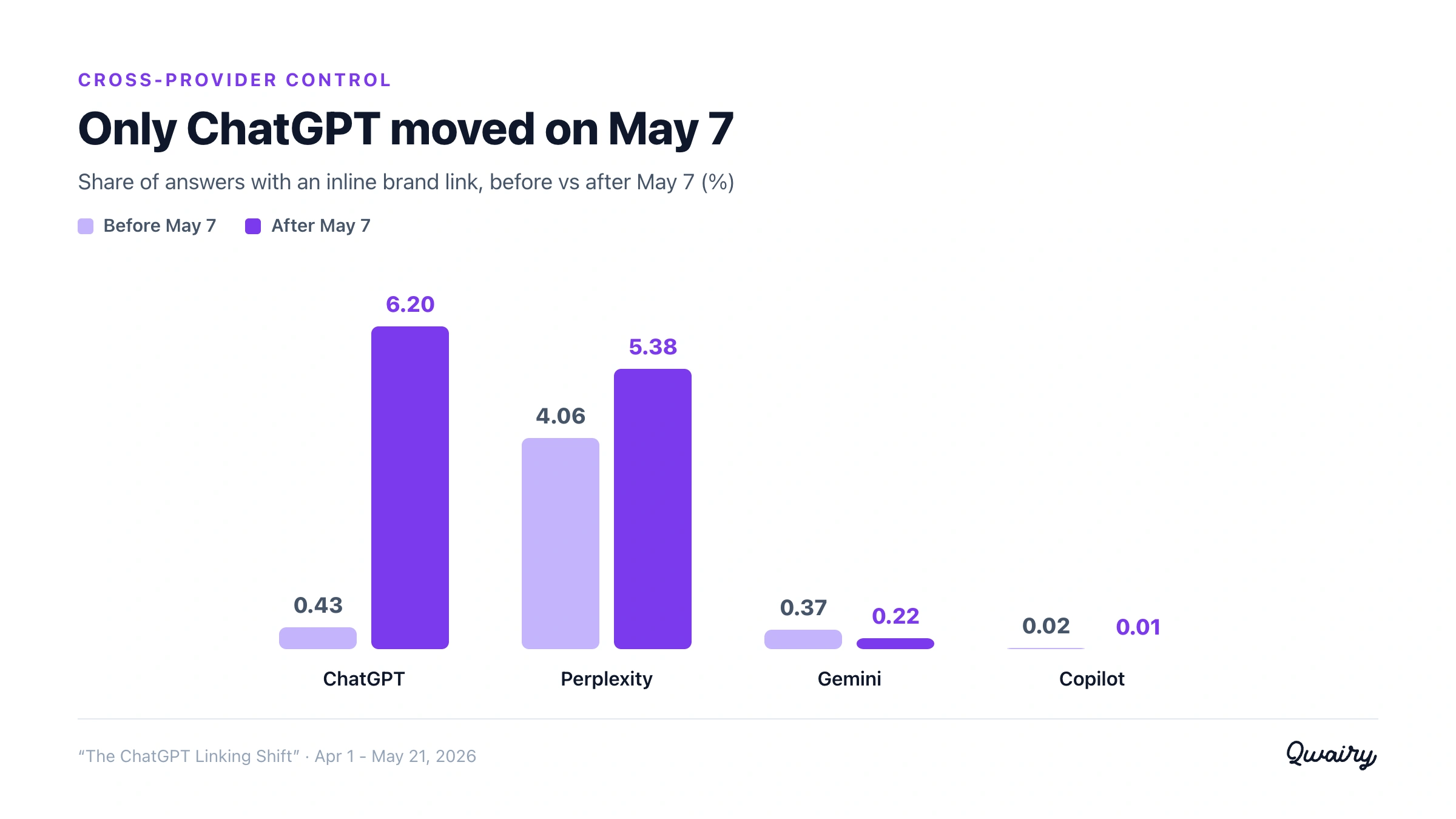
A collection-side artifact would have hit several providers. This hit one. May 7 was a deliberate OpenAI change, not a measurement glitch and not a web-wide trend.
The links overwhelmingly point home. Before May 7, 59% of brand links hit the homepage; after, 79% do. The page most teams treat as a branding afterthought is now the single most-linked destination in this channel, and it has to convert a visitor whose entire context is the one sentence ChatGPT just wrote.
</span> The shift is also broad. Even answers that trigger ChatGPT's shopping surface rose about 20x (0.2% to 4.4%), and the share of answers containing any markdown link roughly tripled. This is not confined to informational queries, and no vertical should assume it is exempt.
We cannot confirm intent from outside the system, but the timing narrows the field. Two days before the shift, on May 5, 2026, OpenAI made GPT-5.5 Instant the default ChatGPT model and announced new ways to buy ChatGPT ads , including cost-per-click bidding and expanded measurement tools. The inline-link change lands squarely in that window. Three hypotheses follow.
A click-signal dataset. Embedding links and watching which ones get clicked produces exactly the signal a ranking or recommendation model needs. Before May 7, ChatGPT recommended brands but had no way to learn which recommendations users acted on. Tagged links close that loop, and the cost-per-click ad bidding OpenAI announced the same week runs on exactly that click signal.
Commerce infrastructure. An attributable outbound link is the primitive you need before routing a transaction, building a paid placement layer, or handing off to a purchasing agent. The link may be plumbing laid ahead of a product, with brands as the early, unpaid beneficiaries.
Relieving the zero-click narrative. The dominant criticism of AI assistants is that they consume brands and publishers without sending traffic back. Visibly routing users to brand sites is a direct answer to it.
One distinction matters. The links we measured sit in ChatGPT's organic answer text; OpenAI states its paid ads are labelled as sponsored and kept separate from it. This is not advertising. But it is the same click-attribution plumbing a cost-per-click ad system needs, now running through organic answers, and the utm_source tag tells us the traffic is meant to be counted. By whom, and for what, is the open question.
See the web searches captured behind answers from supported models, and the content gaps they reveal.
Track ChatGPT as a named referral source. The utm_source=chatgpt.com tag means your analytics can attribute this traffic today. Add chatgpt.com and openai.com as referral sources and segment them: it costs nothing, and the channel is already live.
Treat your homepage as an AI landing page. Four in five inline brand links resolve to the root domain. The homepage now carries first-touch AI traffic, not just brand-aware visitors. Clear positioning and an obvious next action suddenly have AI-acquisition weight.
Win the mention first. ChatGPT links the brands it names. If you are not mentioned, there is nothing to link. Mention share is still the upstream battle. The link is the new reward on top of it.
If 2024 and 2025 asked whether AI assistants would ever send traffic back, May 2026 answers it for one of them. On ChatGPT, a brand mention is no longer a dead end. It carries a link, and the link is tagged. Visibility and traffic, long treated as two separate problems, are converging. We will keep tracking the rate, and report if a second assistant follows.
More than 140,000 ChatGPT answers collected April 1 to May 21, 2026, plus a cross-provider control of more than 350,000 answers across ChatGPT, Perplexity, Gemini and Copilot. For each answer we parse the raw text for markdown links and match each destination against the mentioned brand's own domain; the pre-period (April 1 to May 6) is compared against the post-period (May 7 to May 21). The data is aggregate and anonymized: no individual brand is identified, and the before/after link examples above are illustrative reconstructions, not real brands. Two honest limits: this measures links written, not clicks; and it is a snapshot, the rate eased from a 7-10% first-week peak toward roughly 4-5% by May 21, so the exact steady state is still settling. The May 7 cut point is data-driven, not chosen in advance. Related research: Sources by Intent Study Q2 2026 , 184K-query LLM study (Q3 2025) , Query Fan-Out Study (Q3 2025) . New to the topic? Start with What is GEO? . External context: OpenAI, New ways to buy ChatGPT ads (May 5, 2026); GPT-5.5 Instant became the default ChatGPT model (May 5, 2026).
Want to know when ChatGPT links your brand, and where it sends people? Qwairy monitors brand mentions and links across ChatGPT, Perplexity, Claude, Gemini and expanding providers, with per-source and per-destination analytics.
Track the questions that matter to your business, see which brands each answer mentions and which sources it cites, then work on the gaps.
Free plan with 120 initial credits • No credit card required
Other Articles
ChatGPT Ads Are Coming to France: What US Data Reveals Before Launch
ChatGPT ads appear in 69.25% of US-monitored commercial answers but near zero in France. What US data reveals before the French launch, and how to prepare.
ChatGPT Stopped Citing Reddit. Our Data Shows the Mechanism Behind the 95% Collapse
Reddit's share of ChatGPT Search citations collapsed 95% in one week in August 2026. Qwairy's citation data reveals the mechanism: a query fan-out change on August 8 that switched ChatGPT to direct site: interrogation, redistributing citations from discussion platforms to official sources.